
Pungs, Kongs, Quints and Sextets: The Building Blocks of a Hand
Last updated: Nov 18, 2026
Mahjong Rules Guide › Level 1 — Meet the tiles · Guide 6 of 25
Every hand we play is made of identical-tile groups. There are no runs or sequences in American mahjong—only pairs (2 tiles), pungs (3 tiles), kongs (4 tiles), quints (5 tiles) and sextets (6 identical tiles). Jokers can stand in for any tile inside a group of 3 or more, but never in singles or pairs. Once you recognize these five group types, you can read any hand on the card and build toward it during play.
What Each Group Looks Like
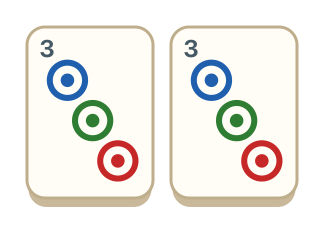
A pair is simply two identical tiles. Pairs form the foundation—most hands have at least one, and some have several.
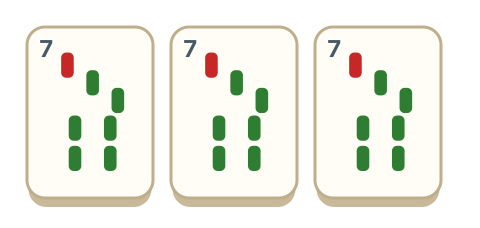
A pung is three identical tiles. It is the most common group in mahjong and appears on almost every hand.
A kong is four identical tiles—all four copies in the set. Kongs are powerful because they use all available copies and give you fewer choices to search for during play.
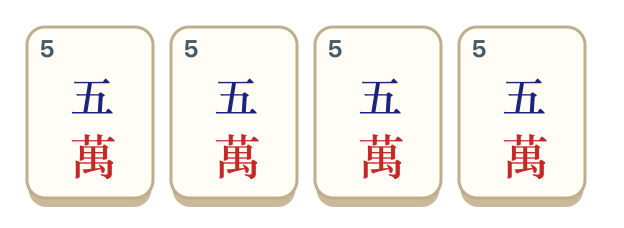
A quint is five identical tiles. Because only four tiles of any number or honor exist in a standard 152-tile set, a quint must use one joker. Quints are less common but appear regularly on the card, especially in hands with high values.
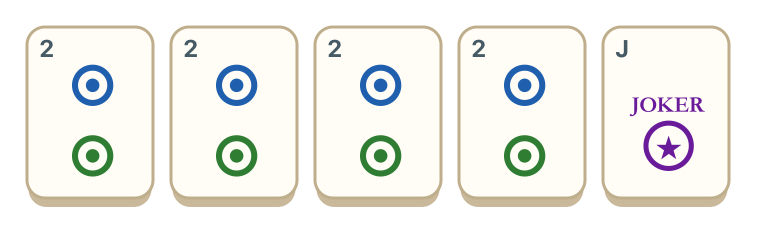
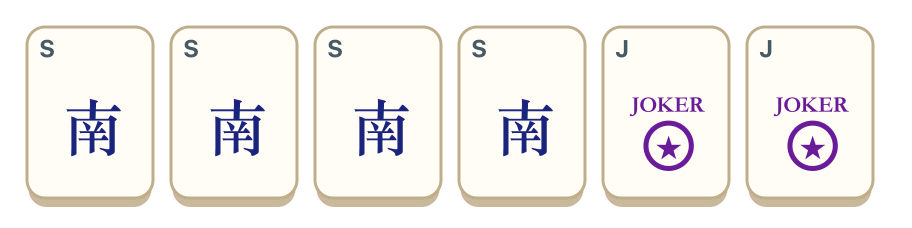
A sextet is six identical tiles—all four real tiles plus two jokers. Sextets are the largest group you can make and are uncommon but dramatic when they appear on the card.
How Jokers Work in Groups
Jokers are the wild cards of American mahjong. They can stand in for any tile you need—but only inside a group of 3 or more identical tiles. Understanding this rule is essential because it shapes both how you build and how your opponents play.
Jokers can substitute inside pungs, kongs, quints and sextets. When you need a tile to complete a group, a joker can fill that spot. For example, if you have two Bam-1s and a joker, that joker becomes a third Bam-1 and completes your pung.
Jokers cannot be used in singles or pairs. If a hand calls for a single Dot-9 or a pair of Red Dragons, no joker can fill that role. You must have the real tile. This is where the Flowers and Jokers guide goes deeper, but the core rule is simple: jokers only work in groups of 3 or more.
Exposed jokers can be redeemed. If a joker is showing in your exposed pungs, kongs or quints and you draw the real tile it stands for, you can trade it on your turn. You take back the joker and keep the real tile in its place. This keeps the game honest and rewards you for drawing the exact tile.
Recognizing Groups on the Card
The National Mah Jongg League card shows hands as printed lines. Each hand lists the tiles in the groups you need to win. Learning to read that notation quickly is a skill that grows with every game.
Identical tiles next to each other = a group. On the card and in hand notation, tiles are shown in the order they appear in a group. A hand might read "DDDD / BBB / CC / WWW / RD RD RD RD N" (four Dots, three Bams, two Craks, three Whites, four Red Dragons, one North). Each "/" marks a group boundary.
The card always shows the groups you must form. You don't get to rearrange them or combine tiles differently. If the card says "B4 B4 / B4 B4 B4" (a pair of Bam-4s and a pung of Bam-4s), that's exactly what you need—two groups, not one kong of all four.
Building Groups During Play
As you draw and discard, you'll form groups tile by tile. Here's how the process works:
Start with a target hand. Choose one that fits what you see in your tiles and on the card. You don't commit—you can pivot if better tiles come your way.
Draw each turn. New tiles arrive one per turn (or more if you call a discard).
Expose groups when safe. Once you have a pung, kong, quint or sextet complete, you can choose to expose it (lay it face-up in front of you) or keep it hidden. Exposing helps you claim called discards and shows others you're close to winning—but it also signals your strategy.
Fill in the remaining tiles. Keep drawing and building until you have all 14 tiles in the exact groups shown on the card.
When you first sit down with mahjong racks with pushers, you'll notice that organizing identical tiles helps you spot groups as they form. Rearrange your hand freely during your turn so that potential groups stand out.
Gear for this step
Practising pungs, kongs, quints and sextets? It's easier with the right setup — see our mahjong racks with pushers.
The Role of Each Group Type
Pairs are essential—they finish every hand. Most hands contain one pair, often called the "eye." A few hands (in the Singles & Pairs section of the card) use multiple pairs and no jokers at all, making them rare and often worth double or triple points.
Pungs make up the bulk of most hands. They are easy to form, easy to recognize, and they use only the tiles you have. Many hands include two or three pungs.
Kongs solidify a hand because they lock in all four copies of a tile. Once you kong a tile, no one else can draw it, and the hand's shape becomes clearer. Kongs are often exposed early to show you're building something specific.
Quints and sextets appear in higher-value hands and are harder to complete because they demand all or most of your jokers. A hand featuring a quint or sextet is usually a bold bet—you're counting on drawing or calling the right tiles to fill it.
Common Mistakes
Mistake 1: Thinking a joker can fill a pair or single. Many new players assume jokers can substitute anywhere. They cannot. Jokers work only in groups of 3 or more identical tiles. If the card calls for a pair of North Winds or a single Red Dragon, you must have the real tile.
Mistake 2: Confusing order with meaning. The order tiles appear in a group notation on the card is just for reading clarity—it does not mean the tiles come in a sequence. American mahjong has no runs. "B1 B2 B3" would be three separate single tiles (or part of three different groups), never a "run" or "chow."
Mistake 3: Forgetting that Flowers are ordinary tiles, not bonuses. In some versions of mahjong played in other regions, Flowers are set aside and drawn fresh. In American mahjong, Flowers stay in your hand and form groups just like any other tile—a pung of Flowers (FFF), a kong of Flowers (FFFF), or a pair (FF). They are part of your 14-tile hand.
Mistake 4: Exposing too early or too late. Exposing a group shows others you're close but also signals your strategy. Keep groups hidden if you're unsure of your direction, and expose them once you've committed to a specific hand. Your table will develop its own rhythm here.
Why This Matters
Recognizing groups instantly—spotting that you have two Dots and a joker can become a pung, or that four Winds and two jokers make a sextet—is the heart of American mahjong strategy. The faster you see groups, the faster you can adapt when new tiles arrive and seize winning chances.
Every hand on the card is a puzzle made of these five pieces. Master them, and you master the game.
Next Step
Now that you know how groups form, you're ready to learn how hands are structured on the card itself. In the next guide, we'll explore the complete tile set and how the honor tiles (Winds and Dragons) fit into the bigger picture of building a winning hand. After that, we'll walk through a real deal from start to finish and show you exactly how groups come together during an actual game.
FAQ
Can a joker ever be part of a pair?
No. Jokers only substitute inside groups of 3 or more identical tiles (pungs, kongs, quints and sextets). Pairs and singles must use real tiles only.
What happens if I need two identical tiles but have only one real tile and a joker?
A joker cannot help you. You need two real tiles for a pair, or three identical tiles (two real plus one joker) for a pung. A pair is always exactly two identical tiles—never a tile plus a joker.
Can I turn a pung into a kong by adding a joker?
No. A kong is always four identical tiles from the set. A pung is three identical tiles (possibly including one joker). You cannot convert one into the other mid-hand. If you draw the fourth real copy of a tile you punged, you can add it to make a kong, but a joker cannot become that fourth tile.
Is the order of tiles in a group important?
No. When the card shows "B5 B5 B5," the order in which those three Bam-5s sit in your hand does not matter. A pung is simply three identical tiles. Some players like to keep them in a neat row on <a href="https://mahstead.com/en-us/collection/mahjong-racks">racks with pushers</a> for clarity, but the order has no game effect.
If I expose a pung with a joker in it, can someone redeem the joker during their turn?
No. Only you can redeem an exposed joker, and only on your own turn if you draw the real tile it stands for. Your opponents cannot take it or swap it—they can only see which tile the joker is standing in for.
Are Flowers treated like any other tile when forming groups?
Yes. <a href="https://mahstead.com/en-us/blog/mahjong-flowers-and-jokers">Flowers are ordinary playing tiles</a> in American mahjong. You keep them in your hand and use them to form pairs, pungs, kongs or sextets, just like Dots, Bams, Craks, Winds or Dragons. They are not bonus tiles and you do not draw a replacement when you get one.
More in Level 1 — Meet the tiles
American Mahjong Tiles Explained: Every Tile in the 152-Tile Set
The Three Suits: Bams, Craks and Dots (and How to Tell Them Apart)
Ready to play at your own table?
Engraved 160-tile American mahjong sets, mats and racks — free shipping across the US.


View More
View More
View More
