
Flowers and Jokers: The 16 Special Tiles — American Mahjong Guide #4
Last updated: Nov 18, 2026
Mahjong Rules Guide › Level 1 — Meet the tiles · Guide 4 of 25
Every engraved American mahjong set contains 152 playing tiles, and the last 16 are Flowers and Jokers—tiles that handle game-play differently than the numbered suits. Flowers are ordinary playing tiles that stay in your hand and form groups exactly like Bams, Craks or Dots. Jokers are wild cards that stand in for any tile in a group of 3 or more, but they come with rules about when they can substitute and how they can be "redeemed" by other players. Understanding these two tile types is essential to building legal hands.
The Eight Flowers: Not Bonus Tiles, Just Ordinary Tiles
One of the biggest misconceptions about American mahjong is that Flowers are special bonus tiles you set aside—that is the rule in Chinese and Hong Kong mahjong, but not in American mahjong. Here, Flowers are ordinary playing tiles that stay in your hand the entire game.
What you do with Flowers:
Keep them in your hand alongside numbered tiles.
Use them to form groups when the card calls for them (e.g., a pair of Flowers, a kong of Flowers).
Never draw a replacement tile for a Flower—unlike Chinese mahjong, it counts as one of your 14 tiles.
Treat them exactly like Bams, Craks, Dots, Winds or Dragons when building groups.
A standard set has eight Flowers, and on the card they all count as the same tile, written F—so any Flower matches any other Flower. If the card shows a kong of Flowers (FFFF), any four Flowers will do, and Jokers may stand in for Flowers in a group of three or more, exactly as with any other tile.
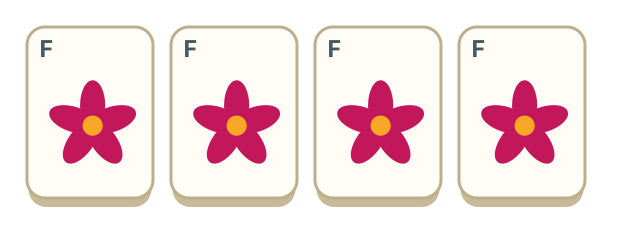
Because there are eight Flowers, a Flower group can run larger than with suit tiles, but Jokers still never go into a single or a pair. That said, many hands on the card will call for Flowers in various patterns. Some hands are pure (using only Flowers, Winds, Dragons and Honors); others mix Flowers with numbered tiles.
The Eight Jokers: Wild Tiles with Rules
Jokers are the wild cards of American mahjong. A Joker can stand in for any real tile you need—but only under specific conditions. Understanding when a Joker can and cannot be used will prevent costly mistakes.
The core rule: A Joker can substitute for any tile in a group of 3 or more identical tiles (a pung, kong, quint or sextet). A Joker can never stand in for a tile in a pair or a single tile.
Examples of legal Joker use:
A pung: D5 D5 J (Joker stands for the third D5).
A kong: C3 C3 C3 J (Joker fills the fourth C3).
A quint: B7 B7 B7 B7 J (Joker is the fifth B7).

Examples of illegal Joker use:
A pair: D1 J (Joker cannot stand for the second D1 because it is a pair).
A single: J alone as a tile you are holding toward a hand (Jokers must be part of a group of 3+).
Joker Redemption: How to Reclaim a Joker
When you call a discard to complete an exposed group (a pung, kong, quint or sextet), any Joker in that group can be redeemed—taken out and returned to you—if another player holds the actual real tile that the Joker is standing for.
Here is how it works:
You call a tile and expose your group. For example, you expose a pung: D3 D3 J (the Joker is standing for a D3).
Another player has the real tile. For instance, East has a D3 in hand that they do not need for their hand.
That player redeems the Joker on their turn. East takes the Joker from your exposed group, keeps it, and gives you the real D3 in exchange. Your exposed group now reads D3 D3 D3 (no Joker).
You keep playing. The Joker goes back into East's hand as a playable tile; your group is now real and cannot be redeemed again.
Redemption is permitted only when you have exposed a group by calling a discard. If Jokers are still in your concealed hand, they cannot be redeemed. Also, you cannot be forced to redeem a Joker—if you hold the real tile, you can choose to keep it in your hand or use it elsewhere. Redemption is a courtesy and a strategic choice.
Gear for this step
Practising flowers and jokers? It's easier with the right setup — see our engraved American mahjong sets.
Jokers and Hand Patterns: When You Cannot Use Them
Not every hand on the card allows Jokers. The card is organized into sections, and one key section—Singles & Pairs—forbids Jokers entirely. Any hand in that section must be built with real tiles only. Many players also choose to play jokerless hands for an extra point multiplier (common house rules vary).
When you look at the card and see a hand you want to play, always check the hand label. If it is marked "Quint + Pung + Pung + Pung + Pair," Jokers are allowed in the pungs and quints but not the pair. If it is a "Singles & Pairs" hand, no Jokers anywhere.
How Flowers and Jokers Fit Into Your Game
Once you understand Pungs, Kongs, Quints and Sextets: The Building Blocks of a Hand, you can see how Flowers and Jokers work within the larger structure. Both types of tiles form or complete the four groups (plus a pair) that make up a 14-tile American mahjong hand.
In practice:
Flowers are used like any suit tile—they are eight tiles that all count as the same tile, F. When the card calls for them, you grab them from your hand and arrange them into a pair, pung or kong.
Jokers are your backup plan. If you are one tile short of a pung or kong and you have a Joker, you can use it to complete the group. But never rely solely on Jokers; many hands forbid them or will be more valuable without them.
During the initial setup and Charleston phases, Flowers and Jokers are passed like any other tile. They have no special status in the passing rounds. Once play begins, Flowers and Jokers integrate into your hand-building strategy.
Common Mistakes
Mistake 1: Setting Flowers aside. In Chinese mahjong, Flowers are bonus tiles you remove from the game and replace with a fresh tile. In American mahjong, Flowers stay in your hand. You never set them aside, and you never draw a replacement. Count them as part of your 14 tiles.
Mistake 2: Using a Joker in a pair. Many new players try to use a Joker as the second tile of a pair (e.g., D1 J). This is illegal. Jokers only work in groups of 3 or more identical tiles.
Mistake 3: Forgetting Joker limits. A standard set contains only four of each real tile, so you cannot have five or more Jokers representing the same tile in a single hand. For example, you cannot make a group of B5 B5 J J J (that would be three Jokers standing for three more B5s, requiring seven copies total—impossible). Jokers are helpers, not infinite copies.
Mistake 4: Trying to redeem a Joker in a concealed hand. Jokers can only be redeemed once you have exposed a group by calling a discard. A Joker hidden in your hand cannot be redeemed.
Mistake 5: Not checking the card for Joker restrictions. Always look at the hand label. If it says "Singles & Pairs," there are no Jokers allowed anywhere. If it says "Quint + Pung + Pung + Pung + Pair," the pair is real only; Jokers may only appear in the quint and pungs.
Next Steps
Now that you know how Flowers and Jokers work, you are ready to dive into how hands are actually built and read from the card. The next guide in this series will walk you through the Winds and Dragons: The Honor Tiles in American Mahjong, which form the foundation of many hand patterns. Once you master all the tiles, building a winning hand becomes much more intuitive.
FAQ
Why don't I set Flowers aside in American mahjong?
In American mahjong, all 152 tiles—including Flowers—are in active play. Flowers stay in your hand and form groups like any other tile. Setting them aside is the Chinese/Hong Kong rule, not the American rule. You never draw a replacement for a Flower.
Can I use a Joker in a pair?
No. Jokers can only stand in for a tile in a group of 3 or more identical tiles (pung, kong, quint, sextet). Pairs always use real tiles only.
What happens if I call a discard and expose a Joker in my group?
The Joker is now visible to all players. If another player holds the real tile that the Joker is standing for, they may redeem it on their turn—they take the Joker from your exposed group and give you the real tile in exchange. If no one redeems it, the Joker stays in your exposed group.
Are there hands that forbid Jokers altogether?
Yes. The "Singles & Pairs" section of the card has no Jokers at all. Some other hands may also forbid them. Always check the card label for the hand you want to play.
How many Jokers are in a standard American mahjong set?
A standard set has eight Jokers. You cannot have more than four Jokers representing the same real tile in a single hand (since the set has only four copies of each real tile).
Can I redeem a Joker that is still in my concealed hand?
No. Jokers can only be redeemed after you have exposed a group by calling a discard. Jokers in your hand cannot be redeemed by other players.
More in Level 1 — Meet the tiles
American Mahjong Tiles Explained: Every Tile in the 152-Tile Set
The Three Suits: Bams, Craks and Dots (and How to Tell Them Apart)
Ready to play at your own table?
Engraved 160-tile American mahjong sets, mats and racks — free shipping across the US.


View More
View More
View More
