
Defensive Play: Reading Exposures and Safe Discards (American Mahjong Strategy Guide #22)
Last updated: Nov 18, 2026
Mahjong Rules Guide › Level 4 — Strategy & variations · Guide 22 of 25
The difference between a cautious player and a winning one often comes down to defensive awareness. You cannot always build your own hand faster than the player opposite you—so you must slow her down. Reading exposures (the groups an opponent places face-up on the table) tells you what hand she is chasing, which tiles are dangerous to discard, and when you must shift from offense to defense. A safe discard is one that no one can use; a risky discard feeds an opponent's near-complete hand. This guide teaches you how to spot both.
Why Defensive Play Matters Before You Pick Up a Tile
American mahjong is not a solo race to build your hand—it is a four-player race where each player tries to Mahjong before the others do. While you are drawing and discarding, your opponents are doing the same. If you focus only on your own hand and ignore their exposures, you may find yourself handing the winning tile directly into their rack. Scoring in American mahjong distributes payouts to the winner, so letting an opponent win costs you real points (or chips). Defensive play is not about paranoia—it is about smart probability.
When an opponent exposes a pung, kong, quint, or sextet, she has committed those tiles to her hand. She cannot undo that choice. By studying her exposures and the tiles she discards (the tiles she did NOT need), you can often infer what hand she is chasing and which tiles would help her finish.
Reading Exposures: What Each Group Tells You
An exposure is a legal group (identical tiles, 3 or 4 of the same, or 3–6 of the same if using jokers) that an opponent has placed on the table. A called discard creates an exposure only if it completes an exposed pung, kong, quint, or sextet—or Mahjong. Misnamed or illegal exposures are dead hands, but assume all exposures at your table are legal until the hand is over.
Step 1: Track Which Tiles Are "Committed"
Every tile in an opponent's exposure is committed to her hand. Count the number of copies of that tile in the standard set (4), then subtract the ones already exposed. The remaining copies are "loose" and available in the wall or in other players' racks.
Example: South has exposed a pung of Green Dragons (3 identical tiles). There are 4 Green Dragons in the set. One is in South's hand, two are on the table in her exposure, so only one Green Dragon remains in circulation (the wall or in another player's hand). If you hold that last Green Dragon, you hold a powerful brick in South's hand—she cannot use it, and discarding it safely does not feed her. If East holds it, you must assume East might call it or use it in a future meld.
Step 2: Infer the Hand Structure
Exposures are snapshots. They do not tell you the complete hand, but they narrow the possibilities. A player who exposes a pung of Dots is likely chasing a hand heavy in Dots, or a hand with a specific number of Dot groups. Look at your card and ask: "Which hands on the card have three or more Dots groups?" Now ask: "Which of those hands would also have the other suits or patterns I see in her other exposures?"
Example: North has exposed a kong (4 Red Dragons), a pung of B4 (all four 4 Bams), and a sextet of D9 D9 D9 J J J (six 9 Dots, two real and four jokers). This is a very specific hand: it uses 4 + 3 + 6 = 13 tiles, all Red Dragons, Bams, and Dots. North needs one more tile to Mahjong (14 total). Scan your card for hands with four Red Dragons, three B4, and six D9. There may be only one or two options—and now you know almost exactly what North is chasing.

Step 3: Identify the "Hot" Tiles
Hot tiles are those that would complete the suspected hand. They are the tiles you must avoid discarding. Once you have inferred a likely hand or two from the exposures, look at your card and identify which tiles would be called to complete an exposed group or create a new one. For each hot tile, ask yourself: "Do I hold this? If I discard it, can this opponent call it?"
Recognizing and Avoiding Danger Discards
A danger discard is a tile that an opponent could use to Mahjong or to move closer to Mahjong. The risk depends on how close the opponent is and how many copies of the tile remain.
Ranking Danger by Exposure Count
The more tiles of a suit or value an opponent has exposed, the more dangerous it is to discard a related tile:
Extreme danger: Opponent has exposed a group and is one tile away from Mahjong (Mahjong must be the only remaining group). Any tile that fits her hand is lethal.
High danger: Opponent has exposed three groups and holds 2 tiles (hand is 14 total, but one group is missing or incomplete). Only two tiles complete the hand.
Moderate danger: Opponent has exposed two groups and discarded many tiles without calling. The hand is less clear; fewer tiles are hot.
Low danger: Opponent has exposed one small group and many discards. The hand may not be close to completion yet.
The "Dead Tile" Strategy
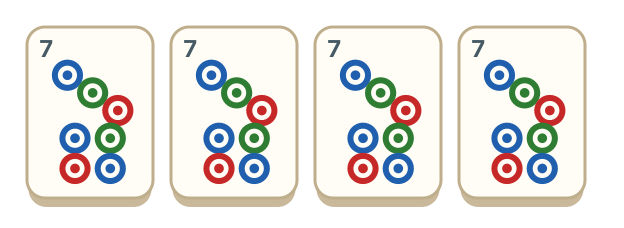
A dead tile is one that no one can use because all four copies are accounted for. If all four D7 are on the table (in discards, dead walls, or exposures), then the D7 is dead and is absolutely safe to discard. It cannot feed anyone.
Conversely, a tile that appears only once in the entire game (e.g., one copy in a discard pile, three others unseen) is live and potentially hot. Assume unseen tiles belong to other players' racks or remain in the wall, making them usable.
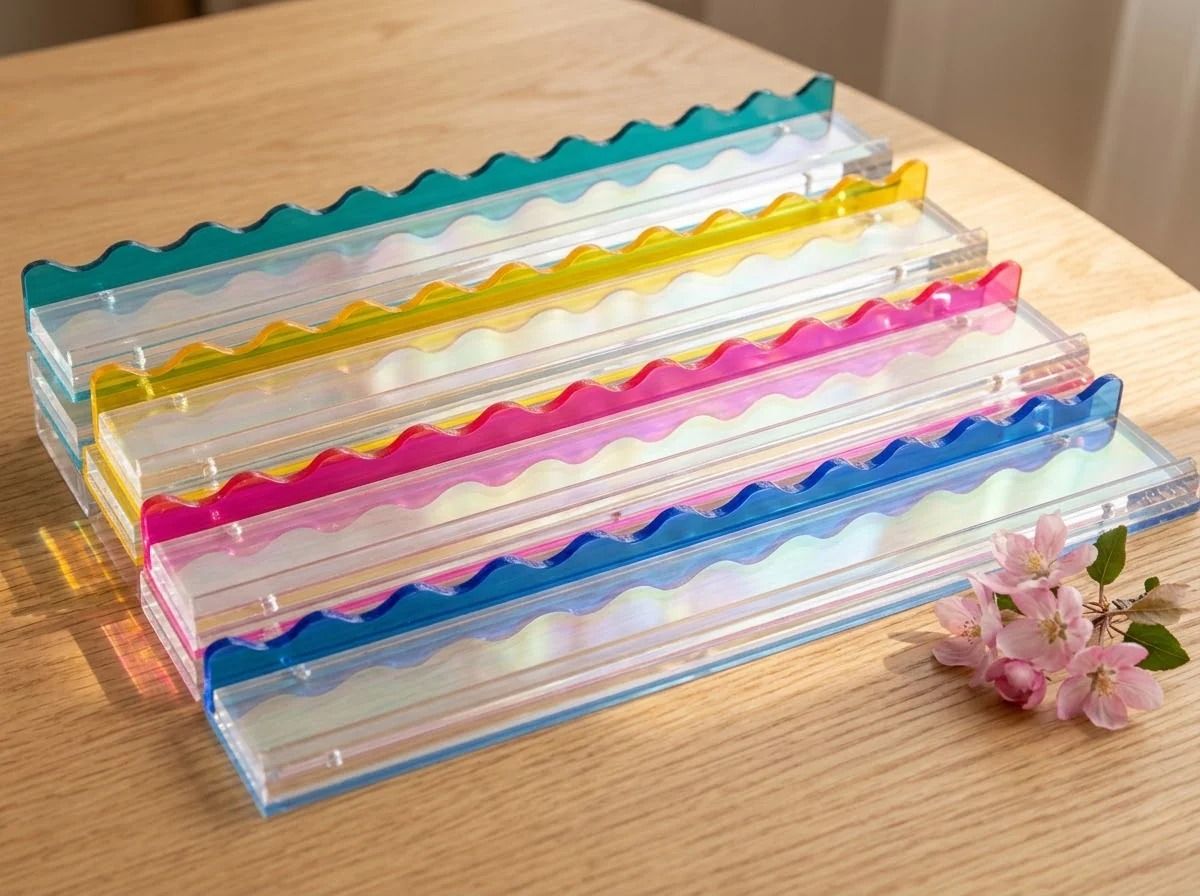
Track the public discard piles and exposures to identify dead tiles. Many experienced players keep mental notes of this, but you can also use mahjong racks with pushers to organize your own discards clearly, making it easier to scan the table for dead tiles when deciding which tile to play.
Gear for this step
Practising defensive play? It's easier with the right setup — see our mahjong racks with pushers.
Table Positions and Danger Zones
Your position relative to the player who controls the discard matters. In American mahjong, any player can call a discard to complete a pung, kong, quint, sextet, or Mahjong—they do not have to be the next player in turn order. However, players closest to discarding often have more options:
East (the dealer) discards first each round and sets the tone. Her discards are scrutinized early.
The player to your right has just drawn and may call your discard immediately.
The player across from you is next in turn after the right player and may also call.
The player to your left draws after you and may hold a tile you discarded earlier.
When you are uncertain about which tile to discard, err toward discarding a tile that would help the player to your right or across—they are closer to Mahjong due to turn order. Protect against the player opposite if she has many exposures; she has had more turns to draw and build.
Defensive Play in the Mid-Game and End-Game
Mid-Game: Slow Information Gathering
In the mid-game (first 10–15 discards), most hands are incomplete. Exposures are sparse. Defensive play means discarding safe, middle-of-the-road tiles (D4–D6, B4–B6, C4–C6) rather than the extremes (D1, D9, B1, B9), since mid-range tiles appear in fewer hands. Winds and Dragons are also safer than number tiles in the mid-game if no one has exposed many of them.
End-Game: Aggressive Defense
When a player has three or four exposures and few discards (meaning she has not discarded much and is close to Mahjong), you must shift to high alert. At this stage, any tile you discard should be one she has already discarded (dead to her) or one that appears in all four copies on the table or in your own hand. In three-player or two-player variants, exposures happen faster due to fewer players, so defensive awareness must begin earlier.
Common Mistakes in Defensive Reading
Mistake 1: Assuming an exposure means the hand is set in stone.
A player can discard and change direction. Someone with a pung of Red Dragons and a sextet of Dots might abandon the Dots hand and chase a different one if she draws a string of Winds. Exposures are strong hints, not prophecies. Re-evaluate as the hand evolves.
Mistake 2: Panicking and discarding blind.
Some players freeze in fear and discard randomly. This is worse than calculated risk-taking. Always think: "Can this player call this tile?" If you truly cannot answer, discard a tile she has already discarded (a sure safe) or a tile with many public copies.
Mistake 3: Ignoring your own hand's timing.
Defensive play is not passivity. If you are two tiles from Mahjong and the opponent is three tiles away, you should discard more aggressively because you will likely win first. If you are five tiles away and she is two, play defense. Know your own hand's speed relative to the table's.
Mistake 4: Over-reading a single exposure.
A pung of Winds tells you little on its own. A pung of Winds *and* a kong of Dragons *and* a sextet of Dots tells you much more. Combine multiple exposures before deciding which tiles are hot.
Next Step: Mastering the Call Ahead
You have learned to read danger. The next skill is acting on that knowledge in real time—knowing when to call a discard (and which one) before another player does. House rules and table etiquette govern how calls are made and resolved. Guide #23 in this series will walk you through the mechanics and psychology of the call ahead and blocking plays that let you protect your seat at the table.
FAQ
Can I discard a tile that three other players have already discarded?
Yes. If a tile is in the discard pile (already played by others), it is effectively dead and safe for you to discard. It means all copies of that tile are either in that pile, in exposures, or held by a player who already chose not to use it.
How do I track what tiles are dead when there are so many discards?
Glance at the public discard piles frequently. If all four copies of a tile appear in discards or exposures, mark it mentally as dead. Early in the hand, most tiles are live; as more discards pile up, more tiles become dead. Some players keep a small notebook or mental checklist.
What if I have a tile that would help two opponents equally?
Discard it to the player who is further from Mahjong, or to the player whose hand is less clear to you. If you cannot judge, choose the player closer to the dealer (turn order advantage) so you have more control if the hand goes around the table again.
Does reading exposures work in two-player or three-player mahjong?
Yes, but faster. With fewer players, each player gets more turns, so hands build quicker and exposures reveal intent sooner. The defensive principles are the same, but you must read exposures more aggressively because the end-game arrives sooner.
Is it ever okay to feed a tile to a far opponent to block a nearer one?
In rare cases, yes—if the far opponent is still several tiles from Mahjong and the near opponent is one tile away, letting the far opponent win might be preferable to letting the near one. This is advanced table dynamics and depends on <a href="https://mahstead.com/en-us/blog/american-mahjong-scoring-and-payouts">scoring</a> and your relationship to each player.
What is a "courtesy pass" and does it affect defensive reading?
The courtesy pass (0–3 tiles passed across after the second Charleston) is a voluntary exchange that can alter hand structure at the last second. Some players use it to dump dangerous tiles or beg for safe ones. It happens before play starts, so it does not affect mid-game reading, but it can signal which hand a player is chasing.
More in Level 4 — Strategy & variations
Ready to play at your own table?
Engraved 160-tile American mahjong sets, mats and racks — free shipping across the US.


View More
View More
View More
