
Winds and Dragons: The Honor Tiles in American Mahjong
Last updated: Nov 18, 2026
Mahjong Rules Guide › Level 1 — Meet the tiles · Guide 3 of 25
Winds and Dragons are the 28 "honor" tiles that sit outside the three numbered suits. Together with Flowers and Jokers, they are what make American mahjong different from the original game. Every hand we play uses these tiles—either as the backbone of a winning combination or as the flexible pieces we discard early. Learning to recognize them, name them, and build groups from them is essential before you sit down at the table.
The Four Winds
There are four Winds in American mahjong: North, East, West and South. Each Wind appears on exactly four tiles in the set, so you can have a pair, a pung (3 tiles), or a kong (4 tiles) of any single Wind. Winds are the most straightforward honor tiles to recognize because they are printed with their cardinal direction clearly marked.
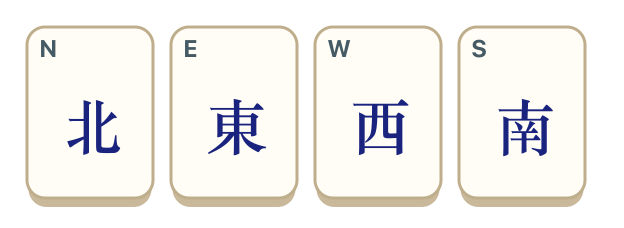
On the table, we refer to them as N, E, W and S. When you are dealing and counting tiles, the Wind of the round matters: East always holds 14 tiles at the start, and the East player sits in the East position during that hand. At a casual weekly game, we rotate who plays East after each hand, but the Wind name stays the same for that position and round.
Winds are identical tiles only. You cannot make a Wind group by combining different directions. Two Norths and a South is not a valid group. All four must be the same Wind to form a pair, pung, kong, or quint. This is why understanding valid groups is so important: honor tiles have no flexibility the way the numbered suits might suggest.
The Three Dragons
There are three types of Dragons in American mahjong: Red, Green, and White. We often call the White Dragon "Soap" to avoid confusion with blank or unprinted tiles. Each Dragon appears on exactly four tiles, just like the Winds.
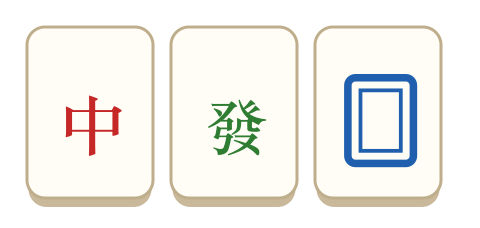
The three Dragons have a hidden connection to the three numbered suits: Bams, Craks, and Dots. Craks are traditionally paired with the Red Dragon, Bams with the Green Dragon, and Dots with the White Dragon (Soap). You will not see this rule directly on an engraved American mahjong set or your hand card, but many players remember suit groups this way, and it appears on certain hands printed each year by the National Mah Jongg League.
The White Dragon, or Soap, plays a special role that goes beyond honor tiles. In year hands and certain other patterns, the White Dragon doubles as zero, giving it extra power in the hand calculator. But in standard play, it is treated exactly like the Red and Green Dragons: a tile you use to form identical groups.
Building Groups from Honor Tiles
Winds and Dragons follow the same grouping rules as all identical tiles in American mahjong. You can build:
A pair: 2 identical honor tiles (N + N, or RD + RD)
A pung: 3 identical honor tiles (E + E + E)
A kong: 4 identical honor tiles (S + S + S + S)
A quint: 3 identical honor tiles + 2 jokers (W + W + W + J + J)
A sextet: 4 identical honor tiles + 2 jokers (GD + GD + GD + GD + J + J)
Remember: jokers can only substitute in groups of 3 or more tiles. You cannot use a joker to make a pair or a single. If you have two Norths and a joker, you cannot declare a pair of Norths with a joker—that is not legal. You can only call a single tile if it completes your entire hand (Mahjong). Otherwise, honor tiles must match exactly.
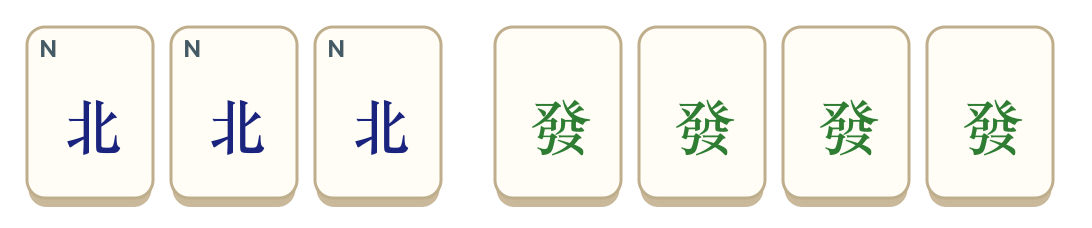
This strictness is one reason honor tiles are so valuable. When you pick one up, you know instantly which group it belongs to. There is no ambiguity, no "this could go here or there." A Red Dragon is always a Red Dragon, and it only combines with other Red Dragons.
Gear for this step
Practising winds and dragons? It's easier with the right setup — see our engraved American mahjong sets.
Honors on the Hand Card
On your printed hand card, honor tile groups are always shown as identical tiles, never as runs or sequences (because those do not exist in American mahjong). You might see:
N N N (a pung of North)
E E E E (a kong of East)
RD RD (a pair of Red Dragons)
GD GD GD + J (a quint: three Green Dragons and two jokers)
When you scan the hand card, every group with an honor tile contains only that honor tile repeated. If your card shows N E W S in a row, that is four separate singles, not a group—and you cannot win using only single tiles without other groups attached. The card is printed by the NMJL each spring and shows the exact patterns that win in tournament or league play, so reading it correctly is your first step to building a winning hand.
Common Mistakes with Honor Tiles
Mistake 1: Thinking you can mix Winds
The most common error new players make is trying to combine different Winds into one group. "I have a North, an East, and a West—can I use that as a pung?" No. Each Wind is its own tile type. You need three Norths, or three Easts, or three Wests—not one of each. Honor tiles have no "wild" reading like numbered tiles sometimes do on certain hands.
Mistake 2: Mixing Dragons with Winds
Honor tiles are honor tiles, but a Wind is not a Dragon. A North is not a Red Dragon. They live in the same world of non-numbered tiles, but they do not combine. If you have a North and a Red Dragon, they are two separate pieces. You cannot use them together in a group.
Mistake 3: Using a joker in a pair of honor tiles
If you hold two honor tiles of the same type, you have a pair. A pair is complete. You do not need a joker, and the rules do not allow you to add one. Jokers enter the picture only when you have three or more real tiles and need to fill out a group to five or six tiles. In a pair, jokers stay in your hand.
Mistake 4: Forgetting that White Dragon doubles as zero
In most hands, the White Dragon behaves like any other Dragon. But when you are playing a year hand or another pattern that uses a zero, you must know whether your hand card is calling for a Soap-as-zero or a Soap-as-Dragon. If you confuse them, you will build the wrong group. Read your hand card closely when Dragons appear alongside numbered tiles on the same line.
Why Honor Tiles Matter
Winds and Dragons are often the heaviest hitters in a winning hand. They require no arithmetic, no color-matching, no row-counting. If your hand card calls for a kong of South winds, and you draw the fourth South, you are done with that group. The simplicity is also what makes them so strong: honor tiles are predictable, and predictability wins games.
In a typical evening, you will build honor-tile groups far more often than you think. A pung of Red Dragons appears on dozens of hands each season. Pairs of Winds are everywhere. Learning to spot them, call them correctly, and place them confidently on your rack will cut your hesitation time in half and give you confidence when the game moves fast.
Next Step
Now that you know the 28 honor tiles, you are ready to explore how they fit into complete hands. Our next guide walks you through Flowers and Jokers, the final two types of special tiles, and how all 160 tiles in your set work together. Then we will move into hand patterns and the Charleston—the first ritual every game begins with.
FAQ
Can I make a group with one North, one East, and one West?
No. Winds are honor tiles, and honor tiles of different types cannot combine. You need three of the same Wind (three Norths, three Easts, or three Wests) to form a valid pung. A single North and a single East count as two separate tiles, not a group.
Can I mix a Dragon with a Wind in the same group?
No. Dragons and Winds are both honor tiles, but they are different types. A Red Dragon belongs only with other Red Dragons. A North belongs only with other Norths. They do not mix.
If I have two honor tiles of the same type and a joker, do I have a pung?
No. You have a pair of honor tiles, which is complete by itself. Jokers can only substitute in groups of 3 or more real tiles. A pair (2 tiles) plus a joker is not a valid group in American mahjong.
How many of each Wind and Dragon are in a standard set?
Each Wind (North, East, West, South) appears exactly 4 times. Each Dragon (Red, Green, White/Soap) appears exactly 4 times. This means you can make a kong (4 tiles) from any single Wind or Dragon.
Why is the White Dragon sometimes called "Soap"?
Players call it "Soap" to avoid confusion with blank tiles or to distinguish it clearly when speaking aloud. In most hands, it behaves like any other Dragon. However, in special year hands and certain patterns, the White Dragon doubles as a zero, and knowing this distinction helps you build the correct group.
What happens if I use a joker to stand in for a Dragon or Wind?
If you have three real Dragons and a joker, the joker can substitute for the fourth Dragon to make a kong. The same applies to Winds. However, if another player is holding the real tile, they can call it and redeem the joker on their turn, taking the joker and returning it to your rack.
More in Level 1 — Meet the tiles
American Mahjong Tiles Explained: Every Tile in the 152-Tile Set
The Three Suits: Bams, Craks and Dots (and How to Tell Them Apart)
Ready to play at your own table?
Engraved 160-tile American mahjong sets, mats and racks — free shipping across the US.


View More
View More
View More
