
American Mahjong Tiles Explained: Every Tile in the 152-Tile Set
Last updated: Nov 18, 2026
Mahjong Rules Guide › Level 1 — Meet the tiles · Guide 1 of 25
A standard American mahjong set holds exactly 152 tiles: three numbered suits (Dots, Bams and Craks), Winds and Dragons as honor tiles, Flowers, and Jokers. Every tile except Flowers and Jokers appears four times, so you can build pungs and kongs with confidence. When you buy engraved American mahjong sets, you're getting the full toolkit to host weekly games with your friends or join a game night anywhere in North America.
The Three Numbered Suits: Dots, Bams and Craks
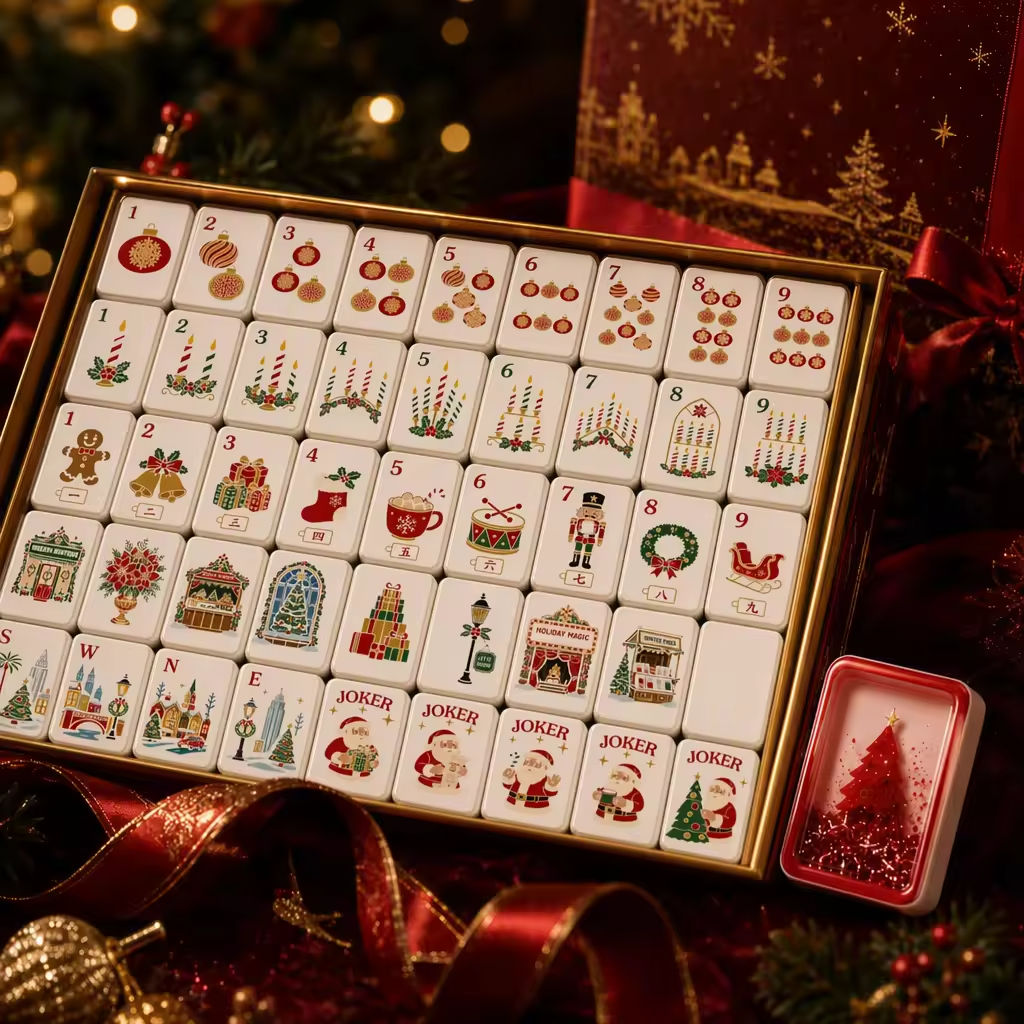
The backbone of every American mahjong hand comes from three suits, each numbered 1 through 9. Each suit appears four times in the set, giving you the flexibility to form multiple groups in a single hand.
Dots (1–9)
Dots (also called Circles) are marked with small round symbols—the 1 Dot shows one circle, the 2 Dot shows two circles, and so on. They are often associated with the White Dragon, sometimes called Soap.

Bams (1–9)
Bams (also called Bamboos or Sticks) feature thin lines or bamboo-like symbols. The 1 Bam is always drawn as a bird—a distinctive image that makes it instantly recognizable on the table. Bams 2 through 9 show increasing numbers of bamboo stalks. Bams are traditionally linked to the Green Dragon.

Craks (1–9)
Craks (also called Characters, Myriads or Ten Thousands) display numbers in an ornate style, sometimes enclosed in circles or frames. Craks are the suit most closely connected to the Red Dragon in traditional play.

You'll use these 27 tiles (9 of each suit × 3 copies = 27 base tiles, plus one more copy of each = 108 tiles total) to build pungs, kongs, quints and sextets on the card. For much more detail on identifying and using each suit, see our guide to the Three Suits: Bams, Craks and Dots.
The Honor Tiles: Winds and Dragons
American mahjong adds 28 honor tiles to the numbered suits. These break into two groups: Winds and Dragons. They are called "honors" because they hold special meaning in the game and appear in many hands on the card.
Winds (4 each: North, East, West, South)
Winds are labeled N, E, W and S. You have four of each Wind in the set—four North (N), four East (E), four West (W) and four South (S). The card often calls for pairs or pungs of a specific Wind, and they appear in the all-honour hands too. Winds are crucial in the early turns as well: East sits in the East seat and gets to draw 14 tiles on the first hand.
Dragons (4 Red, 4 Green, 4 White / Soap)
The three Dragons are Red Dragon (RD), Green Dragon (GD), and White Dragon (WD)—also known as Soap. Each Dragon appears four times. The White Dragon (Soap) has a special double life: it doubles as zero in year hands and other number sequences on the card. To understand why Soap works as a zero and how it opens up hand possibilities, read The White Dragon (Soap) and Why It Doubles as Zero.
For a complete breakdown of how Winds and Dragons fit into your hand strategy, see Winds and Dragons: The Honor Tiles in American Mahjong.
Flowers and Jokers
The remaining 16 tiles—8 Flowers and 8 Jokers—are the most flexible and sometimes the most misunderstood tiles in the set.
Flowers (8 total)
Flowers are ordinary playing tiles, not bonuses. You keep them in your hand just like any other tile, and you use them to build groups (a pair, pung, kong, or larger group) exactly as the card calls for. You do not set them aside, and you do not draw a replacement when you pick a Flower—that rule belongs to Chinese mahjong, not American. All 152 tiles stay in play.
Jokers (8 total)
Jokers are wildcards that can stand in for any tile inside a group of three or more identical tiles. A Joker in a pung of 3 Green Dragons takes the place of one Green Dragon. A Joker in a quint of 5 Dots can be any single Dot. However, Jokers can never stand in for a single tile or a pair. If a hand calls for NEWS (North, East, West, South as singles), you cannot use a Joker for any of them—only the real tiles will do.
Here's a crucial detail: if you hold the real tile that a Joker is standing in for, you can redeem that Joker on your turn, claiming both tiles and freeing the Joker back into play. This adds a layer of strategy to the endgame.
For the full picture on how Flowers truly work (they are not bonuses!) and when Jokers unlock hidden plays, read Flowers and Jokers: The 16 Special Tiles.
Gear for this step
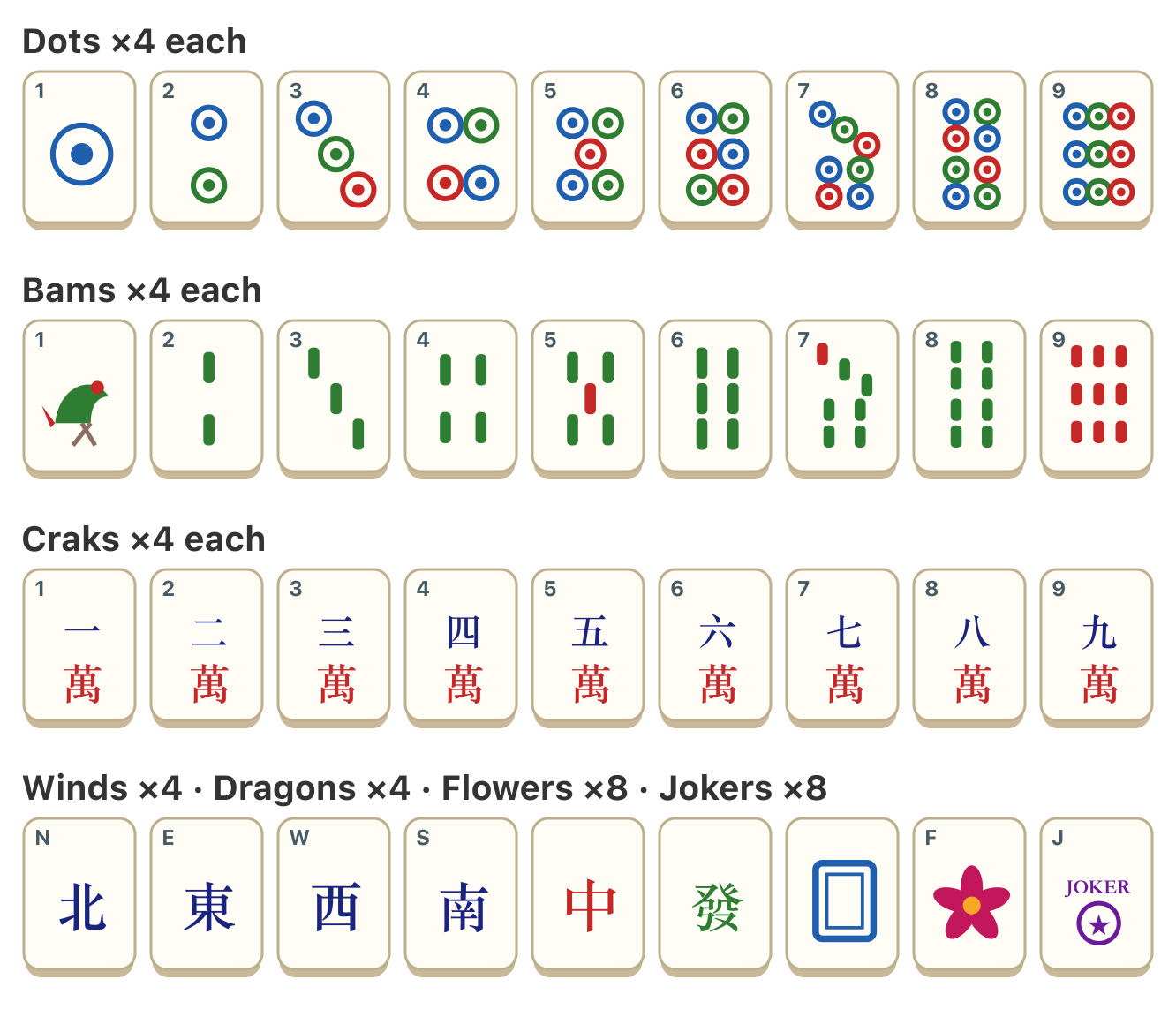
Practising american mahjong tiles explained? It's easier with the right setup — see our engraved American mahjong sets.
How to Count Your Tiles
When you first open a new set, here's a quick audit to make sure you have everything:
Numbered suits: Sort all Dots, Bams and Craks by number. You should have exactly 4 of each number in each suit (4 × 3 numbers × 3 suits = 108 tiles).
Winds: Collect all four N's, four E's, four W's, four S's (16 total).
Dragons: Sort Red, Green and White—four of each (12 total).
Flowers: You should have 8 Flower tiles (F).
Jokers: You should have 8 Jokers (J). They are typically blank or marked with an X or star.
Total: 108 + 16 + 12 + 8 + 8 = 152 tiles.
Why Each Tile Matters
Every tile in the set is in active play. Unlike some tile games where pieces sit on the sidelines, American mahjong uses all 152 in a single game. That's why no tile is ever wasted: even the Flowers you draw are part of your hand strategy, not tossed aside. This makes deck composition matter deeply. When you play with a set where all tiles are accounted for and clearly marked, the game flows fairly and no one second-guesses whether that fourth Green Dragon is still in the wall or already on the table.
Common Mistakes
Confusing the 1 Bam with other tiles: The 1 Bam is a bird, not bamboo stalks. If you see a bird on a tile, that's your 1 Bam. This becomes second nature after a few games.
Thinking Flowers are bonuses: Flowers are not bonus tiles and do not trigger a draw. You keep them in your hand and form groups with them. This is different from Chinese or Hong Kong rules.
Using Jokers in singles or pairs: Jokers work only in groups of three or more. If a hand calls for singles (like NEWS) or a pair, Jokers cannot fill those slots.
Forgetting that Soap is zero: The White Dragon can count as zero in hands that call for a zero in a number sequence. This opens up hands you might otherwise miss on the card.
Confusing suit colors with dragon colors: Craks are associated with Red Dragons, Bams with Green, and Dots with White (Soap). The colors help you spot patterns on the card, but the association is traditional—not a hard rule that blocks play.
Next Step: Learn to Spot the Tiles at a Glance
Now that you know what each tile looks like and where it belongs, you're ready to build actual groups. In our next guide, we'll walk through the five types of tile groups—pairs, pungs, kongs, quints and sextets—and show you how to recognize them on the card. You'll also learn why some hands forbid Jokers entirely and why that rule makes the game fair for everyone at the table.
FAQ
What does "152 tiles" mean? Are there extra tiles I need to know about?
A standard American mahjong set contains exactly 152 tiles: 108 numbered tiles (Dots, Bams, Craks in numbers 1–9), 16 honor tiles (four each of North, East, West, South), 12 Dragons (four Red, four Green, four White/Soap), 8 Flowers, and 8 Jokers. All 152 tiles are in play during a game; nothing sits out as a spare unless your set is larger than standard.
Can I use a Joker to stand in for a pair?
No. Jokers work only in groups of three or more identical tiles. You cannot use a Joker for a single tile or a pair. If a hand calls for a pair of Red Dragons, you must use two real Red Dragon tiles.
Are Flowers treated differently in American mahjong than in other mahjong games?
Yes. In American mahjong, Flowers are ordinary playing tiles. You keep them in your hand, use them to build groups on the card, and do not draw a replacement tile when you pick a Flower. In Chinese or Hong Kong mahjong, Flowers are bonus tiles set aside with an automatic draw. American rules are simpler and all 152 tiles stay in play.
What makes the 1 Bam different from other numbered tiles?
The 1 Bam is drawn as a bird, not as a single bamboo stalk. It is always instantly recognizable on the tile. All other Bams (2–9) show increasing numbers of bamboo stalks or lines.
Can the White Dragon (Soap) ever count as a normal Dragon?
Yes. The White Dragon can be used as a regular Dragon tile in any group (pair, pung, kong, quint or sextet of White Dragons). Its special role as zero appears only in specific hands on the card that call for a zero in a number sequence. Both uses are equally valid.
How many of each tile should be in my set?
Dots, Bams, Craks, Winds and Dragons each appear exactly four times. Flowers appear eight times total (not four of one flower variety—the standard set just has eight generic Flower tiles). Jokers also appear eight times. This four-per-tile rule (except for Flowers and Jokers) lets you build all the groups a hand requires.
More in Level 1 — Meet the tiles
Ready to play at your own table?
Engraved 160-tile American mahjong sets, mats and racks — free shipping across the US.


View More
View More
View More
