
Playing With Three or Two Players — American Mahjong Strategy & Variations
Last updated: Nov 18, 2026
Mahjong Rules Guide › Level 4 — Strategy & variations · Guide 23 of 25
American mahjong is designed for four players, but many home groups find themselves short a seat. Playing with three or two players is possible—though the game changes in pace, defense, and luck—if you agree on tile distribution and whether discards stay visible. There is no single NMJL standard for short-handed play, so we'll walk through the most common variants that keep the game fair and playable.

Playing With Three Players
Three-player mahjong removes one entire hand's tiles from the game. You'll have 114 tiles in play instead of 152, which tightens draws and speeds completion. The game is tenser: fewer safe discards, faster hands, and harder defense.
Tile Setup and Distribution
Remove one entire player's hand before dealing. East sits, North sits, West sits; South's 14 tiles never enter play. Some groups set aside a second stack of 14 (the old South hand) to replace drawn tiles if the main wall runs short—though this is rare. The wall remains in one line; East takes the first 14 tiles, North and West take 13 each.
The three of you then conduct a modified Charleston:
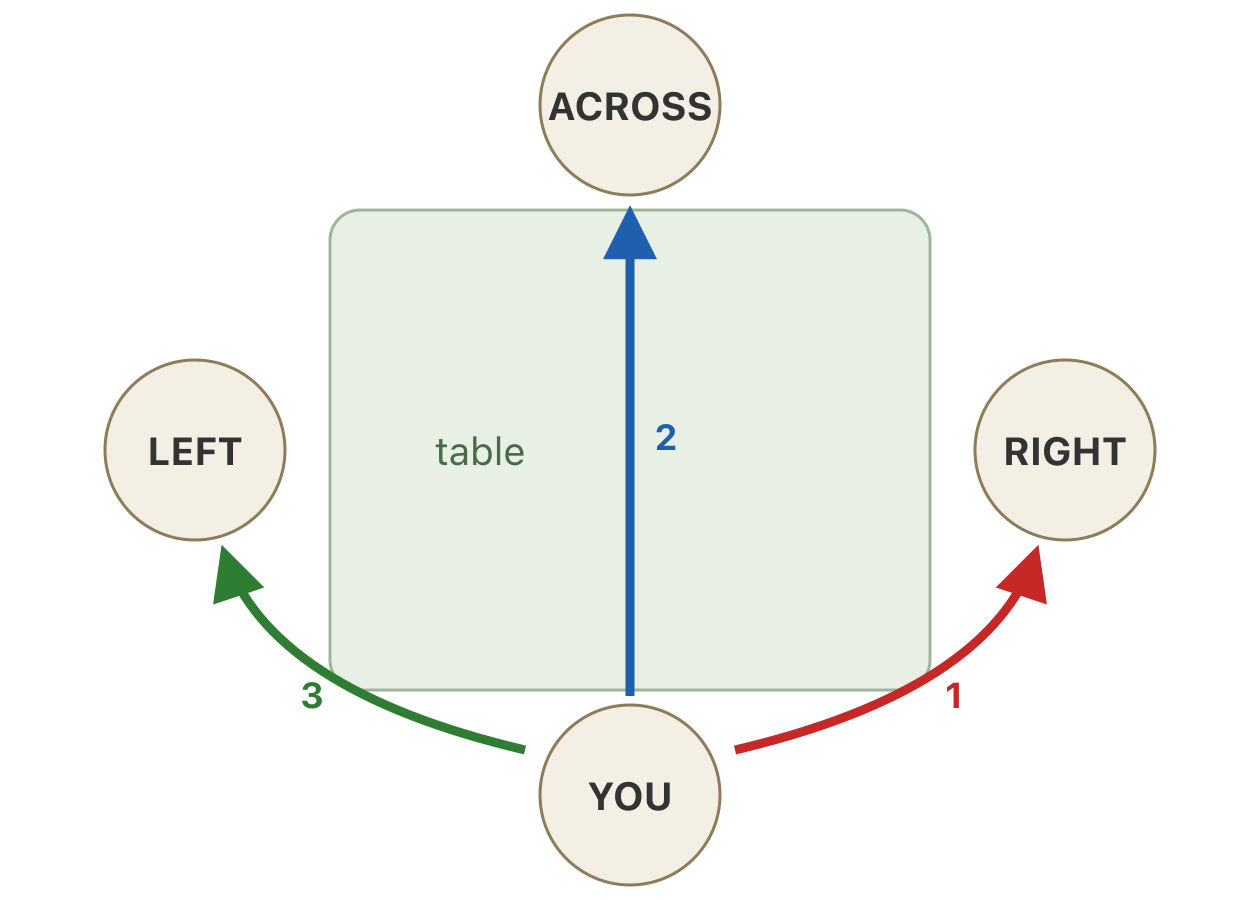
Pass 3 tiles right, 3 left, 3 across (three passes, not four).
Decide as a table whether a second Charleston is possible. If yes, any player can stop it after the first pass (right).
No courtesy pass is typical in three-player games.
The smaller pool and faster draws mean your initial hand choice matters even more. Look for hands that need fewer jokers and can "wait" in multiple directions.
Exposure and Dead Walls
The critical difference is what happens to discards. Some tables keep discards face-up and visible to all three players; others follow a rule that any discard older than one turn is considered "dead" (cannot be called). This changes your defensive math drastically.
Variant A: Open Discard Line. Every discard stays in front of the player who threw it and remains callable by anyone until someone completes a hand. This is fastest and most transparent—ideal for casual play. Defense relies on reading the exposures and knowing what others are building.
Variant B: Dead Tiles (One-Turn Rule). A discard is live only for the next player's turn. After that, it becomes "dead" (cannot be called for an exposure or win). This favors the discarder but can feel punishing if you miss a call by one turn. Agree in advance whether only the player to your immediate right can call your discard, or if all players can call on their own turn before it dies.
We recommend Variant A (Open) for beginners learning three-player rules. It is simpler to track and teaches defensive reading.
Scoring Adjustments
Payouts in three-player games follow the same principle as four-player: if you win on a discard, the thrower pays double; if you self-draw, both opponents pay double. However, some groups modify the payment because there are fewer losers:
Standard (no change): Discard win = thrower pays 2× hand value, opponent pays 1×. Self-draw = both opponents pay 2×. This can make three-player payout larger per person than four-player.
Reduced scale: Some tables cut all payouts by 25–33% to keep the game social. Agree before you start.
Always reference your table's house rules on scoring and money (or chips) before the first hand.
Playing With Two Players
Two-player mahjong is actually quite different from the four- or three-player game. Only 76 tiles are dealt (38 each), and the game becomes almost entirely about hand management and luck rather than defense. Many groups do not play true two-player mahjong at all—they prefer the "four-player game with one empty seat" (three players, with rotation) to keep the strategy alive.
Tile Setup and Distribution
Remove two full hands (North and West, or any two directions) before dealing. East takes 14 tiles; West takes 13; the wall shrinks to 114 tiles remaining. Only two players draw from the wall; when it empties, the game ends or you declare a draw (no winner).
The Charleston in two-player is optional:
Some tables skip it entirely to save time.
Others do a single pass: 3 tiles right only, then keep the rest.
A few do a full Charleston but it feels slow with so few tiles.
Agree before you deal whether you're using Charleston at all.
Exposure and the "Scooping" Question
Two-player mahjong has no defense. You cannot avoid discarding what your opponent wants, and reading their hand is almost pure guesswork because so few tiles are in play. This is why most home games avoid true two-player.
A common house rule is "scooping": after East discards and West draws, West immediately discards without waiting for East to draw. This keeps pace and prevents excessive thinking. Other tables play it as a true turn structure: East draws, East discards, West draws, West discards—identical to four-player but with two people.
The most important rule is exposure visibility. In two-player, if a player melds a pung, kong, or quint, it must stay face-up on the table in front of them. This gives the opponent at least some reading material. Jokers inside exposed groups must be marked or clearly visible so both players know what tile they stand for.

Scoring in Two-Player
Payment stays the same: discard = thrower pays 2× hand value to winner; self-draw = thrower pays 2× (there's only one opponent). Many two-player groups use reduced chips or play for play-money only, since wins can swing large in a short pool.
Why Most Tables Use "Three-Player With Rotation" Instead
If you have four people and one cannot make it, consider rotating that empty seat rather than playing true two-player. Have three players go one hand, then rotate one player out and bring the fourth in. This keeps the strategy, defense, and rhythm of the real game alive. True two-player is very luck-heavy and can feel like a puzzle rather than a game.
Modified Charleston Diagram for Three Players
Here is how the pass sequence works with three seats:
Hand Recommendations for Short-Handed Play
With fewer tiles in circulation, the card becomes stricter. Hands that rely on many jokers are riskier because jokers dry up faster. Similarly, hands that need all four copies of a tile can be blocked if opponents hoard them.
Pungs and kongs are your friend. Identical-tile groups form faster with fewer players creating noise.
Singles and pairs (from the card's Pairs section) are safer in three-player. They require no jokers.
Avoid hands with 5 or 6 jokers if you can. The discards are leaner, and redemption (exchanging a real tile for an exposed joker) is less likely.
Watch the live wall carefully. With 114 tiles in play, you'll see the wall empty before the 8th turn in three-player. Plan for fewer draws.
Revisit the guide Beginner Strategy: Choosing a Hand After the Charleston for deeper hand selection, then adapt it to the short-handed context.
Gear for this step
Practising playing with three or two players? It's easier with the right setup — see our mahjong bags and cases.
Defense in Short-Handed Games
With only one or two opponents, your reading of exposures and safe discards becomes even more critical. In three-player, you have two opponents; in two-player, you have one. Every discard you throw is a possible gift. Discard patterns and which player called which tile become your entire defense strategy.
In three-player open-discard play:
Note which player called a D5 last turn. If they called it, they likely need Dots. Avoid throwing other Dots if possible.
If a player hasn't discarded from a suit for three turns, assume they are building it. Throw that suit only if you have no choice.
Two opponents means two distinct hands, two distinct strategies. Do not assume they want the same tile.
Common Mistakes
Forgetting to remove a full hand before dealing. If you forget and deal all 152 tiles, you'll have 38 in the wall—one player will run out of draws mid-game.
Changing the dead-tile rule mid-game. Agree on whether discards stay live or die after one turn before you begin. Switching mid-hand creates conflict.
Overconfident defense in two-player. Two-player is luck-heavy. You cannot read the hand like in four-player. Discard broadly and accept that the game is swingy.
Ignoring flower tiles. Flowers are ordinary playing tiles in American mahjong. Do not set them aside or draw replacements. In short-handed play, a flower might complete a needed group—keep them in your hand.
Miscounting the wall in three-player. With 114 tiles in the wall, the game ends faster. Plan for a wall that empties around turn 9–10 instead of turn 12–14. If the wall runs out before anyone wins, the hand is a draw (no payment).
Setup Checklist for Short-Handed Games
Players | Remove | East Gets | Others Get | Tiles in Play | Charleston |
3 | 1 full hand (14 tiles) | 14 | 13 each | 114 | 3R, 3L, 3A (or skip) |
2 | 2 full hands (28 tiles) | 14 | 13 | 76 | Optional or skip |
If you need mahjong bags and cases to store and carry your set, mark the removed tiles clearly so you don't accidentally mix them in for future games.
Next Step
Now that you understand short-handed play, the next guide will explore how American mahjong compares to other regional variants. In Guide 24, we'll examine American vs. Chinese vs. Riichi Mahjong: The Real Differences—so you can switch between rulesets without confusion if you travel or play online.
FAQ
If I'm playing three-player and the wall runs out before anyone wins, what happens?
The hand is a draw (tie). No one pays or is paid. Some tables allow one bonus draw per player before declaring a draw; others play that any empty wall ends the hand immediately. Agree in advance.
Can I play three-player mahjong with a rotation so all four players stay involved?
Yes. One player sits out each hand, then rotates in for the next. This keeps everyone in the game and avoids learning a separate three-player ruleset. It takes longer overall but preserves the full four-player strategy and defense.
In two-player, do I still need to call a discard, or can I take it automatically?
You must still call it. Say "pung," "kong," or "mah-jongg" (for winning). The turn structure stays the same as four-player; only the number of opponents changes.
Are flowers mandatory in three- or two-player games?
Yes. Flowers are ordinary playing tiles in American mahjong. You keep them in your hand and use them in any group the card calls for (e.g., a pair or pung of Flowers). Do not set them aside or draw a replacement—that is a Chinese rule, not American.
What happens to jokers if the wall empties in three-player?
Any joker still in the wall (not drawn) is simply unused. Jokers already in players' hands or melds stay on the table. There is no special redemption rule if the wall ends.
Is three-player or two-player considered "official" by the NMJL?
No. The National Mah Jongg League publishes the card for four-player American mahjong only. Three- and two-player variants are house rules. Tables may agree on any fair system as long as everyone knows the rules before play begins.
More in Level 4 — Strategy & variations
Ready to play at your own table?
Engraved 160-tile American mahjong sets, mats and racks — free shipping across the US.


View More
View More
View More
