How to Play American Mahjong: A Step-by-Step Guide for Beginners
Last updated: Oct 07, 2026
Last updated: October 2026
American Mahjong looks complicated the first time you sit down, but the flow of a game is simple once you see it in order: build the wall, deal, pass tiles in the Charleston, then draw and discard until someone completes a hand from the card. This guide covers the basic rules of American Mahjong for beginners, step by step, with the terms you will hear at the table.
Quick answer
American Mahjong is played by four players with 152 tiles (including 8 Jokers) and the current year's card from the National Mah Jongg League. Each player starts with 13 tiles (the dealer, East, starts with 14). After the Charleston, a series of tile passes, players take turns drawing and discarding. The first player to match a hand on the card exactly calls "Mahjong" and wins.
What you need
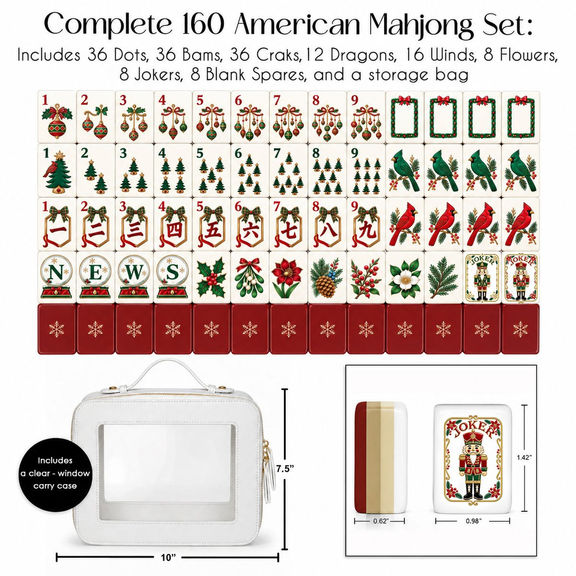
An American Mahjong set: 152 playing tiles, including 8 Jokers. Set the blank tiles aside.
Four racks, ideally with pushers.
Two dice.
One current card per player. The card changes every year, so everyone at the table should use the same year.
A mat or a table cover (optional, but it keeps the game quiet).
Not sure what every tile means? Start with our guide to what's in an American Mahjong set.
Key terms
Pung: three identical tiles. Kong: four. Quint: five (only possible with Jokers).
Exposure: a group you have called from a discard and placed face up on your rack.
Concealed hand: a hand marked "C" on the card. You cannot call discards to make exposures, except the last tile for Mahjong.
East: the dealer, who starts with 14 tiles and takes the first turn.
How to play American Mahjong, step by step
1. Build the wall
Turn all 152 tiles face down and shuffle them. Each player builds a wall in front of their rack, 19 tiles long and 2 tiles high. Racks with pushers make the next steps much easier.
2. Choose East and deal
Players roll the dice to choose East. East then rolls again and breaks the wall at that count. Players take tiles from the wall in groups of four, then single tiles, until East has 14 tiles and every other player has 13. Each player places their tiles on their rack facing them.
3. The Charleston
The Charleston is a series of passes that lets everyone get rid of tiles they do not need. It is unique to American Mahjong.
First Charleston (required): pass three tiles to the right, three across, then three to the left.
Second Charleston (optional): pass three to the left, three across, then three to the right. Any player can choose to stop it before it starts.
Courtesy pass (optional): the players sitting across from each other can agree to swap up to three tiles.
Jokers can never be passed. On the last pass of each Charleston you may "blind pass": pass on tiles you just received without looking at them, if you have nothing you want to give away.
For the full pass order, blind passes and tips on what to pass, read our guide to the mahjong Charleston.
4. Pick a hand from the card
While you pass tiles, look at the card and choose two or three hands your tiles fit best. The card groups hands into sections, such as 2468, Consecutive Run, Winds and Dragons, and Singles and Pairs. Colors on the card show suits: one color means one suit, different colors mean different suits. Stay flexible early and narrow down as the game goes on.
5. Draw and discard
East starts by discarding one tile, since East already has 14. Play then moves to the right. On each turn, you draw a tile from the wall, decide whether it helps your hand, and discard one tile face up in the center of the table, saying its name out loud ("3 Bam", "North").
6. Calling discards
When another player discards a tile you need to finish a pung, kong or quint, you can call it before the next player draws. Place the completed group face up on your rack as an exposure, then discard a tile. Play continues from you. A few rules to remember:
You can only call a discard for a single tile or a pair if it gives you Mahjong.
If more than one player calls the same tile, a call for Mahjong wins. Otherwise the player whose turn would come first gets it.
Concealed hands cannot call discards for exposures.
7. Jokers and Joker exchanges
A Joker can stand in for any tile in a pung, kong or quint, but never in a single tile or a pair. On your turn, if any player has an exposure that contains a Joker and you hold the real tile it stands for, you can swap your tile for the Joker. Joker exchanges are one of the best ways to move closer to a hand.
8. Mahjong, or a wall game
When your 14 tiles match one hand on the card exactly, call "Mahjong" and lay your tiles face up for everyone to check. If the wall runs out and nobody has won, it is a "wall game": the tiles are shuffled and the next deal begins. A player whose exposures show they can no longer make any hand is declared "dead" and stops playing that round.
Scoring, briefly
Each hand on the card shows a value. Under the standard rules, every player pays the winner the value of the hand. The player who threw the winning tile pays double, and if the winner drew the tile from the wall, everyone pays double. A hand with no Jokers pays double. Many tables play for small stakes or none at all, so agree on house rules before the first game. For a full payout chart, see American mahjong scoring.
Beginner tips
Keep Jokers. Unless it gives you Mahjong, never discard a Joker early in the game.
Watch what others expose and discard. If three of a tile are already gone, stop waiting for it.
Do not commit to one hand too early. Hold tiles that work for two or three hands.
Take your time. New players often feel rushed; experienced groups are happy to slow down while you learn.
Play with easy-to-read tiles. Clear suits and numbers in the corners help while you learn.
Get your table ready
Everything you need for your first game, from tiles to racks and a mat:
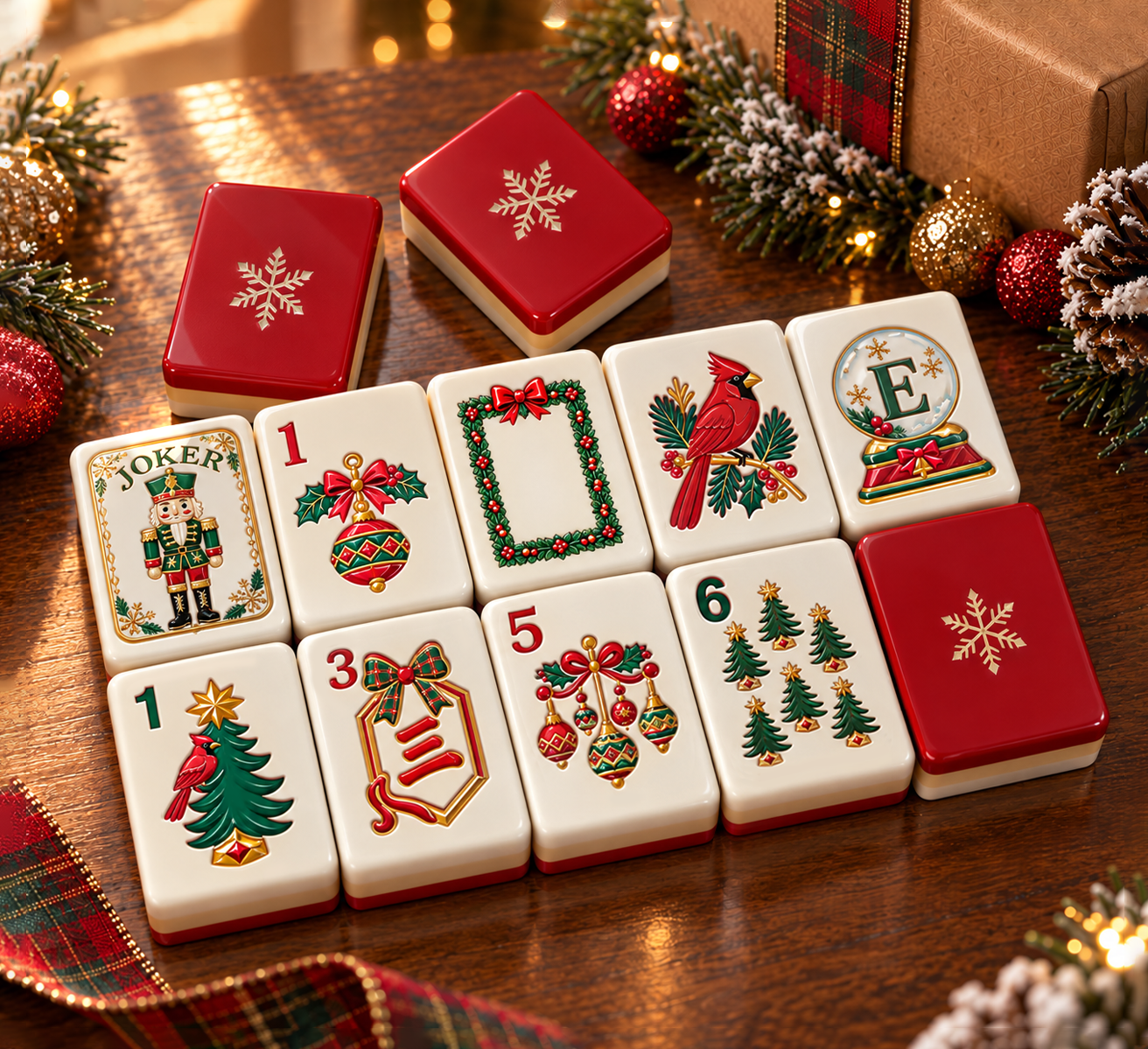 | Holiday Red Christmas Mahjong Set $289.99 |
 | Clear Acrylic Mahjong Racks with Pushers, Set of 4 $139.99 |
 | Regal Pearl & Gold Mahjong Mat, Roll-Up $99.99 |
Need dice too? Our natural gemstone mahjong dice come as a set of six. For more choices, see our guide to the best American Mahjong sets, how to choose mahjong racks and how to choose a mahjong mat.
FAQ
How many players do you need for American Mahjong?
Four is standard. There are variations for two and three players, but the standard rules and card are written for four.
How many tiles does each player get?
13 tiles, except East (the dealer), who starts with 14 and discards first.
What is the Charleston in mahjong?
A series of three-tile passes before play begins: right, across and left in the first Charleston, then an optional second Charleston and courtesy pass. Jokers cannot be passed.
Do I need a new card every year?
Yes, if you play with a regular group. The National Mah Jongg League changes the hands each year, and most groups switch to the new card in the spring.
How is American Mahjong different from Chinese Mahjong?
American Mahjong uses Jokers, the Charleston and a yearly card of set hands. Chinese Mahjong has no Jokers or Charleston and uses its own scoring rules.
Shipping: we ship to all US addresses. Shop American Mahjong sets, racks or mats.


View More
View More
View More
Copyright © 2026 Mahstead. All Rights Reserved | (361) 264-4881
