
American Mahjong for Beginners: Learn Rules & Start Playing
Last updated: Nov 23, 2026
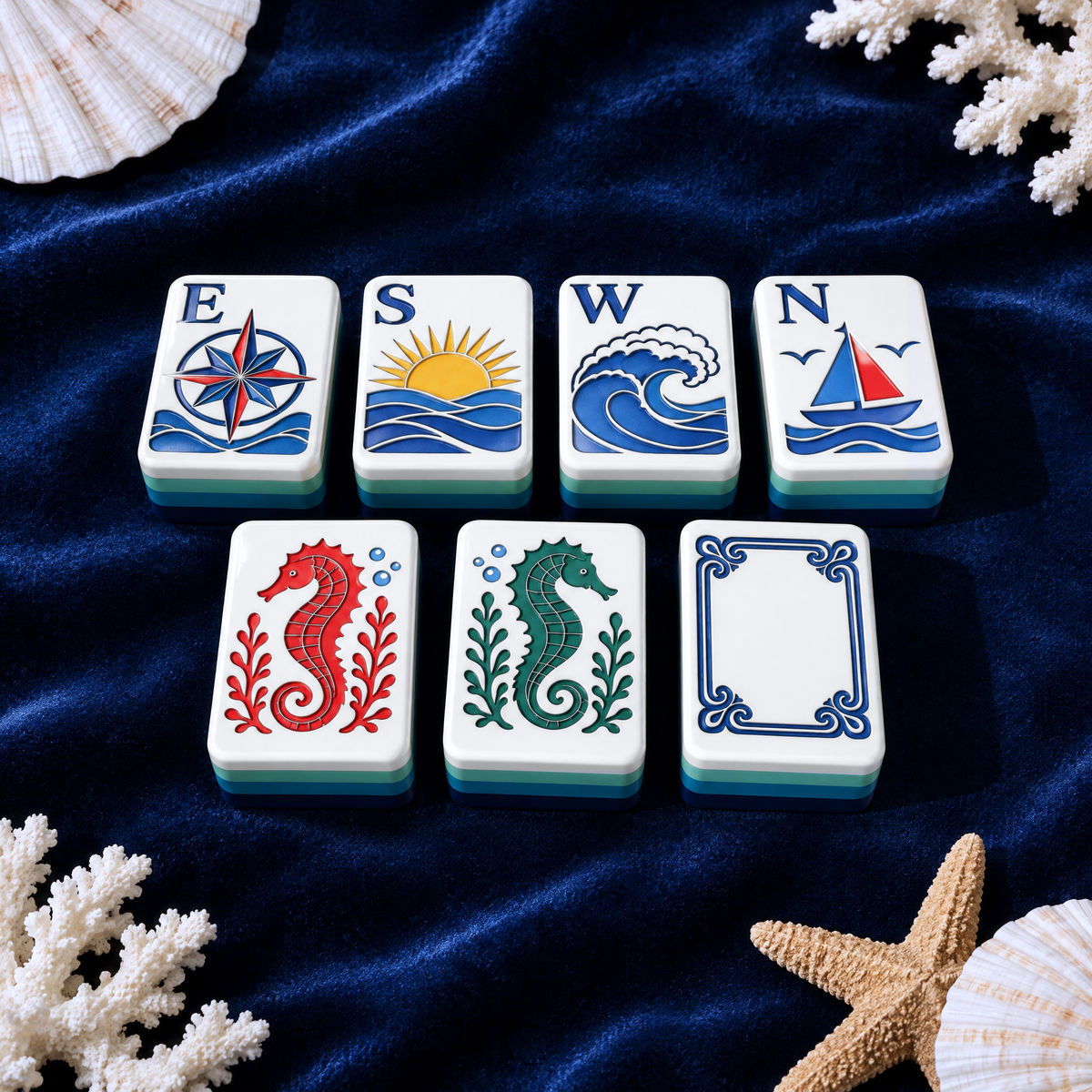
American mahjong is played by four players using a standard 152-tile set—three numbered suits (Bams, Craks, Dots 1–9 in four copies each), 16 winds, 12 dragons, 8 flowers, and 8 jokers. Before dealing, players perform the Charleston: a ritual three-pass exchange of tiles that ensures shuffled, unpredictable starting hands. Play rotates, East starts, and players draw and discard to complete a hand pattern from the current year's National Mah Jongg League card—the official playbook of legal combinations. Winning requires a complete matching hand (typically 14 tiles), and scoring is based on the pattern's complexity. A game takes 30–90 minutes; you can begin today with any standard tile set and a current card, both available from Mahstead and most retailers.
What tiles are in a standard American mahjong set?
A 160-tile set from Mahstead contains 152 playing tiles plus spares. The 152 break down as: three suits of numbered tiles (Bams, Craks, Dots), each with numbers 1–9, four copies of each = 108 tiles total. Then 16 winds (four each of North, East, West, South), 12 dragons (four each of Red, Green, White), 8 flowers (two each of Plum, Orchid, Bamboo, Chrysanthemum), and 8 jokers. Understanding the tile hierarchy is your first step to reading hands accurately. The 1 Bam displays a bird; the White dragon is also called "Soap" and acts as zero in numeric patterns.

How do you shuffle and start a game?
Before the first hand, players perform the Charleston—a scripted three-pass exchange of face-down tiles. Each player passes three tiles to their right, then three to the left, then three across. After the Charleston, the dealer (East) draws 14 tiles; the other three players (South, West, North) each draw 13. The dealer then discards one tile face-up into the center, and play begins. The Charleston explained covers the full ritual step-by-step. Never skip it; the game depends on randomized, unpredictable starting hands, and the Charleston enforces that fairness.
🀄 Shop best-selling mahjong sets →
What is the National Mah Jongg League card and why does it matter?
The card is a paper or digital reference sheet issued each spring listing every legal hand pattern for that year. Each pattern shows required tiles (e.g., three 5 Craks + jokers, two 9 Dots, a pair of Greens). American mahjong uses only hands from the current card; if a hand isn't on the card, it cannot win. This differs entirely from Chinese or Hong Kong mahjong, which use hand logic rather than a published list. How to read the mahjong card walks you through pattern notation, section headers, and common shortcuts. At the start of each season, your group must get a new card; playing last year's patterns will cost you.
What does the discard-and-draw cycle actually mean in play?
After the dealer discards one tile, South draws one from the wall (the 14-tile reserve pile arranged by players). South then discards one face-up tile. If West can use that tile to complete a pung (three identical tiles), a kong (four identical), a quint (five), or a sextet (six)—or to win the entire hand—West calls it and plays immediately. Otherwise, West draws and discards. Play moves in order: South, West, North, East. This repeats until someone wins by discarding a tile that completes another player's winning hand, or the wall empties (a draw). In American mahjong, you cannot call or expose sequences (1-2-3 of the same suit), only pungs and larger groups.

How do jokers, pairs, and the winning condition work?
Every complete hand contains exactly 14 tiles: one pair (two identical tiles) and four melds—either three, four, five, or six tiles each. Jokers substitute for any missing tile within a meld; they are never used alone as a single tile and never part of a pair. If a meld calls for three 5 Craks and you hold two 5 Craks, you can use one joker as the third. How jokers work in American mahjong covers edge cases like using jokers in pairs (you cannot) and exposed kongs with joker substitutions (you can). Winning happens when you draw or call a tile that, when added to your hand, forms a complete pattern matching one on the current card—and you call "Mahjong!" immediately.
Beginner Decision Framework | Example | Verdict |
I'm learning solo; do I need four people? | "I want to practice hand-reading." | No. Study the card, build hands face-up, watch videos. Play live once weekly. |
Which tiles go where on the rack? | "High Dragon, then Winds, then numbered suits." | Arrange by suit and rank for speed. Your preference. |
Can I expose a pung before my turn ends? | "I called it immediately; dealer discarded." | Yes. Expose it; draw one tile from the wall. |
Can I use two jokers in one meld? | "The card says three 7 Dots; I hold one." | Yes. Use two jokers. Jokers can be as many as needed per meld. |
What if the wall runs out and no one wins? | "We drew all 14 wall tiles this round." | It's a draw. East remains dealer; shuffle and play again. |
🎁 See our most-loved mahjong sets & accessories →
What common beginner mistakes should you avoid right now?
Playing off-card hands. If a pattern isn't on this year's card, you cannot win with it. Always verify on the card first. Mixing up suit names. Bams, Craks, Dots—learn these three immediately. Using jokers in the pair. The pair must be two identical non-joker tiles. Jokers substitute only for missing tiles in melds. Discarding recklessly. Track what others discard. If a player is clearly fishing for Winds, don't discard a Wind. Forgetting the Charleston. Some new players skip it to speed up; resist. The Charleston exists for randomness and fairness.
Comparison table: Your first month
Goal | Action | Why |
Master tile names | Spend 10 minutes naming every tile in your set. | Speed and confidence. Speak aloud. |
Learn card notation | Scan five patterns on the card. Write them in plain English. | Card shorthand is cryptic until you decode it. |
Play one live game | Host four players for one round. Use a current card. | One game teaches more than videos. |
Join a local group | Search meetup boards, community centers, libraries. | Weekly play cements rules and strategy. |
Choose your set | See best-selling mahjong sets for durable acrylic options with free US shipping. | Acrylic tiles last; engraving adds personality. |
What equipment do you truly need to start?
A 160-tile set (152 playing tiles), the current National Mah Jongg League card, a flat surface for four players, and a way to track score (paper or an app). Optional but practical: mahjong racks with pushers to hold and slide tiles cleanly, a mat to define the playing area and protect tiles, and a bag or case for transport. A set of dice for tie-breaking exists but is rarely needed in casual play.
What to check before you buy a set
Tile size & weight. Hold them. 1-inch acrylic tiles from Mahstead are standard for home play; they're durable and easy to shuffle.
Joker count. A 160-tile set has 152 playing tiles (8 jokers included) plus spare tiles; this is correct. Never buy a set claiming fewer than 8 jokers or unclear spare tile counts.
Tile clarity. Can you read suit symbols and numbers quickly in low light? Print isn't always centered; check photos before checkout.
Included accessories. Some sets ship with racks or a mat; Mahstead's best-selling sets vary—check the product page.
Case. If you'll transport the set, verify a protective bag or case is included or available separately.
✨ Find your Mahstead set — free US shipping →
The easiest entry point is a best-selling Mahstead set—acrylic, durable, engraved clearly—paired with the current year's League card and a playgroup of three friends. Host your first game on a Friday night, don't expect perfection, and follow the rules strictly for the first two rounds. By round three, you'll know enough to play casual, confident mahjong.

FAQ
Can I play American mahjong with three people or fewer?
American mahjong is designed for four players. Three- and two-player variants exist but use modified rules and fewer tiles. Ask your local club if you need non-standard formats.
What's the difference between American, Chinese, and Hong Kong mahjong?
American uses a fixed card, no sequences (chows), jokers, and hand patterns that change yearly. Chinese and Hong Kong rely on hand logic and sequences; Hong Kong plays faster. Pick American if your friends play it locally; it's the easiest to learn from written rules.
How long does a real game take?
Typically 30–90 minutes for four rounds (each player deals once). Casual play with stops for strategy runs longer. Competitive league play is faster.
Do I need to memorize the card?
No. Keep the card visible during play. Beginners should refer to it constantly. After six months of weekly play, patterns start to stick.
Where do I find other players in my area?
Search meetup boards, community centers, public libraries, synagogues, and country clubs for mahjong groups. Ask in person or post a wanted ad online. Many cities have weekly casual games open to beginners.
Can I play American mahjong online?
Yes. Online platforms exist, though no official digital League standard dominates the market yet. Start with in-person play to build habits and confidence.


View More
View More
View More
