Mahjong Jokers Explained: How to Use Jokers in American Mahjong
Last updated: Oct 06, 2026
Last updated: October 2026
Jokers are the tiles that make American Mahjong different from every other version of the game. There are only eight of them in a set, and knowing exactly when you can use one, when you can swap for one and when you have to let one go is what turns a beginner into a confident player. This guide covers every Joker rule you need, with simple examples and a few strategy tips.
Quick answer
An American Mahjong set has 8 Jokers. A Joker can stand in for any tile in a group of three or more identical tiles (a pung, kong, quint or sextet). It can never be used as a single tile or in a pair, it cannot be passed in the Charleston, and once a Joker is discarded it is dead: nobody can claim it. On your turn you can swap the real tile for a Joker sitting in any player's exposed group, and a winning hand with no Jokers at all is usually paid double.
Where you can use a Joker
Every hand on the card is built from groups. A Joker can replace any tile in a group of three or more matching tiles:
Pung (3 of a kind): for example 5 Dot, 5 Dot, Joker.
Kong (4 of a kind): for example North, Joker, Joker, North.
Quint (5 of a kind): a set only has four of each suit, Wind and Dragon tile, so a quint of those always needs at least one Joker.
Sextet (6 of a kind), when the card includes one.
A group can be made of mostly Jokers, or even all Jokers, as long as it is a group of three or more and you can name the tile it represents.
Where you cannot use a Joker
Single tiles. Any tile that stands alone on the card, such as one of the tiles in a NEWS or a year hand, must be the real tile.
Pairs. A pair must be two real, matching tiles. That is why hands in the Singles and Pairs section of the card can never use Jokers.
The Charleston. You may not pass a Joker in any part of the Charleston, including the courtesy pass. (New to passing? See the Charleston explained.)
A discarded Joker. Once it hits the table, it cannot be called for an exposure or for Mahjong.
Joker rules at a glance
Situation | Joker allowed? |
Pung, kong, quint or sextet | Yes |
Single tile (NEWS, year hands) | No |
Pair | No |
Singles and Pairs hands | No |
Passing in the Charleston | No |
Claiming a discarded Joker | No, it is dead |
Swapping for an exposed Joker on your turn | Yes |
How to swap for a Joker (the Joker exchange)
When a player exposes a group that contains a Joker, that Joker is up for grabs. If you hold the real tile the Joker represents, you can trade it in.
Wait for your turn. You can only exchange during your own turn.
Bring in your tile first. Draw from the wall, or claim a discard and finish your exposure. You must have taken your tile for the turn before you redeem a Joker.
Place the real tile and take the Joker. Put the matching tile into the exposed group and pick up the Joker. If the group belongs to another player, say what you are doing so the table can follow.
Keep going if you can. You may exchange more than one Joker in the same turn, from any exposure, including your own.
Discard to end your turn as usual.
The player whose Joker you take cannot refuse the swap. Jokers still hidden on someone's rack can never be taken, only Jokers in exposed groups.
Example: your opponent has exposed 7 Bam, 7 Bam, Joker. You draw a 7 Bam from the wall. Before you discard, you place your 7 Bam in their group and take the Joker, which can now complete a pung or kong in your own hand.
Discarding a Joker
A discarded Joker is dead: no one can call it, claim it or use it to declare Mahjong. When you throw one, most groups say the name of the previous discard ("same") or simply "Joker". Because nobody can use it, a Joker is technically the safest tile you can discard, but it is also the most valuable tile in your hand, so it is usually a last resort.
Jokerless hands
If you declare Mahjong with a hand that contains no Jokers at all, announce "jokerless". Under the National Mah Jongg League rules a jokerless win is paid double. Two exceptions:
Singles and Pairs hands are always jokerless by design, so they do not get the bonus.
Hands with a quint (of a suit, Wind or Dragon tile) cannot be jokerless, because a set has only four of each.
Many groups add house rules on top, such as paying the jokerless bonus differently, so agree on them before the first game.
Joker strategy for beginners
Hold on to your Jokers. Two or three Jokers can carry a hand that would otherwise be out of reach.
Expose with care. Every Joker you put in an exposed group is a Joker someone else may swap out. If you can, expose groups with real tiles and keep Jokers on your rack.
Watch the table. Before you discard a tile, check whether it matches a Joker in someone's exposure. If it does, you may want to keep it and swap on your next turn.
Count what is gone. If three of the four 9 Craks have been discarded, a 9 Crak pung will need Jokers. Plan your hand around tiles that are still live.
Go for jokerless when it is close. If your hand is nearly complete with real tiles, the double payout can be worth waiting one more turn.
What Jokers look like
Jokers are easy to spot because each set gives them its own artwork, and many sets also print the word JOKER on the tile. In our Christmas sets they are part of the theme: the Holiday Red set uses Nutcracker Jokers on ruby-red backed tiles.
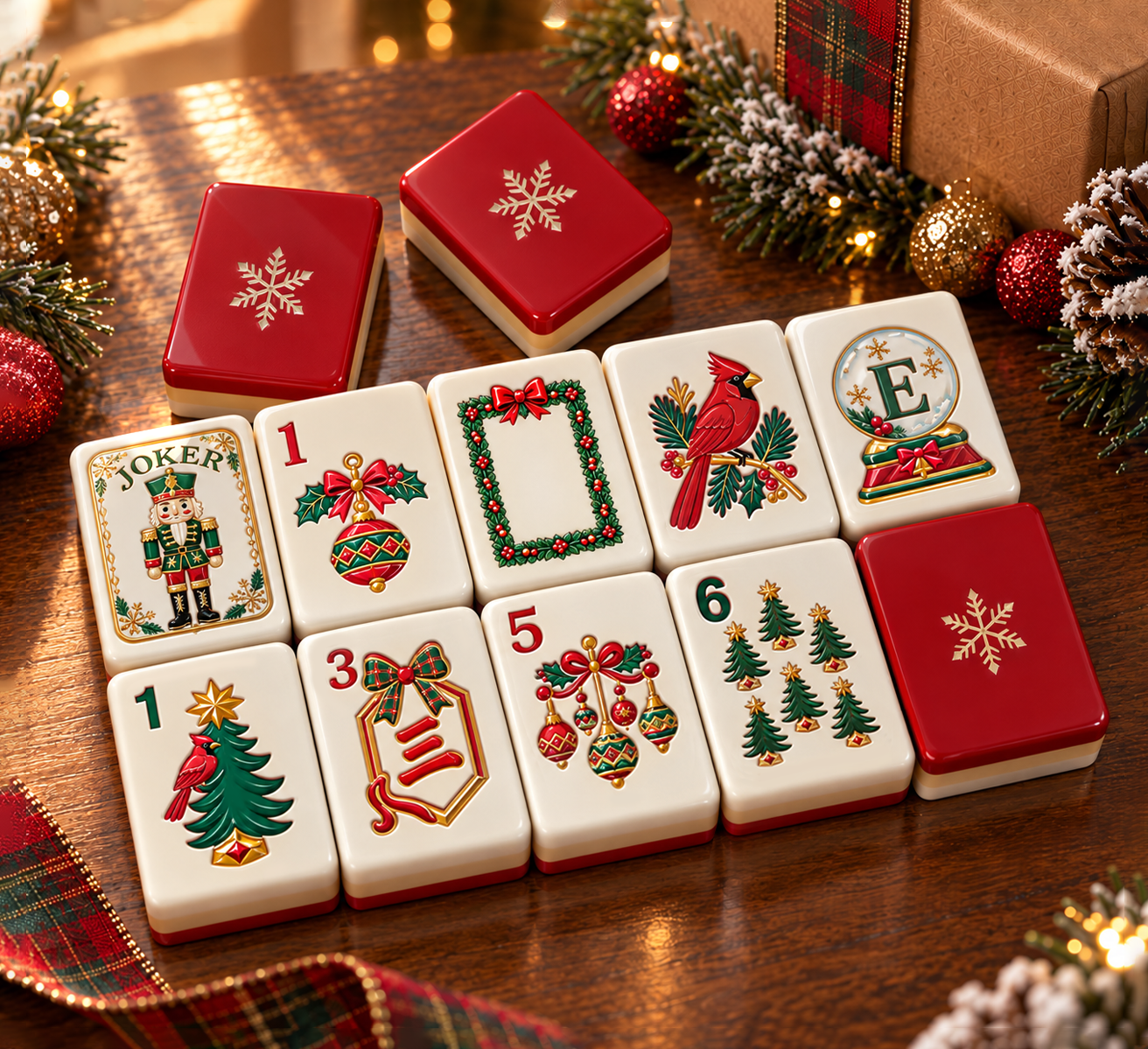 | Holiday Red Christmas Mahjong Set $289.99 |
Jokers do not even have to match each other. The White Christmas Sisters set has two Joker designs, four tiles each, showing a pair of performers in blue dresses with feather fans. Both count as Jokers in exactly the same way.
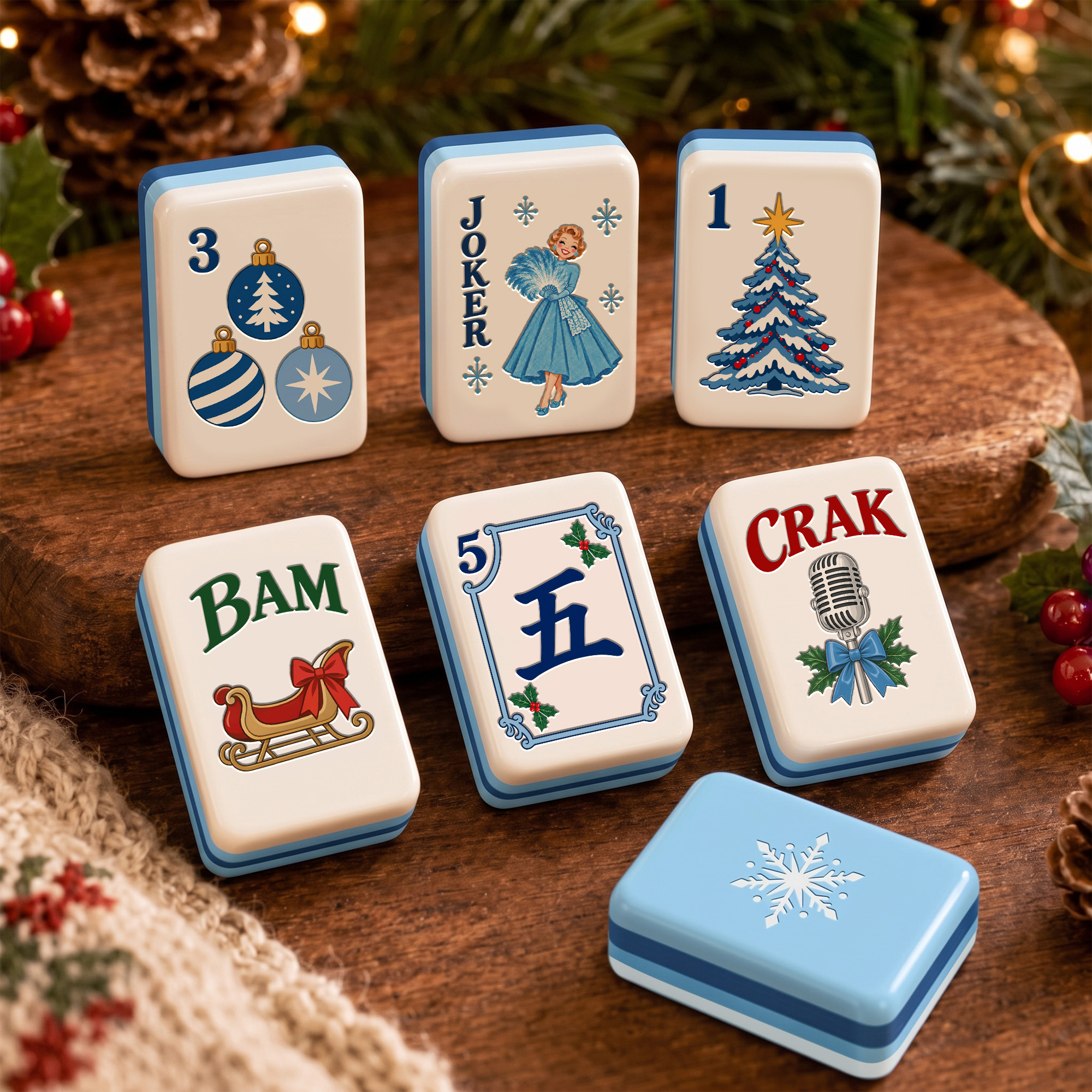 | White Christmas Sisters Mahjong Set $289.99 |
Whatever set you play with, check that it includes all eight Jokers. Chinese and Hong Kong sets do not have them. See what is in an American Mahjong set for the full tile count, or shop all American Mahjong sets.
FAQ
How many Jokers are in American Mahjong?
Eight. They come with every American set, along with 144 other playing tiles, for 152 in total.
Can you use a Joker for a pair in Mahjong?
No. Jokers can only be used in groups of three or more identical tiles. Pairs and single tiles must be real tiles.
Can you pick up a discarded Joker?
No. A discarded Joker is dead and cannot be called by anyone, even to win.
When can you exchange a Joker?
Only on your own turn, after you have drawn from the wall or claimed a discard. You can swap from any exposed group, including your own, and you can make more than one exchange in a turn.
Can you pass Jokers in the Charleston?
No. Jokers may not be passed at any point in the Charleston.
Do Jokers count in Singles and Pairs hands?
No. Those hands are made only of single tiles and pairs, so Jokers cannot be used.
Ready to play? Start with how to play American Mahjong, then add racks with pushers and a mahjong mat for your table.


View More
View More
View More
Copyright © 2026 Mahstead. All Rights Reserved | (361) 264-4881
