How to Read a Mahjong Card: A Beginner's Guide to the NMJL Card
Last updated: Oct 07, 2026
Last updated: October 2026
The card is the rulebook of American Mahjong. Every winning hand you can make is printed on it, and until you can read it, the game feels like a code. The good news: the card uses only a handful of symbols and rules. Once you know what the colors, letters, numbers and the little X and C mean, you can read any hand on any year's card.
Quick answer
Each line on the card is one winning hand of 14 tiles. Groups of tiles are separated by spaces. Colors show suits: one color means one suit, two colors mean two different suits, three colors mean all three suits. F is a Flower, D is a Dragon, N, E, W, S are the Winds and 0 is the White Dragon. The X or C after a hand tells you whether it can be exposed (X) or must stay concealed (C), and the number after that is what the hand pays.
What the card is and where it comes from
American Mahjong is played from a card published by the National Mah Jongg League. A new card comes out every spring, usually in April, and most groups switch to it right away, so the hands change every year. The card is sold separately from tile sets, so order the current one before your first game. A large-print version is also available and is easier to read across the table.
How the card is organized
Hands are grouped into sections, each with a theme. The exact sections change a little each year, but you will usually see:
Year hands, built from the digits of the current year.
2468, using only even numbers.
Any Like Numbers, the same number in different suits.
Quints, hands with groups of five identical tiles (which always need Jokers).
Consecutive Run, numbers in a row, such as 1-2-3 or 5-6-7.
13579, using only odd numbers.
Winds and Dragons.
369, using only the numbers 3, 6 and 9.
Singles and Pairs, hands made only of single tiles and pairs.
Reading one hand, left to right
Every hand adds up to exactly 14 tiles. Read it in groups, the way the card spaces them:
One character (for example 5) is a single tile.
Two (55) is a pair.
Three (555) is a pung.
Four (5555) is a kong.
Five (55555) is a quint.
To the right of the hand you will see a small note, such as "Any 1 Suit", "Any 3 Suits", "These Nos. Only" or "Any Like Nos.". Read it every time: it tells you which suits and numbers are allowed and often changes what the colors mean.
The color rule
Colors on the card do not stand for a particular suit. Green does not mean Bams and red does not mean Craks. Colors only tell you how many different suits the hand uses:
On the card | What it means |
Everything in one color | All suit tiles come from one suit of your choice |
Two colors | Two different suits, one for each color |
Three colors | All three suits: Dots, Bams and Craks |
So if a hand shows one group in blue and one in red, those two groups must be in different suits, but you choose which suits.
Letters, zeros and Dragons
Symbol | Tile |
F | Flower (any Flower tile counts) |
N, E, W, S | North, East, West and South Winds |
D | A Dragon |
0 (zero) | The White Dragon, nicknamed Soap |
Dragons follow the colors too. Each Dragon belongs to a suit: Red with Craks, Green with Bams and White with Dots. A D printed in the same color as a group of numbers is the Dragon that matches that suit. A D in a different color is the Dragon of another suit. Zeros are always White Dragons, which is why year hands like 2026 use White Dragons for the 0.
X, C and the value
X means the hand may be exposed: you can call discards to complete pungs, kongs and quints and put them face up on your rack.
C means the hand must stay concealed. You can only call a discard for the very last tile that completes your Mahjong.
The number is what the hand pays. Most hands are worth 25 to 50, and the harder hands, such as many concealed and Singles and Pairs hands, are worth more.
A hand with no Jokers at all usually pays double. See our guide to mahjong Jokers for when Jokers can and cannot be used. For who pays what when a hand wins, see American mahjong scoring.
A worked example
Here is a made-up hand written in the card's style (it is not a hand from this year's card):
FF 222244446666 Any 3 Suits X 25
FF: a pair of Flowers.
2222, 4444, 6666: three kongs in three colors, so each kong comes from a different suit. For example 2 Dots, 4 Bams and 6 Craks.
Count: 2 + 4 + 4 + 4 = 14 tiles.
X 25: you may expose the kongs, and the hand pays 25.
Jokers: allowed in the kongs, never in the pair of Flowers.
How to use the card during a game
After the deal, sort your tiles by suit and look for the two or three sections that fit what you hold.
Use the Charleston to pass tiles that do not fit any of those hands. (New to passing? Read the Charleston explained.)
Narrow it down to one hand by the middle of the game, and stay flexible until then.
Check the X or C before you call a discard. Exposing tiles locks you in and shows the table what you are building.
Watch other players' exposures and compare them with the card to guess their hands.
Common beginner mistakes
Thinking a color means a specific suit.
Forgetting that zero is the White Dragon.
Calling a discard for a concealed (C) hand.
Using a Joker in a pair or a single.
Playing from last year's card when the group has switched to the new one.
Practice with a set you love
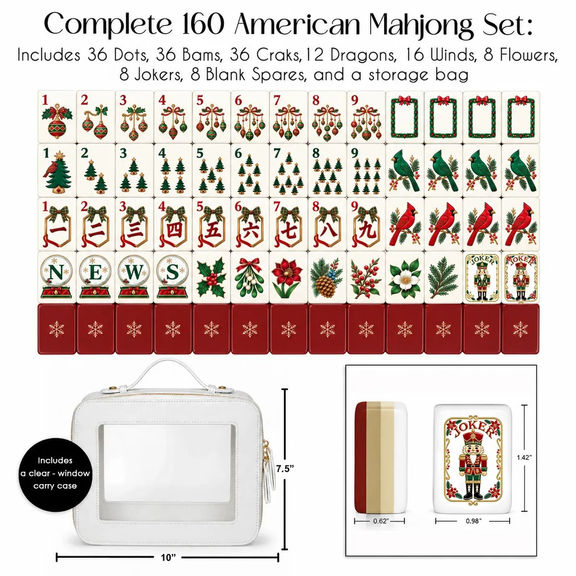
The fastest way to learn the card is to lay out a few hands with real tiles. A set with clear, easy-to-read tiles helps, and ours are engraved, so the numbers and symbols stay sharp. Our best seller:
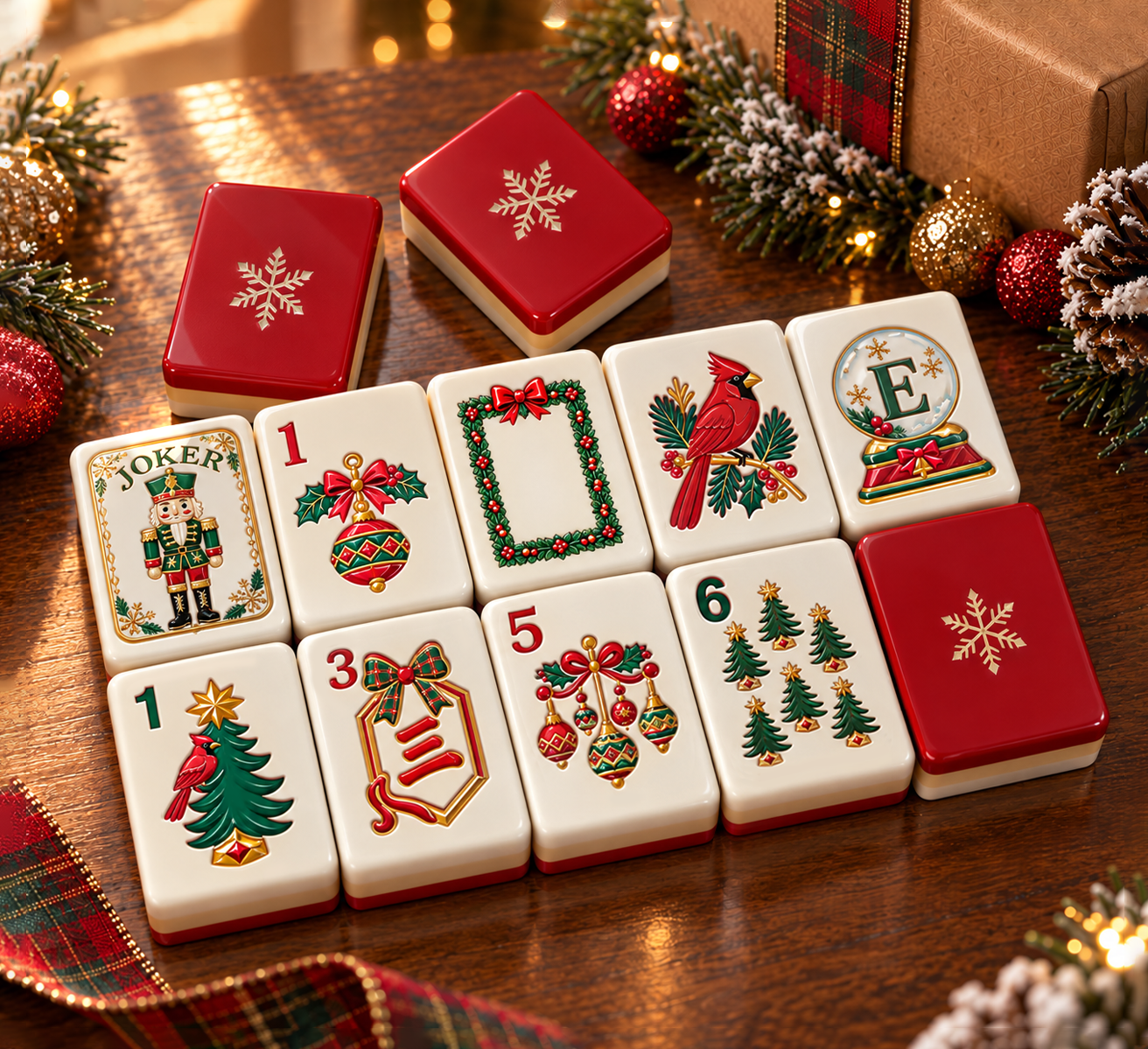 | Holiday Red Christmas Mahjong Set $289.99 |
Or choose vintage Santa artwork with Nutcracker Jokers:
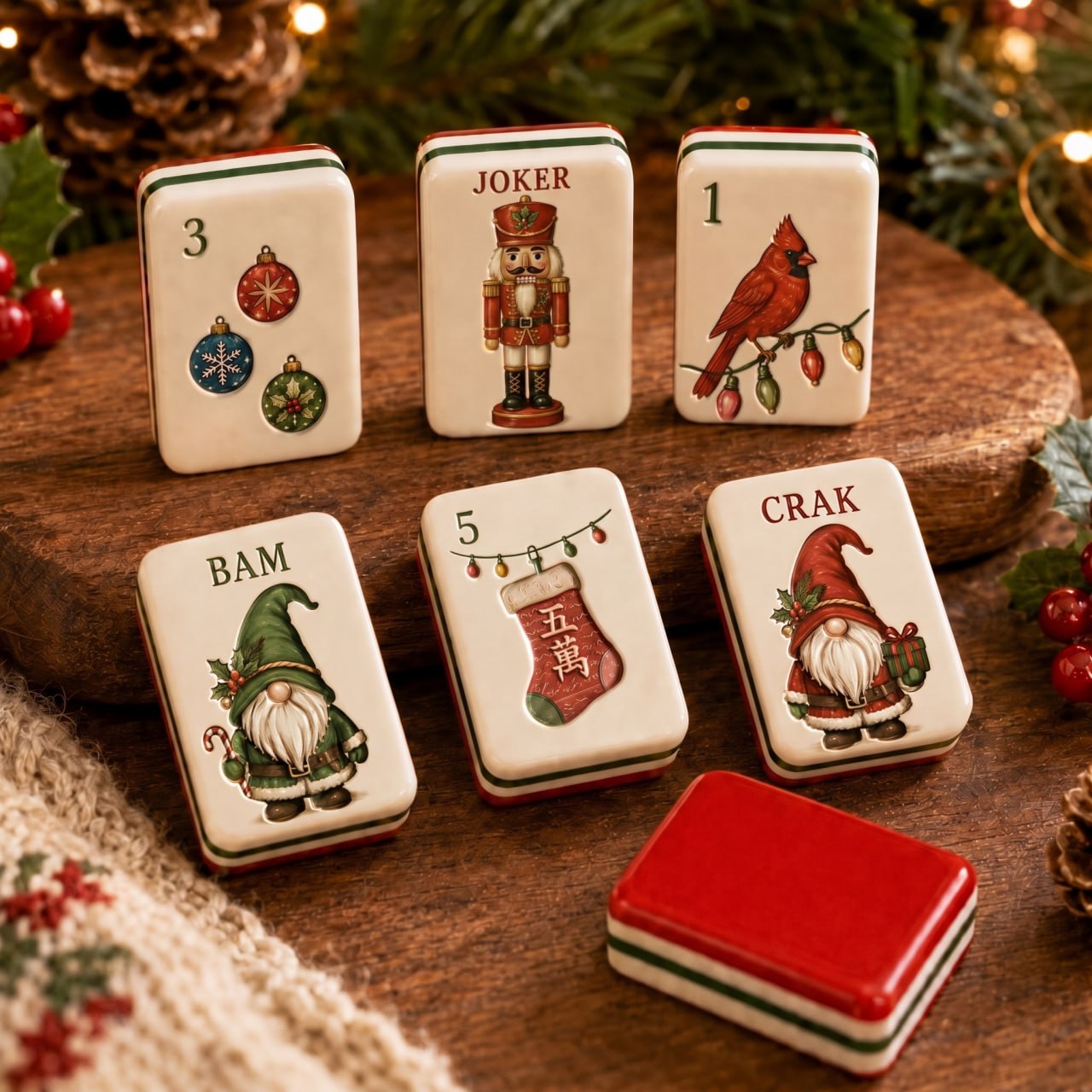 | Classic Santa Christmas Mahjong Set $289.99 |
See every design in our Christmas mahjong sets, or start from the basics with how to play American mahjong and what is in an American mahjong set.
FAQ
What do the colors on the mahjong card mean?
They show how many suits a hand uses. One color is one suit, two colors are two different suits and three colors are all three suits. A color never stands for a particular suit.
What does 0 mean on the mahjong card?
Zero is the White Dragon, also called Soap.
What do X and C mean?
X means the hand can be exposed. C means it must be concealed until you call the final tile for Mahjong.
How often does the card change?
Every year. The National Mah Jongg League releases a new card each spring.
Is the card included with a mahjong set?
No. It is sold separately by the League, so order it on its own.
How many tiles are in a hand on the card?
Every hand on the card is exactly 14 tiles.


View More
View More
View More
Copyright © 2026 Mahstead. All Rights Reserved | (361) 264-4881
