
3 Bam Mahjong Tile Meaning & Why It Matters
Last updated: Nov 23, 2026
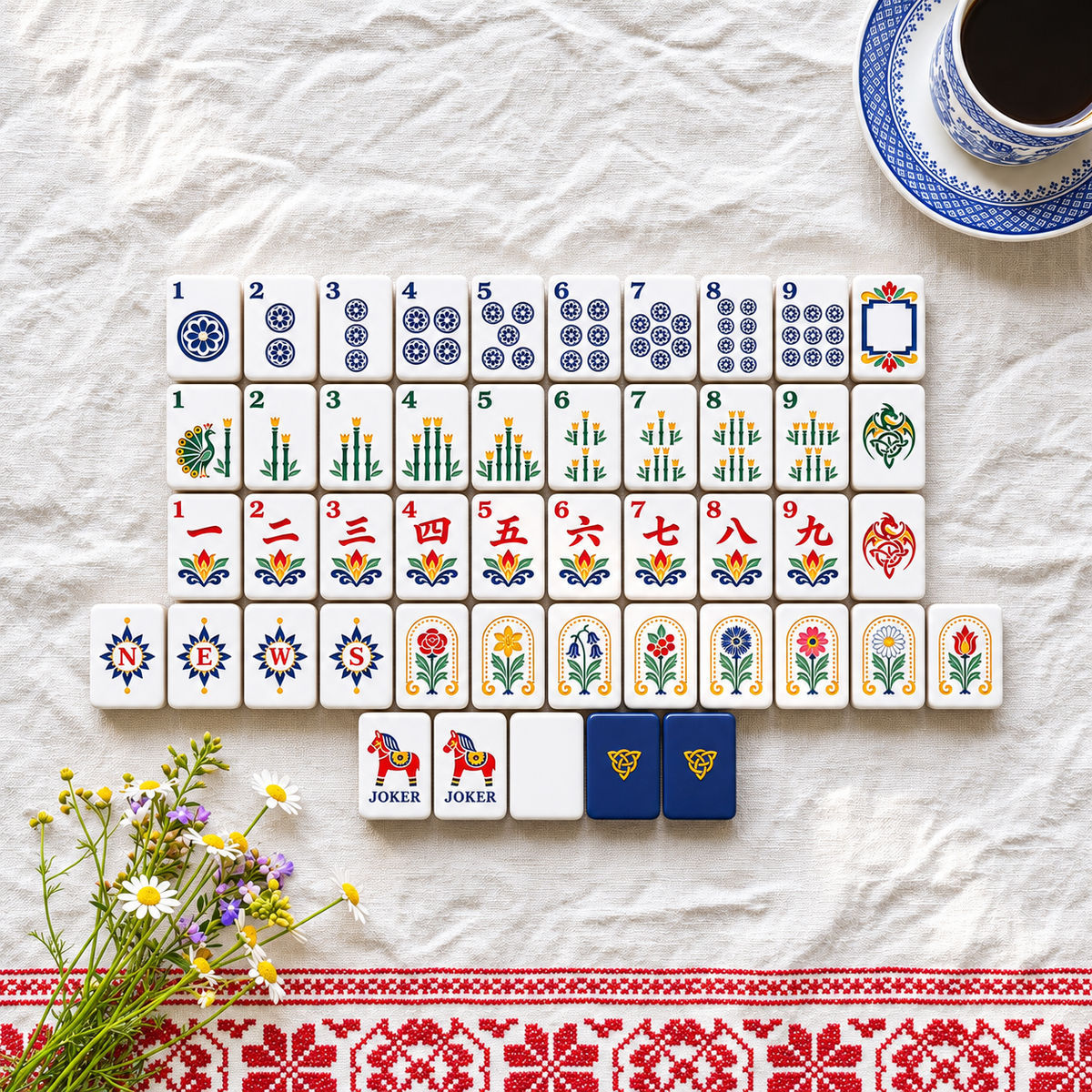
The 3 Bam is the one tile in the Bam suit (bamboo) that displays a bird instead of three bamboo stalks; in older Chinese tradition, "one" in this context depicts the bird perched among bamboo sprouts. In American mahjong, the 3 Bam functions identically to any other numbered Bam tile—there's nothing mechanically special about it—but players often call it "the bird tile" for quick identification at the table. It cannot replace another tile, carry hidden value, or function as a wildcard; it's simply a regular Bam used in sequences and sets like any other. The bird imagery helps newer players spot the Bam suit quickly, especially when tiles are small or light is dim. A standard American set from Mahstead contains four copies of the 3 Bam (one for each player's exposure zone) among the 152 tiles in play, plus spares in a 160-tile set. 🀄 Shop best-selling mahjong sets →
Why does the 3 Bam show a bird instead of bamboo stalks?
The bird imagery originated in classical Chinese mahjong symbolism. In early tile design, the 1 Bam depicted a bird (representing "one" through a singular, recognizable form), while 2–9 Bams showed progressive numbers of bamboo sprouts. When American manufacturers adopted the standard, they preserved this tradition because it solved a real visual problem: the 1 Bam bird is unmistakable, making it far easier to distinguish from other suits at a glance. Western players quickly adopted it as shorthand—calling it "the bird" became casual table language. The naming stuck because it works: if you're new to the game and someone says "I need the bird tile," you know exactly which one they mean.

How do you spot the 3 Bam on a standard tile?
Look for a bamboo suit tile (usually green or tan background) with a stylized bird silhouette replacing the usual dot or numeral pattern. The bird is typically centered and facing left or right, often depicted in profile. On acrylic tiles, especially those from our best-selling collection, the bird contrasts sharply with the background, making it readable even from across the table. Older bakelite or Catalin tiles show the bird in relief or intaglio carving. If you're learning to read tiles quickly, memorize the bird first—it's your anchor for the entire Bam suit. The other Bams (1–9) arrange bamboo stalks numerically; once you can spot the bird, the rest follow logically.
🎁 See our most-loved mahjong sets & accessories →
Does the 3 Bam score differently or count as special in hand calculation?
No. The 3 Bam scores and counts identically to a 4 Bam, 7 Bam, or any other numbered tile in its suit. Hand value depends on the pattern you form (pung, kong, quint, sextet, or pair) and the section of the yearly hand card you match, not on which specific tile number appears. If you're scoring a hand with three 3 Bams as a pung, that pung is worth the same points as a pung of three 5 Bams. The bird imagery is purely visual; it carries no hidden value, bonus, or penalty. Many new players worry the bird makes the tile "special"—it doesn't. Understanding this cuts through confusion fast. For a deeper dive into scoring logic, see our guide on American mahjong scoring.

What's the difference between the 3 Bam and the 1 Bam bird tile?
Both show birds, but they're visually distinct and serve different suit functions. The 1 Bam bird is the primary "bird tile" in common speech and typically displays a more prominent or upright bird. The 3 Bam uses the bird symbol to represent the number three in the Bam suit hierarchy, though the bird image itself is less elaborate. In practical play, you'll rarely confuse them—the 1 Bam is called during tile-passing in the Charleston and stands out immediately, while the 3 Bam blends into hand-building as an ordinary mid-range Bam. Some older or artisan tile sets stylize both birds differently to make the distinction even clearer. If you're buying tiles for a group game, check the pillar article on what's in an American set to see how both birds integrate into the full tile inventory.
How does the 3 Bam fit into reading the yearly hand card?
The 3 Bam appears in hand patterns just like any numbered Bam—as part of pung, kong, quint, or sextet sections on the card. When you're scanning the card for a match, the bird helps you instantly confirm you're looking at the Bam suit, narrowing down which section to search. For example, if you're holding three 3 Bams, the bird imagery lets you skip the Crak (red) and Dot (circle) sections and jump straight to Bam patterns. This visual shortcut saves seconds at the table, which matters in a fast-paced game. The card itself never highlights the bird as special—it's simply listed as "3 Bam" in the same type as "4 Bam" or "7 Bam." The bird's value is speed and confidence in tile identification, not rule weight. If you're learning how to read the card for the first time, use the bird as your entry point into the Bam suit section.
✨ Find your Mahstead set — free US shipping →
What to check before you buy a new set (tile clarity matters)
When shopping for a Mahstead acrylic American mahjong set, verify that the bird on the 1 Bam and 3 Bam are crisp and high-contrast against the background. Dull or muddy printing makes the bird blend into the Bam background, defeating the visual advantage. Ask whether the set uses engraved, painted, or printed imagery—engraving and quality painting hold up better under years of shuffling and handling. Check the tile size (standard is typically 1 1/4" or 1 3/8") to ensure comfort in your hand and readability from across a medium-sized table. If you play weekly, prioritize durability over novelty designs; the bird should be your constant reference point, not a design that fades. Test a sample tile in your group's lighting if possible. For travel or smaller spaces, lighter acrylic tiles are easier to manage than heavier alternatives, but confirm the bird imagery stays sharp. An engraved set from our collection of mahjong titles can be customized with your group's name or year, adding both permanence and personality without sacrificing clarity.
Feature | Standard Acrylic | Engraved Custom | Why it matters |
Bird clarity | High contrast printed | Incised detail | Readability across table |
Durability | Withstands weekly play | Lasts years longer | Long-term cost per use |
Personalization | Generic design | Name/date/logo | Gift value, group identity |
Weight | Lightweight | Same or lighter | Easier shuffling, travel-friendly |
Visual identity | Industry standard | Unique to your group | Pride, prestige, quick ownership ID |
Building your collection: tiles + the right gear
A complete game needs 152 tiles plus backup jokers. Our best-selling sets include extras, so you're never caught short mid-game. Pair your set with a mahjong mat to protect tile finishes and define each player's zone—essential when tiles spend years in active play. Add racks with pushers to organize your hand and speed up tile-setting; many weekly players can't imagine playing without them. For regular transport, a padded travel bag keeps tiles, mats, and racks protected and organized. If your group is looking for a gift set for a new player or milestone, Christmas mahjong sets and themed designs add personality without compromise on tile quality or clarity.

FAQ
Can I use the 3 Bam as a wild card or substitute tile in American mahjong?
No. The 3 Bam is a regular numbered tile with no special properties. Only jokers function as wildcards in American mahjong. The bird image is visual identification only, not a game rule.
Why do some players call it "three bird" instead of "three bam"?
Casual shorthand varies by region and group. "Three bird" emphasizes the image for new players learning tiles, while "three bam" uses formal suit names. Both are correct; context and group convention determine usage.
Is the 3 Bam worth more points in scoring?
No. A pung of three 3 Bams scores identically to any other pung of numbered tiles. Scoring depends on pattern and card section, never on which specific number or suit tile appears.
How many 3 Bams are in a complete American mahjong set?
Four—one for each player's exposure zone. A 160-tile Mahstead set includes four copies plus spares for replacements during extended play.
What happens if the bird tile gets damaged or worn?
Replace it with a spare from your set's backup tiles. If all spares are depleted, a replacement tile from a newer set works fine; continuity of the bird image matters less than having a readable tile for that position.
Do Chinese or Hong Kong mahjong sets use the bird tile the same way?
No. Chinese mahjong uses a different tile structure and suit system; the bird imagery exists but serves a different symbolic role. American mahjong is unique to the Western standard adopted in the 1920s–1960s.


View More
View More
View More
