
The Second Charleston, Stopping It, and the Courtesy Pass
Last updated: Nov 18, 2026
Mahjong Rules Guide › Level 2 — Set up & the Charleston · Guide 11 of 25
The first Charleston is mandatory—every hand, everyone participates. The second Charleston is optional: any player can stop it before it begins or at any point during the passes. If it continues, tiles move left, across, and right (the reverse of the first), and a final courtesy pass may happen. Understanding when you have the power to stop, and what the courtesy pass does, is essential to controlling your hand before play begins.
Why a Second Charleston?
The first Charleston gives all four players one structured exchange. The second Charleston is a bonus round—a chance to fine-tune your hand after seeing what came back to you. Because it's optional, any player unhappy with their tiles after the first pass can say "Stop" or "No second," and the second Charleston never happens. If it does proceed, it moves in the opposite direction (left instead of right), which changes who receives whose discards and gives the hand one more shuffle.
The second Charleston is most common in casual games; some serious tables skip it to speed up play. Table rules may vary—ask your group before you play.
The Second Charleston: Left, Across, Right
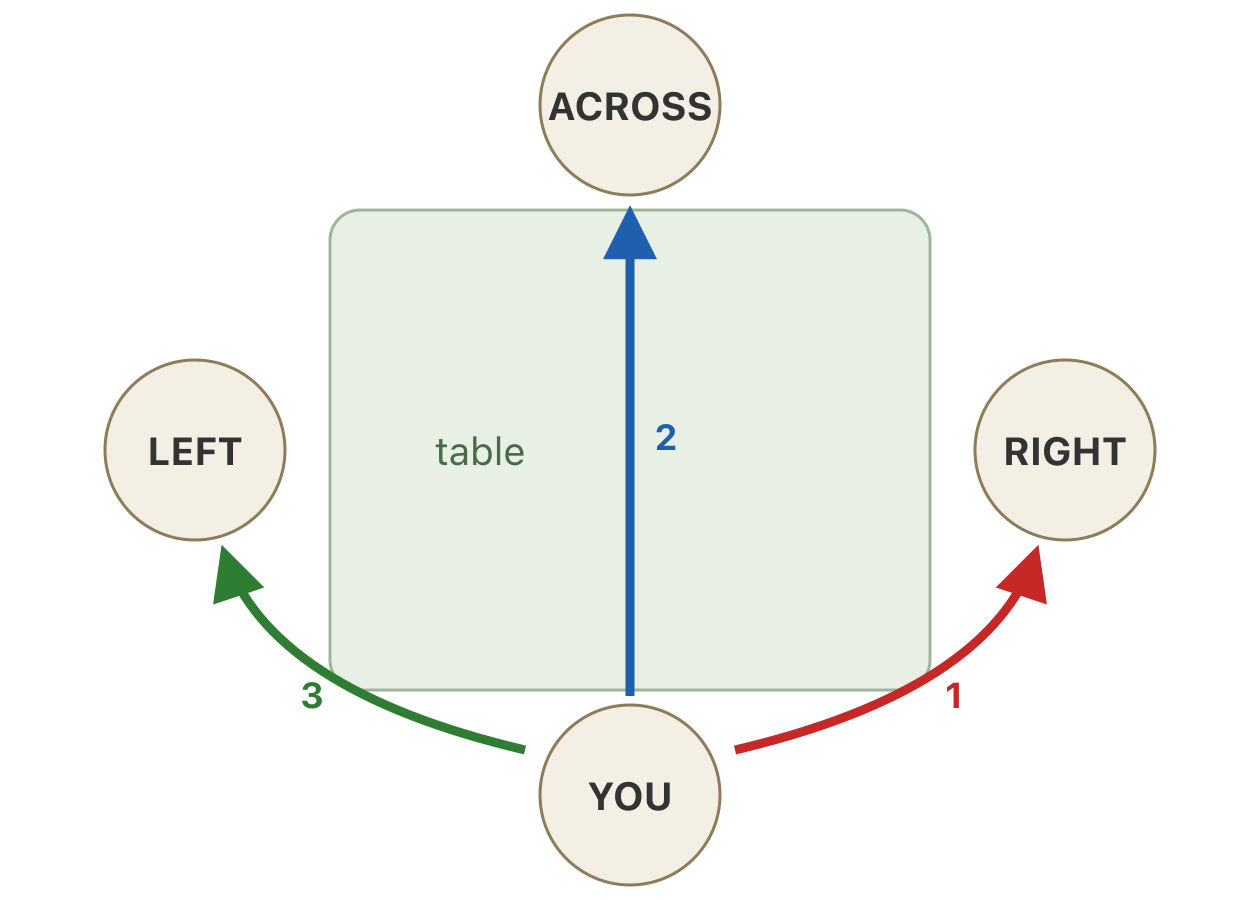
If no one stops it, the second Charleston begins immediately after the first one ends. Tiles move in this order:
Pass LEFT: Each player passes 3 tiles to the player on their left (opposite direction of the first pass right).
Pass ACROSS: Each player passes 3 tiles straight across the table.
Pass RIGHT: Each player passes 3 tiles to the player on their right (opposite direction of the first pass left).
As in the first Charleston, the third pass (right) may be blind if both players agree—you don't look at the tiles before passing.
After the second Charleston completes, your hand has been reshuffled by two full rounds of passing. Players often use this round to correct mistakes from the first pass or to respond to the tiles they received. For example, if the first Charleston gave you many high numbers, you might pass low ones left to set up a different hand.
Who Can Stop the Second Charleston?
Any one of the four players can prevent the second Charleston from happening at all. The moment the first Charleston ends, before anyone touches new tiles, any player can announce "Stop" or "No second." If even one person says it, the second Charleston is cancelled and you move directly to the courtesy pass.
Once the second Charleston has started, most groups finish it; a stop is called before the first tiles move. Ask your table which rule they follow.
Stopping the second Charleston is rare in friendly games but common when time is tight or when someone is satisfied with their first result and wants to lock it in.
The Courtesy Pass
After the second Charleston (or after the first Charleston if the second was stopped), a final optional courtesy pass may occur. This is the only pass that involves choice about which tiles move. Unlike the Charlestons, where you must pass exactly 3 tiles, in the courtesy pass each player may exchange 0, 1, 2, or 3 tiles across the table only—no left or right.
Here's how it works:
One player (usually East or the player who stopped the second Charleston) speaks first: "How many?"
Each player announces 0, 1, 2, or 3 tiles they wish to pass.
All four players select their tiles, place them face-down in the center, and exchange them across simultaneously.
If you pass 2 tiles and your across partner passes 3, you receive 3 and they receive 2—the count does not have to match.
The courtesy pass is always optional. If all four players say "0" or pass no tiles, the courtesy pass ends and play begins immediately.
The courtesy pass is popular in casual games because it gives each player a moment to respond to their final hand. However, some competitive or experienced groups skip it to keep the game moving. Confirm your table's rule before play starts.
Gear for this step
Practising the second charleston, stopping it, and the courtesy pass? It's easier with the right setup — see our best-selling mahjong sets.
Step-by-Step Example
Let's walk through a complete Charleston sequence with all three phases:
After the first Charleston: You have 13 tiles (or 14 if you're East). One includes a pair of North winds, three Dot 5s, and some mixed tiles that don't look promising.
No one says "Stop": The second Charleston begins.
Second Charleston Left pass: You pass 3 tiles to your left neighbor. You decide to pass two of the Dot 5s and one low bam, hoping to clear room.
Second Charleston Across pass: You pass 3 more tiles across the table. Now your hand is getting closer to a pattern you see on the card.
Second Charleston Right pass (blind): You and your right neighbor both agree to pass blind. You set aside 3 tiles without looking at them, pass them, and receive 3 more unseen.
Courtesy pass offered: East asks, "How many?" You look at your hand and realize you now have the start of a good hand—you say "0" (pass nothing). The player across from you says "2." So you receive 2 new tiles from them. You don't pass any, but you do receive.
Ready to play: The wall is broken, play begins.
Common Mistakes
Assuming the second Charleston moves the same direction as the first: It doesn't. The second goes left, across, right. The first went right, across, left. Reversing the direction is intentional.
Forgetting that any player can stop it: You don't need East's permission. If you're unhappy with your tiles, say "Stop" before the second begins and it ends.
Confusing the courtesy pass with a required exchange: The courtesy pass is entirely optional. You can pass 0 tiles, or your across neighbor can pass 3 while you pass 0. Counts don't have to match.
Trying to stop the second Charleston during a pass that's already in motion: Call "Stop" before any tiles move, or accept that the second Charleston will complete. Once the left pass has begun, you cannot halt it mid-pass.
Passing in the wrong direction during the courtesy pass: The courtesy pass is across only. You cannot pass left or right in this phase. Some players instinctively try to pass left and create confusion.
Taking too long to decide on the courtesy pass: Each player's 0–3 count should be announced fairly quickly. Delays slow the game; decide as you look at your tiles.
Variations by Table
American mahjong rules are not one-size-fits-all. Before sitting down with a new group, confirm:
Is the second Charleston mandatory or optional?
Can a player stop it before it begins, or only between passes?
Do you do a courtesy pass, and if so, is it across only or in other directions?
Can players see the tiles during the courtesy pass announcement, or must counts be called blind?
Most casual groups play both the second Charleston and the courtesy pass to make sure everyone has a fair shot at a playable hand. Faster or more serious games may skip one or both. It's always fair to ask.
After the Passes: What's Next
Once the courtesy pass is complete (or skipped), your hand is finalized. No more exchanges happen until the next game. From this point, you move straight to building and breaking the wall, which determines who draws first and in what order. Tiles are drawn and discarded according to strict turn order, and the game begins in earnest.
If you're still learning to read the card and match your tiles to hands, keep a reliable set nearby so you can test your hand quickly during these early moments. Knowing whether you have a real Mahjong before play begins is always worth the seconds it takes.
Next Step
Now that you understand the full Charleston sequence and the courtesy pass, you're ready to move to the wall. The next guide covers how to build and break the wall using dice, which determines who draws first and sets the exact order of play. You'll learn why the wall position matters and how to count correctly so the deal stays fair.
FAQ
Can I stop the second Charleston after the left pass is complete?
In most casual games, no. Stop it before any tiles move, or let all three passes happen. Some groups allow stopping between passes; ask your table before play begins.
What if I pass 2 tiles in the courtesy pass and my across neighbor passes 3?
You receive 3 tiles and they receive 2. The counts do not have to match. Each player decides independently how many to pass (0–3) and exchanges those with the player across.
Is the courtesy pass mandatory?
No. Every player can announce "0" (pass no tiles) and the courtesy pass still happens—you just don't exchange. If all four players pass 0, the courtesy pass is complete and play begins.
Do the second Charleston passes go in the same direction as the first?
No. The first Charleston is right, across, left. The second Charleston is left, across, right—exactly reversed. This is intentional and gives your hand another shuffle.
Who decides whether to do a courtesy pass?
Any player can suggest or skip it, but table custom and agreement matter most. Ask your group at the start of the game. Most casual games include it; faster games skip it.
Can I pass left or right during the courtesy pass?
No. The courtesy pass is across only. Left and right passes happen only during the two Charlestons. Mixing up the direction is the most common courtesy pass mistake.
More in Level 2 — Set up & the Charleston
Ready to play at your own table?
Engraved 160-tile American mahjong sets, mats and racks — free shipping across the US.


View More
View More
View More
