
What to Pass in the Charleston (and What to Keep)
Last updated: Nov 18, 2026
Mahjong Rules Guide › Level 2 — Set up & the Charleston · Guide 12 of 25
The Charleston is your chance to improve your hand before any tiles are discarded. The goal is simple: pass away tiles that don't fit your hand and receive tiles that do. The real skill lies in reading your initial 14 tiles (or 13 if you are not East), spotting which numbers and suits cluster together, and deciding what can go.
Keep Jokers Always
This is the easiest rule: never pass a Joker. Jokers are wildcards that can represent any tile in any group of three or more on the card. A hand with a Joker is usually more flexible than a hand without one, and you cannot know what the player who receives your Joker might build with it. Guard your Jokers as if they were your hand.
Pass Orphan Honor Tiles First
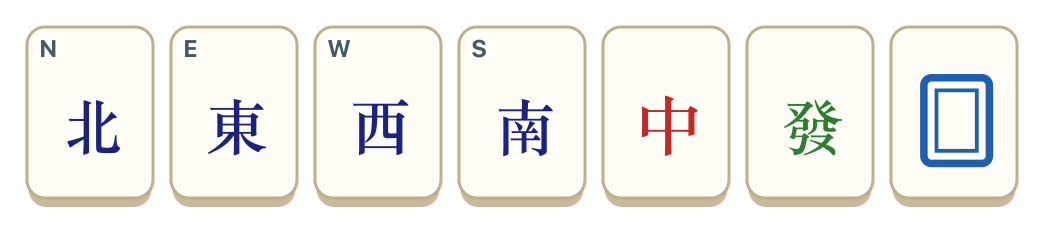
Honor tiles are the Winds (N, E, W, S) and Dragons (Red, Green, Soap). Many hands on the card use pairs or groups of these tiles, but many do not. If you hold a single Wind or Dragon that does not match any other Wind or Dragon in your hand, pass it away during the first pass (right).
Why? Honor tiles are harder to match than suit tiles. A single North wind takes up space and has no suit neighbors to combine with. If the hand you eventually build does not call for that honor tile, it becomes dead weight.
Exception: If you hold two or three of the same honor (e.g., two Reds, two Norths), keep them. They form a potential pair or pung and might be useful later.
Pass Duplicate Pairs
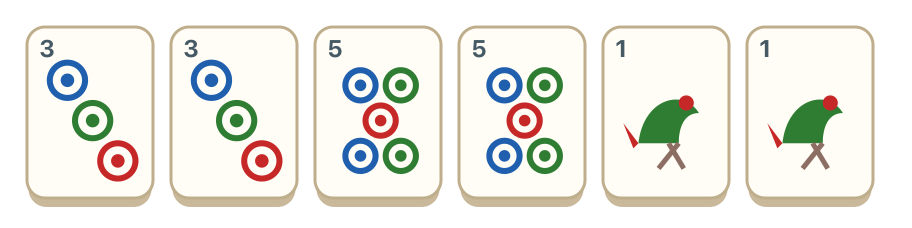
If you hold two separate pairs of tiles (for example, two 3-Dots and two 5-Dots), keep the one that might connect to other tiles in your hand and pass the pair that stands alone. Most hands on the card call for one pair; holding two pairs means one of them will likely be extra.
Keep: A pair of 4-Craks if you also hold 3-Craks and 5-Craks nearby (they might form part of a larger group).
Pass: A pair of 1-Bams if no other Bams are in your hand.
Look for Suit Runs in Your Hand (Not on the Card)
When we say "runs," we do not mean a playable group—American mahjong has no chows or sequences in play. What we mean is: look for consecutive numbers in the same suit. If you hold tiles like 4-Dots, 5-Dots, and 6-Dots, those three tiles might all be part of three separate pungs or parts of different groups on the card. That proximity is a sign those tiles belong together in your hand.
Pass tiles that break that chain. If your hand has 4-Dots, 5-Dots, 6-Dots but also a lone 9-Dots that connects to nothing, the 9-Dots is a candidate for passing.
Pass Unmatched Suit Tiles Far from Others
Every suit tile (Dots, Bams, Craks) sits on the card in different groups and patterns. During the Charleston, pass away suit tiles that are completely isolated from the rest of your suit tiles.
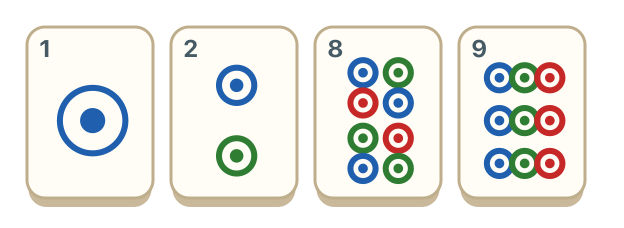
You hold: D1, D2, D8, D9, B3, B4, B5, C2, C3, plus honors and a Joker.
The Dot tiles split into two clusters: 1–2 and 8–9.
If you have to choose, keep the cluster that feels fuller or that you can see on the card more easily, and pass the other.
How to Pass: Timing Matters
The Charleston proceeds in three mandatory passes: right, across, left. Your strategy changes with each pass because you have less information as passes go on.
First Pass (to your right)
You are passing blind—you do not know what you will receive. Pass your worst three tiles: orphan honors, isolated suit tiles, and the least promising of any duplicate pairs. Be aggressive here.
Second Pass (across the table)
You have now received three tiles from your left neighbor. You can see some of your hand taking shape. Refine your passes: if the tiles you received help a certain suit or honor, pass the tiles that conflict with it. Keep your Joker and any honors that now have partners.
Third Pass (to your left)
This is your last mandatory pass. By now your hand is nearly complete. Pass only what you are sure does not fit. If you are unsure, keep it—you have only three more tiles to move, and a wrong pass here might cost you the game.
After the mandatory Charleston, you and your opponents can proceed with an optional second Charleston and courtesy pass. Passing strategy in these later rounds becomes more conservative: pass only tiles you are certain block your hand.
Gear for this step
Practising what to pass in the charleston (and what to keep)? It's easier with the right setup — see our best-selling mahjong sets.
Special Case: High Honors (Dragons and Winds)
Some hands on the card are built entirely on Winds and Dragons (NEWS and Dragon hands). If you hold multiple Winds or Dragons in your opening hand, do not automatically pass them all. Count how many you hold.
Four Winds: keep them; you might build a NEWS hand or use them in pairs.
Three of the same Wind: keep them; they form a potential pung.
Two Winds plus two Dragons: keep all four; honor hands are common.
One North, one East, one 3-Crak: pass one or both Winds as orphans.
The card layout shows which honor patterns are actually playable hands for that season. If you see multiple NEWS or Dragon sections on the card, protecting your honors is wise.
The Most Common Mistake: Passing Jokers
We cannot stress this enough: never pass a Joker during any pass. We have seen tables where a beginner passed a Joker thinking it was a blank or a tile they did not recognize. A Joker is the most valuable tile in your hand. If you hold one, it stays.
Another Common Mistake: Holding Too Many Orphans
The opposite error is keeping every tile because "it might be useful." If you hold five or six tiles that do not connect to each other—three different isolated Winds, two unmatched suit tiles, a solo Flower—your hand will be stuck. The Charleston is the only time you can shed dead weight for free. Use it.
Reading Your Hand After the Deal
You have received your initial tiles after the wall break. Before the first Charleston pass:
Count your Jokers. (Keep them all.)
Count your honors by type: how many Winds? How many Dragons?
Count your suit tiles by suit: how many Dots, Bams, Craks?
Spot any clusters or pairs.
Note any tiles that stand completely alone.
Choose your three worst tiles for the first pass.
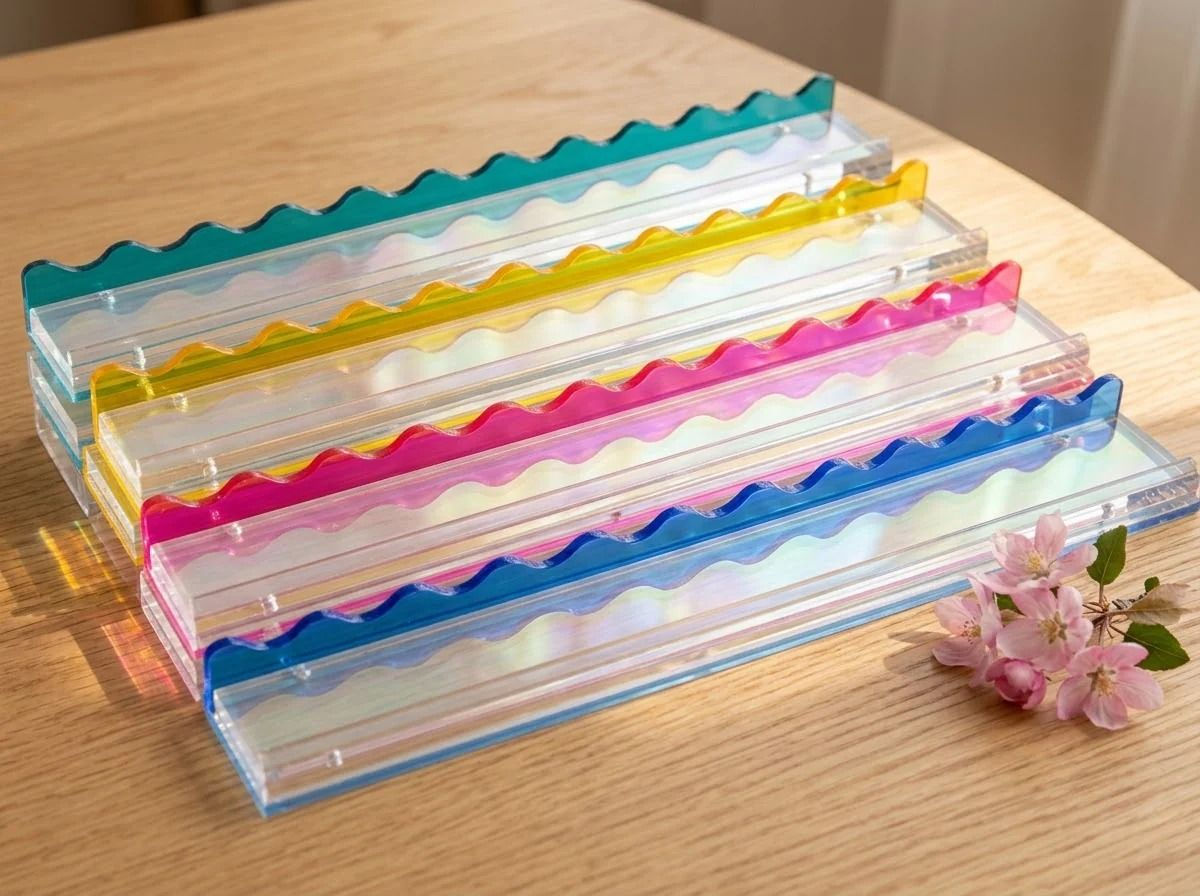
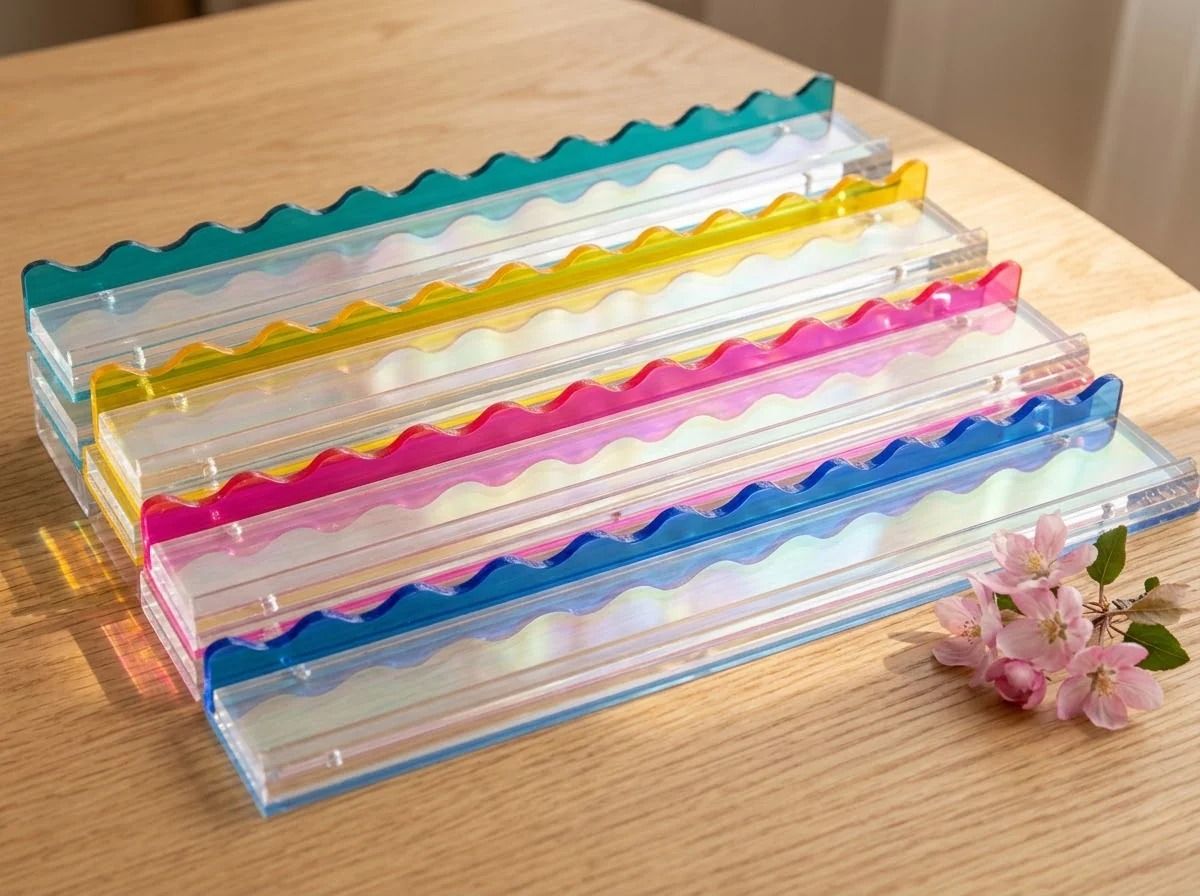
If you are using a best-selling mahjong set with a quality rack, you can organize your tiles by suit and number as you receive them, which makes this analysis much faster.
Common Mistakes
Passing a Joker: The cardinal sin. Jokers never go out.
Keeping five orphan tiles: You cannot build a hand from tiles that do not connect. Pass orphans aggressively in the first pass.
Passing all your honors because they are "low value": Many hands use honors. Count them and keep clusters.
Passing a tile in the third pass that you later need: By the third pass, be conservative. When in doubt, keep it.
Not reading the card: Before your first pass, glance at the current season's card to see which honor patterns and suit patterns are actually playable. That shapes your passing choices.
Next Step
You now understand what to pass and why. The next guide covers the second Charleston and the courtesy pass, where you have the power to stop passing or refine your hand even further. From there, you are ready to draw your first tile, organize your rack, and discard—and the real game begins.
FAQ
Should I ever pass a Joker?
No. Jokers are wildcards and the most valuable tiles in your hand. Never pass a Joker during any pass, no matter what.
What if I have two pairs in my opening hand?
Keep the pair that connects to other tiles in your hand (e.g., if you hold D3 D3 and also D4 D5, keep the D3 D3). Pass the isolated pair.
How do I know if an honor tile is "orphan"?
An honor tile is orphan if you hold only one of it and no matching Wind or Dragon nearby. For example, a single North wind with no other Winds or Dragons is orphan; two Red Dragons are not.
Should I pass based on what I think other players might build?
No. In the first pass especially, you are passing blind. Pass based only on what is weak in your hand, not on what you imagine your opponents need.
Is it okay to keep a tile because "it might fit the card"?
If you are uncertain and it is your third pass, yes—keep it. But in the first pass, be more ruthless. Pass tiles that have no obvious connection to anything else in your hand.
Can I pass a Flower tile?
Yes, Flowers are ordinary playing tiles in American mahjong and not set aside or replaced. You can pass them like any other tile, but only if they do not fit your hand and you do not hold others that match them.
More in Level 2 — Set up & the Charleston
Ready to play at your own table?
Engraved 160-tile American mahjong sets, mats and racks — free shipping across the US.


View More
View More
View More
