
Is Mahjong Similar to Gin Rummy? Key Differences Explained
Last updated: Nov 23, 2026
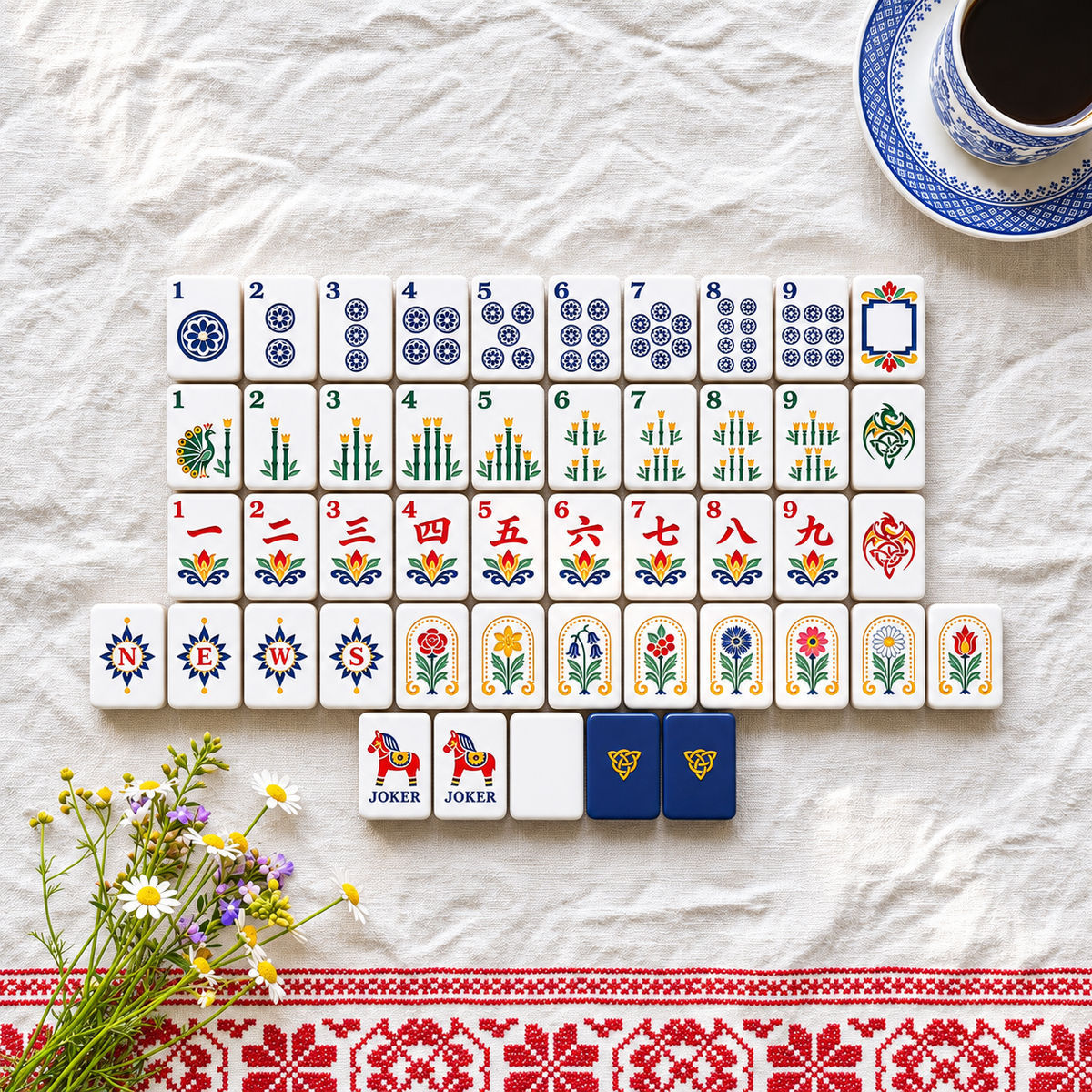
Gin rummy and mahjong both reward pattern recognition and tile management, but they diverge sharply in structure. Gin rummy uses a standard 52-card deck; American mahjong uses 152 tiles across suits, winds, and dragons, plus 8 jokers. Gin rummy allows any sequence (1-2-3, 4-5-6) and any three-of-a-kind; American mahjong requires hands from the current year's National Mah Jongg League card, meaning only specific pre-published patterns win—no improvisation. Gin rummy ends when someone knocks or reaches 500 points; a mahjong round ends when one player melds all tiles to match a card pattern. Jokers in mahjong act as wildcards in exposed melds only; they're central to strategy in ways gin rummy doesn't require. If you love gin rummy's tactical depth, mahjong's rigid hand structure and tile-draw rhythm may feel restrictive at first, but the ritual—including the Charleston tile-pass at game start—creates a social experience gin rummy lacks. Learn mahjong fundamentals at our beginners guide. --- 🀄 Shop best-selling mahjong sets →
How does the hand-building work differently?
In gin rummy, you draw one card per turn and discard one, building any legal sequence or set of the same rank. Mahjong requires drawing one tile and discarding one, but only specific hand patterns printed on the annual card win. You cannot invent a hand; you must match the card exactly. This removes improvisation but adds puzzle-solving appeal—you're reading a pattern library, not inventing. American mahjong hands are always 14 tiles (13 in hand, 1 drawn to win); gin rummy hands are 10 cards. The hand card—updated yearly—is mahjong's anchor and the reason experienced players keep a laminated copy at the table.

Why does mahjong need a tile-passing ritual?
The Charleston happens before play starts: three rounds of passing tiles left, right, and across the table. This randomizes tile distribution fairly and builds group energy. Gin rummy has no equivalent—you simply deal. The Charleston transforms mahjong from a solitary draw-discard game into a collective moment. Players learn opponent tendencies during the pass (who holds tiles longer, who "steals" before passing). Newcomers often skip this or rush it; experienced groups know the ritual slows the game intentionally, building anticipation and conversation. Our beginner guide walks you through the Charleston step-by-step.
🎁 See our most-loved mahjong sets & accessories →
What role do jokers play?
In gin rummy, there are no jokers; you work with 52 fixed cards. In American mahjong, 8 jokers are shuffled into the 152-tile set and act as wildcards—but only in exposed (shown) melds. You can never use a joker as a single tile or as a pair to win. This constraint means jokers amplify risk: playing a joker exposes your strategy to the table, yet holding them uses precious hand space. A gin rummy player used to fixed, predictable draws must adjust to mahjong's joker variability. Joker placement and strategy are covered in depth in our jokers guide.
Can you play mahjong with any hand you want?
No. This is the defining rule shift. Gin rummy rewards creative card combinations within basic rules (straights, sets). Mahjong allows only hands on the current year's National Mah Jongg League card. If your tiles spell a pattern not on the card, you cannot win, even if the pattern looks perfect. This feels restrictive to new players but actually deepens strategy: expert players memorize patterns, spot "impossible" hands early, and adjust their discard pile accordingly. The card changes every spring, so players must relearn the meta yearly. Gin rummy players often struggle here because they expect flexibility.

Which game has a steeper learning curve?
Both require 4–6 weeks of regular play to feel natural. Gin rummy's rules are simpler (draw, meld, knock), but mahjong's hand card and tile notation add cognitive load upfront. Mahjong's payoff: once the card patterns click, strategy becomes richer—you're reading probabilities against a fixed library of 70+ hand shapes, not just counting cards. Gin rummy's payoff: faster round times and lower setup friction. If you enjoy studying a reference chart and memorizing patterns, mahjong rewards that. If you prefer seat-of-your-pants card play, gin rummy suits you better. Neither is objectively harder; they demand different brain muscles.
Comparison: Gin Rummy vs. American Mahjong
Aspect | Gin Rummy | American Mahjong |
Tiles/Cards | 52 cards, no jokers | 152 tiles + 8 jokers |
Hand Flexibility | Any legal sequence or set | Only patterns on current-year card |
Winning Requirement | Knock or reach 500 points | Meld all 14 tiles in a card pattern |
Setup Ritual | Deal two hands | Charleston (three rounds of passing) |
Jokers | None | 8 (wildcards in exposed melds only) |
Round Length | 15–30 minutes | 20–45 minutes |
Learning Curve | 2–3 weeks | 4–6 weeks |
Pattern Inventory | Infinite (within rules) | ~70–80 per year (fixed) |
Social Element | Moderate | High (Charleston, multi-round play) |
What to check before you buy a mahjong set
If you're coming from gin rummy and want to try mahjong, ensure your set is American (not Chinese or Hong Kong variant, which have different rules and tile counts). American sets contain exactly 152 playing tiles plus spares. You'll need a current-year hand card—buy or print one free from the National Mah Jongg League. Acrylic tiles are louder and faster than bone/bamboo, which some players prefer for social games. A quality mat protects tiles and keeps play organized; consider a set with a matching mat and racks with pushers if you host regularly. Test a set before committing—tile weight, size, and feel matter more than aesthetics.
Why switch from gin rummy to mahjong?
Gin rummy is faster and easier to teach to one new player. Mahjong requires exactly four players and a deeper commitment to the hand card, but rewards that investment with richer social dynamics. The Charleston makes strangers into collaborators before play starts. The ritual of drawing, discarding, and watching for exposures becomes meditative. If gin rummy feels predictable after a few hundred hands, mahjong's annual card refresh and joker unpredictability restore surprise. Many gin rummy players eventually play both—they solve different needs. Gin rummy is your Thursday-night wind-down; mahjong is your weekend event.
✨ Find your Mahstead set — free US shipping →
How to get started if you know gin rummy
Find a local mahjong group (check community centers, libraries, synagogues, or online meetup boards in your area).
Buy or download a current-year National Mah Jongg League hand card.
Purchase an American mahjong set—our best-selling collection includes sets designed for consistent play and durability.
Ask a host to teach the Charleston and one simple hand pattern.
Play two rounds; don't worry about winning the first session.
After 6 games, you'll recognize 10–15 patterns and feel confident.
Many gin rummy players find mahjong's structure liberating: no invented hands means no regret about "what could have been." You either fit the card or you don't. That clarity, combined with the social ritual, often converts casual card players into lifelong mahjong hosts.

FAQ
Can I use gin rummy strategy in mahjong?
Partially. Counting exposed tiles and tracking discards works in both. But mahjong requires memorizing hand patterns from the card; gin rummy's discard-reading skills transfer, but the pattern library is new.
Do I need four players for mahjong like I do for some gin rummy variants?
Yes, American mahjong is always four-player. Gin rummy works with two. If you have fewer than four, 2- and 3-player American mahjong rules exist but are less common.
How long does a mahjong game take versus gin rummy?
Gin rummy rounds typically last 15–30 minutes per hand. Mahjong rounds last 20–45 minutes, partly because four players take longer and the Charleston adds setup time.
Is the mahjong hand card hard to read?
Not once you learn the notation. Our card-reading guide breaks down the symbols and layout. Most players grasp it in two games.
Do I need special equipment to play mahjong, or can I use any tiles?
Any set labeled "American mahjong" with 152 tiles works, but a mat and racks with pushers keep play organized and tiles secure, especially if you host weekly.
Can I switch between gin rummy and mahjong nights?
Absolutely. Many players alternate weekly or play both socially. The skills overlap enough that muscle memory doesn't conflict; gin rummy sharpens counting, mahjong deepens pattern recognition.


View More
View More
View More
