
American Mahjong Rules: Complete Hand-to-Win Guide
Last updated: Nov 23, 2026
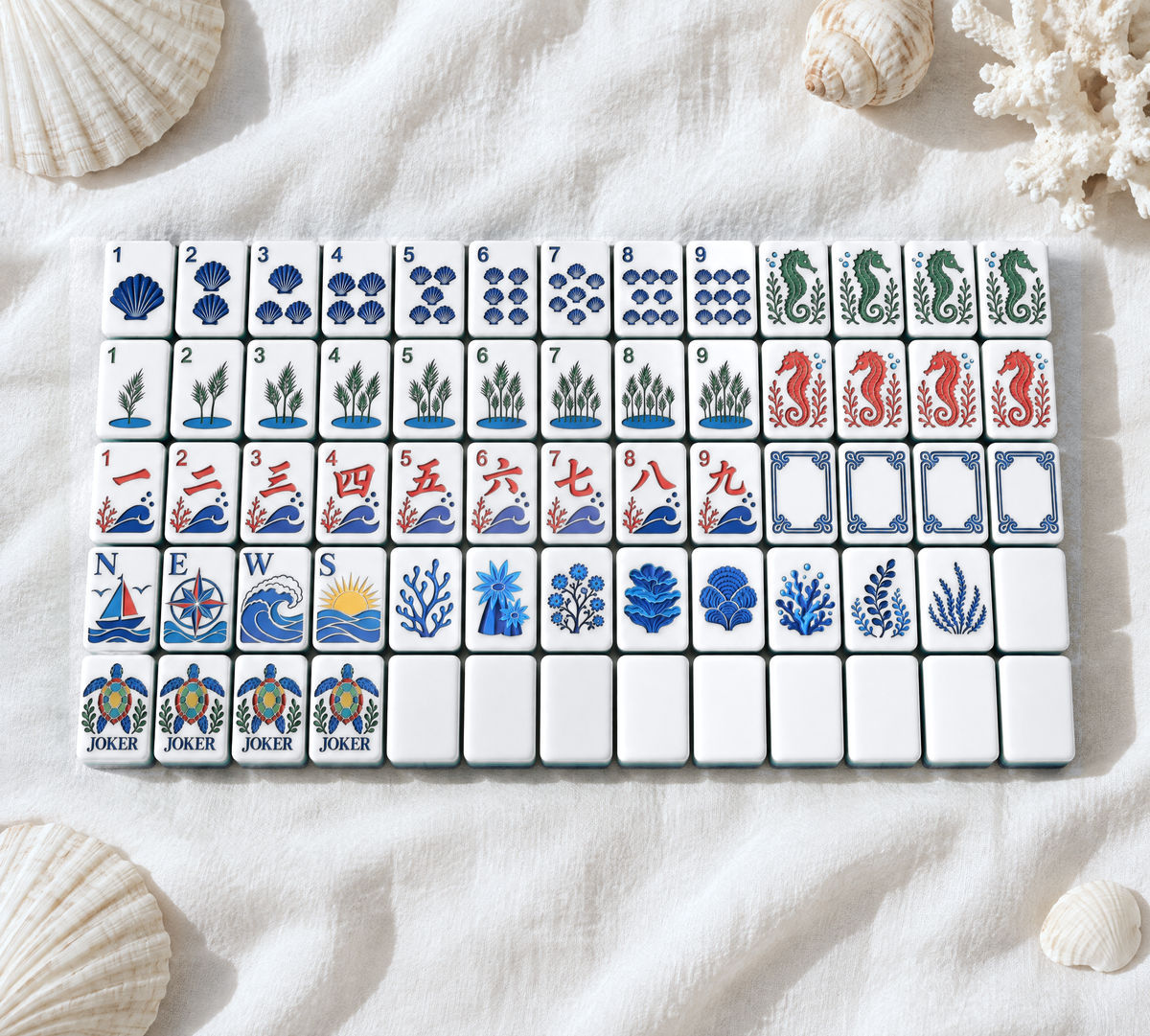
American mahjong is played with exactly 152 tiles—three suits (Bams, Craks, Dots) numbered 1–9 with four copies each, 16 winds (four of each: North, East, West, South), 12 dragons, 8 flowers, and 8 jokers—dealt across four players over roughly one hour per game. The core difference from other variants: you play hands only from the current-year National Mah Jongg League card, which lists all legal winning combinations; there are no sequences or chows you can call or expose; and you may only expose pungs (three identical tiles), kongs (four identical), quints (five), and sextets (six). Jokers act as wildcards but never replace a single tile or sit as part of a pair. Before the first hand, players perform the Charleston—a formal three-stage tile pass that randomizes holdings. Winning means your concealed hand matches a card pattern exactly, you declare Mahjong, and points are scored based on hand type. Our best-selling mahjong sets contain all 160 tiles (the standard 152 plus spares) and come with a current-year card.
What tiles make up an American mahjong set?
An American mahjong set contains exactly 152 playing tiles plus spare tiles. You get 36 Bams (numbered 1–9, four each; the 1 Bam shows a bird), 36 Craks, 36 Dots, 16 winds, 12 dragons, 8 flowers, and 8 jokers. The Red Dragon goes with Craks, the Green with Bams, and the White Dragon (called "Soap") with Dots and serves as zero. Most sets sold include 160 or 166 tiles total—the extra pieces are spares used if a tile cracks or is lost, never added to active play. What's in an American mahjong set explains every tile's role and how to verify your count before game one.

How does the Charleston work before play starts?
The Charleston is a mandatory three-stage tile-passing ritual that randomizes holdings before the first hand. All four players simultaneously move three tiles to the right, then three to the left, then three across the table—each stage moving tiles face-down without looking at replacements until all players finish. This ensures no player knows what anyone holds and prevents predictable patterns. If your group prefers, you can skip the Charleston on later hands with mutual agreement, but it's standard at the start. The Charleston typically takes two to three minutes. Understanding how the Charleston works prevents common mistakes like passing during the wrong stage or accidentally revealing tiles early.
What hands can you win with, and where do you find them?
Every legal winning hand in American mahjong comes from the current-year National Mah Jongg League card—a single reference sheet that lists all ~70 winning patterns organized by hand type (pairs, kongs, pungs, joker counts). The card changes yearly, issued each spring, so a hand that wins in 2026 may not be valid in 2027. Hands never repeat as sequences; a "1-2-3" is never playable. Your hidden hand must match a card pattern exactly: for example, a pair of 5 Dots plus a pung (three) of Red Dragons plus a kong (four) of 4 Craks plus a pung of North winds. Jokers can fill any missing tile in a pung, kong, quint, or sextet—but never the pair, and never the single tile in a one-tile pattern. How to read the mahjong card teaches you to scan card sections in seconds and spot patterns under pressure.
🀄 Shop best-selling mahjong sets →
What does it mean to expose a pung or kong?
Exposing means removing three or more identical tiles from your hidden hand and placing them face-up on the table where all players can see. You expose a pung (three identical), kong (four identical), quint (five identical), or sextet (six identical)—never a pair or a sequence. Once exposed, the tiles remain public for the rest of the hand. You may only call an exposure if another player discards the exact tile you need; you cannot draw from the wall and immediately expose without a call. For example, if the discarder plays a 7 Bam and you hold two 7 Bams in hand, you can call "Pung," expose all three, and draw from the wall to replace the called tile. This speeds up hands and lets other players track what tiles are in play. Jokers in a pung, kong, quint, or sextet are legal and common, but if you expose a tile that includes a joker, you may not replace that joker later. Keeping most of your hand concealed—called "closed"—is often worth more points.

How do you know when someone wins, and what happens next?
A player wins (declares "Mahjong") when their complete 14-tile hand matches a single pattern on the current year's card. The winning hand consists of 13 tiles melded into the card's pattern plus one final tile drawn from the wall or called from a discard. When you win, flip all your tiles face-up on the table so all players verify the match against the card. If the hand is valid, the player who discarded the winning tile (or the wall, if the winner drew) pays points to the winner based on the hand type—simpler patterns pay less, complex ones (many kongs, flowers, or specific suit combinations) pay more. Scoring uses a scoring table that varies by hand. After a win, the player who won becomes the new East (dealer), or if they were already East, the title passes to the next player in order (South, West, North). Tiles are collected, shuffled, and the next hand begins with a new Charleston.
What are the most common mistakes beginners make?
Beginners often confuse joker rules: jokers can substitute for any tile in a pung, kong, quint, or sextet, but never for the pair, and never for a single-tile pattern. Another error is trying to play sequences (1-2-3 of the same suit)—American mahjong has no sequences; hands come only from the card and include only melds of identical tiles. New players also misread the card by scanning too slowly or by assuming a hand with the same suits and numbers is valid when the card shows a different arrangement (for example, "pair of 5 Dots + pung of Red Dragons + …" is not the same as "pair of Red Dragons + pung of 5 Dots + …"). Exposing too early is another trap: if you expose a pung or kong before verifying it fits your winning hand pattern, you may lock yourself into a losing path. Finally, players sometimes forget that the current year's card is the only source of legal hands—hands from last year's card are not valid. Before your first game, review the card's layout and spot two to three patterns you recognize; this builds speed.
Decision Framework: When to Expose vs. Stay Closed
Situation | Expose? | Why | Common Outcome |
Pung of 8 Bams; card shows pairs only; hand is already 14 tiles | No | Closed hands score more; you're ready to win. | Safer higher score. |
Kong of North winds called by discarder; hand needs 4 more tiles | Yes | Calling forced; staying closed impossible. | Win after drawing tiles. |
Three 2 Craks in hand; card shows 2 Craks in a pung section; 6 more tiles to collect | Maybe | Depends on how many Craks remain. If many gone, exposure locks you in. | Risk: loses flexibility if card shows pung in a closed hand section instead. |
Quint (5 Red Dragons); card shows quint of Reds | Yes | Quints are rare and worth high points. | Large payout if you win; exposes your plan. |
🎁 See our most-loved mahjong sets & accessories →
What to check before you buy your first set
Verify the set includes a current-year National Mah Jongg League card—without it, you cannot look up legal hands. Count the tiles: a proper American set has 152 playable tiles, plus spare tiles for damage. Check that acrylic or resin tiles are engraved or stamped on both faces so you can read them from any angle at the table; ink-printed tiles fade with handling. Ensure the set comes with 8 jokers and a rack or bag to organize your holdings during play. For your first group, consider a mat with printed scoring references or a rack with pushers so players can manage tiles without fumbling. If you plan to host weekly, acrylic sets and cases last years; plastic sets may warp or crack faster. Our engraved American mahjong sets come personalized with names, dates, or jokes—useful gifts for longtime players and a way to keep sets organized if your group plays at multiple homes.
✨ Find your Mahstead set — free US shipping →
How does American mahjong differ from Chinese, Hong Kong, and Riichi variants?
American mahjong is the only variant that uses a printed hand card as the sole source of legal patterns; Chinese and Hong Kong mahjong rely on traditional fixed patterns (no card needed) and allow sequences (chows) that can be called and exposed, which American does not. Riichi mahjong (Japanese) also permits sequences and uses a different tile set and scoring system. American mahjong has no "ready" hand state (where you draw one tile to win); you simply draw and check against the card. Joker rules differ: American jokers are wildcards; Chinese mahjong does not use jokers at all. Hong Kong uses jokers more restrictively. American sets are also larger (8 jokers, flowers) and use wind and dragon designs closer to classical sets, while some variants simplify to fewer wind and dragon tiles. If you've played another variant, American mahjong's "card-only" rule is the biggest adjustment—you must own the current year's card and accept that hands change annually. The how to play American mahjong pillar covers the full ruleset and how to adapt if your group includes players from other variants.

FAQ
Can you play American mahjong with fewer than four players?
Yes. Two- and three-player American mahjong uses modified tile draws and hand patterns. A two-player game uses 80 tiles each and special card patterns; three-player uses modified wall sections. Rules differ significantly, so consult the National Mah Jongg League's guidelines or our guide to 2 and 3 player mahjong rules before starting.
What happens if the wall runs out of tiles before someone wins?
If all 152 tiles are drawn and no one has won, the hand is voided—called a "dead hand." No points are scored, and a new hand begins. This is rare; most hands end within the first round or two of play.
Can jokers be used in a pair or a single tile?
No. Jokers can only substitute for tiles in a pung (3), kong (4), quint (5), or sextet (6). They never replace a pair or a single-tile pattern. This is a critical rule that prevents joker overuse and keeps the game balanced.
Do I need a special mat or rack to play?
No, but they help. A mat defines the play area and often shows scoring reminders; a rack with pushers organizes your tiles so opponents cannot see your hand and you move tiles efficiently. Both are convenience tools, not requirements. Our mahjong racks with pushers and mahjong mats are designed for regular home games.
How long does one hand typically take?
A hand usually lasts 15 to 25 minutes for experienced players, 30 to 45 minutes for beginners. The Charleston adds two to three minutes; drawing, exposing, and discarding add up over 13 to 14 rounds of play per hand.
What year's card do I need to play in 2026?
You must use the 2026 National Mah Jongg League card, issued in spring 2026. Cards from previous years are not valid. Best-selling mahjong sets are sold with the current year's card included.


View More
View More
View More
