
Wright-Patterson Mahjong Quick Start Guide
Last updated: Nov 23, 2026
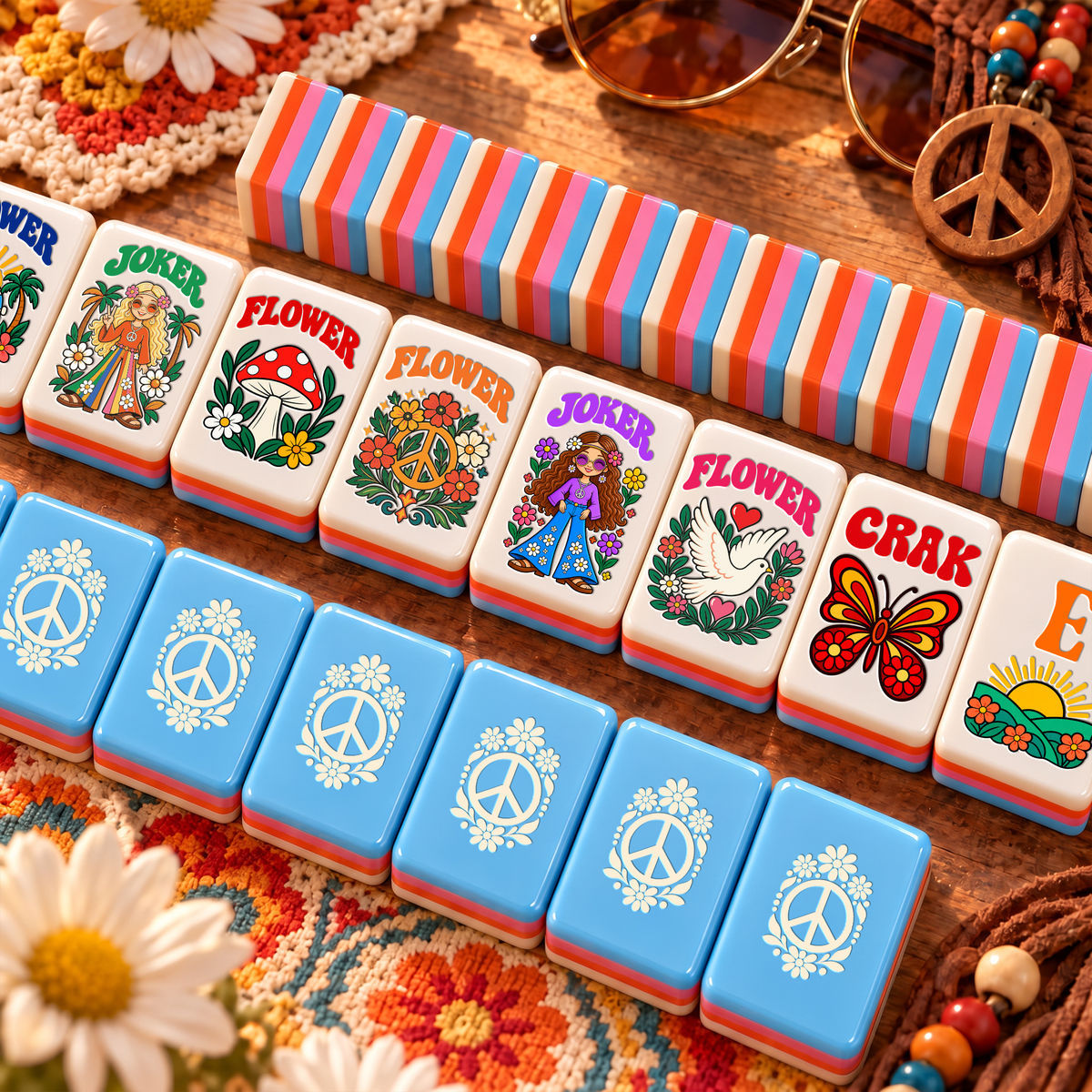
American mahjong plays four players in roughly 90 minutes per round. You'll need a 152-tile set (160-tile sets include spares), a mat for organized tile placement, a current-year National Mah Jongg League card, and dice. Deal 13 tiles each; execute the Charleston (a three-stage tile-passing ritual); then players form melds (exposed sets of matching tiles) and draw-discard until someone declares "mahjong" by completing a hand printed on that year's League card. Scoring depends on the hand type and any bonuses. The game ends when all four players agree; many groups play five rounds rotating dealer positions. Mahstead's best-selling mahjong sets ship ready to play, complete with racks, mats, and dice, so beginners can host a full game immediately.
Why is the Charleston so important for a fair game?
The Charleston prevents any player from controlling which tiles remain in the wall. Before play begins, each player passes three tiles right, then three left, then three across; any player may opt out at each stage. This shuffle ensures randomness and gives everyone an equal opportunity to start with useful tiles. Skip the Charleston and you've lost a core protection against dealer advantage. Most groups play strictly: if you haven't passed by the time the next person announces "go," your pass defaults to three random tiles from your hand.

How do you read the National Mah Jongg League card?
The card displays all legal hand patterns for that calendar year, organized by suit, number, and special combinations. Each row shows one valid hand: symbols represent tile groupings (pung = three identical, kong = four identical, quint = five, sextet = six). Numbers and suit abbreviations (Craks, Bams, Dots) identify which tiles. Jokers appear as wildcards in many patterns—you can substitute a joker for any tile except a single tile or a pair. Study the card for 10 minutes before your first game to recognize common shapes: "2468 Like," "Consecutive Pungs," "Pairs and Quints." The best-selling mahjong sets often include a laminated card, so you have a reference on the table during play.
🀄 Shop best-selling mahjong sets →
What tiles go into a standard American mahjong set?
A 152-tile American mahjong set contains exactly: 108 suit tiles (Craks, Bams, Dots numbered 1–9, four of each number per suit), 16 wind tiles (four each of North, East, West, South), 12 dragon tiles (four Red, four Green, four White), 8 flower tiles, and 8 jokers. The 1 Bam depicts a bird. White dragon (also called "Soap") counts as zero in scoring. A complete game uses all 152 tiles plus 8 jokers; no blanks enter play. If you buy a 160-tile set from Mahstead, the extra tiles are spares for replacements if any crack—never added to the game itself. Verify your tiles before the first shuffle so you can spot a missing or cracked piece before anyone complains mid-game.
Component | Qty | Notes |
Craks (1–9) | 36 | Red-outlined suits |
Bams (1–9) | 36 | Bamboo symbols; 1 = bird |
Dots (1–9) | 36 | Circle pips |
Winds (N/E/W/S) | 16 | 4 of each |
Dragons (Red, Green, White) | 12 | Red = Craks, Green = Bams, White = Dots |
Flowers | 8 | Usually numbered 1–8 or seasonal |
Jokers (in play) | 8 | Wildcards; never used as single/pair |
Total playing | 152 | Always 152 for a legal game |
How do you expose and score a meld?
Once you have a valid meld (pung, kong, quint, or sextet of identical tiles), remove it from your rack, place it face-up in front of you on the mat, and announce it clearly—"three 5 Craks" or "four Red Dragons." Other players may now see it and reference it during play. Jokers can appear only in a multi-tile meld (never as a solo replacement). Each meld scores points based on the hand pattern on the League card and any multipliers (e.g., "Like" hands score double if all tiles match a printed pattern exactly). American mahjong is never scored by point per tile; every hand on the card has a fixed point value. When someone calls "mahjong," total the hand's value and any bonuses from who discarded the winning tile. A mahjong scoring guide covers all bonus scenarios in detail.

What are the most common beginner mistakes?
Illegal draws or discards: Always draw one tile before discarding one, and always discard face-up on the mat so others see it immediately. Buried or unclear discards cause disputes. Joker misuse: Jokers cannot stand alone or form a pair—they are wildcards only within a pung-or-larger meld. If you try to use a joker as your pair, the table can call "dead hand" and you're out for that round. Forgetting the wall: The wall is a line of un-drawn tiles; once the wall shrinks below a playable size, the game ends (no winner). New groups sometimes lose track mid-game. Wrong hand on the card: Before declaring mahjong, whisper the card row number to the scorekeeper so they verify it matches your tiles exactly. One wrong suit or tile count voids the hand. Not tracking who dealt: Most groups use a marker or token to track the dealer (East position). This matters for scoring bonuses and determining next round's dealer. A how-to-play guide walks through each error scenario step-by-step.
🎁 See our most-loved mahjong sets & accessories →
What's the best way to set up for your first game?
Lay the mat flat on a stable table large enough for four players comfortably (at least 36 inches square). Each player sits at one edge. Open your set and sort all 152 tiles into four stacks of 38 tiles each—this is the "wall." Roll the dice to determine who deals first; that player is East, and play rotates counter-clockwise. East deals 13 tiles to each player, then draws one more (14 total). Everyone else holds 13. Do the Charleston immediately: pass three tiles right without looking, wait for others, then pass three left. Confirm the scorekeeper has the current League card visible. Place jokers and a discard pool near the center. Use racks with pushers if available—they keep hands organized and prevent tiles from tipping. Once everyone holds 14 tiles and the wall is closed, East discards one tile face-up, and play begins. A dedicated mat selection guide explains mat sizes and materials for different table types.
What to check before you buy
Set condition: Open the box and count all 152 tiles. Look for cracks, chips, or printing errors. Mahstead ships checked sets, but travel or storage can cause damage. Verify before you leave the store or open the box. Mat size: Measure your table's width and length, then select a mat 3–4 inches smaller on each side to avoid overhang. A racks and pushers guide shows how racks stack alongside the mat. Joker count: Your set includes exactly 8 jokers for play; spares (beyond 152 tiles) are for broken-tile replacement only. Never add spares to the game. Card currency: Buy or download the current year's League card before your first game. Cards change every spring; old cards have illegal hand patterns. Group size: Confirm you'll have exactly four players. If you're short, look into 2- and 3-player variant rules or wait for a fourth.
✨ Find your Mahstead set — free US shipping →
How long does a game really take?
A single round averages 45–90 minutes depending on player skill and pace. Complete games typically run 5 rounds (one per player as dealer), so 4–8 hours total. Beginners often play longer in early rounds as they learn to read the card and spot valid hands. Once everyone recognizes 10–15 common patterns, speed picks up noticeably. Set a round limit (e.g., "five rounds or 8 p.m., whichever comes first") before you start so no one feels trapped at the table. Many groups pause between rounds for snacks or a brief break—this lets everyone decompress and re-focus.
Quick Reference Checklist
[ ] Buy or print current-year National Mah Jongg League card
[ ] Verify all 152 tiles present and undamaged in your set
[ ] Confirm four players and a stable table (≥36″ square)
[ ] Lay mat flat; sort tiles into four wall stacks of 38 each
[ ] Roll dice; designate East (dealer); execute Charleston
[ ] East deals 13 to each player, draws 14th; others hold 13
[ ] East discards first; players draw and discard in turn
[ ] First to complete a valid hand on the League card calls "mahjong"
[ ] Scorekeeper verifies the hand, records points, rotates dealer
[ ] Play rounds until everyone has dealt once (or group agrees to stop)
A group in Wright-Patterson or any US community can host a complete mahjong night with nothing but a quality set, a mat to organize tiles, and this guide. The beauty of American mahjong is that the rules are fixed by the League card—no house rules needed—so once you learn the basics, you can sit with any group and follow their pace. Start with our best-selling mahjong sets, which arrive ready to play with racks and mats included.

FAQ
Can I play American mahjong with fewer than four players?
Yes, but rules differ significantly. Two or three players use variant rules to adjust hand difficulty and scoring. See our 2 and 3 player mahjong rules guide for exact adjustments.
What's the difference between a joker and a blank tile?
Jokers are wildcards that substitute for any tile within a multi-tile meld. Blank tiles are spares only—never used in play. American mahjong sets include 8 jokers in the game and blank spares outside it.
Do I have to follow the Charleston, or can I skip it?
Skipping the Charleston is legal if all four players agree beforehand. However, the Charleston ensures fairness and is standard in organized play. Most groups use it every game.
How do I know if my hand is "mahjong"?
Your hand must match one row on the current-year League card exactly: the right suit symbols, the right numbers, the right number of tiles in each meld. Ask the scorekeeper to verify before you announce it.
Can jokers be used as a pair?
No. Jokers can only appear in a multi-tile meld (pung of 3 or larger). A pair must be two identical natural tiles—never jokers or wild substitutes. Using a joker as a pair makes your hand illegal.
What happens if someone discards out of turn or draws the wrong tile?
Most groups call this a "dead hand"—that player is out for the round, but play continues with the other three. Some tables allow a one-time do-over for a first mistake; confirm house rules before you start.
Is American mahjong the same as Chinese or Hong Kong mahjong?
No. American mahjong uses a fixed League card of hand patterns, plays with 152 tiles, and has no chows (sequences). Chinese and Hong Kong variants use different tile counts, hand logic, and scoring. They're entirely separate games with their own rules.


View More
View More
View More
