
Mahjong Classes for Beginners in San Antonio: Where to Start
Last updated: Nov 23, 2026
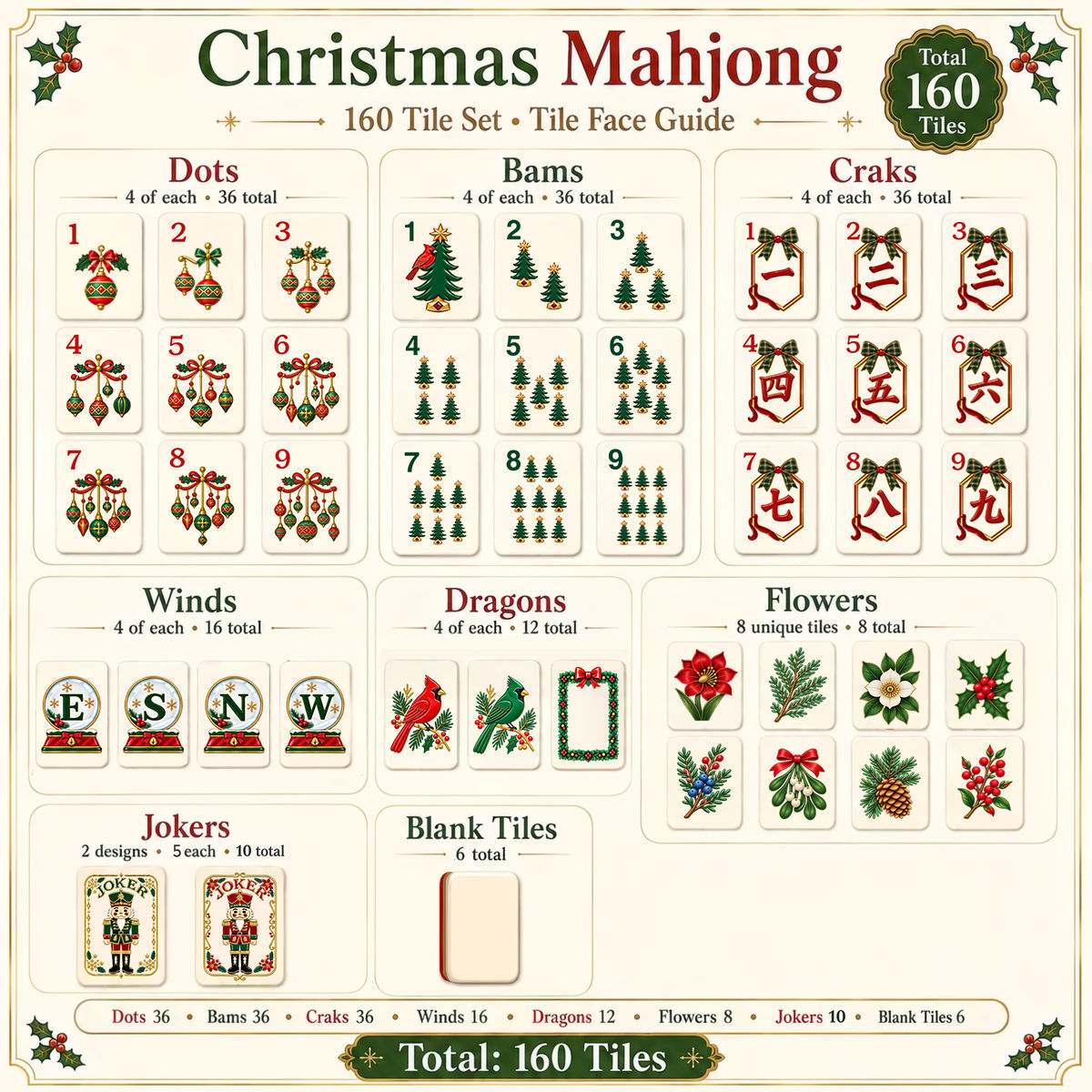
San Antonio's beginner mahjong classes meet primarily through public libraries, community recreation centers, synagogues, and private instructors advertising on local meetup boards and Facebook groups. Most introductory sessions run 4–8 weeks, meeting weekly for 1.5–2 hours, and cover tile names, hand-reading basics, the Charleston (the tile-passing ritual), and how to call or expose melds. Cost varies from free library workshops to modest per-session fees at private instructors. Classes teach American mahjong using the National Mah Jongg League's official hand card (updated each spring). Before signing up, confirm the instructor uses American rules—not Chinese or Hong Kong variants—and ask whether they provide tiles or if you need your own 160-tile set. Begin by searching your city's Parks & Recreation department website, library catalog, and local community boards for "mahjong" or "mah jongg" and contact instructors directly to ask class size, what's provided, and prerequisite knowledge. 🀄 Shop best-selling mahjong sets →
Where Do San Antonio Beginners Find Classes?
San Antonio's public library system often hosts free or low-cost mahjong workshops during community program seasons. Check the main branch's events calendar and ask the librarian about seasonal offerings—libraries frequently partner with volunteers to run beginner circles. Community recreation centers run by the Parks & Recreation Department offer structured 4–6 week courses in spring and fall; call or visit their website to ask about upcoming sessions. Synagogues and Jewish community centers in the greater San Antonio area regularly sponsor mahjong leagues and beginner nights, welcoming all denominations and backgrounds. Private instructors advertise on Nextdoor, Meetup.com, and local Facebook groups—search "San Antonio mahjong" and message instructors to ask about one-on-one lessons or small group starts. Word-of-mouth remains powerful: join local mahjong Facebook groups, attend open game nights at community venues, and ask players where they learned.

What Does a Typical Beginner Class Cover?
A beginner mahjong class teaches tile recognition, hand structure, and the American rules system in its first 2–3 sessions. You'll learn the 152-tile deck: three suits (Bams, Craks, Dots numbered 1–9), winds, dragons, flowers, and jokers. Classes explain how to recognize a legal hand using the current year's National Mah Jongg League card and walk you through the mechanics: drawing, discarding, calling a pung (three matching tiles), exposing a kong (four matching), and the scoring grid. Instructors demonstrate the Charleston—the formal tile-exchange ritual that begins every American game—and show how jokers work as wildcards that cannot be used singly or as a pair. Later sessions cover strategy: reading the card efficiently, tracking discards to deduce what opponents hold, and common mistakes beginners make. Most classes wrap-up with practice games at slower pace, allowing learners to ask questions mid-play. Expect to leave knowing the rules well enough to join a casual table within 4–6 weeks.
How Long Does It Take to Play Your First Real Game?
Most learners are ready for a supervised beginner game after 2–3 class sessions—roughly 3–6 hours of instruction. You'll recognize tiles, understand hand structure, know when to call, and follow play without constant rule lookups. A full, confident first game (without pausing to check the card) typically takes 4–6 weeks of weekly classes plus informal practice. Here's the realistic timeline: weeks 1–2 cover tile names and card basics (you can now identify a legal hand); weeks 3–4 add strategy and the Charleston (you can now play slowly with coaching); weeks 5–6 bring confidence and speed (you can now play at a regular table without slowing the game). Avoid the trap of expecting fluency after one session—mahjong is a pattern-recognition game, and your brain needs repetition to internalize the card's layout. Return to class week after week and play at least one casual game during or after each session; this combination accelerates learning far faster than theory alone.
Do You Need Your Own Tiles to Start?
Most introductory classes provide tiles, so you don't need to buy before your first lesson. However, once you join a regular game or want to host, a quality set becomes essential. Instructors and casual groups often have 1–2 sets on hand for instruction, but they expect regular players to own their own (just as bridge players own their own score pad, or poker players bring chips). Before committing to classes, ask the instructor: "Do you provide tiles for the class, or should I bring my own?" If you'll be starting soon, our best-selling collection includes clear acrylic American mahjong sets designed for visibility and easy shuffling—features beginner groups appreciate. A standard 160-tile set contains the 152 playing tiles plus spare jokers, and these sets ship free across the US. Getting your own set within 2–3 weeks of starting classes (rather than before) lets you confirm you enjoy the game before investing.

What Should You Prepare Before Your First Class?
Arrive 10–15 minutes early to meet the instructor and other students; bring a notebook to jot down suit names, the hand card structure, and any rules that feel unclear on first hearing. Most instructors post or email the hand card (the National Mah Jongg League's annual reference) before class; download it and flip through it once so you see the grid layout and a few hand examples, but don't memorize it—the instructor will teach you how to read it. Wear comfortable clothes and expect to sit upright for 1.5–2 hours; bring water. Ask the instructor what level of prior knowledge is assumed—true beginner-only classes assume zero. If the class is intermediate-weighted, it may move too fast; don't be shy about requesting a beginner track or a different cohort. Finally, check the class size: groups of 4–6 learn faster than 10+, and instructors should confirm the ratio before you enroll. Realistic expectations beat regrets: mahjong is learnable, social, and fun, but the first class will feel like drinking from a fire hose—that's normal.
Class Type | Best For | What to Expect | How to Find |
Public library workshop | Budget-conscious, flexible schedule | Free or sliding-scale; group instruction; no materials to buy | Library website, call main branch |
Parks & Rec center course | Structured learning, recurring cohort | 4–6 weeks, small groups, per-session cost or package rate | City Parks & Recreation website |
Synagogue/JCC night | Community atmosphere, social aspect | Open game + optional beginner help, monthly or weekly, welcoming | Local JCC or synagogue events calendar |
Private instructor (1-on-1) | Fast-track learning, custom pacing | Higher hourly rate, flexible schedule, personalized feedback | Nextdoor, Meetup, Facebook groups, local players |
Casual drop-in group | Low-key, peer learning | Free or nominal table fee, no formal curriculum, learn-by-playing | Facebook groups, community boards, word-of-mouth |
🎁 See our most-loved mahjong sets & accessories →
What to Check Before You Sign Up
Confirm the rule system: ask "Is this American mahjong?" Some instructors teach Chinese or Hong Kong variants, which use different tiles, sequences, and scoring. American mahjong uses only this year's National Mah Jongg League hand card—not classical rules or any other system.
Verify class size and scheduling: insist on no more than 6 learners per instructor; larger groups fragment attention. Ask about make-up sessions if you miss a week.
Ask what you'll need to bring or buy: if tiles are provided, great. If not, you'll need a set before week 1. Confirm whether the instructor has recommendations or if you're picking blindly.
Check instructor experience: ideally, your instructor has played in league games or regular groups for at least 2–3 years. Ask how many beginner cohorts they've taught.
Assess the learning style: does the instructor explain the hand card visually (grid sections, pattern families)? Mahjong improves faster when the card is demystified. Avoid instructors who hand you the card and say "Just memorize this."
Understand cost upfront: no hidden fees. Libraries and some JCCs are genuinely free; private instructors post hourly or per-session rates; Parks & Rec courses list the total and payment terms. If anyone refuses to quote a cost, keep looking.
Why Your First Set Matters for Long-Term Learning
Once you join a regular group, having your own tiles accelerates pattern recognition because you play with the same set weekly. Your hands develop muscle memory for tile weight, shuffle rhythm, and color/symbol contrast. Cheap or worn sets slow learners down—if tiles stick together or symbols blur, you'll re-verify every tile you draw, which exhausts your cognitive load and leaves no bandwidth for strategy. A clear acrylic American set with crisp symbols lets your brain file tiles automatically, freeing mental energy for reading discards, tracking hands, and planning ahead. Our best-selling mahjong sets come engraved with titles or witty designs that make your set instantly yours; hosting a weekly game feels more intentional when your tiles reflect your personality or inside joke.
✨ Find your Mahstead set — free US shipping →
What Else Do You Need Once You're Playing Weekly?
If you move from class-room learning to hosting a regular game, you'll want a mat to define the play surface (protecting tables and keeping tiles corralled), a rack with pushers to organize and hide your hand, and eventually a case for travel or storage. A quality mat makes shuffling, calling, and exposed melds clearer for all players. Racks with pushers aren't mandatory—many casual players prop tiles in a line—but they speed up hand management and reduce tile-touching accidents. These aren't urgent; focus on nailing the rules first. As you enter your second or third month and join real games, a mat becomes useful. After 2–3 months of weekly play, a rack pays for itself in convenience. Visit the beginner guide to understand the full game before investing beyond tiles: mahjong fundamentals cover the philosophy and pace of learning.

FAQ
Can I learn mahjong online instead of in-person classes?
Online tutorials teach rules, but mahjong is a tactile, social game—handling tiles, reading opponents' body language, and managing the pace matter enormously. Online learning works as a supplement (refresher videos, card review), but first-time learners benefit hugely from a live instructor answering real-time questions. Search YouTube for "American mahjong basics" to preview the game; then enroll in a local class for the full experience.
How much does a beginner class cost in San Antonio?
Public library workshops are free; Parks & Rec courses range from modest per-session fees to a bundled package price (contact your local center for current rates); synagogues and JCCs typically charge modest fees or are free for members; private instructors vary widely depending on location and experience. Call your chosen venue directly to ask, as pricing changes seasonally.
What if no beginner class is running right now?
Join an open casual game night (libraries, JCCs, and community centers often host these) and ask a player if they'll mentor you one-on-one before or after games. Many veteran players love coaching beginners informally. Alternatively, request that your library or recreation center start a class—word-of-mouth demand often triggers new offerings.
Is American mahjong harder than Chinese mahjong?
American mahjong has stricter rules and uses a hand card (a yearly reference chart) that governs which tile combinations are legal. Chinese mahjong allows sequences (chows) and offers more hand flexibility. American mahjong is different, not objectively harder—it's more like a puzzle where you must match patterns on an official chart. Choose based on which community you're joining.
Do I need to own a set before attending my first class?
No. Most instructors provide tiles for beginners. Ask when you enroll. Once you're in a regular game (after 4–6 weeks), owning a 160-tile set becomes important so you can host or practice at home, but don't buy preemptively—confirm you enjoy the game first.
What's the best way to find open games after I finish beginner classes?
Ask your instructor where local players gather; they often know weekly game nights or groups. Check Facebook groups for "San Antonio mahjong" or "San Antonio mah jongg"; these groups post game times and locations. Attend open game nights at libraries or JCCs and exchange contact info with other players. Most communities have a small, connected player base—once you're in, you'll hear about games by word-of-mouth.


View More
View More
View More
