
How to Play Consecutive Run Hands in American Mahjong
Last updated: Nov 23, 2026
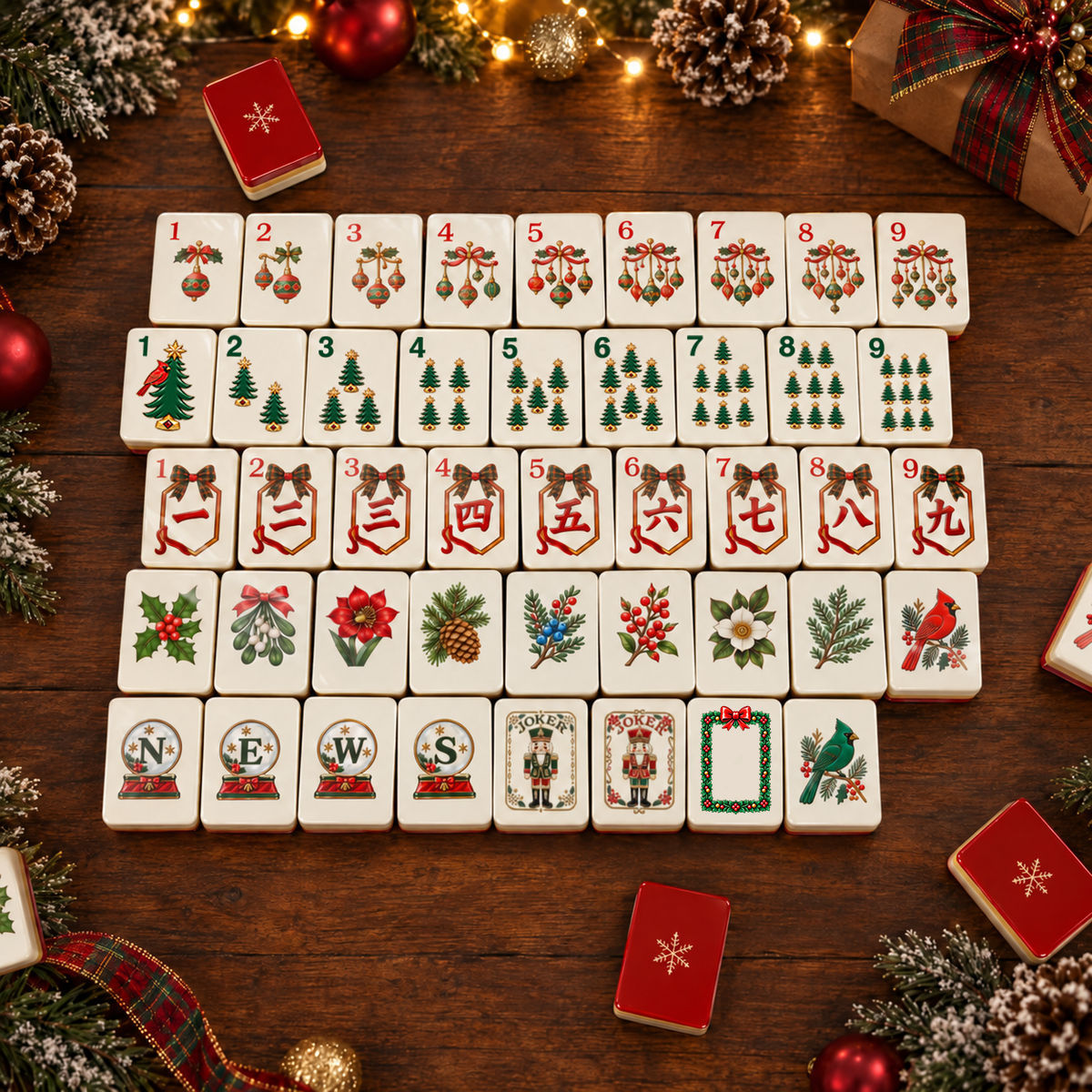
American mahjong has no consecutive runs, chows, or sequences that can be called or exposed during play. Unlike Chinese or Hong Kong mahjong, where 1-2-3 in one suit forms a valid meld, American tiles must match exactly in rank to form a pung (3 identical), kong (4 identical), quint (5), or sextet (6). The National Mah Jongg League card—issued each spring—defines every legal hand for the year. All hands consist of pairs, melds of identical numbered tiles, and honor tiles (winds, dragons, flowers). Jokers substitute only for missing tiles within a meld, never for pairs. When you're learning to read the mahjong card, you'll notice hands are printed as combinations of these patterns, not sequences. Our weekly games follow this rule strictly: no runs, no mixed suits in a single meld, only the card. Beginners often confuse American rules with other variants; clarifying this one mistake saves hours of confusion. 🀄 Shop best-selling mahjong sets →
Why American Mahjong Has No Consecutive Runs
American mahjong evolved to use a fixed card rather than rely on player memory or judgment of hand legality. The card acts as the rulebook: only patterns printed on it are playable. This design choice enforces consistency and makes the game accessible to new players. Because hands are predefined, we never count sequences like 4-5-6 or 7-8-9 as valid melds. Instead, identical-rank tiles (four 3 Craks, for example) form the basic unit. This constraint keeps the game fast, fair, and focused on tile-reading skill rather than combinatorics. Other variants like Chinese or Riichi mahjong use runs as core mechanics; American rules exclude them entirely to simplify strategy and speed up play.

What Patterns Actually Count as Valid Melds
In American mahjong, a meld must contain tiles with the same rank and suit—three 5 Dots, four Red Dragons, two White Dragons as a pair. We recognize four types: a pung (exactly 3 identical tiles), a kong (exactly 4 identical), a quint (exactly 5 identical), and a sextet (exactly 6 identical). Jokers can substitute for any missing tile within a meld only—never for a pair, never as a standalone tile. A hand on the card might show a pung of 2 Bams, a quint of 7 Dots, a kong of East Winds, and a pair of Red Dragons; you expose the first three and keep the pair concealed. Mixed-suit melds—say, 3 Craks, 3 Dots, and 3 Bams together—have no value and are illegal. Honor tiles (winds, dragons, flowers) follow the same rule: three identical tiles form a pung, never a run. This simplicity is a strength: once you know the tile names and suit colors, meld legality becomes obvious.
How to Use Jokers Correctly in American Hands
Jokers are wildcards, but with strict limits. You cannot use a joker in a pair—ever. If you need a 5 Craks to complete a pair and you have a joker, you cannot substitute it; you must wait for the actual tile or discard and start over. In melds, jokers fill gaps: if your hand shows a kong of 8 Dots on the card and you hold three 8 Dots plus a joker, the joker stands in for the fourth 8 Dot. One joker can replace one tile per meld; you cannot use two jokers in the same meld (the card defines the meld size, and jokers respect that). A quint of 4 Bams might include one joker and four live 4 Bam tiles; the joker fulfills the fifth position. Once you expose a meld with a joker, the joker stays locked in that spot until you win or the round ends. Many new players accidentally use jokers in pairs or try to substitute two jokers in one meld; both mistakes lose the hand. The rule is simple: jokers plug single gaps, never pairs, never multiple gaps in one meld. When you're unclear, reference the exposed meld on the card and count live tiles versus joker count.
🎁 See our most-loved mahjong sets & accessories →
Comparing American Rules to Other Mahjong Variants
Variant | Sequences Allowed | Meld Types | Hand Source | Jokers in Pairs |
American | No | Pung, kong, quint, sextet only | Official card (annual) | Never |
Chinese | Yes (chow: 1-2-3 etc.) | Chow, pung, kong | Player judgment | Varies by house rules |
Hong Kong | Yes (chow) | Chow, pung, kong, special combos | Player judgment | Varies |
Riichi | Yes (sequence: 1-2-3 etc.) | Sequence, triplet, quad, special patterns | Player judgment | No (no wild tiles) |
Taiwanese | Yes (chow) | Chow, pung, kong, special melds | Player judgment | Varies |
This table clarifies the core difference: American mahjong forbids consecutive runs entirely and uses a printed card to define legality. Other variants treat runs as fundamental. If you learned another variant first, unlearning consecutive logic is essential for American play. A hand that looks legal in Chinese mahjong (1-2-3 in one suit, for instance) is not even a concept in American rules; it cannot exist on our card. The card is your authority—not intuition, not analogy to other games. Many casual players mix rules from different variants at home; at official clubs or tournaments, the American card is law.

Common Mistakes When Learning American Hand Patterns
Mistake 1: Assuming a "run" is valid. New players often come from Chinese or casual home mahjong and expect 4-5-6 Bams to be a legal meld. It is not. Only identical ranks work: three 4 Bams, three 5 Bams, three 6 Bams as separate melds, each a pung.
Mistake 2: Using a joker in a pair. You hold a pair of 2 Dots and one joker. You cannot substitute the joker for the second 2 Dot. Pairs must be live tiles, always.
Mistake 3: Mixing suits in a single meld. Three tiles from different suits (1 Bam, 1 Crak, 1 Dot) do not form a pung. Melds must be single-suit, single-rank.
Mistake 4: Misreading the card. The card prints some hands with symbols or shorthand. Without learning to read the card accurately, you'll call illegal hands or miss legal ones. Spend time decoding the notation—it's the foundation.
Mistake 5: Trying to use two jokers in one meld. A sextet might need two jokers if you only draw four live tiles; however, a meld can contain only as many jokers as gaps exist. A quint (5 tiles) with three live tiles and two jokers is legal; but a sextet (6 tiles) with three live and four jokers is not—the card says exactly 6, and you have exactly 7 (3 live + 4 jokers), which exceeds the meld size.
Mistake 6: Forgetting the card changes yearly. Hands legal in 2024 may not appear on the 2025 card. Always verify you're using the current year's card; old cards will mislead.
To avoid these, learn American mahjong fundamentals before sitting in a game. Spend 15 minutes with the current card, spotting melds and practicing how jokers work. Most mistakes evaporate once you internalize these two truths: no runs exist, and the card is absolute.
How to Spot Patterns on the Card Quickly
The card is organized into sections (usually by suit and meld type). Each pattern shows a combination of melds that add up to a complete winning hand. When you draw tiles, your job is to match your holding to a hand on the card. Start by identifying which melds you hold: "I have four 6 Craks—that's a kong" or "I have three East Winds—that's a pung." Then scan the card for hands that include a kong of 6 Craks or a pung of East. Over time, card-reading becomes automatic; new players often need a minute or two per hand.
Pro tip: On the card, identical-rank melds are grouped together or marked with consistent symbols. Flowers and winds occupy separate sections. If you have a pair of 3 Dots and a pair of South Winds, you're hunting for hands with exactly those elements. Mark off melds as you build them; cross-reference with the card line by line.
A best-selling mahjong set with clear tile print helps speed this process. If tile faces are hard to read under table lighting, you'll squint and lose focus. Legible tiles and a laminated card nearby reduce errors and keep the game flowing.
What to Check Before You Buy a Set for Serious Play
Tile legibility: Can you read the numbers and suit symbols under your table lighting in 2 seconds?
Card clarity: Is the current year's card included? Is it laminated or laminated-ready?
Joker count: Does the set include at least 8 jokers? (Standard 160-tile sets include spare jokers; verify this matches your game's needs.)
Rack quality: Do pushers move smoothly? Can you organize tiles without them toppling?
Case durability: Will the set survive weekly transport? Are tiles protected inside?
A set that looks pretty but has tiny, smudged tiles or flimsy racks will frustrate you weekly. Invest in legibility and durability over aesthetics alone.
✨ Find your Mahstead set — free US shipping →
Setting Up to Learn Correctly at Home
If you're teaching yourself or a new group, commit to the American card 100%. Print or laminate a copy and place it center-table. Call out hands aloud before exposing them—"I'm going for South Section, Line 4: pung of 1 Craks, quint of 3 Dots, kong of White Dragons, and a pair of 2 Bams." Hearing the structure aloud trains your ear and catches mistakes faster. Play slowly your first 5–10 games; speed comes naturally. Avoid mixing rule variants mid-game; if someone suggests a "run," gently redirect: "That's not on the American card—let's stick to identical-rank melds tonight."
Once you lock in American patterns, you'll see why the game works: the card constrains chaos, and identical-tile melds make strategy clearer. You're not counting possibilities; you're pattern-matching against a finite list. That's the genius of American mahjong.

FAQ
Can I ever play a sequence like 5-6-7 in American mahjong?
No. American mahjong forbids consecutive sequences entirely. Only identical-rank melds (three 5 Craks, for example) are legal. The card defines all valid hands; no runs appear on it.
What if I hold tiles that look like a run?
They don't form a meld. If you have a 5 Dot, 6 Dot, and 7 Dot, they must be part of three separate pungs (three 5 Dots, three 6 Dots, three 7 Dots) on the card, not a single run.
Can a joker replace a tile in a pair?
Never. Pairs must consist of two identical live tiles. A joker cannot substitute for either tile in a pair, even if it's your only path to a hand.
How many jokers can I use in one meld?
One joker per gap. A quint (5 tiles) with four live tiles can include one joker. A sextet (6 tiles) with four live tiles can include two jokers. The card dictates meld size; jokers fill holes without exceeding it.
What's the difference between American and Chinese mahjong hands?
Chinese mahjong uses chows (consecutive sequences like 4-5-6), while American uses only identical-rank melds. American hands come from an official printed card; Chinese hands are judged by players. This is the biggest rule divide.
If I'm used to another mahjong variant, how do I transition?
Unlearn runs entirely. Spend 30 minutes with the American card before your first game. Whenever you think "that looks like a run," stop and remind yourself: "American has no runs—check the card." Most confusion clears in 2–3 games.
Can flowers and dragons mix in a meld?
No. Each meld must consist of identical tiles only. Three flowers are not a pung; three Red Dragons are. Flowers have no numeric value and cannot combine with numbered suit tiles.


View More
View More
View More
