
Is Mahjong Similar to Backgammon? Key Differences Explained
Last updated: Nov 23, 2026
Mahjong and backgammon are both classical games with deep roots—backgammon originated in Mesopotamia around 3000 BCE, mahjong in 19th-century China—but they play nothing alike. Backgammon is a two-player race game where you roll dice to move pieces around a board toward home and off the table; the player to bear off all pieces first wins. Mahjong (in the American variant most taught to beginners) is a four-player tile game where players draw and discard tiles to build a hand matching one of dozens of patterns on an annual card; it rewards memory, attention to other players' moves, and pattern recognition. American mahjong uses 152 tiles across suits, winds, dragons, and flowers; backgammon uses two dice and 30 checkers. Games of backgammon last 10–60 minutes; American mahjong rounds run 20–40 minutes. If you're drawn to the social, turn-based depth of mahjong, explore our best-selling mahjong sets to see what a modern American game looks like.
Mahjong and backgammon are often mentioned together because both are ancient, skill-based social games played at tables worldwide. But beyond that, they're almost entirely different experiences. One is built on chance and racing; the other on memory and pattern hunting. Understanding the distinction helps you choose the right game for your table—and your temperament.
What's the core goal of each game?
Backgammon is a race. You move your 15 pieces around a 24-point board according to dice rolls, trying to reach your home and exit the board before your opponent exits theirs. The highest die value possible is 6; dice determine what moves you can make, so luck plays a measurable role. Mahjong, especially American mahjong, is about hand assembly. You draw and discard tiles over several rounds to complete one valid hand pattern from the official card—think of it as a puzzle where you're racing against three opponents but not in a linear way. In backgammon, your opponent's position directly blocks yours; in mahjong, you're all chasing different hands at once.

How much does luck play a role in each?
Backgammon is famously balanced between luck and skill—a newcomer can beat an expert on a lucky streak of rolls, which is part of its appeal. Dice rolls are random; you cannot control what you roll, only how you use it. Mahjong, by contrast, has almost no pure chance. The tiles are dealt randomly in the beginning, but after that, every tile you draw and every tile you see other players discard is information you control and remember. A skilled player beats a lucky beginner almost every time because the game rewards attention, inference, and strategic discarding. Luck exists only in the initial tile draw; after that, mahjong is a closed system of 152 known tiles, which means the difference between expert and novice is vast.
Which game takes longer to learn?
Backgammon rules fit on two pages: move pieces according to dice, capture undefended pieces, bear off when all pieces reach home. A beginner can play competently in 15 minutes of teaching. Mahjong has more layers. American mahjong requires learning the 152-tile set composition, the annual official card of valid hands (which changes every spring), how to read that card, the Charleston (the pre-game tile-passing ritual), how jokers work, hand exposure rules, and scoring. Most players need 4–8 weeks of weekly practice to feel confident. However, once mahjong clicks, players often stay devoted for years or decades. Backgammon is faster to pick up but mahjong offers more strategic depth and complexity over time.
What skills matter most in each game?
Skill | Backgammon | Mahjong |
Probability | High—dice odds dominate; you calculate which pieces to expose | Low—tile count is fixed; probabilities don't shift as much |
Memory | Moderate—track opponent's piece positions and strategy | Very high—remember every tile played, predict remaining tiles |
Tactics | Immediate—respond to current dice roll and board state | Long-term—plan a hand 4–5 turns ahead, adjust mid-hand |
Blocking/Interaction | Direct—your pieces physically block opponent's path | Indirect—you win by discarding carefully, not by blocking others |
Pattern Recognition | Low—positions repeat but strategy is situational | Very high—you match current tiles to dozens of card patterns |
Risk Appetite | Moderate—deciding whether to expose pieces or play safe | High—deciding whether to fish for a tile or declare your hand |
Backgammon rewards quick arithmetic and positional sense. Mahjong rewards long-term memory and pattern matching. A bridge player often excels at mahjong; a poker player often excels at backgammon.

Is one game more social than the other?
Both are social, but in different ways. Backgammon is one-on-one, intimate, and competitive—two players focus entirely on each other. You can chat and watch, but the game is you versus them. Mahjong is four-player, collaborative in spirit (you're all pursuing your own hands, but there's genuine camaraderie at the table), and turn-based, which means between turns you can chat, laugh, or step away briefly. Mahjong is often played at home with the same group weekly; the game becomes a ritual. Backgammon is more commonly played in tournament settings or casually at cafés. If you want a cozy, repeating-group experience, mahjong wins. If you want head-to-head competition, backgammon wins.
How should you choose between them?
Ask yourself: Do you like racing games, or puzzles? Do you want dice rolls to matter, or do you prefer a fully-known-tile system? Do you want to play two-player, or four-player? Are you drawn to ancient games that feel new each time, or to depth that builds over years of play?
If you choose mahjong, start with American mahjong for beginners guidance and invest in a quality set with clear tiles—crisp markings and comfortable tile weight make learning faster. If you choose backgammon, any board works; the game is the same. But if you're torn, play both. They're not rivals; they're complementary ways to engage with games.
🀄 Shop best-selling mahjong sets →
What to check before you buy a mahjong set
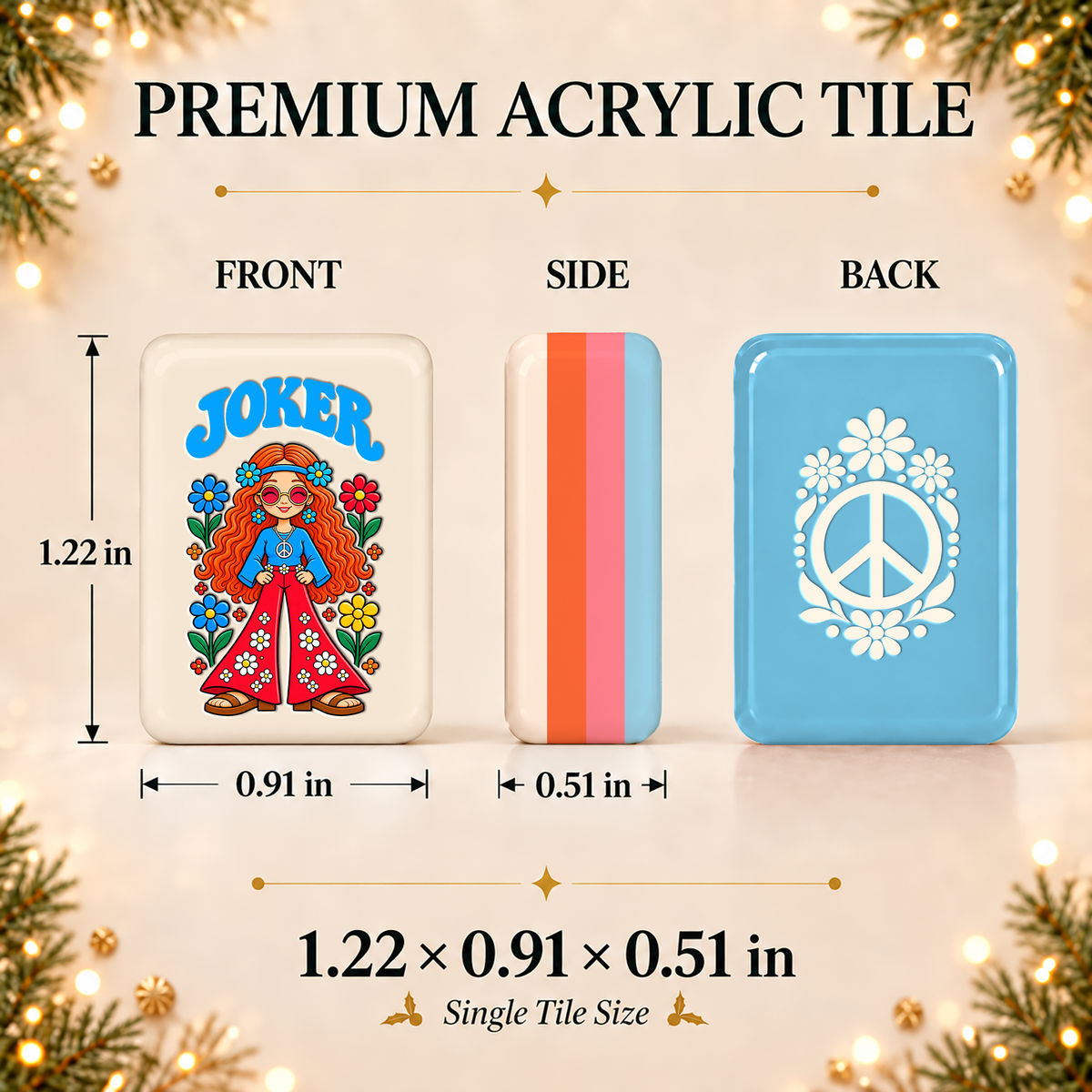
If you've decided mahjong is for you, a few specifics matter. American mahjong uses 152 playing tiles plus 8 jokers—sets are sold as 160-tile collections that include spares. Ensure your set includes a current-year card (the rules change annually). Tile size matters: standard is 1.25 inches wide. If players at your table have vision challenges, look for sets with larger print or engraved symbols. A mahjong mat isn't essential but helps keep tiles organized and quiets the click-clack many players love. Racks with pushers make organizing your hand easier, especially early on.
🎁 See our most-loved mahjong sets & accessories →
If you're gifting to a beginner
Mahjong sets make thoughtful gifts for puzzlers, memory enthusiasts, or anyone looking to join a community. Consider sets with warm designs—many players appreciate engraved or personalized sets that reflect their style. If the recipient already has a group, ask whether they prefer a travel set (compact, portable) or a luxury home set. A mahjong mat or bag and case pairs well with a set for someone serious about the hobby.
✨ Find your Mahstead set — free US shipping →

FAQ
Can you play mahjong with two players like backgammon?
Yes. Two-player and three-player mahjong exist and follow adapted official rules, though four-player is the standard. Two-player mahjong is faster but less commonly taught; most weekly groups play four.
Is backgammon harder to master than mahjong?
Both have high ceilings. Backgammon mastery centers on probability calculation and piece placement strategy—experts study opening moves and endgame theory. Mahjong mastery centers on tile memorization, hand inference, and reading opponents. Most people feel competent at backgammon faster; mahjong depth takes years.
Can you play mahjong online like backgammon?
Yes. Online mahjong platforms exist, though American mahjong online is less common than Chinese or Riichi variants. The social, in-person experience is considered part of mahjong's appeal—many players specifically choose it to gather around a table weekly.
Do I need special tiles or a board?
Backgammon requires a board and 30 checkers; it's complete with just those. Mahjong requires a 160-tile set, which includes all tiles needed. A mat, racks, and a current-year card are highly recommended for beginners but not strictly required to start learning.
Which game is better for a family game night?
Backgammon is easier to teach in 10 minutes and works for two players. Mahjong needs four, takes longer to learn, but becomes a beloved ritual if your family commits. If your group meets regularly, mahjong deepens the tradition; if you want a quick game on random nights, backgammon wins.
What's the cost difference between sets?
Backgammon boards range widely by material and aesthetics. Mahjong sets sold by Mahstead are 160-tile American sets; see current prices on the product page as sets are offered in various designs and customization options. Initial investment is similar, but mahjong players often acquire multiple sets over time because the game becomes a lifestyle.


View More
View More
View More
