
Calling a Discard: When You Can and How to Expose
Last updated: Nov 18, 2026
Mahjong Rules Guide › Level 3 — Play a hand · Guide 15 of 25
What It Means to "Call" a Discard
When another player discards a tile, you have a brief moment to claim it if it helps your hand. Calling that tile means you stop the game, take the discard, add it to tiles from your hand to form a legal exposed group, and place them face-up on the table in front of you. The discard does not go to the dead wall; it becomes part of your exposed set. After you expose, play passes to your left, and the next player draws from the wall.
The key rule: you can call a tile only if it completes a group of 3 or more identical tiles, or if it wins your hand (Mahjong). This is very different from games like rummy—there are no sequences or runs in American mahjong, only identical groups.
What Groups You Can Call Into
American mahjong recognizes only one type of group: identical tiles. A legal group must have:
Pair: 2 identical tiles (you cannot call a discard into a pair)
Pung: 3 identical tiles (you can call a discard here)
Kong: 4 identical tiles (you can call a discard here)
Quint: 5 identical tiles (you can call a discard here)
Sextet: 6 identical tiles (you can call a discard here)
You may never call a discard to complete a single tile or a pair. If you hold two Dots 5 and someone discards a third Dots 5, you cannot call it unless that discard completes your entire hand (Mahjong).
The Role of Jokers in Called Discards
Jokers can replace any tile in a group of 3 or more—and called discards are no exception. If you hold two Red Dragons and a Joker standing in for a Red Dragon, and a Red Dragon is discarded, you can call it. Your exposed pung will show: Red Dragon (called discard), Red Dragon (from your hand), and Joker.
However, jokers cannot stand for tiles in a pair. And if a called discard itself is a Joker (which happens if the discard itself is the Joker tile being played), the same rules apply—you still need a group of 3 or more.
How to Expose Your Called Group: Step by Step
Wait for the discard. When another player discards, the tile lands in the center of the table. Everyone has a moment to claim it. Be ready if the tile helps your hand.
Call clearly. Say "Call" or "Taking" and reach for the tile. At a casual table, you may simply point or take it quickly. The key is to claim it before the next player draws from the wall.
Gather your group. Take the discard plus the matching tiles from your hand (or use jokers as stand-ins). Count them: you must have exactly 3, 4, 5, or 6 tiles, and all must be identical (or be jokers standing in for that tile).
Expose on the table. Place your completed group face-up on the table directly in front of you, between your hand rack and the center. The called discard typically sits to one side or in a clear position so observers can see which tile you called.
Return your tiles to your hand (sort for clarity). After you have exposed the group, remove the same number of unneeded tiles from your hand and discard them on your turn (when it comes around to you). Your hand now has one fewer set of tiles; the exposed group does not count toward your 14.
Play passes to your left. The player to your left now draws from the wall, as if a normal discard cycle had completed.
The rhythm is fast: call, expose, pass. The game does not pause for long.
Example: Calling to Make a Pung
Suppose you have three Bam 2 tiles in your hand and East discards a Bam 2. You call it immediately.
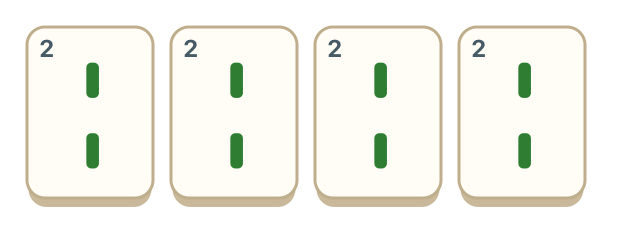
You take the discard and place it on the table with your two Bam 2 from your hand. Your exposed pung now sits in front of you. The three Bam 2 are no longer "in hand"—they are locked in the pung. You remove three different tiles from your hand to bring yourself back to 13 tiles, then discard one when your turn comes.
Gear for this step
Practising calling a discard? It's easier with the right setup — see our mahjong racks with pushers.
Calling a Discard for a Kong or Larger Group
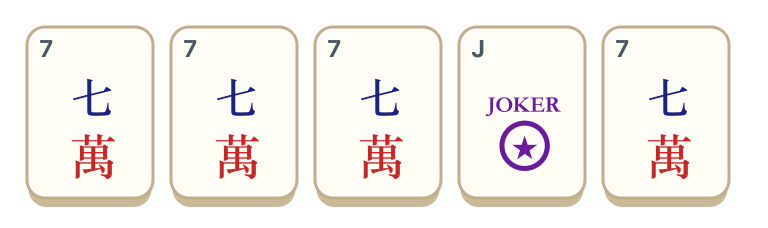
The same rule applies for kongs (4 identical), quints (5), and sextets (6). If you hold three Craks 7 and a Joker standing in for a Craks 7, you have four identical tiles. When someone discards a real Craks 7, you can call it, expose all five tiles (your three, the Joker, and the called discard), and lock that group on the table. Only the called discard is taken from the discards; the Joker was already in your hand.
Calling a Discard to Win (Mahjong)
There is one exception to the "group of 3 or more" rule: you can call a single tile if that tile completes your entire winning hand. If you are one tile away from Mahjong and someone discards that tile, you call it immediately and declare Mahjong. Declaring Mahjong ends the round, and your hand is checked against the current NMJL card.
In this case, you do not need a group of 3—the winning tile might complete a single, a pair, or the final element of a larger combination. The hand as a whole is what matters.
Common Mistakes and Penalties
Calling a Tile for a Pair (Non-Winning)
If you call a discard and someone notices you were trying to complete a pair and you are not winning, you have exposed an illegal group. Table rules vary, but most commonly you are assessed a penalty and play restarts. Always verify you have at least 3 identical tiles (or that the discard wins your hand) before calling.
Slow or Unclear Calls
If you hesitate or fail to call before the next player draws, you have missed the opportunity. The discard enters the dead wall, and you cannot take it. Be decisive at the table—if you think the tile helps, claim it fast. A mistake once in a while is forgiven; chronic delays slow the game.
Calling When You Cannot Legally Form the Group
If you call a tile but then realize you do not actually have two matching tiles in your hand, you have a dead hand and the round ends in a penalty. Double-check your rack before calling, especially when jokers are involved. Many players use mahjong racks with pushers to keep tiles sorted and clear, which makes it easier to spot matches in a split second.
Misidentifying a Tile
If you call "Dots 5" but the discard was actually "Bams 5," you have called for a tile that does not match your group. This is typically treated as either a correction-and-no-call or a dead hand, depending on house rules. Use the moment of silence before the next draw to verify the tile's suit and number.
Redeemed Jokers and Called Discards
If you have an exposed group with a Joker standing in for a tile, any player may redeem that Joker on their turn by playing the real tile. However, when you call a discard, the Joker does not get redeemed at that moment—it stays in your exposed group until another player's turn and they choose to redeem it (if they can).
Next Steps
Now that you understand when and how to call a discard and expose a group, you are ready to learn about the full rhythm of a turn—what happens after you call, when you draw, and how to handle multiple calls in one round. Your next guide covers turn order, drawing, and discarding in detail. From there, you will move into special situations like joker redemption and how to read the card accurately so you know which hands are within reach on your table.
More in Level 3 — Play a hand
Ready to play at your own table?
Engraved 160-tile American mahjong sets, mats and racks — free shipping across the US.


View More
View More
View More
