
How Jokers Work: Where They Can and Can't Go
Last updated: Nov 18, 2026
Mahjong Rules Guide › Level 3 — Play a hand · Guide 16 of 25
Jokers can stand in for any tile in a group of 3 or more identical tiles (a pung, kong, quint, or sextet). They cannot appear in pairs or singles. This rule is absolute and applies whether your groups are concealed in your hand or exposed on the table.
The Core Rule: Groups of 3 or More Only
A joker's job is to substitute for a real tile when you are building a set of multiples. The moment a group has three or more identical tiles, a joker can replace any of them—even all of them. But a pair (two tiles) and a single tile (one tile) have no room for jokers, because the pattern is too small to hide a substitute.
Why? In American mahjong, the card is the truth. When the card says you need "D5 D5 D5 / D5 J J," the two J jokers are standing in for two more D5s to make a sextet. A player reading your hand must immediately see: "Those jokers are D5s." With only two tiles, there is no way to tell what a joker represents—it creates ambiguity and breaks the fundamental rule that every hand must be readable from the card.
Where Jokers Work: Legal Positions
Jokers in a Pung (3 identical tiles)
A pung is three identical tiles. One joker can take the place of one real tile.
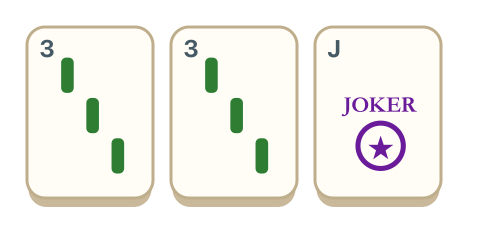
The joker is exposed on the table and anyone at the table immediately knows: "That joker is a B3." You may also hold a concealed pung with a joker—for example, in your hand you might keep B3 B3 J as your three B3s until the moment you are ready to expose or declare.
Jokers in a Kong (4 identical tiles)
A kong is four identical tiles. You can use one joker, two jokers, or even all four tiles can be jokers (though having the real tiles is rare in mid-game).
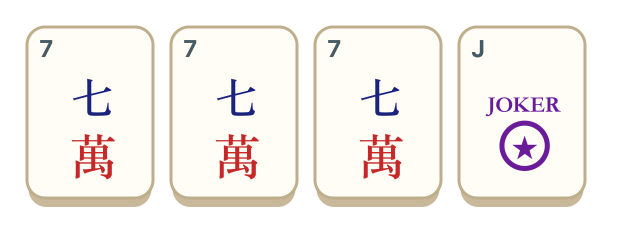
More often, if you are holding or calling a kong, one joker is typical. The remaining real tiles stay in your possession until you expose, or they stay hidden in your hand if the kong is concealed.
Jokers in a Quint (5 identical tiles)
A quint is five identical tiles. You can use one, two, three, or even all five jokers—though you must still have enough real tiles in the game to make the group legal (there are only four of each real tile in a standard set).
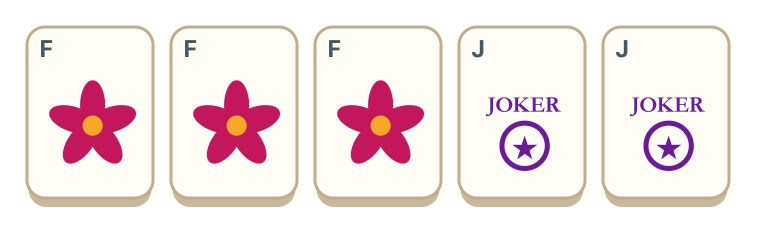
Quints are common on the card because Flowers, Dragons, and Winds (each with only 4 real copies) often appear in groups of 5 or 6, requiring jokers to complete them.
Jokers in a Sextet (6 identical tiles)
A sextet is six identical tiles. In a game where you have best-selling mahjong sets with 160 tiles, you will sometimes draw or build a 6-tile group. Jokers fill the gaps.
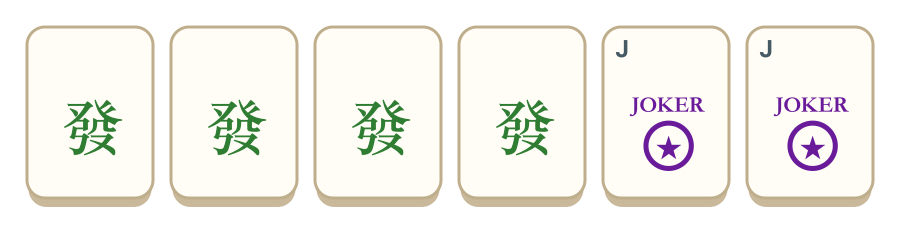
Sextets are less common than quintet, but they appear on the card—especially with Winds and Dragons, where you need more copies than the standard four real tiles allow.
Where Jokers Do NOT Work: Forbidden Positions
No Jokers in Pairs
A pair is exactly two identical tiles. You cannot use a joker as one of the two tiles in a pair. A pair is a pair only when both tiles are the real, identical suit and number.
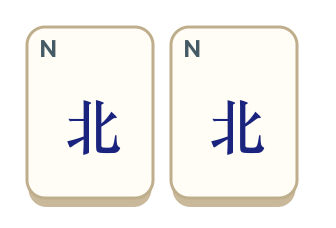
This rule is strict because a pair is a fixed anchor in every hand—it sits in your rack as-is, and must be readable at a glance. When you declare Mahjong, the pair you lay down is examined first. If a joker is in it, your hand is dead.
No Jokers as Singles
A single tile is a tile that stands alone in a hand position—it is not part of a group. If you are building a hand and one space needs to be filled by just one tile (a single), that tile must be real. Jokers cannot substitute for singles.
Why? Because a single tile has no context. It is not a pair; it is not part of a set of three. There is no way to know what a joker is supposed to be if it is sitting alone. The card structure assumes every single tile is a specific, real tile.
Jokers Cannot Redeem Each Other
If you expose a group on the table that includes a joker, and later another player redeems that joker by playing the real tile, you remove the joker from the group and add the real tile. You do not swap a joker for another joker. The redemption brings in a real tile, and the joker leaves the table entirely.
Jokers on the Table vs. in Your Hand
Exposed groups with jokers: When you call a discard and expose a pung, kong, quint, or sextet that includes a joker, that joker sits on the table and is visible to all players. Any player on their turn may redeem it if they hold the real tile. The joker remains part of that group until it is redeemed or your hand ends.
Concealed groups with jokers: You may keep a group with a joker hidden in your hand. For example, you can hold three N Winds, one of which is a joker, and not expose them. That joker only becomes visible if you expose the group later or if you declare Mahjong with that group in your hand. Until then, only you know the joker is there.
Gear for this step
Practising how jokers work? It's easier with the right setup — see our best-selling mahjong sets.
Counting Jokers: The 8-Joker Limit
A standard American mahjong tile set contains 8 jokers. You cannot have more than 8 jokers in play at any one time (though many players own larger sets). If the card calls for more than 8 jokers, the hand cannot be completed; that scenario is rare and is usually flagged on the card itself or resolved by table agreement.
In practice, most hands use 0 to 3 jokers. A hand using 5 or more jokers is heavy and requires careful attention to avoid making a dead hand.
Jokers and Calling Discards
When you call a discard from another player, the tile you call must complete a group of 3 or more. If you are calling to complete a group that includes a joker, that is legal. For example:
You hold S S J (South Wind, South Wind, joker) in your hand.
Another player discards a South Wind.
You call that discard, exposing your S S J as a complete pung. The joker was already standing in for a third South Wind; now you have called the real one to finish the group.
What you cannot do: call a discard to fill a pair or a single, no matter how many jokers are elsewhere in your hand.
Common Mistakes
Mistake 1: Using a joker in a pair at the end. A player may try to declare Mahjong with a pair containing a joker, thinking "The joker can be anything." It cannot. If your pair has a joker in it, your hand is dead, and you lose that hand and pay a penalty. Always verify your pair is real before you announce Mahjong.
Mistake 2: Hiding the identity of a joker. If you expose a group with a joker on the table, make sure it is immediately clear what tile the joker represents. If another player has to ask, "Which tile is that joker?" you have made an error. State it aloud: "Kong of D7s with one joker," and position the joker so its companions are obvious.
Mistake 3: Forgetting that a joker can be redeemed. Once you expose a joker on the table as part of a group, any player on their turn can redeem it if they hold the matching real tile. Do not assume your exposed joker is safe. Plan for the possibility that another player will take it.
Mistake 4: Using jokers in the wrong group size. A joker cannot be used in a pair or single. If you are trying to fill out a small hand and think "I'll just make a pair with a joker," stop. You need real tiles. Jokers are team players—they work only in groups of three or more.
Next Step
Now that you understand how jokers fit into groups, the next guide will show you what happens when another player holds the real tile you need—and redeems your exposed joker. Learning to time your joker plays and manage the risk of redemption is a key skill for intermediate play.
More in Level 3 — Play a hand
Ready to play at your own table?
Engraved 160-tile American mahjong sets, mats and racks — free shipping across the US.


View More
View More
View More
