
Blind Pass in Mahjong Examples: American Rules & Tips
Last updated: Nov 23, 2026

During the Charleston (the tile-passing ritual before American mahjong play begins), the blind pass occurs in round three: you pass three tiles face-down to the player across the table without looking at their tiles or yours. You do this after the first pass (to your right, face-up) and the second pass (to your left, face-down); the player opposite must accept what you send without knowing their content beforehand. The blind pass is mandatory if any player at the table requests it (a right every player holds), and if all four players decline the blind pass, play begins with no third exchange. It typically takes 10–15 seconds per person. The goal is to inject randomness into your starting hand and prevent overly predictable openings, which keeps the game strategic and social. Brush up on full Charleston rules here.
The blind pass is often the most nerve-wracking moment of the Charleston, because unlike the first two passes (where you either see exactly what you're sending or receiving), you're surrendering control. You hand over three tiles without any visual feedback, then receive three mystery tiles in return. That unpredictability is precisely why it exists: it levels the playing field and stops experienced players from engineering a perfect hand before the game even starts.
Why do we even have a blind pass in American mahjong?
The blind pass prevents players from stacking their hand deliberately during the Charleston. If both the first and second passes were visible and optional, a skilled player could theoretically engineer a winning hand before play begins—especially if the table agrees to skip the blind pass. The rule ensures that luck and strategy both play a role. Learning how to play American mahjong includes understanding why each step of the Charleston exists; the blind pass is a check on excessive control and encourages players to adapt after receiving unknown tiles.
What exactly happens during a blind pass?
You select three tiles from your hand without showing them to anyone. You pass them face-down to the player sitting directly across you (not to your left or right, as in the first two passes). That player simultaneously passes three of their face-down tiles back to you. The exchange is simultaneous—no one peeks until the pass is complete. If you're sitting North, you pass to South; if East, you pass to West. After the blind pass concludes, every player now has 13 tiles (you started with 14 after the initial draw, passed one to your right in the first pass, received one from your left in the second pass, then passed three and received three in the blind pass). All tiles remain in hand until play begins.
When must the blind pass happen?
The blind pass occurs during round three of the Charleston if any player requests it. This is a table decision made before the Charleston begins. Some casual home games skip it entirely; tournament play always includes it. If all four players agree to waive the blind pass, you proceed directly to play. If even one player says "blind pass, please," everyone must do it. There is no negotiation. Once the Charleston and blind pass are complete, the player to the dealer's right discards first, and play begins.
What are common mistakes during the blind pass?
Mistake | Why it happens | How to avoid it |
Peeking at tiles before the pass is complete | Nerves; you want to know what you're getting | Place your three tiles in a small pile, cover them with your hand, and slide them toward the center. Don't touch your received tiles until the passer has let go. |
Passing tiles slowly, one at a time | Indecision or fatigue | Gather your three tiles, hold them as a small packet, and pass them in one smooth motion. Everyone benefits from a quick pass. |
Forgetting the direction (passing to your left instead of across) | Confusion after two previous passes in different directions | Announce "blind pass" aloud before it begins. Say "I'm passing to [player name] across from me" to confirm. |
Refusing the blind pass when another player requests it | Misunderstanding the rules | Accept that any one player's request overrides everyone else's preference. The blind pass is not optional for you—it's mandatory for the table. |
Picking up your received tiles too early | Impatience; wanting to see what you got | Wait for the dealer (or the person coordinating) to announce "pass complete" or "ready to play." Count to three silently after the pass. |
The most common real-world error we see: players pass their tiles but then immediately grab the tiles coming toward them before the other person has fully released them. This creates confusion about who passed what and can lead to disputes. Slow down by two seconds and make eye contact with the player across from you—it creates a natural rhythm and ensures a clean handoff.
How do you strategize which three tiles to send?
Many new players ask: "Should I send my worst tiles, or my best?" The honest answer is neither—you send tiles that leave your hand balanced. If you're working toward a hand that requires two specific suits, a blind pass is your chance to break the other suit. If you have four 1 Dots and three Red Dragons, you might send the three Red Dragons blind, hoping to receive something that completes a different pattern. But remember: you won't know what you're receiving, so the strategy is defensive (eliminate unwanted tiles) rather than offensive (assemble your winning hand). Check the current year's mahjong card to see which hands are playable before you decide what to pass.
🀄 Shop best-selling mahjong sets →
Real game example: the blind pass in action
Scenario: It's round three of the Charleston. You're sitting East. You have 13 tiles: 1, 3, 5 Bams; 2, 4, 6 Craks; 1, 3, 5, 7, 9 Dots; two White Dragons. You just received a White Dragon in the second pass and now hold two White Dragons, which is useful. In the first two passes, your pile has steadily accumulated high Dots. But you only need 0–2 White Dragons for most hands this year. You decide to pass your two White Dragons and one 1 Bam blind to the player sitting West (across from you). West passes three random tiles back to you. You receive 2 Dots, 3 Craks, and 1 Bam. Suddenly, you have three 1 Bams and a new Crak suit fragment. Your hand just shifted. You now have to adapt your strategy based on what you received in the blind pass, not on what you engineered in the first two passes. That adaptation is the entire point.
What happens if two players are sitting side-by-side but the blind pass is supposed to go across?
This is a table-geometry question. Blind pass always goes to the player directly opposite you—the one who is not your left neighbor or right neighbor. If your table is square and each seat is labeled North, East, South, West, North passes to South, and East passes to West. If your table is rectangular or has an unusual shape, agree before the Charleston begins who sits "across" from whom. Some players use a simple rule: if you can see the player's face head-on without turning your head, that's your blind-pass partner.
🎁 See our most-loved mahjong sets & accessories →
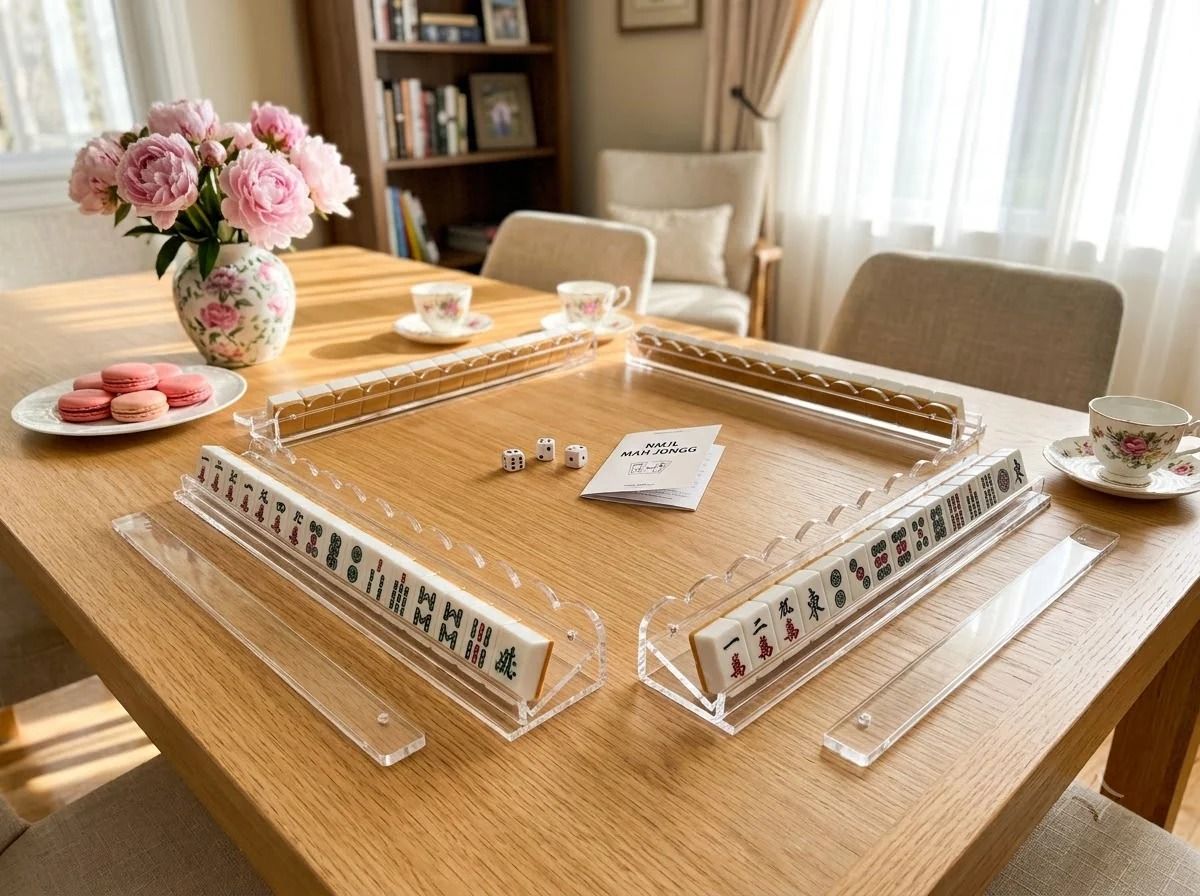
When setting up your weekly game at home, a good mat and tile organizer racks make the Charleston—including the blind pass—faster and clearer for everyone. A raised wall (from a mat or rack system) ensures tiles don't scatter and that the blind pass direction is obvious because each player's space is defined.
What to check before you play with a new group
Before your first game with a new table, confirm:
Does this group do a blind pass? Ask before the Charleston begins.
Which direction counts as "across"? Point to the player opposite you and say, "I pass to you blind, right?"
Can you decline and have it rescind for the whole table? (Answer: no. If one player requests it, it happens.)
What's the signal that the pass is complete? (Often someone says "pass complete" or the dealer announces "ready to play.")
If you're hosting and own an engraved American mahjong set, consider one with a design or saying that makes the table feel cohesive—it eases first-time jitters and sets a welcoming tone before the Charleston begins.
✨ Find your Mahstead set — free US shipping →

FAQ
Can I look at the tiles I receive during the blind pass before play starts?
Yes. The "blind" part means you pass without seeing what you're sending and don't peek while the exchange happens. Once the pass is complete and the dealer confirms play is about to begin, you can organize and study your 13 tiles before the first discard.
What if the player across from me isn't sitting directly opposite—what if the table is crowded?
Agree on "across" before the Charleston. Usually it's the player farthest from you. If genuinely ambiguous, ask the dealer or a veteran player at the table to clarify your blind-pass partner before round three begins.
Do I have to pass three tiles in the blind pass, or can I pass fewer?
Always three tiles, no exceptions. The blind pass is always a three-tile exchange, same as the first and second passes. If you pass fewer, the exchange is incomplete and the game cannot begin.
Can I announce what I'm about to pass blind so the table knows I'm about to do it?
You don't need to announce it—the blind pass is simply the third round of the Charleston after the first two passes are done. If a player asked for the blind pass at the start, it's understood. A casual "passing blind" as you reach across is fine and helps avoid confusion.
If someone accidentally peeks at their blind pass tiles before they leave my hand, do we restart?
No restart required. The pass is complete once the tiles leave your hand. If someone peeks before or during, gently remind them that the blind pass is blind for a reason, but play continues. Peeking is a common accident, not a rules violation.
Does the blind pass change the balance of the game or favor one player?
The blind pass is random by design, so no player gains an inherent advantage. It's meant to level the playing field and ensure that no one enters play with a hand that's too perfectly engineered. Everyone experiences the same surprise.


View More
View More
View More
