
Birthday Mahjong Tournament Format: Rules & Setup Guide
Last updated: Nov 23, 2026
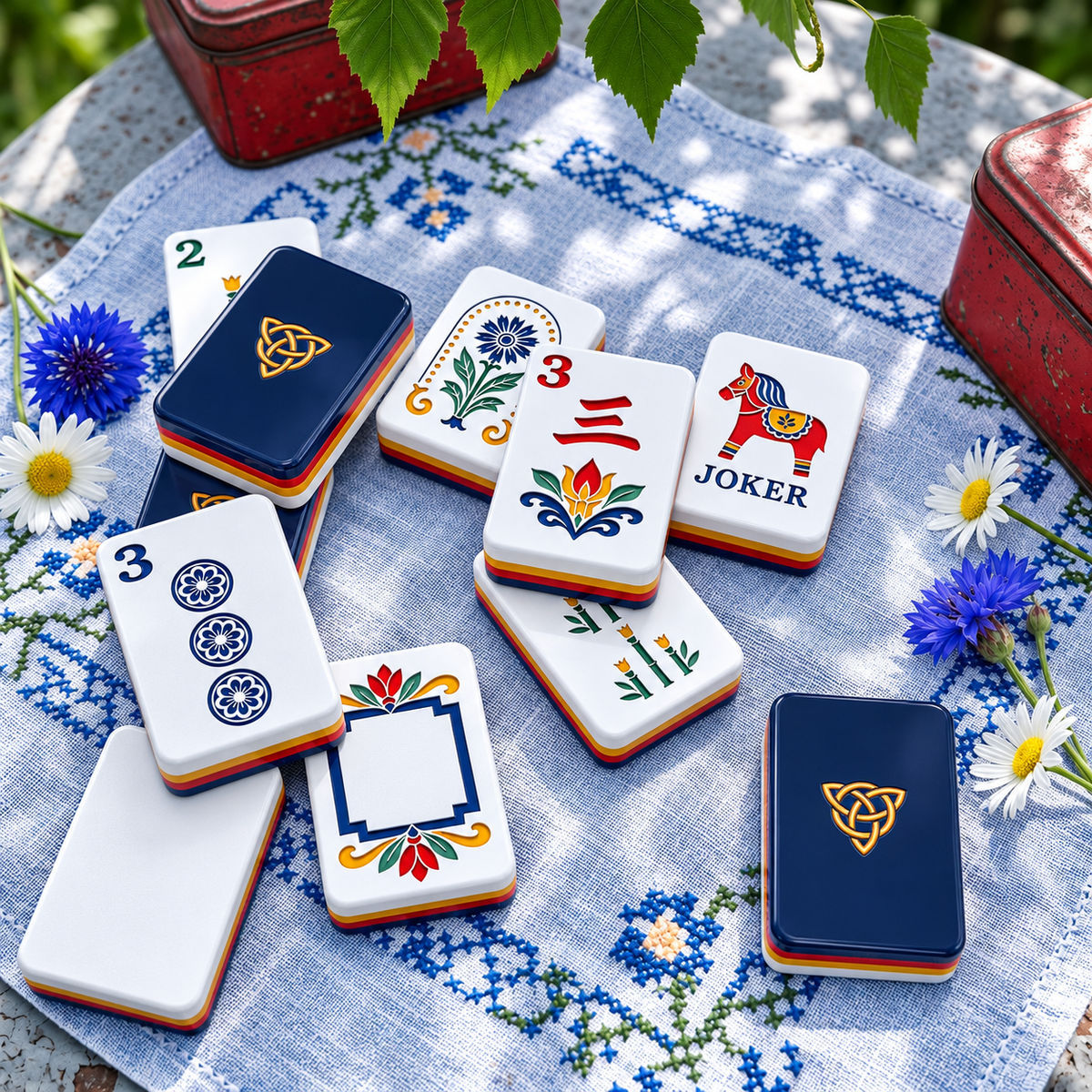
A birthday mahjong tournament isn't just four people playing—it's an event. We've hosted enough games to know what goes right and what derails halfway through. This guide walks you through format choices, scoring logic, timeline, and the equipment decisions that prevent chaos at the table.
What's the difference between round-robin and bracket tournaments?
Round-robin means every player sits with every other player exactly once over multiple rounds. Bracket tournaments pair winners and losers separately, like tennis. For a birthday party with 4–6 regular players, round-robin is simpler: three rounds, fixed rotation, everyone plays the same number of games. With 8–12 players, bracket or Swiss-system (a hybrid where winners play winners, losers play losers) scales better and stays interesting. Round-robin works best when players are evenly skilled; bracket favors competitive groups. Count your guests first—it determines everything else.

How do you calculate points across multiple games?
American mahjong scoring awards 1x, 2x, 3x, or 4x the hand's base point value depending on exposure and whether it's the player's first or last win of the game. The National Mah Jongg League card lists each legal hand with its point multiplier. For a tournament, total each player's points across all rounds; highest total wins. Keep a simple printed scoresheet: Player name, Round 1, Round 2, Round 3, Total. Some hosts add a tiebreaker rule (e.g., wins second). Avoid house-rule scoring during a tournament—stick to standard American rules so no one disputes results. Learn more about American mahjong scoring if your group plays with variations.
Tournament Aspect | Round-Robin (4–6 players) | Bracket (8–12 players) |
Rounds needed | N = number of players minus one | Log₂ of players (e.g., 8 players = 3 rounds) |
Games per player | N (same for all) | 3–4 typically |
Seeding complexity | None; rotate fixed order | Required before Round 1 |
Skill balance | Works best if evenly matched | Separates strong from new players quickly |
Scoresheet burden | One column per round | Advances/eliminations or points ladder |
Party vibe | Inclusive; everyone plays together | Competitive; focused groups |
What timeline works for a birthday tournament with 8 people?
Eight players typically means two tables running in parallel. Plan for 20–30 minutes per game (deal, Charleston, play, scoring). Build in 5–10 minutes between rounds for score entry and new seating.
Sample 4-hour timeline (two tables of 4):
0:00–0:10 — Welcome, rules review, confirm current NMJL card year
0:10–0:15 — Assign tables and initial wind positions
0:15–0:45 — Round 1 (simultaneous at both tables)
0:45–1:00 — Score tallying, seating for Round 2
1:00–1:30 — Round 2
1:30–1:50 — Break, snacks, score review
1:50–2:20 — Round 3
2:20–2:40 — Final tally, awards, photos
2:40–4:00 — Open play (casual games, cake, celebration)
This rhythm keeps energy up without exhaustion. Pro tip: print scoreboards in advance and assign a non-playing scorekeeper if you have nine or more people.
What equipment do you actually need for a multi-table birthday tournament?
You'll need one complete 160-tile American mahjong set per table. Our best-selling mahjong sets come with tiles, racks with pushers, and dice—everything a table requires. For a birthday event, we recommend sets with engraved or fun designs: many hosts pick personalized or themed designs to make the celebration memorable. Each set includes spare jokers, so missing tiles mid-tournament won't ruin the day.
Beyond sets, bring:
Mahjong mats — One per table protects surfaces and speeds tile sorting. Explore our durable mats so players don't slide tiles across wood or glass.
Current NMJL card (printed copies) — One per table; laminate if possible so spilled drinks don't erase hand patterns.
Scoresheet (printed, one per table) — Prevents phone chaos and keeps records transparent.
Backup jokers — Tiles go missing. Our sets come with spares; keep them in a small bag.
Timer (phone app or kitchen timer) — Optional but useful for keeping rounds on pace.
If you're hosting 12 people across three tables, that's three complete sets. Browse travel cases if you're transporting them; a padded bag makes setup and breakdown stress-free.
What rules clarifications prevent birthday-game disputes?
Before anyone sits down, nail these rules in writing:
Joker rules — Jokers can only replace tiles in exposed melds (pungs, kongs, quints, sextets), never in pairs or single tiles. Understand joker mechanics fully to settle any "can I play this?" questions instantly.
Charleston timing — The Charleston (tile-passing ritual before play) must follow the same three passes every round. If someone passes wrong, stop, reset, and restart. See the full Charleston protocol before Round 1.
Card year lock — Everyone plays using the same year's National Mah Jongg League card—do not mix years. If someone proposes a hand from an old card, it's not valid. Print the year on the scoresheet.
Self-draw vs. claim — American mahjong allows claiming discarded tiles to complete a legal hand. Set a time limit for claiming (typically 5 seconds before the next player draws). A player cannot claim a tile, say "wait," then un-claim it.
Payment and prizes — Agree before play whether the tournament is for fun or points only, or if prize amounts are involved. Write it on the scoresheet so no one feels blindsided at the end.
Common birthday disputes we've seen: someone using an illegal hand from a years-old card, confusion over joker placement, and unclear seating for Round 2. Print and review the rules sheet before cake. It takes 10 minutes upfront and saves 20 minutes of argument later.

How do you set up seating and wind positions fairly?
Round 1 seating: Assign players to tables randomly (pull names from a hat or use a random number generator). At each table, designate Wind positions (East, South, West, North) by drawing from tiles: pull the four winds, shuffle, and deal one per player. East plays first and is considered the strongest seat in a round. Write Wind assignments on the scoresheet.
Round 2 and beyond (round-robin): Rotate players so no two play together twice. Use a rotation schedule (search "round-robin scheduling" online; many free tools generate them). If players aren't evenly distributed, one table will have three players—that's fine, and the fourth seat rotates to a different table next round.
Round 2 and beyond (bracket): Advance the top two scorers from each table to Table A (winners' bracket), and the bottom two to Table B (losers' bracket). Reshuffle winds randomly within each table.
Print the seating chart and tape it to the wall. Players see exactly where they sit, eliminating "who do I play with?" confusion.
🀄 Shop best-selling mahjong sets →
What should you check before you buy sets for a birthday tournament?
Before ordering or borrowing equipment:
Tile count: Confirm you have one full 160-tile set per table (152 playing tiles + spares). Never share tiles between tables mid-tournament.
Joker count: Ensure spare jokers are present. Losing a joker mid-game grinds play to a halt.
Rack condition: Pushers should slide smoothly; cracked racks frustrate players. Test racks in advance.
Mat cleanliness: Wipe down mats or bring new ones so tiles move freely and players don't get distracted by grime.
Tile readability: Check that all symbols and numbers are legible from arm's length. Faded sets confuse newer players.
Card condition: Laminate printed NMJL cards or use card sleeves so coffee spills don't obliterate the hand patterns during breaks.
Set up a practice table the evening before the tournament. Draw a sample hand, run through a Charleston, and play a few tiles. If anything feels off—sticking tiles, missing pieces, unclear symbols—you have time to replace or repair it.
🎁 See our most-loved mahjong sets & accessories →
Sample birthday tournament scoresheet (what to include)
Print one scoresheet per table:
``` BIRTHDAY MAHJONG TOURNAMENT — [Date] Table: ___ Card Year: ___
Player Name | Wind | R1 Pts | R2 Pts | R3 Pts | Total | Rank [Name 1] | E | | | | | [Name 2] | S | | | | | [Name 3] | W | | | | | [Name 4] | N | | | | |
Rules reminder: Jokers only in exposed melds. Charleston = 3 passes. No mixed-year hands. Self-claim window = 5 seconds. ```
Fill in names and winds before play. After each round, tally points and announce who moves to the next round (if bracket) or which table players rotate to (if round-robin). Post the cumulative totals on a central board so everyone can see standings.
✨ Find your Mahstead set — free US shipping →
Gift idea: personalized or seasonal sets for tournament hosts
If you're the birthday player and others are hosting the tournament for you, engraved mahjong sets make excellent thank-you gifts for co-hosts. Many players treasure a set with a meaningful design or inside joke. Our new arrivals rotate seasonally, so if the birthday falls near a holiday, themed sets add festive energy. A host who receives a keepsake set often organizes the next tournament, so it pays dividends.

FAQ
Can I run a birthday mahjong tournament with fewer than four people?
With three players, you'd need adapted rules for 2 and 3 player mahjong, which use fewer tiles and different hand patterns. Standard American mahjong tournaments assume four seated players per table, so a three-player format requires special hands from a modified card. If you have exactly three people, play casual rounds instead.
What if someone doesn't know how to play American mahjong yet?
Host a 30-minute teaching session before the tournament begins. Walk through how to play American mahjong, the Charleston, and how to read the mahjong card. Pair newer players at the same table with experienced ones in Round 1, or mix them across tables. A birthday celebration should welcome all skill levels.
How do I explain American mahjong scoring to guests who've never played?
The National Mah Jongg League card assigns a point multiplier (1x, 2x, 3x, 4x) to every legal hand based on difficulty and exposure. The winner of a round collects points from each player. American mahjong scoring details the system fully. Print a one-page summary for each table so players don't ask repeatedly.
Should the birthday person have a seeding advantage in bracket play?
No. Fair competition means random seating in Round 1, and results determine brackets thereafter. If you want the birthday person to feel special, give them first pick of which table they sit at, or assign East wind (the player who draws first) as a courtesy. Rigging the bracket defeats the fun of a tournament.
How do I handle tied scores at the end?
Before Round 1, announce a tiebreaker rule: most wins (games won, not points), head-to-head results if only two are tied, or highest single-game score. Write it on the scoresheet. Apply it consistently. If two people end with identical scores and identical tiebreakers, they can split a prize or play a final tiebreaker game.
Can I run a tournament with mixed skill levels?
Yes, if you seed carefully. In Round 1, place strong players at separate tables so they don't dominate one table's scores. Use bracket play (not round-robin) so winners and new players don't play each other repeatedly. Experienced players often enjoy mentoring; frame it as a birthday learning celebration, not just a win race.


View More
View More
View More
