
Big Three Dragons Mahjong: Meaning and Points Explained
Last updated: Nov 23, 2026
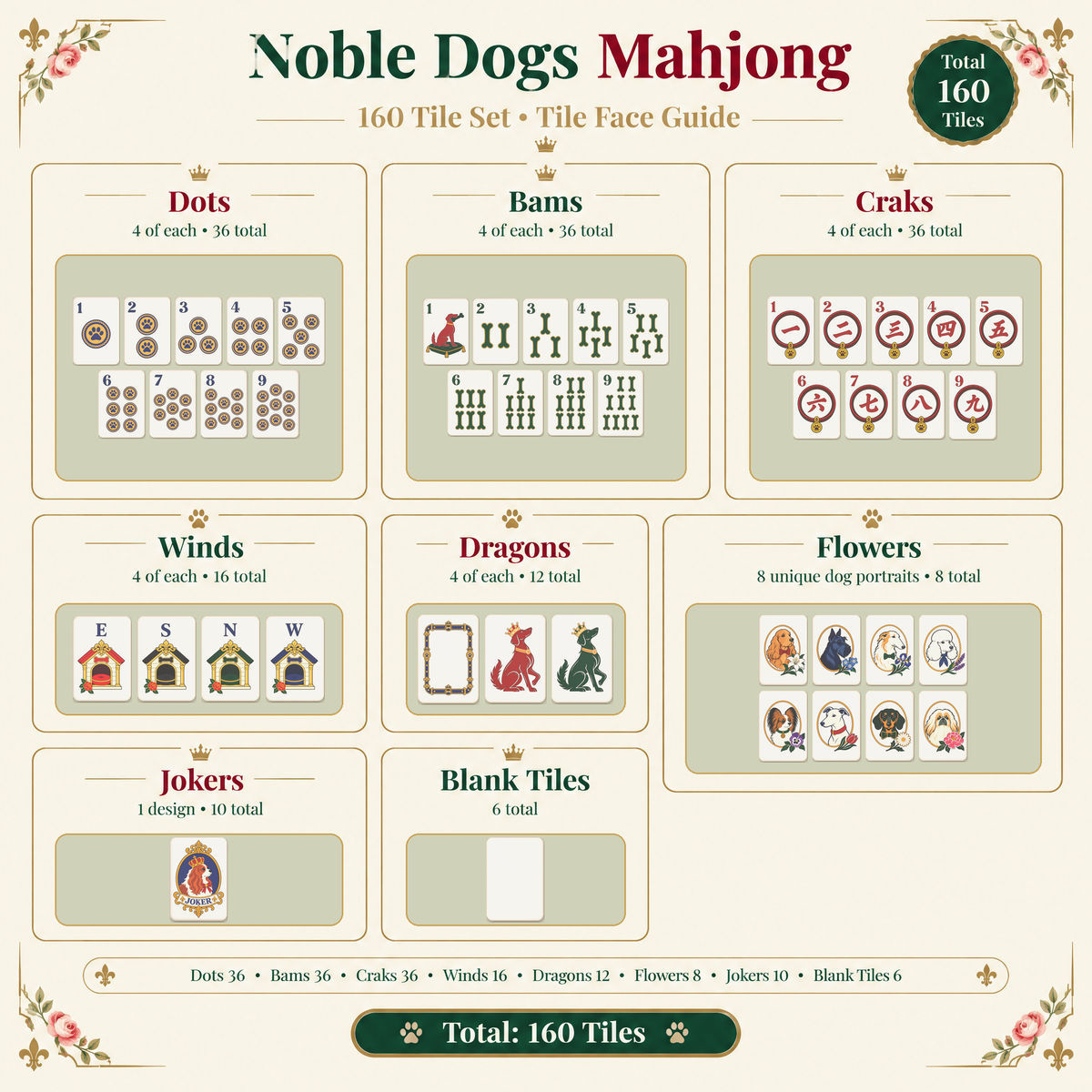
The Big Three Dragons refers to collecting all three dragon types—Red (paired with Craks), Green (paired with Bams), and White/Soap (paired with Dots)—as matching sets in a single hand. In American mahjong, this is always a bonus, never a foundational pattern, meaning you build a legal hand first from the current year's National Mah Jongg League card, then add the dragon bonus on top. The points awarded vary by card year and hand classification but typically range from 40 to 60 bonus points when achieved. Each dragon pung, kong, or higher exposure counts toward the bonus; jokers can fill in missing dragons. This combination appears on the card as a separate bonus line, not as a hand pattern itself, so you must match both the base hand and the bonus requirement simultaneously to claim the full score. Many newer players confuse it with other dragon patterns or miss the bonus entirely because they don't check the card's bonus section before declaring.
The Big Three Dragons is one of the most rewarding—and most overlooked—bonuses in American mahjong, especially for players still learning to read how to read the mahjong card. When you collect all three types of dragons (Red, Green, and White), you unlock a significant points boost on top of your base hand score. But the trick is that American mahjong plays by rigid rules: you can't just throw three dragons together and win. You must satisfy your hand first, and the dragons must fit the bonus conditions laid out on that year's card. Let's walk through exactly what this means, how to spot it in real play, and how to avoid the common mistakes that cost players serious points.
What exactly are the three dragons in American mahjong?
In American mahjong, dragons are honor tiles unrelated to any number. Red dragons traditionally pair with Craks (the suit showing circular symbols). Green dragons pair with Bams (the suit often showing bamboo or a bird-like pattern on the 1 Bam). White dragons (also called "Soap" because of their blank appearance) pair with Dots and also serve as zero. Each dragon exists in exactly four copies in a standard 160-tile set, giving you multiple chances to collect them. Unlike suits, which go 1–9 in each type, dragons have no rank order—they're individual honors that only matter when grouped together as pungs, kongs, or higher exposures.

How does the Big Three Dragons bonus work on the card?
The Big Three Dragons bonus lives in a dedicated section on the National Mah Jongg League card, separate from base hand patterns. To claim it, your hand must satisfy two things at once: first, you must match one of the legal hands listed on the card that year; second, you must have all three types of dragons showing (either exposed or in your concealed 14 tiles). The bonus doesn't replace your hand—it adds to it. So if your base hand scores 30 points and you hold all three dragons as required, you add the dragon bonus on top, often reaching 70–90 points total. The card specifies which dragon groupings count: typically, each dragon must be at least a pung (three identical tiles). Jokers can substitute for any dragon tile you're missing within a pung or kong, but you still need to demonstrate all three dragon types on the table or in hand.
What's the point value, and does it change year to year?
Point values for bonuses, including the Big Three Dragons, are printed directly on each year's card and vary by hand classification and game context. Because the card is reissued every spring by the National Mah Jongg League, the exact point total for this bonus can shift from year to year. In general, bonus points range from 40 to 60, but we've seen variations depending on hand difficulty and whether you're playing casual or tournament rules. The safest approach: always check the card's bonus section before declaring a hand. Never assume last year's point value applies this season. Discussing the exact bonus with your table before the game begins prevents disputes and keeps everyone confident in their scoring decisions.
Common mistakes that cost you the bonus
Forgetting to check the bonus section before declaring. Many players focus only on the base hand patterns and don't realize they've also achieved the Big Three Dragons. By the time you notice, you've already declared a lower-scoring hand. The fix: scan the bonus rows every time you're close to winning.
Misplacing a dragon in the wrong suit pairing. Red must be a Crak-related hand, Green a Bam-related hand, White a Dot-related hand. If your base hand is all Craks but you try to claim the dragon bonus, you're mixing rules. Verify suit alignment before committing.
Using jokers incorrectly to fill dragons. Jokers can substitute for missing dragons within a pung or kong (three or four of the same type). They cannot create a dragon set that doesn't already have at least one real dragon tile. For details on how jokers work in American mahjong, learn how jokers work.
Declaring the bonus with only two dragons. You must have all three types visible. Two dragons don't qualify; the card is clear on this.
🀄 Shop best-selling mahjong sets →
Step-by-step: How to claim the Big Three Dragons bonus
Build your base hand first. Match any legal hand pattern from the card—Pung, Kong, Quint, Sextet, or mixed combinations. Do not focus on dragons yet.
Check the card's bonus section. Look for the Big Three Dragons bonus row. Confirm the point value and any restrictions (e.g., minimum hand class, suit alignment).
Count your dragon tiles. Verify you have at least one real copy of each dragon type (Red, Green, White) or a joker substituting within a pung/kong of that dragon.
Expose dragons if required. American mahjong rules allow you to expose pungs, kongs, quints, and sextets. If your bonus rule requires visible dragons, lay them down on the table during your turn.
Declare your base hand and bonus together. Name both the primary hand and the bonus. Announce the total points. Example: "Pung hand, 30 points, plus Big Three Dragons, 50 points, for 80 total."
Verify with the table. Let other players confirm before finalizing the score. Mistakes caught early preserve goodwill.

Comparing dragon bonuses: Big Three vs. other dragon patterns
Pattern | Requirement | Typical Points | When to Look For It |
Big Three Dragons | All three dragon types showing (any grouping) | 40–60 | Every hand close to completion |
Like Number Dragons | Dragons and matching numeric Pung from same suit | 20–40 | Mid-game hands with suit consistency |
All Simples + Dragons | Numeric tiles 2–8 plus dragon bonus | Variable | Hands avoiding terminals and honors |
Quint/Sextet Dragons | Five or six identical dragons in one hand | 50–80 | Rare; requires multiple copies of one type |
The Big Three Dragons bonus stands out because it doesn't require matching numbers or even the same suit—it rewards diversity. This makes it more achievable than patterns like "Like Number Dragons," which demand a specific numeric pung from the same suit as your dragon collection. That said, it only applies once you've already won a legal hand, so it's a pure bonus, not a shortcut.
Why beginners miss this bonus (and how to train yourself to spot it)
New players often focus narrowly on completing a single hand pattern and tunnel-vision past bonus opportunities. The card's layout can be overwhelming: base patterns occupy most of the space, and bonuses live in smaller print at the bottom or side. Here's a practical training method:
Before your turn ends, scan the bonus section. Spend five seconds looking for Big Three Dragons if you have two dragon types showing.
Color-code your mental map. If you remember Red = Craks, Green = Bams, White = Dots, you'll spot misalignments faster.
Ask your table about bonuses. "I have all three dragons—does this hand qualify for the Big Three bonus?" Normalizes the question and builds collective knowledge.
Review hands after play. If you missed a bonus this round, discuss it during cleanup. Repetition rewires pattern recognition.
🎁 See our most-loved mahjong sets & accessories →
What you'll need to play confidently
Claiming the Big Three Dragons bonus requires reliable equipment and a current card. A best-selling mahjong set with clearly engraved dragon tiles eliminates confusion about which dragons you're holding, especially if you wear glasses or play under poor lighting. You also need this year's National Mah Jongg League card—printed, laminated, or booklet form—because bonuses change annually. If you host weekly games, consider a large mahjong mat with dedicated zones for exposed tiles and the discard pile; better visibility of dragon groupings prevents miscounts. Mahjong racks with pushers help you organize dragons separately from other honors, making bonus checks faster and less error-prone. For traveling to weekly groups, a durable travel bag protects your set and card so you can play anywhere with confidence.
What to check before you buy a set (bonus-relevant features)
Dragon tile clarity. Engraving or print quality should make Red, Green, and White instantly distinguishable. Blurry or faded dragons create scoring disputes.
Pung grouping. Your set should have four copies of each dragon type. Count them before play if you have a new set or a mixed collection.
Card condition. Laminated cards survive weekly play; paper cards crease and tear. A bent card's bonus section may become unreadable mid-game.
Table space. Verify your mat or table has dedicated room to expose three separate dragon pungs or kongs without crowding your base hand.
✨ Find your Mahstead set — free US shipping →
Recap: Big Three Dragons at a glance
The Big Three Dragons bonus rewards you for collecting all three dragon types in a single hand while also matching a legal hand pattern from that year's card. It is always a bonus, never a primary hand. The point value varies by card year and hand context, typically ranging from 40 to 60. To claim it, expose your dragons (or confirm they're in your hand), verify they align with your base hand's suit requirements, and announce both the base hand and bonus together. The most common mistake is forgetting to check the bonus section before declaring. By training yourself to scan for dragons every turn and keeping a clear, current card on the table, you'll spot this bonus consistently and boost your average score. Your best-selling mahjong set with clearly legible dragons and your table's commitment to reviewing bonuses each round will make claiming your rightful points effortless.

FAQ
Can I claim the Big Three Dragons bonus if one dragon is a joker?
Yes, one joker can substitute for a missing dragon within a pung or kong of that dragon type. You still need at least one real dragon of each type; you cannot use three jokers to fake all three dragons.
Do the dragons have to be in the same exposure, or can they be spread across different pungs?
They can be spread. For example, you might have a Red dragon pung, a Green dragon kong, and a White dragon pung—all exposed separately—and still claim the bonus.
If my base hand doesn't include suits (e.g., all honors), does the Big Three Dragons bonus still apply?
Yes, as long as your card lists a Big Three Dragons bonus for that specific hand type. Check the bonus row to confirm suit alignment isn't required.
What happens if I declare a hand without the Big Three Dragons bonus, then realize mid-game I qualify?
You cannot retroactively add a bonus after you've declared. In casual play, you might agree to recalculate; in formal tournaments, the declared score stands. This is why scanning bonuses before declaring is critical.
Does the point value for the Big Three Dragons bonus ever change mid-season?
No. The National Mah Jongg League card is fixed from spring to spring. The bonus value printed on your 2026 card remains the same all year; a new card in 2027 may differ.
If I'm playing Hong Kong or Riichi mahjong instead of American, do I still use the Big Three Dragons bonus?
No. The Big Three Dragons bonus exists only in American mahjong and is tied to the League card. Hong Kong, Riichi, and other variants have entirely different scoring systems and bonus structures.
Can I use the Big Three Dragons bonus in a 2 or 3 player game?
If you're playing American mahjong with fewer players, the card and bonuses remain the same. However, fewer players means fewer tiles in play and faster hand completion; refer to 2 and 3 player mahjong rules for hand adjustments.
How do I remember which dragon pairs with which suit?
Red = Craks (circular symbols), Green = Bams (bamboo or bird), White = Dots (small circles). A mnemonic: "Red likes round Craks, Green likes Bam bamboo, White likes Dot dots."


View More
View More
View More
