
Is Mahjong Harder Than Hanafuda? A Player's Honest Comparison
Last updated: Nov 23, 2026
Mahjong is generally harder than hanafuda for beginners, though "harder" depends on what you mean. Hanafuda uses 48 cards and simpler hand-matching rules; you can learn it in an afternoon. American mahjong uses 160 tiles, requires memorizing the current year's hand card, involves a tile-passing ritual called the Charleston, and demands faster pattern recognition. Hanafuda rewards memory and strategy; mahjong rewards speed, spatial reasoning, and rule flexibility—jokers can substitute for any tile, changing strategy mid-hand. If you prefer meditative, turn-based play, hanafuda wins. If you like fast-paced, math-heavy games with shifting tactics, mahjong suits you. Both are learnable; mahjong just has a steeper entry curve. Starting with a best-selling mahjong set and the current year's hand card is the quickest way past the learning plateau.
Mahjong and hanafuda are both beloved traditional games, but they're fundamentally different beasts. We host weekly games of both, and we watch newcomers choose one or the other based on patience, reflexes, and social appetite. Here's what separates them—and which one might click for you first.
What is the actual rule count difference?
Hanafuda has roughly 8–10 core rules; American mahjong has 20–30 core rules plus an annual hand card that shifts strategy every spring. Hanafuda is played with 48 cards in two players or three-player variants; the hand is learned through repetition and doesn't change per year. American mahjong always uses exactly 152 tiles from a 160-tile set, plus 8 jokers, split among four players. Hanafuda rounds take 10–15 minutes; American mahjong rounds take 15–30 minutes. In hanafuda, you play one card per turn and collect matched pairs; in mahjong, you draw and discard, build melds (pungs, kongs, quints, sextets), and win only by matching a hand listed on the current year's official card. Hanafuda feels like rummy with cards; mahjong feels like Tetris with tiles and a living rulebook.

How much memory do you actually need?
This is where the games diverge sharply. Hanafuda requires you to memorize the 48 cards, which suits belong together, and about six standard hand patterns—think of it as flashcard work that pays off in two weeks. American mahjong requires you to memorize the same tiles (152 unique pieces), but also to recognize dozens of hand patterns on a card you must carry to every game. The card has sections: Like Hand, Consecutive Like Number, Consecutive Dots, Consecutive Craks, and others. You read it under pressure while other players call tiles. Hanafuda players often say mahjong feels like "learning a new card every year." Mahjong players say hanafuda feels like "relearning the same thing forever." Neither is wrong. If rote memory exhausts you, hanafuda is gentler. If you love learning new patterns each year, mahjong is a puzzle that refreshes.
Which game has faster, more unpredictable play?
Hanafuda is methodical. You play one card, see what the board collects, plan two or three moves ahead, and rarely get surprised. Mahjong is chaotic—other players call tiles, jokers can stand in for any tile, and your winning hand can evaporate if someone declares a kong (four of a kind). American mahjong winners are unpredictable because jokers work as wildcards, so a player can have a hand in their rack and suddenly declare it after someone discards the right tile. Hanafuda winner is usually clear two rounds early. Mahjong can flip on a single discard. Speed-lovers prefer mahjong; strategists who like time to think prefer hanafuda. Hanafuda is a slow burn; mahjong is controlled chaos.
What's the social experience like at each table?
Hanafuda is often quieter and more meditative. Players study the board, play deliberately, and the game has a tournament-like atmosphere. Mahjong is louder—you shuffle tiles, call out melds, pass tiles during the Charleston, and celebrate or groan when jokers appear. Hanafuda feels like bridge; mahjong feels like poker. If you want to chat and joke while playing, mahjong's rhythm gives you more breath room (and the Charleston involves playful tile-passing). If you want to focus deeply without interruption, hanafuda is your match. Over a year of weekly games, mahjong tables build faster friendships because of the shared chaos. Hanafuda tables build respect and quiet camaraderie. Both are social—just different vibes.

How long until you can play competently?
Hanafuda: 2–3 weeks of one-hour sessions to move from "confused" to "competitive." The rules lock in fast, and the card pool never changes.
Mahjong: 4–8 weeks of weekly games, plus time studying the annual hand card. You'll understand the mechanics in week one but won't read the card fluently for a month. Jokers and the Charleston add layers that reveal themselves through play, not instruction. Many beginners need 8–12 games to stop asking "Is this a valid hand?"
Aspect | Hanafuda | American Mahjong |
Learning curve | 2–3 weeks | 4–8 weeks |
Card/tile memory | 48 cards, fixed | 152 tiles, plus annual card |
Rule book | Simple, stable | Complex, refreshed yearly |
Pace per round | 10–15 minutes | 15–30 minutes |
Social energy | Quiet, meditative | Loud, chaotic |
Unpredictability | Low | High |
Best for | Patient strategists | Fast-thinking socializers |
How different are they if you already know one?
If you know hanafuda, mahjong will feel like learning a new language with familiar words. The tile-matching concept carries over, but the speed, joker rule, and multi-player draw-discard cycle are new. Mahjong players who then try hanafuda often find it too slow; they miss the wild-card energy. The jump from hanafuda to mahjong is larger than the reverse. Hanafuda feels like a foundation; mahjong feels like a next level, not a parallel path. Most players we know who master one don't abandon the other—they just reach for mahjong on nights they want action and hanafuda on nights they want to think.
🀄 Shop best-selling mahjong sets →
What to check before you buy a set or teach a beginner
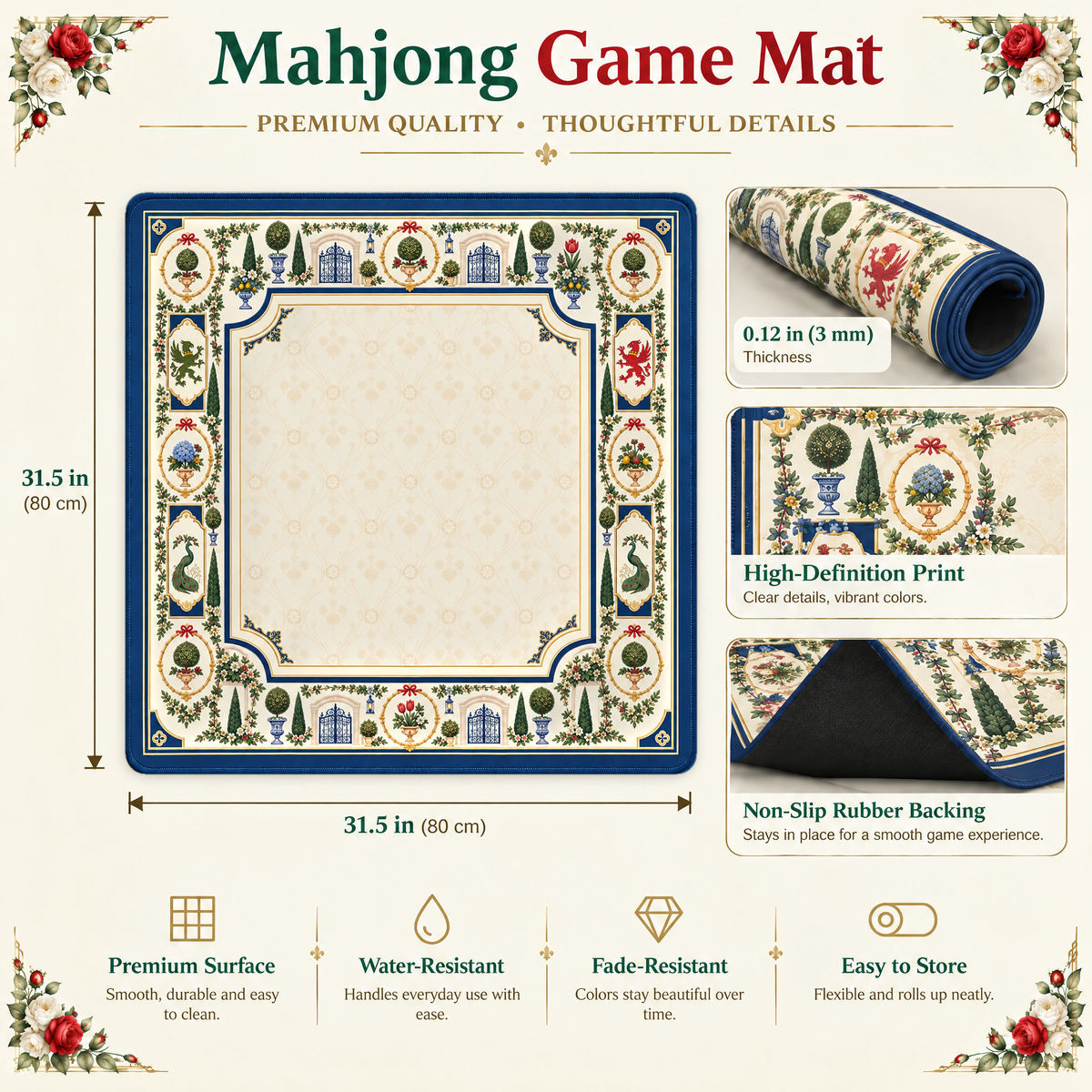
If you're choosing which game to introduce a friend to, ask yourself: Do they like predictable, tactical play or do they thrive in uncertainty? Are they patient with rules or do they want to play within 10 minutes? Do they want to carry a rulebook to every session (mahjong, yes) or learn the game once and own it (hanafuda, yes)? If your household already has a mahjong mat and racks with pushers, mahjong is the obvious start—equipment doubles as a learning aid. If you're shopping for a first game and want low friction, a hanafuda set is cheaper, faster to teach, and won't feel dated next spring when the mahjong card rotates. If you want a lifelong game that evolves, mahjong's annual renewal keeps it fresh. Neither is "harder" in absolute terms—they're hard in different directions.
✨ Find your Mahstead set — free US shipping →
The honest takeaway: why players choose one over the other
We've watched hundreds of people pick up a set. Hanafuda players tend to be introverts, artists, or people who enjoy routine. Mahjong players tend to be extroverts, math-minded folks, or people who like yearly surprises. Both games have lifelong devotees. Hanafuda hasn't changed meaningfully in centuries; mahjong reinvents itself every year by swapping the hand card. If you're buying for a friend, hanafuda is the safer gift (no card to hunt down, no version mismatches). If you're joining a regular game in your community, mahjong is the smarter choice—it's more widely played in the US, and learning American mahjong is a membership into an active social world.
The truest answer: try both if you can. Borrow a hanafuda deck from a friend. Play three rounds of mahjong at a community center or library. Then decide. Neither is "harder"—one just suits your brain better than the other.
🎁 See our most-loved mahjong sets & accessories →

FAQ
Can you play hanafuda with mahjong tiles?
No. Hanafuda uses 48 cards (flowers, seasons); mahjong uses 152 tiles (numbers, winds, dragons, flowers). The games are entirely separate equipment systems. You need the right set for each.
Is mahjong easier if I already know cards?
Yes, somewhat. If you know rummy or bridge, mahjong's draw-discard-meld logic will feel familiar. Hanafuda has no rummy parallel, so card-game experience helps less. But mahjong still requires learning the hand card, which card players don't encounter in Western games.
How long do hanafuda games last compared to mahjong?
Hanafuda rounds: 10–15 minutes. Mahjong rounds: 15–30 minutes. Hanafuda sessions (4–8 rounds plus breaks) are typically 45 minutes to an hour. Mahjong sessions often run 90 minutes to two hours per four-player game.
Do I need to read English to play American mahjong?
Yes. The hand card is printed in English and lists patterns by name (Like Hand, Consecutive Like Number, etc.). You must read it during play. Hanafuda has no such requirement; the cards are visual and intuitive after two weeks.
Which game teaches strategy better?
Both teach strategy, but differently. Hanafuda teaches long-term planning and hand evaluation. Mahjong teaches probability, speed decision-making, and adaptive tactics (how jokers change your math). Hanafuda is chess-like; mahjong is poker-like.
Can beginners win at mahjong or does experience always dominate?
Beginners can win, especially early in a session before they understand the hand card. Luck (tile draw) and joker placement matter. But experienced players win more often because they read the card faster, discard strategically, and track other players' likely hands. Hanafuda is less luck-dependent; experience dominates more consistently.


View More
View More
View More
