
American Mahjong with 3 Players: Rules & Setup
Last updated: Nov 23, 2026
Three-player American mahjong works because the core mechanics—pungs, kongs, quints, the Charleston, joker rules, and the exposed-tile limit—remain untouched. You're not playing a variant; you're simply hosting the standard game with one empty chair. This matters: every rule you know applies directly. The main adjustment is psychological: players tend to play faster in tighter groups, and discards cycle more predictably because fewer players mean fewer options on the table.
How do I set up the wall for 3 players?
Begin with the standard wall-building process: each player stacks 38 tiles (152 total ÷ 4 seats = 38 per seat, but only 3 seats are occupied). Stack all 38 tiles for the missing player as if they were seated; that stack simply never gets drawn. Designate which seat remains empty before the Charleston begins—most groups choose South, East, or the seat that feels least awkward to your seating. The wall break happens at a random position on the wall (as always), and counting around the wall skips the empty seat just as it skips other players' turns. If the East wind sits in position 1, South (empty) in position 2, West in position 3, and North in position 4, then draws proceed 1 → 3 → 4 → 1 → 3 → 4, and so on. The empty stack simply sits untouched until game end.

What changes about the Charleston with 3 players?
The Charleston adapts because passing to an empty seat stops. Arrange seats so the empty chair sits across from or adjacent to you—not in a way that makes passing awkward. The three players execute the standard Charleston: right pass (three tiles to the right), center pass (three tiles across), and left pass (three tiles to the left). When your pass would go to the empty seat, pass instead to the next occupied seat in that direction. Alternatively, some groups skip the pass that would land in the void seat entirely, keeping two passes instead of three. Clarify this before the first hand; either method is fair as long as all players agree. The goal remains the same: shuffle the hand fairly before play starts. Once the Charleston ends, play proceeds normally, with the empty seat simply skipped during turns.
Are jokers and scoring different with 3 players?
No. Jokers function exactly as they do in four-player games: you may use them in a pung, kong, quint, or sextet (but never as a single tile or pair), and joker rules are identical across player counts. Scoring is also unchanged—melds are worth the same points whether four or three players are seated. What shifts is pace: with fewer players, fewer melds get exposed on the table at once, so the wall drains slightly faster. Some groups feel the game favors players in seats 1 and 3 (if seat 2 is empty) because they draw more frequently per round-robin; if you play many sessions, rotate the empty seat to keep fairness balanced.
How do I keep turn order straight during play?
Use a consistent reference: "The empty seat is South" works if all three players know compass positions. Call them by name or position number instead if that's clearer: "Seat 1, Seat 3, Seat 4—Seat 2 is open." Mark the empty spot on your mat with a small object or note so no one accidentally discards into a void or forgets to skip it. Mahjong mats with clear player zones make this automatic—the empty space is visually distinct. Call the sequence aloud at the start of each hand: "East draws, West draws, North draws, East draws…" After a few rounds, the rhythm becomes muscle memory.

What equipment works best for 3-player games?
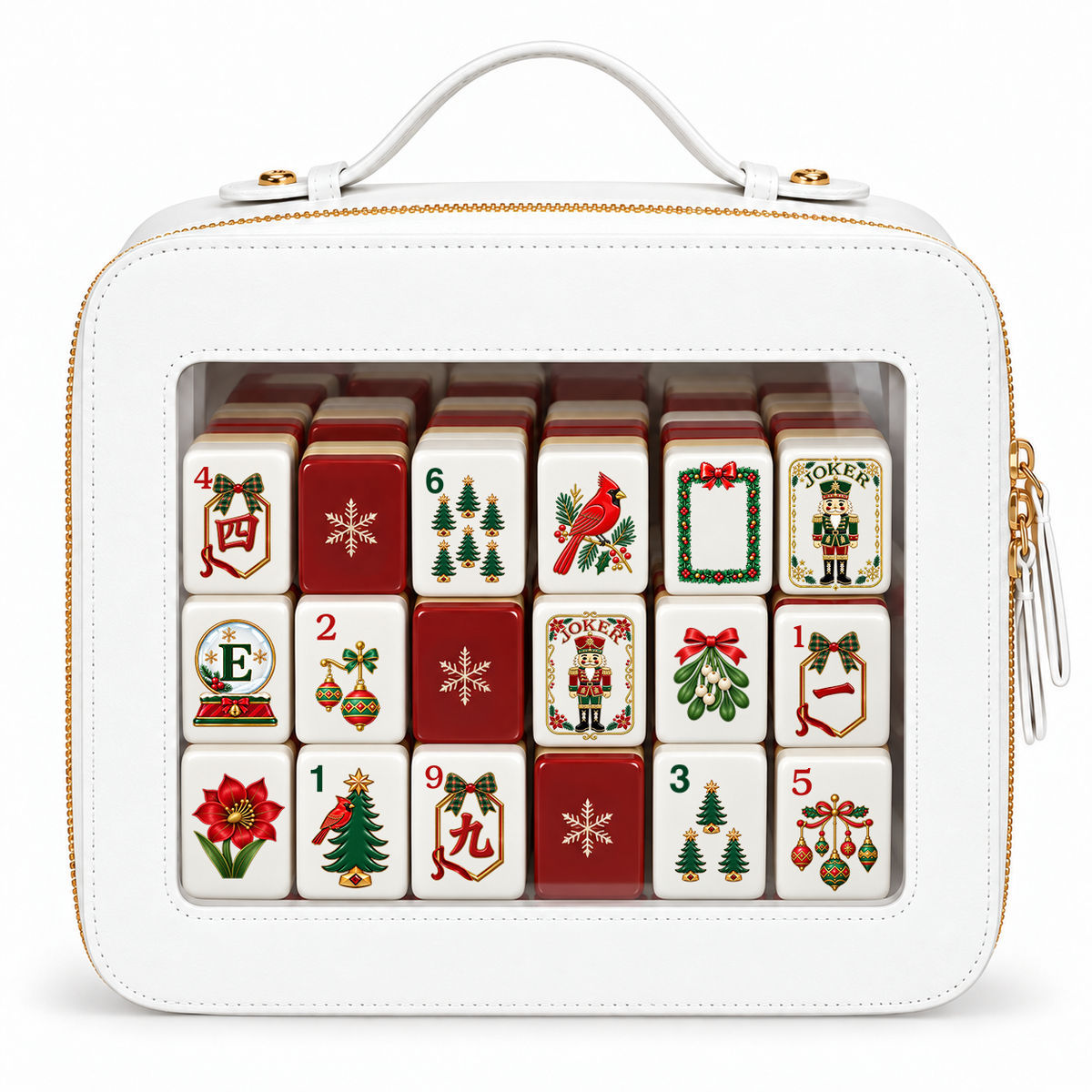
A standard American mahjong set contains all the tiles you need; nothing is removed. The real difference is spatial: three players spread across a table or mat comfortably with an empty seat between or across. A mat sized for standard four-player play leaves the empty seat's space open—no tiles sit there, but the visual zone remains. If you regularly host three-player games, look for mats with clearly divided player zones so the empty seat is unmistakable. Racks with pushers help each player organize tiles quickly; even three players benefit from faster turns. Keep a travel-friendly bag or case if you move sets between homes or venues, since three-player games often happen in casual settings (coffee shops, living rooms, weekend visits).
Setup Element | 4-Player Game | 3-Player Game | Why It Matters |
Tile count | 152 | 152 | No tiles are removed or added |
Wall stacks per seat | 38 | 38 (one sits unused) | Empty seat gets a full stack that never opens |
Charleston passes | 3 (right, center, left) | 2–3 (adjusted for empty seat) | Fewer passes can simplify, but 3 is standard if you reroute to next player |
Turn order | 4-player round-robin | 3-player round-robin (skips empty) | Draws proceed without pausing at the void |
Scoring | Standard card hands | Standard card hands | Empty seat doesn't affect points or melds |
Wall break | Random position (any of 4 stacks) | Random position (any of 4 stacks) | Break method is identical; empty stack just never opens |
Mat size | Full four-player mat | Full mat (empty zone visible) | You can use a standard mat; the empty seat is simply left bare |
What common mistakes should I avoid?
Accidentally drawing from the empty stack: Mark it clearly or position it away from the active wall so no one reaches for it during play. Some groups remove the empty stack from the table entirely until the next game and stack the other three stacks side by side; this works well if your mat is compact.
Forgetting to skip the empty seat during turns: Practice the calling-aloud method ("East draws, West draws, North draws…") for the first hand of a session so muscle memory sets in.
Unfair Charleston: If two players always pass to the occupied seats and one always passes to the empty seat, that player's hand stays less shuffled. Rotate the empty seat across sessions to even out any theoretical advantage.
Assuming a three-player variant is a "house rule": It isn't. The National Mah Jongg League recognizes three-player American mahjong as legitimate play with the standard 152-tile set and card. However, always confirm your group agrees on the empty-seat position and whether the Charleston uses two or three passes before the first hand starts.
What to check before you buy
Tile count: You need exactly 152 tiles plus 8 jokers (standard American set). Mahstead sells 160-tile sets, which include 152 playing tiles plus spares; this works perfectly for three players.
Suit and dragon clarity: Ensure tiles are large enough to see from across a small table. Acrylic tiles with clear markings help three players spot melds faster than bamboo in low light.
Rack and mat fit: If you own racks, confirm all three can fit on your mat or table without crowding the empty seat's space. Racks are optional but speed up play notably.
Card reference: You'll need the current year's National Mah Jongg League card. Three-player games use the same card as four-player; no special edition exists.
🀄 Shop best-selling mahjong sets →
Three-player American mahjong is faster, more intimate, and just as fair as the traditional four-player game—once you establish a consistent turn order and mark your empty seat clearly. The beauty of the three-player setup is that it uses your standard 152-tile set unmodified; you're not buying new tiles or learning new melds. You're simply reshaping the seating and skipping one position. After your first hand, the rhythm becomes automatic, and players usually prefer the tighter, quicker pace. If you host regularly, rotating which seat sits empty across sessions maintains fairness over time.
For the best three-player experience, invest in a good mat with clear player zones and a durable set. Engraved sets make a great gift if you're introducing a friend to the game in your small group. Keep a reference card handy until the turn order becomes second nature, and always confirm the empty-seat position and Charleston style before playing with new people. Three-player games often become regular fixtures once groups discover how well they work—cleaner sightlines, faster rounds, and no waiting for a fourth player.
🎁 See our most-loved mahjong sets & accessories →

FAQ
Can I play American mahjong with only 2 players?
Two-player American mahjong requires significant rule changes beyond simply skipping a seat. See our dedicated guide for the exact modifications. In brief: you must handle the wall differently and adjust tile draws so both players receive equal turns. Standard three-player setup does not work for two.
Do I need a special tile set for 3-player games?
No. Any standard American mahjong set (152 tiles + 8 jokers) works for three players. Mahstead's 160-tile sets contain 152 playing tiles plus spares, so they're ideal for any player count.
What if I forget which seat is empty mid-hand?
Stop and re-establish turn order aloud: "East draws, West draws, North draws." Mark the empty seat with a small chip, note, or position it visibly apart from the other three. Most groups do this at the start of each hand and never have confusion again.
Does the National Mah Jongg League card work for 3 players?
Yes. The standard League card is used for all legitimate player counts, including three. No variant card exists. Learn how to read the card to spot hands that work in your game.
How long does a 3-player game take?
A single hand typically runs 5–15 minutes depending on skill and pace. A casual session of six hands takes 60–90 minutes including breaks. Three-player games often run faster than four-player because fewer players mean quicker discards and fewer exposed melds to consider.
Is one empty seat position better than others?
No. South, East, West, or North all work equally well. Pick the seat that feels natural to your seating and stick with it for consistency. Over many sessions, rotate the empty seat to ensure fairness if you think one position offers an advantage (though mathematically, the standard game favors no seat inherently). ✨ Find your Mahstead set — free US shipping →


View More
View More
View More
