
American Mahjong: Rules, Tiles, and How to Play Today
Last updated: Nov 23, 2026
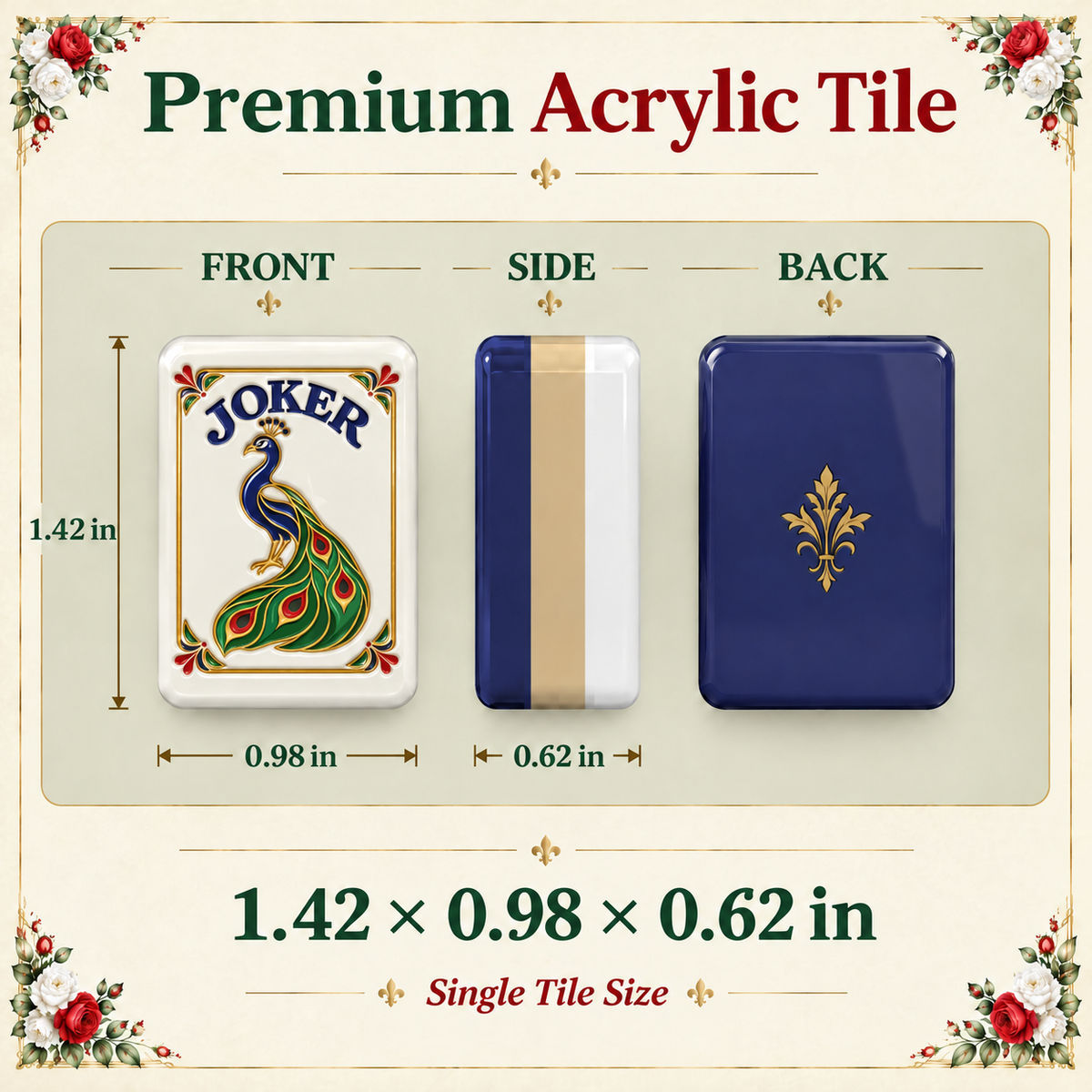
American mahjong is a fast-paced tile-matching game for exactly four players using 152 tiles (three numbered suits, winds, dragons, flowers, jokers). A standard 160-tile set from Mahstead includes spares; you play only 152 per hand. Games follow the current year's National Mah Jongg League card—hands are always called from that card, never invented. Each player draws and discards in turn, passing tiles before play starts via the Charleston ritual. Winning means being first to complete a hand pattern from the card, then calling "Mahjong." A round lasts 15–30 minutes; a session of four rounds takes 2–3 hours. You'll need a mat, racks to hold tiles upright, and a copy of the League card. No sequences (chows) are played—only identical pungs (three tiles), kongs (four), or longer runs using the card. Jokers are wild and swap with any tile in your hand or on the table, but never form a pair or stand alone.
🀄 Shop best-selling mahjong sets →
What are the four suits and special tiles?
American mahjong uses three numbered suits (Bams, Craks, Dots), each numbered 1–9, with four identical copies of each. Bams feature a bird on the 1. Dragons come in three: Red (pairs with Craks), Green (pairs with Bams), and White "Soap" (pairs with Dots and also represents zero). Winds are North, East, South, West—four of each. Flowers are eight tiles, one per season plus duplicates. The 8 jokers are wild cards that substitute for any tile. A complete set contains exactly 152 playing tiles plus 8 jokers, and our 160-tile sets include spare jokers for replacement if any crack during years of play.

How does the Charleston tile-passing ritual work?
Before any hand begins, players pass tiles in a set three-pass sequence—this is the Charleston. On pass one, each player passes three tiles face-down to their right neighbor; on pass two, three tiles go across the table to the opposite player; on pass three, three tiles go left. After all three passes, East picks up their hand plus the first live tile from the wall, then each player draws in turn. Some players offer a "second Charleston" option—a blind pass where players swap any number of tiles before declaring "no" to stop. This controlled shuffling ensures fairness and strategy from the very first tile. Understanding the Charleston is essential, so read our full Charleston guide before your first session.
What hands can you play and how do you call them?
Every legal hand comes from the current year's National Mah Jongg League card—you cannot invent or play hands off-card. The card displays patterns organized by hand number and tile combination. You can expose a pung (three identical tiles), a kong (four identical tiles), a quint (five identical tiles), or a sextet (six identical tiles) by placing them face-up on the table in front of you; your other tiles stay hidden in your rack. Jokers can replace any tile in an exposed set except in a pair or as a single tile. To win, your 14 remaining hidden tiles must form a legal hand pattern on the card. You announce "Mahjong" only when you've drawn a tile that completes your hand and you've verified it against the card—calling incorrectly costs you points that round. Learn how to read the card properly to spot hands quickly and avoid delays.
How do you draw, discard, and manage your wall?
The wall is the unplayed pile of tiles—152 tiles total, arranged face-down in a line. East draws first, then South, West, and North in clockwise order each turn. After drawing, you must discard one tile face-up in the center, building a discard pile visible to all. If your discarded tile matches a pattern another player needs, they can call it: if they have an exposed pung, kong, or longer run that needs your tile, they grab it, add it to their exposed set, and immediately discard one different tile. If no one calls your discard within the next draw, it's "dead"—no longer callable. Once the wall is depleted (usually after 8–12 turns), the hand ends with no winner, and players sort and reset for the next round. This is why a quality mat with clearly marked zones keeps the wall organized and prevents confusion.
What makes American mahjong different from Chinese or Hong Kong variants?
American mahjong has no chows (sequences like 1-2-3 of the same suit) in any form—they cannot be called or even played hidden. All exposed sets must be identical tiles (a pung, kong, or longer run), which fundamentally changes strategy. Chinese mahjong and Hong Kong variants allow chows as part of hands and permit different calling and exposure rules. American mahjong also anchors all legal hands to a single League-issued card that changes yearly, whereas Chinese and Hong Kong games have standard hand patterns that persist. A typical Hong Kong game uses 144 tiles and three players; American uses 152 and exactly four. Riichi mahjong (Japanese) has yet another system: concealed hands, declares of readiness, and point multipliers. If you play multiple variants, keeping separate tile sets organized in labeled bags prevents mixing up rules mid-game.
How does scoring work and who wins the round?
The first player to complete a legal hand and call "Mahjong" wins the hand immediately—play stops. Points are calculated based on hand pattern, tile difficulty, and whether the winning tile came from a draw or a discard. The National Mah Jongg League card lists point values for each hand; basic hands score 20–30 points, complex or rare hands score 40–50 or more. Winners receive points from all three opponents; the exact payout depends on the hand value and local table rules. A game consists of four rounds—called "winds"—where each player takes a turn as East (the first player to draw). After all four winds, the player with the highest cumulative score wins the session. Ties are broken by a playoff hand. For a detailed breakdown of scoring, including rare hands and bonus scenarios, see our scoring guide.

What are the most common beginner mistakes?
Forgetting that hands must come from the current year's card. New players often try to play a hand they remember or one that seems logical, only to discover it's not on the card. Always have the card visible and double-check before calling.
Using jokers incorrectly. Jokers cannot form a pair by themselves, and they cannot represent a single tile standing alone in your hand. A joker can only substitute within an exposed set (pung, kong, or longer) or as part of a pair if the pair uses regular tiles.
Calling a discard too slowly. If another player discards a tile you need, you must call it immediately before the next player draws. If you hesitate, the discard becomes dead and you've lost your chance.
Mismanaging the wall. Forgetting which tiles have been drawn or placing discards in the wrong pile slows the game and creates disputes. Use a mat with clear zones for the wall, discard pile, and exposed sets.
Playing without ranking hands first. Before each round, discuss which hands you'll target—this keeps beginners from chasing impossible patterns and wasting time.
How many tiles are in a set and what do you really need to play?
A standard American mahjong set contains exactly 152 playing tiles used in each hand, plus 8 jokers—that's 160 tiles total in our sets at Mahstead. The 152 tiles break down as: 108 tiles from three numbered suits (Bams, Craks, Dots), 16 winds, 12 dragons, and 8 flowers. Our 160-tile sets include spare jokers so you always have 8 in play even if one cracks or is lost over time. Beyond the tiles themselves, you'll need a mat to keep the wall and discard pile organized (especially during draws), a copy of the current year's National Mah Jongg League card, and ideally racks with pushers so tiles stay upright and visible to you but hidden from opponents. Some players add a score sheet or app, and dice if your table decides winners by rolling ties. For a new group, explore our best-selling sets which include everything from basic acrylic tiles to engraved and themed designs.
🎁 See our most-loved mahjong sets & accessories →
Who sits where and how are positions chosen?
The four players sit around a table and are called East, South, West, and North—the four cardinal winds. East is the highest-ranked position and draws first; then South, West, North in clockwise order. At the start of a session, winds are usually assigned by dealing: each player draws a wind tile at random, or one player simply calls out the winds. The player with East plays that first hand; after that hand ends, the position rotates: East moves to South, South to West, West to North, North to East. A full session ("round" or "wind") includes one hand where each player has been East, so all four players get equal drawing order. After four rounds, the player with the highest score wins. If you're hosting a weekly game, choosing a quality mat with printed positions and zones helps new players understand seating quickly and keeps games moving.
What should you check before you buy a mahjong set?
Consideration | Why It Matters | What to Look For |
Tile count | Must be 152 playing tiles + 8 jokers for American play | Verify "160-tile" label or "152 + spares" in product description |
Tile material | Acrylic is durable; bone/bamboo require care | Check if tiles feel sturdy and edges are smooth, not sharp |
Set comes with | Card, mat, racks, and bag save money later | Confirm what's included before buying—don't assume |
Engraving or personalization | Great for gifts or a group identity | Check design clarity and if text or images are centered |
Tile size and weight | Small tiles suit travel; heavier sets feel premium | Hold a sample if possible; standard American tiles are about 1 inch wide |
Spare tiles | Jokers and blanks replace damaged pieces | Confirm set includes extras—our 160-tile sets always do |
Before purchasing, verify the seller ships complete, unsealed sets with all 160 tiles accounted for, racks with pushers if included, and a current or compatible League card. Ask if the mat is suitable for your table size—most home tables need a mat 24–36 inches wide. If you're a beginner, start with our best-selling collection which includes full starter packages with all essentials.
✨ Find your Mahstead set — free US shipping →
What to check before you buy
Tile count: American play uses exactly 152 tiles + 8 jokers. Our 160-tile sets are the standard; never buy a set without confirming the full count is included and undamaged.
What's in the box: Does it include a mat, racks, pushers, and a current League card? Bundles save money; buying separately costs more.
Tile size and feel: American tiles are roughly 1 inch wide and should feel smooth. If edges are rough or uneven, the set may warp during play.
Spare jokers and blanks: Our sets include spares; confirm yours does too—cracked tiles happen over years of weekly play.
Shipping condition: Open the box immediately and count all tiles. Check for cracks, chips, or staining. Report damage within days so you can replace your set.
Mat quality: A flimsy mat lets tiles slide. Look for rubber backing, clearly marked zones, and enough space for your wall and discards.

FAQ
Can I play American mahjong with three or two players?
Yes, but with modified tile and hand rules. See our guide on 2 and 3 player variants for exact adjustments to walls, draws, and legal hands.
What happens if someone calls "Mahjong" incorrectly?
That player is penalized—they often lose points or must sit out the next hand, depending on your table's house rules. Always verify against the card before calling. This is why having a clear, current League card visible to all four players prevents disputes.
Do I have to expose my pungs and kongs, or can I keep them hidden?
You can keep sets hidden in your hand until you've won, but once you call "Mahjong," all tiles are revealed and verified against the card. Many players expose sets as they build them to prevent someone else from winning first; hiding is risky but offers slight strategy.
How often does the National Mah Jongg League card change?
A new card is issued every spring, typically March or April. Players must switch to the current year's card; last year's card is no longer valid for official play. This keeps the game fresh and prevents repetitive hand patterns.
What's the difference between a pung and a kong, and when can I use jokers?
A pung is three identical tiles; a kong is four. Both can include jokers—one joker in a three-tile pung, or one or two jokers in a four-tile kong. Jokers cannot form a pair alone or stand as a single tile; they only substitute within a set.
Is American mahjong hard to learn?
The basics (drawing, discarding, exposing sets) take one session to grasp. Learning to spot hands on the card and manage joker strategy takes a few weeks of weekly play. Most beginners are competitive within a month.
Can I host a game if I've never played before?
Yes—start by reading the rules thoroughly, assigning seats and winds, and practicing one hand before keeping score. Have the League card and a mat set up so all four players can see clearly. Many groups have one experienced player teach; offer to learn from them first, then host once you're comfortable.


View More
View More
View More
