
What Does the Green Dragon Tile Look Like in Mahjong?
Last updated: Nov 23, 2026
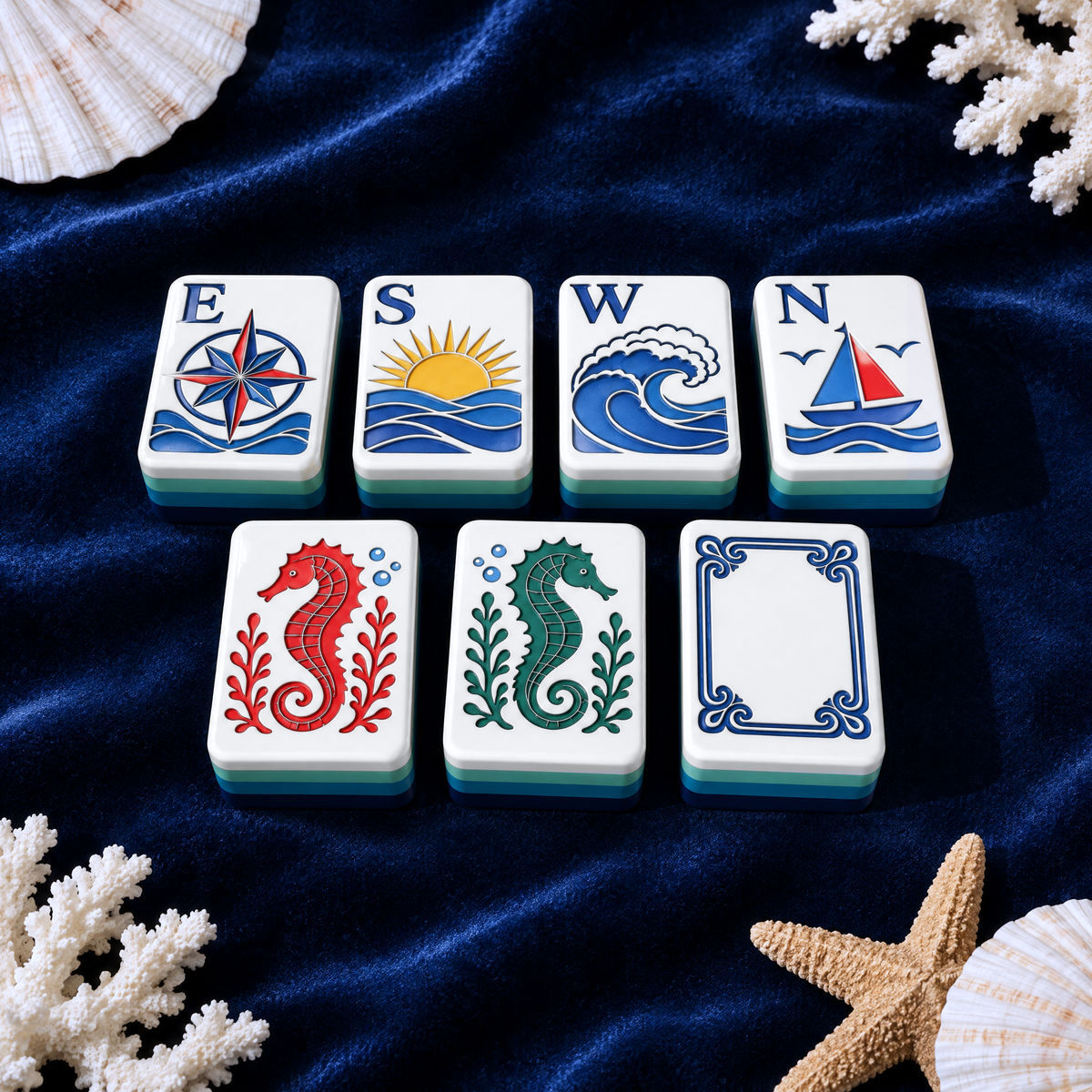
In American mahjong, the Green Dragon is one of three honor dragons, and spotting it correctly matters every time you draw. Let's break down exactly what you're looking for, why the design matters, and how to keep your game moving smoothly.
How is the Green Dragon tile marked and colored?
The Green Dragon displays a solid green color—typically a medium or forest green—covering most of the tile face, with a lighter background (cream, white, or pale green) framing a centered symbol. The symbol itself is usually a stylized character or glyph, often resembling a decorative mark rather than readable text. Unlike Bam, Crak, and Dot tiles numbered 1–9, there is no numeral on a dragon; the dragon type alone identifies it. The tile is square like all standard American mahjong tiles, and the Green Dragon's uniform face allows you to quickly distinguish it from the Red Dragon (which displays red) and the White Dragon, also called "Soap" (which appears mostly blank or white with minimal marking). When you're holding tiles close to your face during active play, the solid green color prevents the misreading that happens with pale or inconsistently printed tiles.

Why is the Green Dragon always paired with Bams?
In American mahjong, each dragon serves a structural role within the suit hierarchy. The Red Dragon pairs with Craks (characters), the Green Dragon pairs with Bams (bamboo), and the White Dragon pairs with Dots (circles) while also serving as zero. This pairing rule appears throughout the National Mah Jongg League card, which releases annually every spring and is the only legal hand reference for American mahjong. When you study the card, you'll notice that most hands containing dragons specify which suit the dragon must accompany—for example, "three Bams with one Green Dragon" or "five Green Dragons with honor pairs." The pairing exists because dragons are honor tiles (not suited numerically), and the card's designers use the dragon-to-suit connection to organize winning patterns. If you misread a dragon's color, you'll build toward the wrong hand or fail to recognize a win when it appears. Learn more in our guide to what's in an American mahjong set.
What's the visual difference between Green, Red, and White Dragons?
The three dragons differ sharply in color and marking so that no experienced player confuses them mid-game. The Green Dragon is solid medium or forest green with a centered symbol. The Red Dragon is bright or deep red, often with the same symbol style but in a contrasting color. The White Dragon, nicknamed "Soap," appears almost blank—white or cream tile with minimal marking, sometimes just a faint border or a small symbol. The reason for White's near-invisibility is historical: early mahjong used actual ivory for the White tile, and modern sets preserve that aesthetic. During the Charleston (the pre-game tile-passing round), beginners sometimes mistake a White Dragon for a blank tile or struggle to spot it in a rack. Experienced players place the White Dragon in a distinctive position or memorize its location to avoid delays. High-quality tile sets, like those we design at Mahstead's best-selling collection, use consistent sizing, clear color separation, and crisp symbols so that even under table lighting, all three dragons remain unmistakable.
How many Green Dragon tiles should be in your mahjong set?
Every American mahjong set contains exactly four Green Dragon tiles—one for each player at the table. You cannot win a hand using only three Green Dragons; the hand card always specifies either a pung (three identical tiles exposed or held) or a kong (four identical tiles exposed or held). Since there are four copies of each tile in American mahjong, a player holding or calling all four Green Dragons satisfies a kong within that hand's requirement. The math works cleanly: 4 players × 4 identical tiles × 12 dragons (4 Green, 4 Red, 4 White) = 12 total dragon tiles in the 152-tile playing set. If your set shows fewer than four Green Dragons after years of play, a tile has been lost—a common hazard with loose-fitting sets or travel cases. Sets with secure closures and padded sleeves reduce loss risk substantially.
🀄 Shop best-selling mahjong sets →

Why does recognizing the Green Dragon matter for winning?
On the National Mah Jongg League card, hands containing Green Dragons appear dozens of times, and misidentifying the color can cost you a win, a turn, or points. For example, a hand might read "three Green Dragons with five Bams and one honor pair"—if you hold three Red Dragons instead, you do not have that hand and cannot declare it. Judges and skeptical players will challenge a win call if the tiles don't match the card exactly. Additionally, understanding how jokers work helps: jokers can substitute for any tile except a single tile, a pair, or a one Bam, so you might use a joker as a Green Dragon in a pung or kong, but you must use an actual Green Dragon for the pair or for the one Bam restriction. A misread in the chaos of a quick hand can mean retracting a win declaration and facing gentle ribbing from the table. Newer players benefit from sets with high contrast and large, clear symbols on every tile.
What should you check before buying a mahjong set to ensure clear dragon visibility?
Before purchasing, examine the sample or product images for these three checkpoints:
Color separation: Can you instantly distinguish the green from red and white, even at arm's length or under warm table lighting?
Symbol clarity: Is the dragon symbol centered, crisp, and sized so it's readable without holding the tile inches from your face?
Tile finish: Does the surface have a matte or satin finish that reduces glare and finger marks, or a high-gloss finish that may blur the symbol under certain angles?
Acrylic sets, like those in Mahstead's collection, use UV-resistant inks that hold color over hundreds of games, whereas tiles on cheaper sets may fade or blur after extended play in bright rooms or after exposure to direct sunlight during travel. If you host weekly games or plan to keep the set for five or more years, prioritize a set with consistent color and engraved or deeply printed symbols.
Feature | Why it matters | What to look for |
Green color depth | Prevents confusion with Red Dragon under poor lighting | Medium to forest green, not pale or blue-tinted |
Symbol visibility | Speeds up tile recognition during active play | Centered, dark outline, sized ≥¼ inch on standard tile |
Tile thickness | Affects how easily the symbol reflects light and causes glare | Uniform thickness across all tiles, no warping |
Finish type | Determines how marks and dust show up during play | Matte or satin finish resists fingerprints better than high-gloss |
Color fastness | Preserves clarity after years of handling and storage | UV-resistant inks; acrylic holds better than bamboo veneer |
🎁 See our most-loved mahjong sets & accessories →
How do you keep track of Green Dragons during the Charleston and gameplay?
The Charleston is the tile-passing ritual before play begins; during this phase, tiles pass around the table three times, and beginners sometimes lose track of which tiles they hold. To avoid mixing up dragons:
Separate dragons into the honor section of your rack, distinct from numbered suit tiles.
Use the pallet or rack divider (if your set includes one) to group dragons together so you can count them at a glance.
Point to each dragon aloud during the Charleston—say "passing three greens" instead of just handing tiles silently—so all players confirm the color and no one questions it later.
Arrange dragons in your rack by color: all Greens on the left, then Reds, then Whites, so a quick scan reveals any missing tile.
Once active play begins and discards pile up on the table, a player may call (expose) a pung or kong of Green Dragons if it matches their hand card. When that happens, the called tiles sit face-up in front of that player for the rest of the hand. Jokers can substitute within that exposed set if the hand allows, but the four Green Dragons in your set remain distinct and countable. Sets with secure racks and pushers keep tiles stable during the Charleston so nothing spills or gets mixed with the wall.
✨ Find your Mahstead set — free US shipping →
What to check before you buy
Verify all four Green Dragons are present and undamaged when you unpack the set.
Test the color under the lighting in your play space before your first game; if the green appears murky or too close to red, return it.
Check the tile edges and symbols for chips or fading after the first few plays; if damage appears immediately, the manufacturer may have a replacement option (review the return policy before purchase).
Confirm the set includes 152 playable tiles plus spares; sets sold as 160 tiles include 152 playing tiles and spare jokers or blanks that remain in storage, never added to the game.

FAQ
Can I use a Green Dragon tile as a joker?
No. In American mahjong, jokers cannot substitute for a single tile, a pair, or a one Bam. A Green Dragon can only appear as itself. Jokers may replace a Green Dragon within a pung or kong if the hand allows a joker in that position, but you must use actual Green Dragon tiles for pairs or when the hand specifies a Green Dragon alone.
What if my set is missing a Green Dragon tile?
Contact the seller immediately and describe the damage or loss. Most sets include spare tiles (typically jokers and blanks) to compensate for normal wear, but a missing dragon usually qualifies for replacement. Keep the original packaging and receipt. If the set is very old or widely used, replacement may not be available; consider purchasing a new set for serious play rather than attempting a partial substitution.
How do I tell a Green Dragon from a Bam suit tile with green printing?
A Green Dragon tile has one unified color (solid green) and no numeral. Bam suit tiles show a number (1–9) and the bamboo symbol, even if printed with green or multi-colored ink. Bams numbered 1–9 have four copies each in the set, but the dragon has a different visual structure entirely. If in doubt, check your tile count: four Green Dragons, 36 Bam tiles (four copies of each numeral 1–9).
Why is the White Dragon called "Soap"?
In traditional mahjong, the White Dragon was made from ivory or a pale bone material and appeared nearly blank. Players jokingly called it "Soap" because of its blank appearance. In modern sets, the White Dragon remains mostly blank or near-invisible by design, preserving the historical aesthetic. It serves as both a dragon honor tile and as the numeral zero when needed in certain hand patterns.
Should I buy an engraved or printed mahjong set to see the Green Dragon more clearly?
Engraved sets often offer sharper symbol definition because the mark is cut into the tile surface and filled with contrasting ink. Printed sets with high-quality inks can be equally clear if the print depth is consistent. Browse our engraved American mahjong sets to compare; the key is consistent color and symbol size across all tiles, regardless of manufacturing method.
Can I play American mahjong with a Hong Kong or Chinese mahjong set?
No. Hong Kong and Chinese sets use different tile compositions (144 tiles instead of 152) and different hand patterns than American mahjong, which requires the National Mah Jongg League card issued annually. American mahjong is its own variant. If you play only American mahjong, purchase an American set with the correct 152-tile count and all three dragon types clearly marked.


View More
View More
View More
