
What Is Closed Hand in American Mahjong?
Last updated: Nov 23, 2026
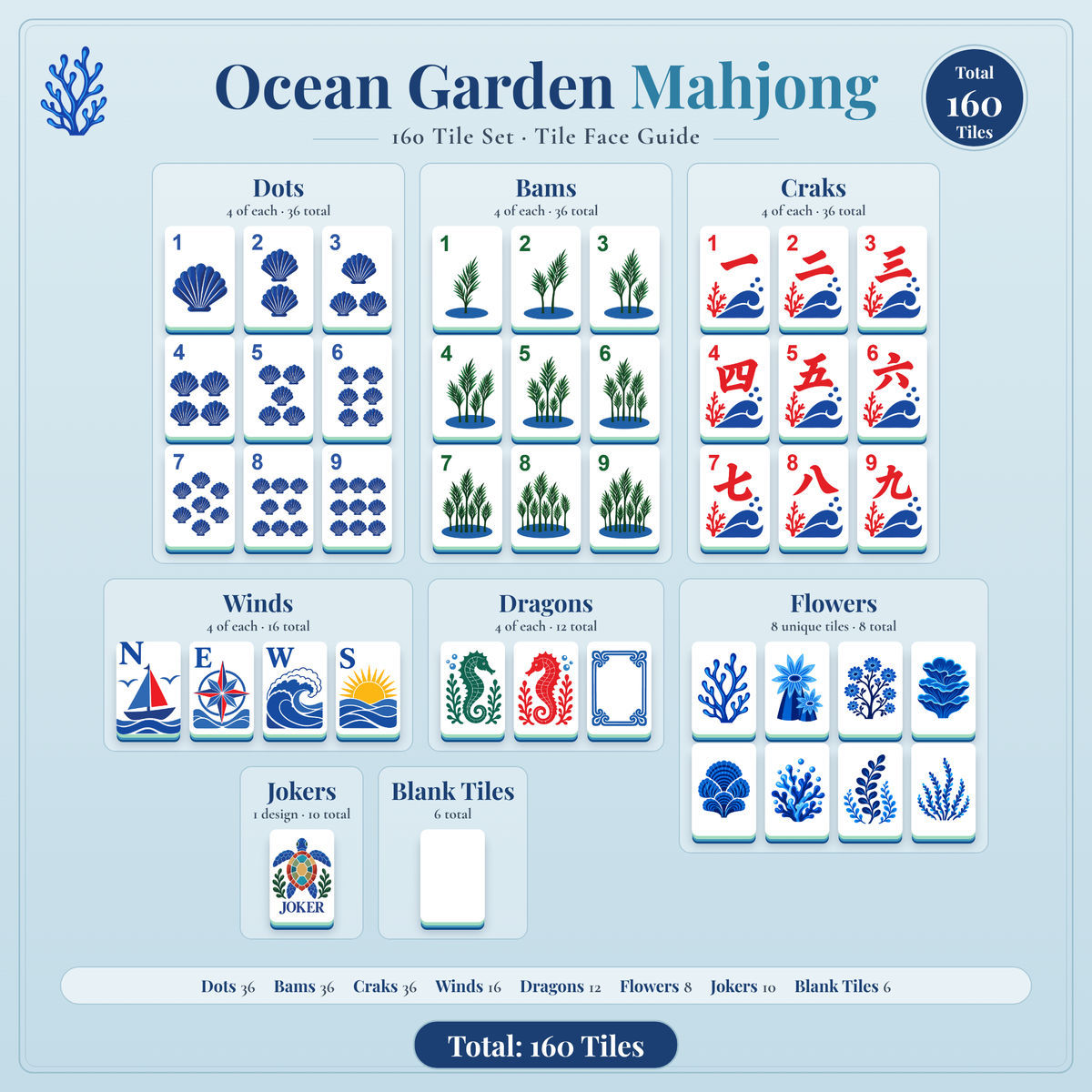
A closed hand in American mahjong is a hand where you have drawn all your tiles directly from the wall and have not exposed any melds (pungs, kongs, quints, or sextets) or called any tiles from other players' discards. You have fourteen tiles in your hand, face-down or hidden from view, when you go out. The hand must appear on the current year's National Mah Jongg League card as a valid closed-hand pattern. Closed hands typically score higher points than open hands because they require less help and carry more risk—you're not signaling your progress or accepting discarded tiles. When you declare mahjong on a closed hand, you reveal all fourteen tiles at once to prove they match a valid closed-hand pattern on the card. This category rewards patience and strategic play, making it a prized outcome at the table.
What is the difference between a closed hand and an open hand?
In American mahjong, an open hand means you have exposed one or more melds (pungs, kongs, quints, or sextets) on the table during play—either by creating them from tiles you drew or by calling a tile from another player's discard. A closed hand never exposes any meld; all tiles stay in your rack until you declare mahjong. Open hands score lower because showing melds reveals your progress and lets opponents adjust their strategy. Closed hands reward silence and discretion by paying significantly more points when you win.

Can you use jokers in a closed hand?
No. The fundamental rule in American mahjong is that jokers can never appear in a single tile, a pair, or in a closed hand—period. If your pattern requires jokers, it must be played as an open hand with exposed melds that contain those jokers. This rule prevents closed hands from becoming too easy to complete and preserves their prestige. Learn how jokers work to avoid accidental open-hand penalties.
How do you recognize a closed-hand pattern on the card?
The National Mah Jongg League card organizes patterns by hand type and point value. Closed-hand patterns appear in designated sections of the card and are marked or grouped distinctly from open-hand patterns. Each row lists the thirteen tiles needed (plus one draw to complete fourteen) using suit notation: for example, Bams 1–4, Craks 2–5, Dots 3–6 signals a run of sequences. To read the card accurately, familiarize yourself with the hand notation, the color or layout of closed-hand sections, and practice matching your tiles before declaring. Our guide to reading the mahjong card walks you through the card layout and closed-hand identification step-by-step.

What happens if you declare a closed hand but tiles don't match the card?
You have made an error. You must retract your declaration, return your tiles to your rack, and play continues. This is called a false mahjong. Depending on house rules, a false mahjong may carry a penalty: some groups require the player to pay a fine to the table or sit out the next hand. Always double-check your tiles against the card before declaring. Practicing with a best-selling mahjong set at home sharpens your card-reading speed and reduces table mistakes.
Why do closed hands score higher than open hands?
Closed hands score higher because they demand more discipline and skill. You have no visual feedback from exposed melds to confirm your progress; you must track the wall depletion, estimate remaining tiles, and resist calling discards even when they help. You also hide your hand completely, so opponents cannot read your strategy or adjust their own game. The extra points compensate for the added risk and mental load. Scoring multipliers on the card reflect this: closed-hand entries typically assign point values one or two tiers above comparable open-hand patterns.
Hand Type | Melds Exposed | Jokers Allowed | Scoring | Risk Level |
Closed | None | No | Higher | High |
Open | One or more | Yes | Lower | Lower |
Semi-open | One or two | Yes | Medium | Medium |
Step-by-step: How to verify you have a valid closed hand
1. Count your tiles. You must have exactly fourteen tiles in your hand—no more, no less. Count twice.
2. Check for exposed melds. Review your rack. If any pung, kong, quint, or sextet is face-up on the table in front of you, your hand is not closed. Return all exposed melds to your hand immediately.
3. Verify no called tiles. Closed hands cannot include tiles you called from another player's discard. Every tile must have come from the wall—either the initial deal, the Charleston pass (if house rules permit), or your draw each turn.
4. Scan for jokers. If any of your fourteen tiles is a joker, your hand is open, not closed. Jokers are banned in closed hands.
5. Match your tiles to the card. Lay out your tiles in the order listed on the card row for a closed-hand pattern. Every suit, number, and quantity must match exactly. If one tile is wrong, it is not a valid closed hand.
6. Announce clearly. Say "Mahjong, closed" and place your rack face-up on the table. Point to the row on the card that matches your hand.
7. Let opponents verify. Other players may count your tiles and check the card. Accept the result and score accordingly.
What to check before you buy
If you are hosting or playing regularly, invest in a quality set that makes closed hands easier to protect. Choose engraved American mahjong sets with clear, large suit symbols and numbers so you can read your tiles quickly without hesitation. Pair your set with a mahjong rack with pushers to organize and conceal your hand; pushers let you slide tiles forward as you draw, keeping all tiles aligned and face-down until you decide to expose or declare. A well-lit mahjong mat prevents misreads and speeds up card verification. If you travel to games or host different groups, a travel bag or case protects your set and mat, preserving tile legibility across seasons.
🀄 Shop best-selling mahjong sets → https://mahstead.com/en-us/collection/best-selling
Common mistakes to avoid: declaring too fast without counting; mixing a called tile into your hand by accident; forgetting that one exposed meld voids closed status; assuming a joker can substitute in a closed hand. Always recount before announcing, and always read the card yourself—do not trust memory or assume a pattern is closed just because it sounds familiar. When in doubt, ask the player hosting: house rules may vary slightly, and clarity prevents disputes.
Common closed-hand patterns and why they work
Experienced players recognize certain structural families of closed hands: all-pungs (three-of-a-kind combos in every group), consecutive runs (sequences of numbers within a suit), mixed-suit sequences, dragon-heavy hands, and wind-heavy hands. Each pattern on the card follows these families, but the point value and exact tile configuration vary year to year based on the League's issue. No two seasons' cards are identical. Study this year's card before you play to learn which closed-hand sections reward which strategies. Learn how to play American mahjong for more context on hand strategy and seasonal card changes.
🎁 See our most-loved mahjong sets & accessories → https://mahstead.com/en-us/collection/best-selling
Closed hands are not rare, but they are less frequent than open hands because the restriction—no melds, no jokers, no called tiles—narrows the patterns available and demands patience. New players often chase quick wins by exposing melds and calling tiles; veterans know that sitting tight and waiting for a closed hand can yield higher scores and respect at the table. The psychological discipline of a closed hand is part of its reward.
✨ Find your Mahstead set — free US shipping → https://mahstead.com/en-us/collection/best-selling

FAQ
Does a closed hand have to be worth high points?
No. A closed hand is defined by its structure (no exposed melds, no jokers, no called tiles), not its point value. The card lists closed-hand patterns at various point levels, from modest to premium. Any valid closed-hand pattern on the card is a legitimate closed hand, regardless of points.
If I expose one meld and then hide it again, is my hand still closed?
No. Once you expose a meld, your hand is open for the remainder of that hand. You cannot "uncall" a tile or "re-hide" a pung. Closed status is determined by your entire play history in that hand, not your final action.
Can I win on a tile I drew from the wall if my hand is closed?
Yes. A closed hand can be completed only by your own draw from the wall on your turn. You cannot win on a discard from another player (that would be a called tile, making the hand open). Drawing your winning tile yourself is the only way to close the hand.
What if another player calls my discard and I realize I had a closed hand brewing?
Too late. Once a tile leaves your hand as a discard, and an opponent calls it, your hand status is reset. You begin looking for a new pattern. You cannot recover a closed-hand opportunity after a tile is called away.
How do I practice reading closed hands at home?
Shuffle a best-selling mahjong set and deal yourself fourteen tiles. Compare them to closed-hand sections on the current year's card. Time yourself. Repeat until you can spot a match in under thirty seconds. Use a mahjong mat to simulate table conditions and keep tiles organized.


View More
View More
View More
