
What Is Charleston in American Mahjong: The Tile-Passing Ritual
Last updated: Nov 23, 2026
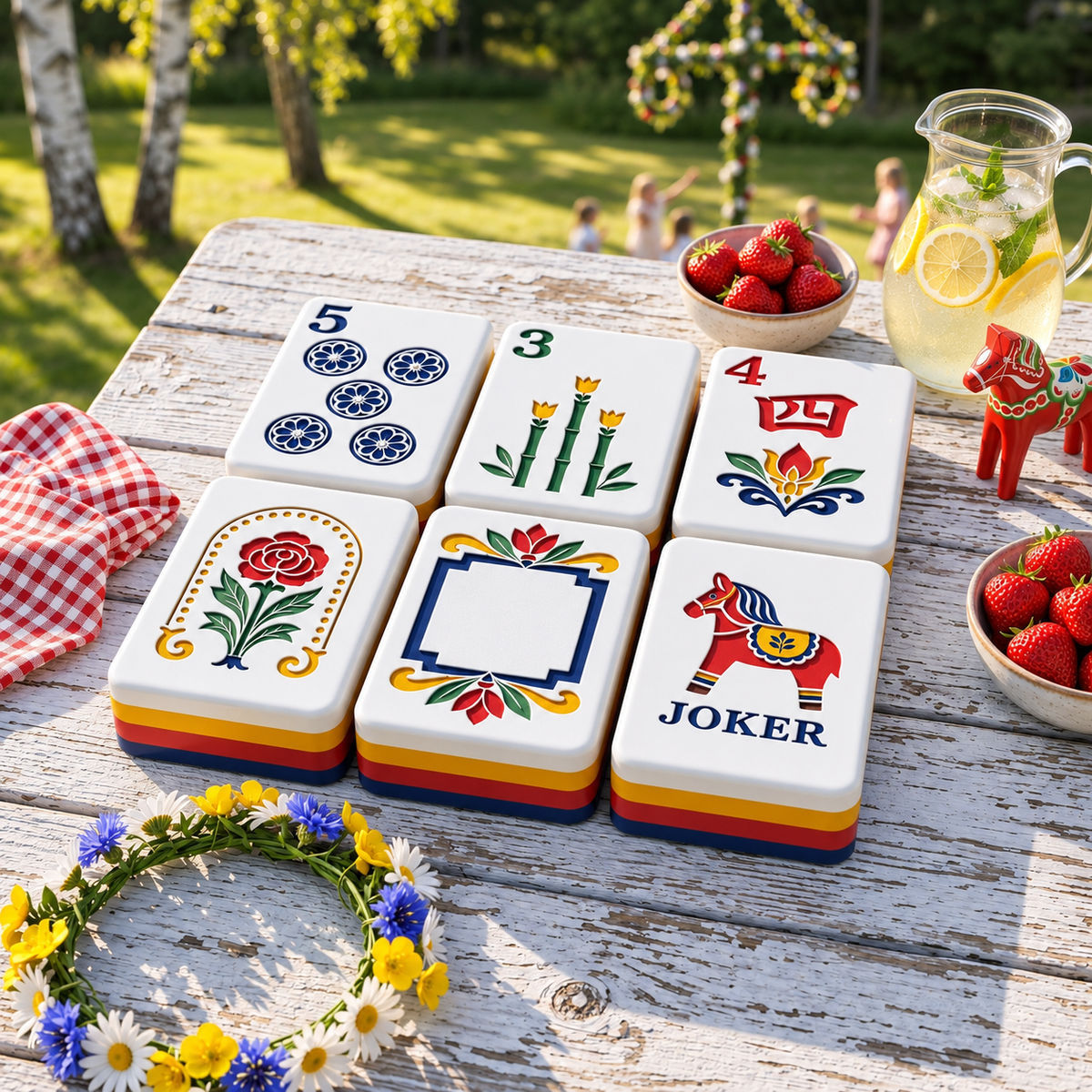
The Charleston is a mandatory four-pass tile-exchange ritual that happens before every American mahjong hand begins. Each player passes three tiles to the player on their right (first pass), then three to the player across (second pass), then three to the left (third pass). If all four players agree, a fourth pass may happen in reverse. Tiles are passed face-down; you cannot look at received tiles until all passes are complete. The Charleston randomizes your starting 13 tiles after the wall is built and hands are drawn. It takes 30–60 seconds per hand and is part of the official rules for every game we host. The goal is to avoid dead hands and distribute stronger combinations more fairly. You need a full American mahjong set with exactly 152 playing tiles, and Mahstead's best-selling mahjong sets include everything required to play with proper tile counts.
The Charleston is the four-pass tile-passing ceremony that opens every American mahjong hand. It's not optional—it's the rule. Before anyone melds, declares a hand, or draws from the wall, players must execute the Charleston. Without it, your starting hand is pure luck. With it, you've had a structured chance to improve your position.
We explain it step-by-step here because the Charleston is where most new players stumble: they pass the wrong direction, look at tiles too early, or skip passes altogether. Once you see it in action, it becomes automatic. But the first few times, questions pile up.
How do the four passes actually work?
The Charleston follows a strict sequence: right, across, left, and optionally back.
First pass (to your right): You select three tiles face-down and pass them to the player on your right. You do not look at what you receive—your new three tiles go into your rack unseen. All four players do this simultaneously.
Second pass (across): The player directly opposite you receives three tiles from you (again face-down). You receive three from them unseen.
Third pass (to the left): You pass three tiles to the player on your left and receive three from the player on your right.
Fourth pass (optional, reverse): If all four players agree, a fourth pass happens—tiles go back in the opposite direction (left, across, right). This is not automatic; the table must vote. If even one player says no, you stop after the third pass.
Once all passes are complete, you look at your rack for the first time. You now have 13 starting tiles. Play begins.

Why does direction matter and how do you remember it?
Direction matters because the Charleston is always relative to your position at the table, not absolute compass directions. If you're sitting north, "right" is east. If you're sitting south, "right" is west. The game always flows around the table in the same pattern: the player holding the East wind (dealer) or the seat nearest to them stays put, and the passing direction is consistent from that anchor.
Memory trick: Think of the Charleston as moving around the table like the wind positions in mahjong—East → South → West → North → East. Your right neighbor is always next in the rotation. Your opposite neighbor is always across. Your left neighbor closes the third pass. Muscle memory sets in after two or three hands.
Write it down on a note card for your first session if you're hosting or learning. Place it near the wall or the tile rack where the discards go. After five hands, you won't need it.
When do you look at your tiles and what's forbidden?
Look only after the third (or fourth, if voted) pass is complete. Do not peek during the passes. Do not slide tiles into your rack before the pass cycle is finished. Many tables use a rule: "No tiles leave the table until all passes are done." This prevents accidents and disputes.
Forbidden moves:
Passing tiles you've already looked at (pass face-down only).
Communicating which tiles you're passing before they leave your hand.
Looking at received tiles before the pass cycle closes.
Refusing a pass mid-sequence (you must pass; you cannot skip a pass).
The reason for these rules is fairness. The Charleston only works if it's blind. If players could signal which tiles they're avoiding, they'd circumvent the randomization. We've played with groups who tried to "help" a friend by passing good tiles their way—it breaks the whole ritual and defeats the purpose.
What happens if someone breaks the Charleston rules?
If a player peeks at tiles mid-pass, looks before the cycle is done, or refuses to pass, house rules vary. In our weekly games, we apply a soft correction: "Hold until the pass is over, then look." In tournament or formal settings (like National Mah Jongg League rules), peeking mid-pass can void your hand or result in a penalty.
The practical approach: Establish your table rule before the first hand. Decide: Do you replay the hand if someone breaks the rule, or do you give a warning and continue? Most casual groups give one warning. Formal league play penalizes immediately.
If all four tiles of a tile type are mistakenly passed in one cycle (rare but possible), some tables rule a re-deal. Check your local rule card or the pillar guide to how to play American mahjong if you're unsure.
Does the Charleston differ in other mahjong variants?
American mahjong: The Charleston (three or four passes, all face-down, mandatory) is core to the game and defined by the National Mah Jongg League rules.
Chinese mahjong: No Charleston. After the wall is built and hands are dealt, play begins immediately. Tiles are not exchanged before the hand.
Hong Kong mahjong: A simpler version exists: sometimes one or two passes happen, but it's not as formalized. Many casual games skip it entirely.
Riichi mahjong (Japanese): No pre-game exchange. Play starts straight after the wall setup.
Taiwanese mahjong: Varies by local house rules. Some groups use a one- or two-pass exchange; others do not.
The American Charleston is unique to American mahjong. If you learn another variant, do not assume a Charleston step—ask the group first. Conversely, if you're teaching American mahjong to someone, emphasize that the Charleston is not universal; it's an American rule.

Common mistakes and how to avoid them
Mistake | Why it happens | How to fix it |
Passing to the wrong direction | New player forgets the sequence | Call out "first pass right" aloud before starting; keep a cheat card visible |
Looking at tiles mid-pass | Impatience or habit | Make it a rule: tiles into the rack stay hidden until all four passes are done |
Passing fewer or more than three tiles | Miscounting or confusion | Count aloud: "One, two, three—pass." Everyone counts together on the first hand |
Forgetting the optional fourth pass | Unaware it requires a vote | After the third pass, announce: "Fourth pass?" and wait for all yes or one no |
Mixing up "across" with left or right | Poor spatial memory at the table | Designate one player as the caller for the first round: "Pass left now." Then silent after the table knows |
Passing the same tiles back in the fourth pass | Trying to reverse the exchange | Fourth pass tiles come from your NEW hand, not from what you just received |
We've watched new players pass all three tiles to one person (their neighbor) instead of three separate tiles in one direction. Have everyone separate their three passing tiles visibly on the table edge before the pass starts. This prevents mistakes and speeds up the rotation.
🀄 Shop best-selling mahjong sets →
How does the Charleston affect your strategy?
The Charleston is your only legal tool for reshaping your starting hand before play. You cannot call a tile or meld until the wall is open and play has begun. So the Charleston is where strategy lives in those first seconds.
Strategic decisions during the Charleston:
Pass your "flowers" or "honors" (winds and dragons) if they're not part of your target hand. Check the National Mah Jongg League card before the hand starts. If you're aiming for a number-based hand, passing dragons is smart.
Pass high Dots or Craks if you're unsure; keep middle numbers (3–7) because they connect more hands.
If you have four of a kind in Bams, pass one Bam away to protect the set (only if you can afford to thin it).
Expect to trade luck for randomness. You might pass away a Dragon and receive a flower, but that flower unlocks a different hand you hadn't considered.
Beginners often hoard their strongest tiles out of fear. Experienced players pass strategically to triangulate toward what the card offers that year. After the Charleston, your 13 tiles are your foundation; the wall is secondary.
What equipment do you need to run a clean Charleston?
A well-organized Charleston requires three things: a full set of tiles, clear sight lines, and (optionally) a mat with a designated passing zone.
Our best-selling mahjong sets come with 160 tiles—the 152 you play with plus spares. For the Charleston, you use all 152 tiles in the wall. You also need clear hand racks so players can't accidentally see tiles while passing. Many groups use mahjong racks with pushers because the pusher keeps tiles aligned and prevents dropped or misdirected passes. A mahjong mat with a designated wall layout zone reduces confusion about where the wall is versus where passing happens.
If you play standing up (common in some groups), a mat keeps the tiles orderly. If you play at a tall table with racks, the mat is less critical but still helpful for defining the central discard zone.
🎁 See our most-loved mahjong sets & accessories →
Does the Charleston change for 2- or 3-player games?
The standard Charleston is for four players. In 2- or 3-player American mahjong, the Charleston is adapted or skipped because there's no "across" player or the geometry changes.
In most 2-player variants, players draw extra tiles from the wall to compensate for missing seats. The Charleston often becomes a single pass (tiles go left) rather than the full four. Some house rules skip the Charleston entirely for 2-player, since the reduced tile pool (each player draws more) already scrambles strategy.
In 3-player games, the Charleston is sometimes reduced to two passes (right, across) because there is no true "left" neighbor—the geometry is uneven. Other groups pass three times but with one player skipping a pass.
For detailed 2- and 3-player rules, see our guide on 2 and 3 player mahjong rules.
What to check before you buy your first set
If you're hosting games or teaching the Charleston to friends:
Confirm the tile count. You need exactly 152 tiles to play. A Mahstead set includes 160 tiles (152 play + spares), which is the standard for American mahjong.
Test the tile size. If tiles are too small, passing is awkward and players fumble. If they're oversized, passing is slow. Standard American mahjong tiles are roughly 1 inch wide.
Check for clear suit symbols. During the Charleston, you're passing face-down, but after the pass, you need to read your tiles quickly. Blurry or small symbols slow you down.
Ensure racks are deep enough. Shallow racks make it hard to hide tiles during the pass. You want racks that keep all 13 tiles out of sight until the pass cycle is done.
Look for a bag or case. If you transport your set weekly, mahjong bags and cases keep tiles organized and prevent loss.
✨ Find your Mahstead set — free US shipping →

FAQ
Can you pass the same three tiles you received in the first pass during the second pass?
Technically yes—the rules do not forbid it. But you cannot see those tiles during the second pass (they're still in your hidden hand), so you'd be passing blind. In practice, players usually mix received tiles with tiles from their hand. It's legal but awkward; most tables avoid it.
What if two players pass their tiles at different times during the Charleston?
If one player is slow, the whole pass pauses. All four players pass simultaneously to keep the exchange fair. If someone takes much longer, call time: "30 seconds, pass when ready." Formal rules say all passes must complete within one minute per cycle.
Is the Charleston mandatory, or can a group skip it?
House rules govern this. The National Mah Jongg League requires the Charleston for all hands. Casual groups can modify or skip it. If you're learning the official rules, assume the Charleston is mandatory. If you're playing socially, agree on the rule before the first hand.
If I mess up my pass (pass to the wrong direction), can I take it back?
Once tiles leave your hand, they do not return. If you passed left instead of right, most house rules complete the pass as-is and call a correction for the next hand. Formal play may nullify the hand or apply a penalty. Avoid this by calling out the direction aloud before passing.
Can the fourth pass be voted down after the third pass is done?
Yes. After the third pass, before anyone looks at their tiles, the table votes: "Fourth pass?" If anyone says no, the Charleston ends and play begins. If all four say yes, the fourth (reverse) pass happens. One no = no fourth pass.
How do you teach the Charleston to a complete beginner in under five minutes?
Use a demo with four volunteers. Say: "First pass—everyone gives three tiles to your right neighbor simultaneously. Don't look. Second pass—three to the person across. Don't look. Third pass—three to your left. Don't look. Fourth pass—vote. If yes, three back to the right." Walk through once, then play a real hand. Repeat as needed. By hand three, it clicks.


View More
View More
View More
