
Mahjong Lessons in Jacksonville: Find a Teacher & Start Playing
Last updated: Nov 23, 2026
Mahjong lessons in Jacksonville are available through community recreation programs (check the Parks & Recreation Department online), local synagogues and Jewish community centers, adult education through Duval County schools, and open-play meetups at libraries and senior centers. Most beginner classes run 4–8 weeks at 1–2 hours per session; some charge a flat class fee, others ask for a small donation. Before enrolling, ask whether the teacher uses American mahjong rules (the most common variant in the U.S., using 152 tiles and the annual National Mah Jongg League card) or Chinese/Hong Kong rules—this matters hugely for hand recognition and strategy. Bring pen and paper to your first class, and invest in a best-selling American mahjong set afterward so you can practice at home; most teachers recommend hands-on play within the first week.
🀄 Shop best-selling mahjong sets →
Where do Jacksonville beginners actually find mahjong teachers?
Three main sources serve Jacksonville learners. Community programs: The City of Jacksonville Parks & Recreation Department, plus Duval County adult education catalogs, list beginner mahjong classes each season—these are often the cheapest and most casual option. Houses of worship and cultural centers: Many Jewish community centers and synagogues in the Jacksonville area host weekly games and seasonal beginner lessons; call ahead and ask if they teach or welcome newcomers to observe. Open-play venues: Libraries, senior centers, and coffee shops sometimes host standing mahjong groups; you can usually join as a spectator first, ask questions, then get invited to play once you learn the basics. We recommend calling 3–5 venues before enrolling—ask each whether they teach American rules, how long learners typically need before their first full game, and whether they provide tiles or ask you to bring your own.

What's the difference between American mahjong and what teachers might use?
This is the single most important question to ask before signing up. American mahjong (the standard in the U.S.) uses 152 tiles, four of each tile, and hands that come only from the current year's National Mah Jongg League card—no improvisation. You cannot form sequences called "chows"; only pungs (three identical), kongs (four), quints (five), and sextets (six) can be exposed and called. Jokers are wild and work in most positions. Chinese mahjong uses 136 tiles, allows sequences (chows), has no league card, and plays by entirely different hand-winning logic. Hong Kong is a faster variant with its own rule set. If your Jacksonville teacher uses American rules, everything you learn transfers directly to home games and clubs; if they teach Chinese, you'll need to re-learn when you join an American game. Before class one, email the instructor or call the venue and ask them to state the ruleset by name. We recommend our guide to American mahjong so you arrive already knowing the tile names and basic hand structure.
What equipment do you need to bring to your first lesson?
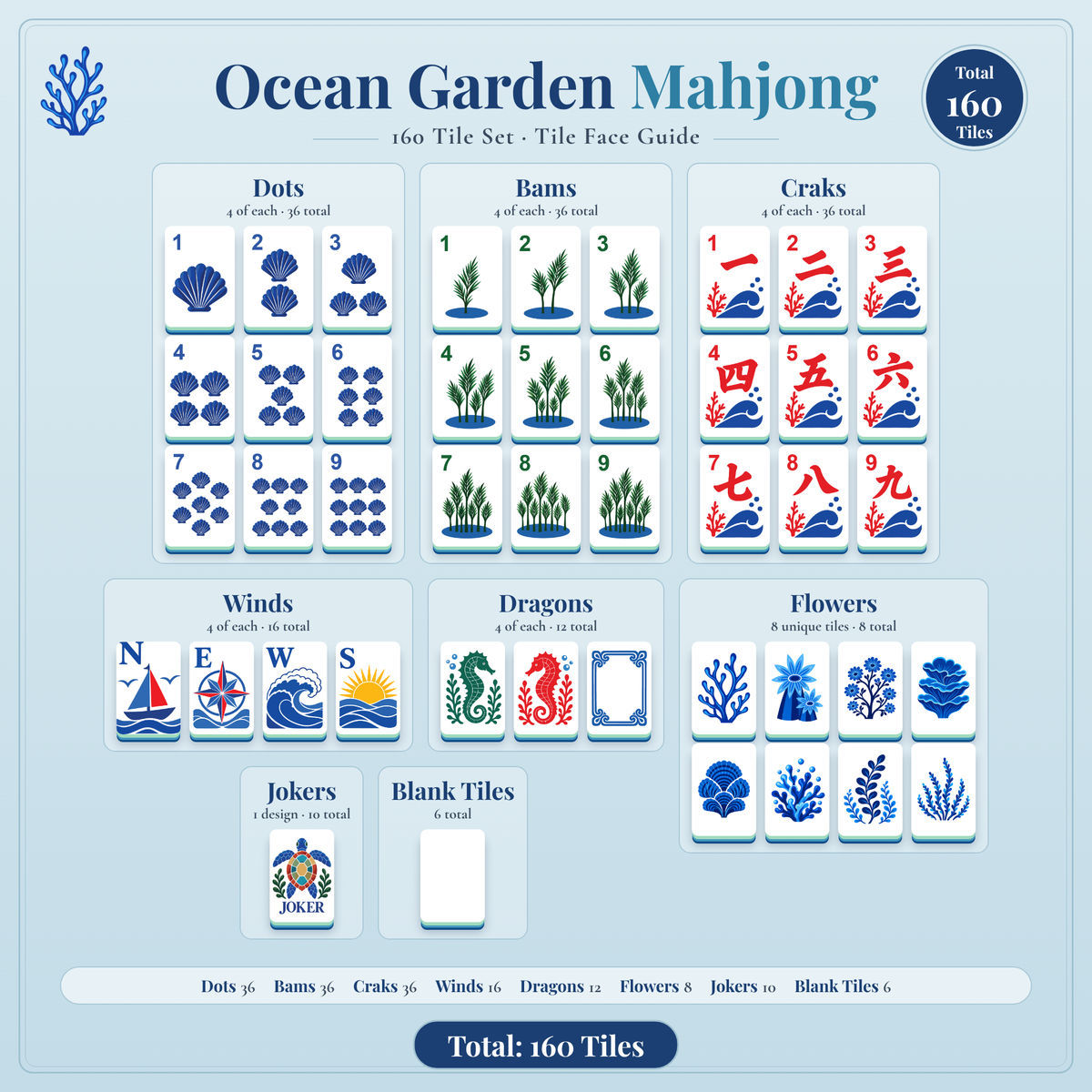
Most Jacksonville teachers provide tiles and mats for the classroom, so you can show up with just a notebook. However, after your first few sessions, you'll want your own set at home so you can drill hands and get comfortable with tile weight and shuffling speed. Here's what matters: 152-tile sets with clear English labels are easiest for new American players—the suits are Bams (circles), Craks (characters), and Dots (bamboo), plus winds, dragons, flowers, and jokers. Avoid unmarked Chinese sets or sets with only Chinese characters; they'll slow your learning. A 160-tile set includes 152 playing tiles plus spares, so if you drop one or it gets worn, you have a backup. Racks with pushers aren't essential for beginners but help enormously—they organize your tiles, keep them hidden from opponents, and the pusher tool lets you draw and play without fumbling. A mat is nice for home games but optional for lessons. Start with just the tiles and racks; add a mat later if you host weekly games.
🎁 See our most-loved mahjong sets & accessories →
How long does it actually take to play your first full game?
Most beginners in formal lessons are ready to play a complete four-handed game after 4–6 classroom hours, spread over 4–8 weeks. Here's the realistic timeline:
Milestone | Hours of Instruction | What You Can Do |
Tile names & suit logic | 1–2 | Recognize Bams, Craks, Dots; spot dragons & winds |
Hand card reading | 2–4 | Find simple patterns on the league card; understand pungs & kongs |
The Charleston (tile pass) | 3–5 | Pass tiles correctly; start a game from scratch |
One full game, with help | 4–6 | Play 4 hands; know when to pick, discard, and call |
Play independently | 8–12 | Handle most game situations; understand scoring basics |
The second full game is much easier than the first—your brain suddenly recognizes tile groupings and patterns jump off the card. Many beginners play their second game in the same session as their first. The leap from "watching" to "playing" happens when you stop thinking about rules and start feeling the hand. This takes practice, which is why owning a home set matters: 30 minutes of solo hand-drilling once or twice a week cuts your learning time in half. Our beginner guide walks you through the Charleston and the first turn-by-turn decision, so you arrive at class already visualizing the game.

What are the most common beginner mistakes in Jacksonville classrooms?
We've played weekly for years, and we see the same errors among new learners everywhere, including Jacksonville. Confusing exposed tiles with hand tiles: Students often forget that a called pung stays visible on the table and doesn't belong in your hand. Your actual hand shrinks as you expose melds. Misreading the league card: Newcomers stare at the card for 90 seconds looking for an exact hand match and miss the pattern because they're looking at the wrong section or aren't scanning left-to-right. The card groups hands by type—like "2 Simples, 1 Pair" or "Like Numbers"—not alphabetically. Ask your teacher to walk you through one full section of the card during class. Not tracking discards: You can't remember what other players threw away, so you discard into their waiting hand by accident and they win off your tile. Keep a mental note—or write it down—of the last three discards from each player. Misunderstanding joker rules: Jokers can fill any position except a single tile or a pair. Many beginners try to use a joker as their pair and lose. Practice reading how jokers work before your third class—it's the rule that sinks the most beginners.
✨ Find your Mahstead set — free US shipping →
How do you find ongoing play groups after lessons end?
Once you've finished your beginner class—which typically runs 4–8 weeks—the next hurdle is finding players. Jacksonville has a few natural gathering spots: libraries often have bulletin boards where players post open games; check back after your class ends and post your own notice if nothing's there. Senior centers and recreation departments sponsor drop-in mahjong sessions once or twice a week; these are usually free or very low cost and serve all skill levels. Online meetup boards (neighborhood apps and city forums) sometimes list mahjong groups; search "Jacksonville mahjong" or "Jacksonville games" a month before your class finishes so you can join a group email list. Social media: Some Jacksonville-area mahjong players organize through community Facebook pages—search "[your neighborhood] mahjong" and request to join. After your first informal game with a new group, you'll know whether the pace and friendliness fit. We recommend attending at least three different groups before picking a regular one; game speed and house rules vary a lot. When you find your spot, bring your own set so you're not dependent on the host's equipment—engraved American mahjong sets and travel bags make it easy to carry your tiles to games week after week.
What should you check before you buy a mahjong set for home practice?
Before spending money, verify three things. Tile clarity: Can you read all English labels in room light without squinting? Cheap sets use tiny fonts or unclear printing—that'll slow your learning. Tile count: Confirm it's a 152-tile set (the American standard) or a 160-tile set with spare tiles, not a 136-tile Chinese set or 144-tile variant. Rack and mat necessity: If your lessons provide a mat and racks, you don't need to buy them immediately; start with tiles alone and add racks later if you prefer them. Many players practice solo hands without racks at all, just spreading tiles on a table. Once you join a weekly group, a mat becomes worth owning—it speeds setup and keeps the table organized. Ask your teacher or other players what they use; buy only what your group actually needs. Our best-selling mahjong sets are 160-tile American sets with clear English labels, designed for learners and experienced players alike.

FAQ
Can I start mahjong lessons if I've never played any tile game before?
Absolutely. American mahjong has no prerequisites. You're learning English-labeled tiles, hand patterns from a card, and straightforward tile-calling rules—all of which are taught from scratch in every beginner class. Most classrooms assume zero prior knowledge.
Should I buy a mahjong set before or after my first lesson?
Wait until after your first class. Attend one session, confirm the ruleset is American, ask the teacher what equipment they recommend, then buy. This prevents buying the wrong set or wasting money if mahjong isn't your thing. Most teachers will tell you exactly what to get.
What's the actual cost of taking mahjong lessons in Jacksonville?
This varies by venue. Community recreation classes typically charge a single session fee; synagogues may ask for a donation per class or per season. Call the specific venue for their pricing. Home practice requires a set, which is a one-time investment, not an ongoing cost.
How do I know if my teacher uses American or Chinese mahjong rules?
Ask directly: "Do you teach American mahjong using the National Mah Jongg League card, or Chinese mahjong?" If they hesitate or say "both," ask them to clarify which one beginners start with. American lessons are far more common in U.S. cities like Jacksonville, but it's worth confirming before you commit.
Can I practice mahjong alone at home, or do I need other people?
You can drill single hands alone—laying out tiles, finding the pattern on the card, exposing melds—and this is excellent practice. But you can't play a full game solo. Solo practice trains pattern recognition and card reading; real games teach strategy, speed, and decision-making. Do both: solo drills 2–3 times a week, group games once a week once you join a club.
What if there are no mahjong lessons near me in Jacksonville?
Check online tutorials (many free, some paid), find a local play group, and learn by watching and playing with experienced players—this is how many older players learned. Buy a set, join a casual weekly game, ask lots of questions, and learn by doing. It's slower than formal lessons but absolutely doable.


View More
View More
View More
