
Two Player Mahjong with 3 Players: Rules, Setup & Workarounds
Last updated: Nov 23, 2026
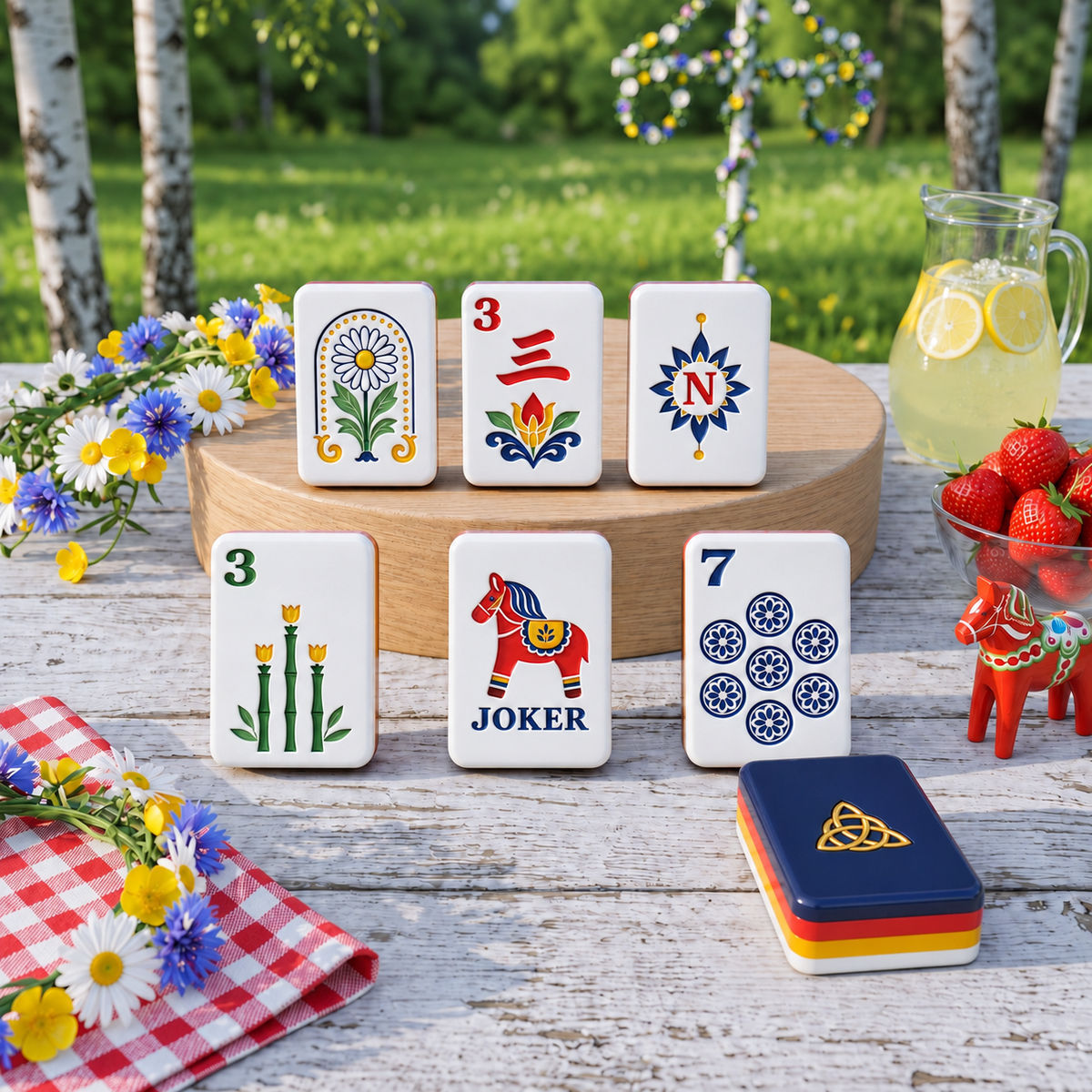
American mahjong is traditionally a four-player game using 152 tiles and 8 jokers. Playing with two or three players requires strategic compromises: reduce the wall size, shorten hands to 12–13 tiles instead of 14, adjust the Charleston passing ritual or skip it entirely, and modify scoring to prevent runaway leaders. With three players, one sits out each hand or rotates. With two players, you'll lose authenticity because the game's probabilities, discarding psychology, and joker utility shift dramatically. You still use the full 152-tile set—no tiles are removed—but fewer players means fewer active draws and a faster, less nuanced game. The official National Mah Jongg League card applies the same, though fewer opponents reduce the blocking opportunities that make American mahjong strategic.
🀄 Shop best-selling mahjong sets →
Why Four Players Is the Standard Setup
The National Mah Jongg League designed American mahjong for exactly four players. Four lets each player discard a unique set of tiles, forcing tough decisions about what to give away. With fewer players, the wall shrinks and hands cycle faster, so luck matters more than reading the table. Two-player games also have an odd feel: you're not blocking two opponents, you're managing one. Three-player rotations work better because you preserve some of that blocking tension, but someone always sits out or the game gets mechanically awkward. If you love the real game, find a fourth player—it transforms the experience from a casual time-filler into genuine strategy.

Two-Player Rules: The Honest Adaptation
Two-player mahjong is possible but not recommended by serious players. Here's why it works and why it doesn't. Starting hand size: Deal 13 tiles to each player instead of 14 (one fewer than usual). The wall: Build it with only 70 pairs (one-quarter the normal 28-tile stack per side), so the game ends faster and the live wall is shallower. Charleston: Skip the passing ritual—it's meaningless with two players. Draw and discard: Each player draws one tile per turn and discards one, as normal, but with only two active players, you'll exhaust the wall in 10–12 turns instead of 15–20. Joker rules: The same—jokers cannot form a single tile or pair, and they're wild in pungs, kongs, quints, and sextets only. Winning: A player must still match a valid hand from the current year's card, but with two players, there's almost no blocking. One player draws a winning tile, calls it, and the game ends. Scoring remains the same (points per the official card), but head-to-head play strips away the psychology—no one is hiding tiles from two other opponents or managing alliances.
Three-Player Mahjong: The Rotation Method
Three-player mahjong works better and is more defensible. The most common approach is the open-seat rotation: one player sits out each hand (no one plays dead). Here's the setup:
Players A, B, C. In round one, players A and B play, C sits out. The tile layout follows two-player rules (13-tile hands, reduced wall).
Positions rotate. After each hand, the sitting player becomes East (first turn advantage) and plays the next hand; a playing player sits out.
Scoring tracker. Keep a cumulative score across three rounds. After hand three, total the points. If you continue, reset and rotate again.
Alternatively, you can play true three-player where all three are active but the wall is reduced and hands are 13 tiles. Discards go to a central discard area (not position-specific), and any player can call an exposed tile. This is closer to Chinese open mahjong but strays from American rules, which assume fixed positions and four active players. Most Western three-player games use the rotation method because it keeps the American structure intact and ensures fairness—everyone plays the same number of hands.
Comparing the Player Counts: A Practical Table
Player Count | Hand Size | Winning Rate | Blocking Power | Game Feel | Best For |
2 players | 13 tiles | ~40–50% (per hand) | None | Luck-heavy, fast | Casual learning, time-limited |
3 players (rotation) | 13 tiles | ~33% (per hand) | Moderate | Balanced, fair | Small groups, rotating groups |
3 players (all active) | 13 tiles | ~33% (per hand) | Low | Chaos, fast | Rare; not recommended |
4 players | 14 tiles | ~25% (per hand) | High | Strategic, tense | Standard; every game counts |
The winning rate reflects the odds of any player winning, not individual skill. With four players and a full 14-tile hand drawn from 152 tiles, winning becomes competitive. With two players and 13-tile hands, probability favors the player who avoids weak discards—but there's no one else to block, so good play matters less. Three-player rotation preserves fairness because everyone sits out equally and plays under the same conditions each round.
Common Mistakes When Playing Short-Handed
Mistake 1: Adding or removing tiles. Some players think a two-player game needs only 100 tiles or three players need 120. Wrong. Always use all 152 tiles—they're in the wall, not on the table. Remove nothing. Reducing the wall size (fewer tiles drawn per turn) is different from reducing the tile count (never do this).
Mistake 2: Skipping the joker rule clarification. New three-player groups often misunderstand how jokers work. A joker cannot be a single tile (e.g., you cannot win with "joker" as your 14th tile). A joker cannot form a pair. A joker can replace any tile in a pung, kong, quint, or sextet. Write this down before you start. See how jokers work for detailed examples.
Mistake 3: Changing the hand card. Use the current year's National Mah Jongg League card—the same one you'd use in a four-player game. Do not invent "easier" hands or remove sections. The card is the law.
Mistake 4: Uneven rotations. If three players rotate, track carefully so each person sits out the same number of times. If someone always plays and another always sits, the scores won't be fair. Use a notebook or phone timer.
Mistake 5: Mixing two- and three-player rules in the same session. Decide before the first hand: are you rotating, or is it a pure two-player series? Switching mid-session confuses scoring and invalidates comparisons.

Why You Still Need a Full Set (and the Right Mat)
Even with two or three players, you need the complete 152-tile set. The tiles in the wall must always total the full amount—you just remove fewer tiles from it per turn. A 160-tile set includes spare jokers and blanks, so you have backups if a tile cracks (rare, but it happens). Acrylic tiles last for years and are easier to shuffle than bamboo or bone, especially if you're mixing up the wall frequently in short-handed games.
For the table itself, a mahjong mat designed for four players works fine—just leave the unused seat's area clear. Mats typically have four marked zones (one per player). In a three-player rotation, lay out three zones and leave one empty. In a true two-player game, you can use the mat's North and South zones, or West and East, and ignore the other two. The mat keeps tiles from sliding and gives everyone a clear discard pool, which matters more in short-handed games because there are fewer hands to read.
🎁 See our most-loved mahjong sets & accessories →
Short-Handed Strategy Tips (What Changes)
With fewer players, your strategic priorities shift.
In two-player games: Watch your opponent's discards obsessively. You're the only one blocking them, so if they throw a 5 Crak early, they probably don't need Craks. Don't sit on high-value dragons or flowers—the wall ends faster, so fewer players mean fewer turns to find melds. Jokers become more precious because there are only 8, and only you two are drawing. Hoard flexibility.
In three-player rotations: The player sitting out holds no power, so focus on the two active players. If you sit out, use the time to note which tiles are gone and plan your next hand. When you're active, remember that your third opponent isn't drawing—they're watching and learning what you have. The sitting player will face you in the next round, so don't telegraph your strategy.
Wall strategy: The live wall shrinks faster, so the end-game tiles are less predictable. Don't rely on "wall luck" in the last five tiles. Win early or expect to lose.
Discarding patterns: With four players, you can throw a safe tile and hope it blocks someone else. With two or three, play only what you're certain won't help your opponent. This is harder and often means discarding a tile you wanted—that's why four-player mahjong is smarter to play.
What to Check Before You Buy (or Before You Play Short-Handed)
Tile quality. If you're playing multiple short-handed sessions, you'll shuffle and draw tiles more often per game. Inspect each tile for cracks or missing paint. Acrylic tiles are durable; bamboo and bone age faster.
Joker count. A 160-tile set includes spare jokers. Count all 8 game jokers before each session—a lost joker breaks the hand-matching logic.
Card clarity. The current year's card must be readable in your playing light. Print a second copy for the sitting-out player in three-player rotation.
Racks or pushers. With fewer active players, a rack with pushers keeps your hand organized and prevents accidental exposure. Especially helpful in short-handed games where tension runs high.
Mat size and marking. A standard mat fits four. If you always play two or three, a smaller mat or a simple cloth works, but beware: coins slide on fabric. A mat with clear zone lines prevents disputes over whose discard pile is whose.
Scoring method. Two- and three-player scoring uses the same point values from the card, but keep a written ledger. Cumulative scores are easy to lose track of with fewer people managing the game flow.
✨ Find your Mahstead set — free US shipping →
The Bottom Line: Play Four When You Can
Short-handed mahjong is real, playable, and sometimes necessary—a sick player or an uneven group happens. The rules work. But it's not the game the League designed, and it's not where the strategy lives. American mahjong's brilliance comes from managing four competing interests, reading table psychology, and knowing when to block versus when to win. Two players strip that away. Three players preserve some of it, especially with rotations.
If you're serious about mahjong, invest in finding a regular four-player group. Many communities host games through recreation centers, libraries, synagogues, and country clubs—check local meetup boards or call nearby venues to ask. Until then, short-handed play is a good way to practice hand-reading and speed up your reflexes. Use the official set, follow the current year's card, and keep careful notes on what worked and what didn't. You're building skills for the real game.

FAQ
Can I use a three-player set (144 tiles) to play two-player mahjong?
No. There's no such thing as a "three-player set" in American mahjong. The game always uses 152 tiles and 8 jokers, regardless of how many people play. Removing tiles changes hand probabilities and invalidates the card's hand values.
Do I need to remove jokers for short-handed games?
No. Always use all 8 jokers. They stay in the wall with the 152 tiles. Fewer jokers changes pung and kong frequency and makes winning hands rarer.
Is three-player rotation as fair as four-player mahjong?
It's fair within itself—everyone plays under the same rules and sits out equally—but it's not equivalent to four-player play. Winning rates and blocking power differ. Use it for practice or small groups, not tournament play.
What if two of my players are strong and one is new?
Short-handed games amplify skill gaps because luck matters less. Consider teaching the new player by rotating more frequently so they see more hands quickly, or let them play all three rounds of a three-player series so they face the same opponents multiple times and adjust.
Can I play one-player mahjong (solitaire)?
Yes, it exists, but it's a puzzle game, not American mahjong. You arrange tiles to match hands on the card, but there's no winning mechanics or scoring. It's a tool for learning hand patterns, not a real game.
Do the official scoring rules change for two or three players?
No. Points per the card remain the same. What changes is how many people earn them—fewer players mean fewer losers and fewer payment opportunities per hand. Adjust your betting only by mutual agreement before the game starts.


View More
View More
View More
