
Mahjong for Poker Players: Rules, Strategy, and How to Start
Last updated: Nov 23, 2026
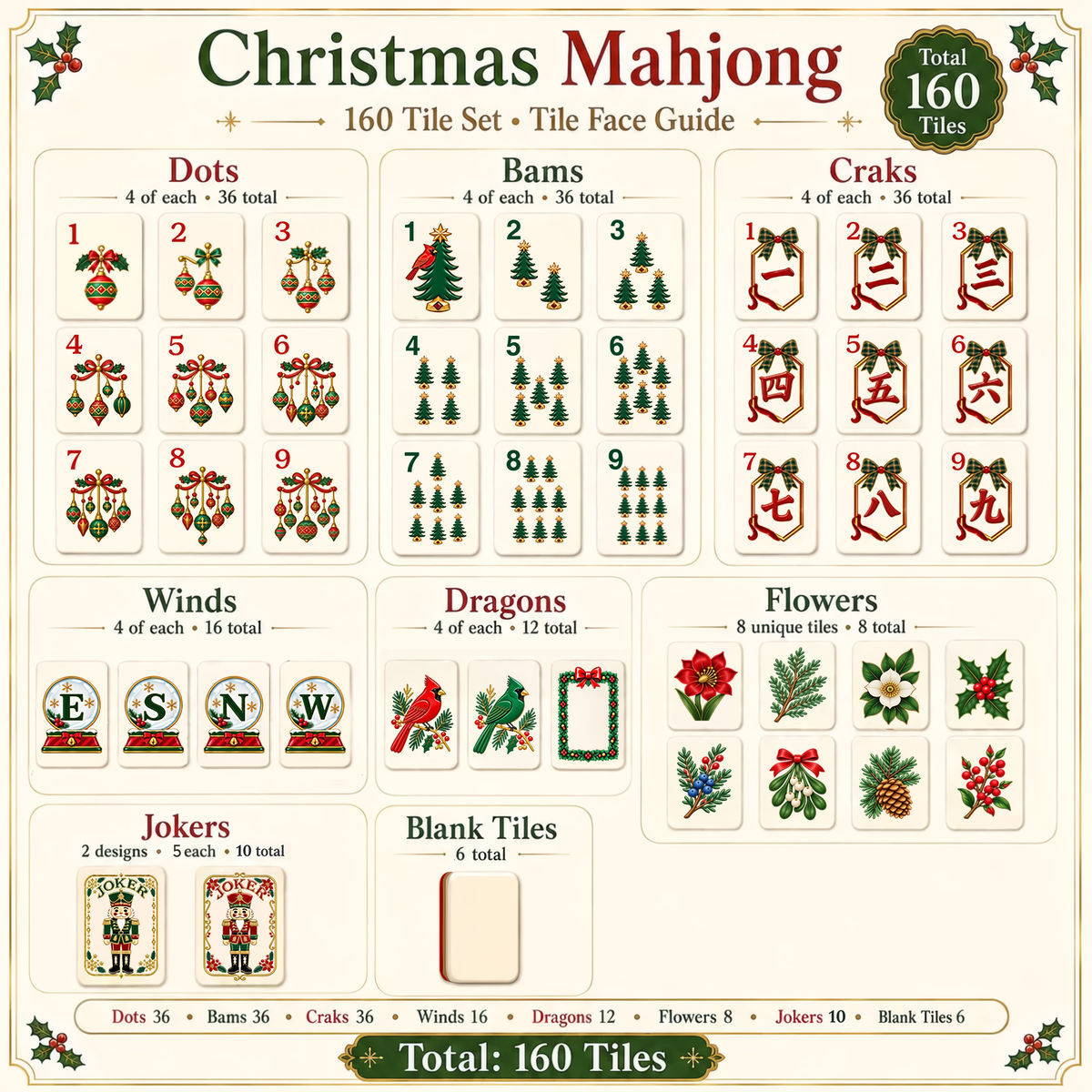
Poker players transition to mahjong faster than non-card players because both games reward probability assessment, opponent modeling, and hand concealment. In American mahjong, you draw and discard tiles to complete one of 88 published hands (from the annual National Mah Jongg League card), using Bams, Craks, Dots, winds, dragons, and jokers. Unlike poker's five-card showdown, mahjong is called when your hand matches the card exactly—no bluffing. A game takes 30–45 minutes per hand; four players sit around a table (or mat) passing tiles clockwise. The strategic difference: poker rewards aggression and deception; mahjong rewards information gathering, memory, and adapting your hand mid-game. Our best-selling sets come ready to play with clear tile faces and jokers that help newer players learn fast.
Why poker players pick up mahjong quickly
Poker teaches you to track probabilities, infer hidden information, and manage risk—skills mahjong demands immediately. In poker, you calculate odds that a hand beats yours; in mahjong, you mentally track which tiles are exposed, which discarded, and which remain in the wall. The reading-your-opponent skill applies: if someone discards a Dragon, they likely don't need Dragons. You also understand pot commitment and hand equity. Mahjong swaps these for tile-draw timing and quint/kong opportunity cost. A poker player used to folding weak hands finds mahjong's "stop building this hand and pivot" decision familiar. The core overlap is ruthless hand abandonment: if your draw doesn't support your target hand on the card, you shift. This is poker's fold reflex in tile form.

How American mahjong differs from poker's logic
American mahjong plays by one rule poker violates: the hand is predetermined. Every legal winning hand appears on that year's card; there is no hand you invent. This removes bluffing and hand-invention—poker's creative chaos. Instead, American mahjong is a pattern-matching race: you and three opponents hunt the same 88 hands simultaneously, and the first to complete one and call "Mahjong!" wins. Poker's deception (tight image, loose play, slow-rolling aces) has no role. Mahjong punishes exposed information: every discard, every pung you claim, every joker you name is public. You cannot read players by bet sizing; you read them by what tiles they hold and reject. Poker rewards aggression and table image; mahjong rewards memory, flexibility, and rapid hand recalculation. A hand lasts 5–10 draws, not a full tournament—each round is a sprint, not a marathon. This compressed timeline suits players who like fast decisions over long grinding sessions.
🀄 Shop best-selling mahjong sets →
The hand card: your new "strategy sheet"
In poker, you study hand charts (range, position, stack depth). In mahjong, the hand card is your only reference—a printed card with 88 sections showing legal winning hands for that year. Each section is a row, and each row shows one hand. You read left-to-right: hand name, tile requirements, and sometimes visual patterns (e.g., "Like Numbers" means 1–2–3, 2–3–4, etc. in one suit). The card updates every spring; all four players use the same card. This is mahjong's radical transparency: no hidden meta-game, no "meta"—only the card and the tiles drawn. Unlike poker, where you profit from knowing ranges opponents don't, mahjong assumes all players study the card equally. Your edge comes from faster mental math (which hands are buildable given your nine tiles?), better memory (which tiles are gone?), and smoother pivots (can I shift to a quicker hand if my first plan stalls?). A poker player used to studying equity tables will find the card's structure familiar—both are static decision trees you internalize. Poker players often find this framework liberating: no guess-work, just execution.
Tile probability and bankroll thinking
Poker teaches expected value: if a coin flip pays 3-to-1 and the coin is fair, you take it because EV is positive over time. Mahjong has similar math, but no money at stake (in casual play). Instead, you track tile probability: if three 5-Dots are gone and one remains in a wall of roughly 90 tiles, the chance you draw it is low—so switching hands is rational. Poker players already do this ("Two opponents folded, so AA looks weaker now"). In mahjong, you apply it to every draw. If you need a 3-Crak to complete a pung and two 3-Craks are discarded, you must pivot because your odds collapsed. Bankroll thinking also translates: a poker player managing variance over 100 hands applies the same mindset to a weekly mahjong session. If you arrive expecting to play six hands, you know some will be drought (unlucky draws, hand impossible to build), and some will be wins. A poker player's patience in dry spells suits mahjong's statistical noise. One key difference: mahjong is typically played for small stakes or no stakes at home, so the risk profile is lower—you're optimizing for enjoyment and skill, not income.
🎁 See our most-loved mahjong sets & accessories →

Memory and hand concealment: the mental skills
Poker requires you to remember bet sizes, aggression patterns, and positional tendencies—data you gather live. Mahjong requires you to remember which tiles have been discarded (roughly 30–40 per round) and infer what opponents hold (by what they draw, claim, and discard). A poker player used to counting cards in blackjack or tracking stack sizes will find this second-nature. In mahjong, you're not counting cards for probability; you're counting for logical inference: if someone drew a Crak and discarded a Bam, they're not building a Bam hand, so you can discard Bams safely. Concealment is subtle: you can't hide your tiles (they're face-down until you claim them), but you can hide your target hand by drawing the same suit others are building or discarding from a second suit to throw off their reads. A poker player who knows check-raising will recognize this delayed-information play in mahjong form. The emotional discipline differs slightly: poker rewards coolness under confrontation; mahjong rewards speed and adaptability. If your hand dies on draw five, you've lost the race—accept it and reset. If you tilt and play the next hand on tilt, you'll waste chips in poker or, in mahjong, waste four players' time.
✨ Find your Mahstead set — free US shipping →
Your first game: a checklist
What you need | Why it matters | Poker parallel |
A 160-tile American set | Standard play; clear tiles; includes jokers | Deck of cards |
The current-year hand card | All legal hands; updated annually | Hand equity chart |
A mat (optional but helpful) | Organizes tiles; speeds play; protects surface | Felt table |
Three other players | Four-player only; roles rotate | Full-ring game |
30–45 minutes per hand | Typical duration; plan 2–4 hands per session | Cash or tournament session |
Before your first hand, learn the Charleston—a tile-passing ritual unique to American mahjong with no poker equivalent. You'll pass tiles left, right, and across before drawing from the wall. This randomizes your starting tiles and adds tactical passing (veterans pass from their hand strategically). Newcomers often pass randomly, which is fine; you'll optimize this over time, just like poker position sense. Ask an experienced player to guide you through the first Charleston; it takes two minutes to execute and two games to feel natural.
What to check before you buy
Set quality: Ensure the set has 152 playing tiles plus spares (jokers and extras). Acrylic sets last longer than bamboo for home play and are easier to clean. Check that Bam suits are clearly marked (the 1 Bam shows a bird), and that the tile faces are large enough to read at arm's length—critical for speed play.
Hand card legibility: Order the current year's card (spring 2026) from your set supplier or the National Mah Jongg League directly. Laminated or oversized versions suit home games. Old cards are useless; the game changes yearly, so a 2025 card is obsolete.
Player group: Mahjong is strictly four-player in American rules. If you have only three, learn the variant first or find a fourth before investing. (Some regional variants allow two or three, but they're rare and play very differently.)
Consistency: Play weekly or biweekly if possible. Mahjong improves with repetition; hand muscle memory matters. Poker players used to grinding schedules will adapt fast.
Getting started: resources and communities
Find players through community centers, libraries, synagogues, country clubs, or meetup boards in your area. Many markets have weekly mahjong groups that welcome newcomers; a quick search for "mahjong club near me" will surface groups. Online play exists (via tile apps and video calls) but loses the physical speed and reading-your-opponents element that poker players love. Your first session with a live group is worth the awkwardness; most players remember being new and will coach you through the hand card and Charleston. If you're starting at home with friends, read our full beginner guide for setup, tile arrangement, and hand-reading tips.
Many poker players find mahjong a perfect complement: it scratches the competitive decision-making itch without the bankroll variance, and a hand lasts long enough to stay engaged but short enough to play five or six in an evening. The hand card removes the "Did he outplay me or did I just get unlucky?" ambiguity—both factors matter, but the card makes strategy transparent. That clarity appeals to poker minds that crave structure.

FAQ
Do I need poker experience to learn mahjong?
No. Poker experience accelerates learning by 20–30% because you already think probabilistically and can read hesitation. But mahjong is fully learnable by anyone with patience; the hand card and four-player table are the hard limits, not poker skill.
Can I play mahjong for money like poker?
Yes, casual home games often play for small stakes (dollar amounts per hand or per round), though many groups play for fun only. Betting doesn't change strategy; it's simply a scorecard. American mahjong is legal in all US states for home play with friends.
How long does a game take?
One hand (one "round") takes 30–45 minutes for four players at normal speed. A typical session is two to four hands, so plan 2–3 hours total. This is shorter than a poker session and makes weeknight play feasible.
What's the biggest strategic difference between poker and mahjong?
Poker rewards hiding information and exploiting position; mahjong rewards visible position-taking (declaring pungs and kongs) and rapid mental recalculation. Mahjong is a sprint; poker is a marathon. Speed and memory beat deception in mahjong.
Do I need to memorize the hand card?
No, but you'll reference it constantly in your first 10–20 games. After that, your brain internalizes the patterns and you'll consult it only for edge cases. Poker players who study ranges will find the hand card as easy to learn as equity tables.
Is there a variant for two or three players?
Yes, but it's rare and plays very differently from four-player American mahjong. Stick to four-player if you're starting; if you find yourself in a two- or three-player situation, ask an experienced player to explain the house rules first.


View More
View More
View More
