
Mahjong for Couples: How to Learn & Play Together
Last updated: Nov 23, 2026
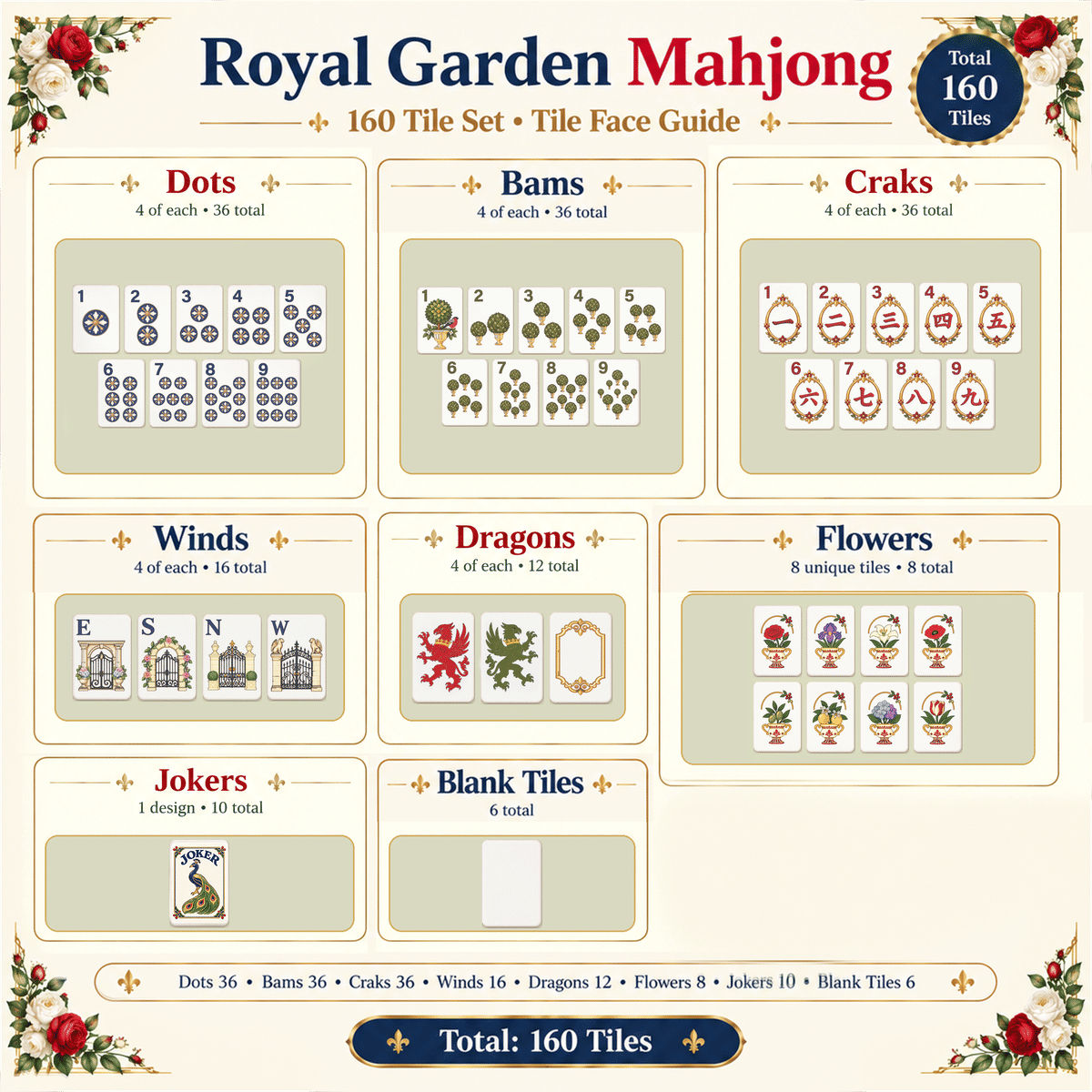
American mahjong is traditionally a four-player game, but you and your partner can play using official two-player rules adapted by the National Mah Jongg League. Two-player mahjong uses the same 152 tiles and 8 jokers as the standard game, the same hand patterns from the current year's card, and the same Charleston tile-passing ritual—but with simplified discard walls and faster rounds because fewer tiles leave the table. The core skill stays identical: reading the card, managing your hand, recognizing which melds complete a winning hand, and knowing when to hold and when to pass jokers. Many couples find the game quieter and more strategic with just two players; rounds last 15–25 minutes per hand. You'll play roughly one to three hands per sitting, depending on speed. To start, both players need to understand how to read the mahjong card and the basics of American tile groups (pungs, kongs, quints). Most couples begin with a dedicated mahjong set with clear markings and a mat to keep tiles organized.
Why is two-player mahjong different from the four-player game?
In four-player American mahjong, each player draws from one of four walls, discards into the center, and competes for winning hands simultaneously. In two-player mahjong, you reduce the walls: instead of four, you use two walls (one per player) positioned at opposite ends of the table. This changes draw order, discard patterns, and how quickly the game moves. The winning-hand patterns remain identical—you still use the current year's National Mah Jongg League card—but with fewer players discarding, you'll see fewer tile options and shorter rounds. Many couples appreciate that two-player games reward memory and hand-reading more than luck, and there's less waiting between your turns.

What equipment do you need to play mahjong as a couple?
You need exactly 152 playing tiles and 8 jokers (sold standard in every American mahjong set), a mat to define the play area and protect tiles from spilling, two racks if you want to hide your hand from view, and optionally a set with racks and pushers included for smoother tile sliding. A mat isn't strictly required, but couples report it makes tile management cleaner and prevents the scattered-tile frustration that kills mood during a date-night game. If you'll play in different rooms or travel, a carrying bag or case keeps everything organized between sessions. Some couples also enjoy dice to randomize seating or starting draws, though two players can simply alternate who opens the hand. A dedicated set with engraved or gift-quality designs often makes the ritual feel more special—many couples keep their set on display between games.
🀄 Shop best-selling mahjong sets →
How do you set up a two-player game?
First, shuffle all 152 tiles face down on the mat and arrange them into a wall—typically a 4×19 formation (four tiles high, 19 tiles wide) or a 3×25 formation, depending on mat size and table space. Decide who goes first (by agreement or dice). That player sits at the "East" position; their opponent sits at "South" (or opposite). East builds a discard wall from one end of the playing surface; South builds from the other. Each player draws 13 tiles from their wall in sequence (East draws first), then East draws one more to open the hand with 14 tiles; South now has 13. The winner is the first to arrange their 14 or more tiles into a legal winning hand shown on the current year's National Mah Jongg League card. Unlike four-player mahjong, the Charleston (the three-part tile-passing ritual at the start) is often shortened or skipped in two-player games—check the two-player rules document before your first session. After opening, players alternate drawing from the wall and discarding into the center. A hand typically ends when one player wins, or when no legal moves remain (dead hand).
🎁 See our most-loved mahjong sets & accessories →
What's the best way for couples to learn the rules together?
Start with the fundamentals of American mahjong before diving into two-player variants. Both of you should understand: what pungs (three identical tiles), kongs (four identical tiles), and quints/sextets are; how jokers work (they substitute for any tile in an exposed meld, but never appear alone or in a pair); how to read the hand patterns on the card; and basic scoring. Then switch to a reference sheet for two-player rules—many online sources from the National Mah Jongg League provide free PDFs. Play your first few hands slowly. Talk through each draw and discard. Pause before announcing a win to confirm the hand is legal. It's normal for the first 3–5 hands to feel clunky; by hand 10, most couples find a comfortable rhythm. Play one or two hands per session until rules feel automatic. Don't rush to play for points or stakes until you both feel confident.

What common mistakes do couples make—and how do you avoid them?
Mistake | What Goes Wrong | How to Avoid It |
Joker confusion | One player thinks a joker can stand alone or be part of a pair; both become frustrated. | Read how jokers work before play: jokers only substitute in exposed melds (pung/kong/quint/sextet). Never alone, never in a pair. |
Card misreading | You both build a "winning" hand, but when checked against the card, it's not actually listed for the year. Game breaks down. | Before each hand, agree on which hand you're chasing and verify it exists on the card. Check the exact tile count and suit order. |
Lost tiles | A tile goes missing during a hand; one player accuses the other of cheating or losing track; tension erupts. | Use a dedicated mat with clear zones for discard piles and player hands. Count tiles before each game: always 152 + 8 jokers. |
Discard chaos | Both players discard into the center simultaneously; tiles overlap; no one remembers who discarded what or in what order. | Discard in strict turn order: one player draws and discards, then the other. Place discards in a line or circle, not a heap. Mark the first discard with a separator tile if needed. |
Hand hype mismatch | One player thinks the other has won, but they haven't; frustration follows. | Define a win rule before the hand starts: announce "I'm calling" and immediately expose all tiles for both players to verify against the card. Don't assume; check. |
What's the best first set for a couple to buy?
Look for a set that feels substantial (solid acrylic tiles, clear engravings) and includes a mat, because that combo removes setup friction. Sets with racks and pushers let each player keep their hand hidden, which adds an engaging element of surprise to the endgame. If you're playing casually at home every week, invest in something you'll enjoy looking at—an engraved set with a personal phrase or design makes the ritual more meaningful. If you're uncertain, start with one of the best-selling collections; they're popular with couples because they balance durability, aesthetics, and ease of use. Avoid bare-bones sets with thin tiles or unclear numbers; they frustrate players within three games. And remember: all Mahstead sets ship free across the US, so you're not paying extra to try a nicer version.
What to Check Before You Buy
Tile clarity: Can you read every suit symbol (Bam, Crak, Dot) and number from arm's length? Poor markings slow down play.
Mat included: Does the set come with a play mat? If not, budget separately for one—it's not optional for couples' play.
Rack quality: If racks are included, are they tall enough to hide your hand? Short racks defeat the purpose.
Joker and blank count: The set should contain 152 playing tiles + 8 jokers as standard. Ignore spare blanks; they're never used in play.
Shipping and return: Verify free US shipping is included. Check the policy if a tile arrives cracked.
Weight and storage: Will the set live on your coffee table or in a closet? A carrying case makes weeknight games easier.
✨ Find your Mahstead set — free US shipping →
How does two-player mahjong compare to playing with four?
Two-player mahjong is faster, quieter, and more strategic—but it removes the social chatter and side-game tension that make four-player sessions feel like an event. With four players, there's always someone else playing while you wait, which creates a rhythm; with two, every draw is yours or your partner's, so you're never idle. This means two-player rounds are tighter and more focused but require stronger attention. Four-player games have more discard variety, so unexpected tiles hit the table more often; two-player games are more predictable, which rewards memory. If you're new to mahjong, playing as a couple actually helps because you can stop, rewind, and discuss without a third or fourth player tapping their fingers. Most couples who play regularly move between two-player sessions at home and four-player games at clubs or game nights—they're complementary, not competitive.
Why do couples enjoy mahjong?
Beyond rules and scoring, mahjong gives couples a shared skill to develop, a reason to spend an hour together without phones, and a game where luck and strategy both matter (so every hand feels different). Unlike chess, it has a built-in shuffle at the start, so you don't need years of study to stay competitive with each other. Unlike card games, the tiles are tactile and visible, so there's less room for confusion or accidental cheating. And unlike many board games, a single hand lasts 15–25 minutes—perfect for a date night that doesn't hijack the whole evening. Couples often report that learning mahjong together deepens their communication: you're reading each other's discards, anticipating what hand your partner needs, and celebrating wins as a team even when one of you loses that hand. The game becomes a language between the two of you.

FAQ
Can we learn mahjong just from watching videos, or do we need a class?
Videos and guides (including our beginner's blog) are enough for couples to start. Play slowly through your first 10–15 hands, reference the card often, and pause to check rules. Some couples prefer one in-person session with an experienced player to get unstuck; many local community centers, libraries, and synagogues offer casual drop-in games where you can observe. No class is required.
Does my partner need to be a "game person" to enjoy mahjong?
No. Mahjong rewards patience and attention more than competitive aggression. Partners who enjoy puzzles, card games, or quiet focus—even if they don't play many games—often love mahjong. Start with one hand and see if it clicks. If it doesn't, you haven't wasted money: the set stays beautiful on a shelf.
What if one partner learns faster than the other?
This is common and normal. The slower learner shouldn't feel rushed. Play more practice hands, skip score-keeping for the first month, and focus on fun over winning. By hand 20, most couples are at similar speed. Patience here actually strengthens connection.
Is two-player mahjong considered "real" mahjong by serious players?
Two-player mahjong is an official variant recognized by the National Mah Jongg League. Serious players respect it as a legitimate game format, not a compromise. It's different from four-player mahjong—not inferior.
How often should we play to get good?
Once a week for two months gets most couples comfortable. After that, skill depends on interest. Some couples play every week for years; others play monthly and stay sharp. Consistency matters more than frequency: weekly play for two months beats daily play for two weeks.
What if we want to play with friends sometimes—can we move from two-player to four-player?
Yes. The tiles, card, and core rules are identical. You'll just add two more discard walls and more players. Learning two-player first actually makes the four-player game easier because you already know how to read the card and manage melds. Many couples start together and join clubs later.
Does the year of the mahjong card matter for couples?
Yes. You must use the current year's National Mah Jongg League card. Each spring, the card changes—new hand patterns are added, old ones removed. Using last year's card means you'll build hands that aren't legal this year. Always buy the current year's card or get a set bundled with the right year's card reference.
What's the best mat size for two people?
A standard mat is 27–30 inches square, which fits two player walls and a central discard area on most dining tables. If your table is small (under 36 inches across), look for a 24-inch mat. If it's large, a 30-inch or larger mat prevents tiles from sliding to the floor and keeps everything centered.


View More
View More
View More
