
Mahjong Competition Rules: NMJL Hand Card & Scoring Explained
Last updated: Nov 23, 2026
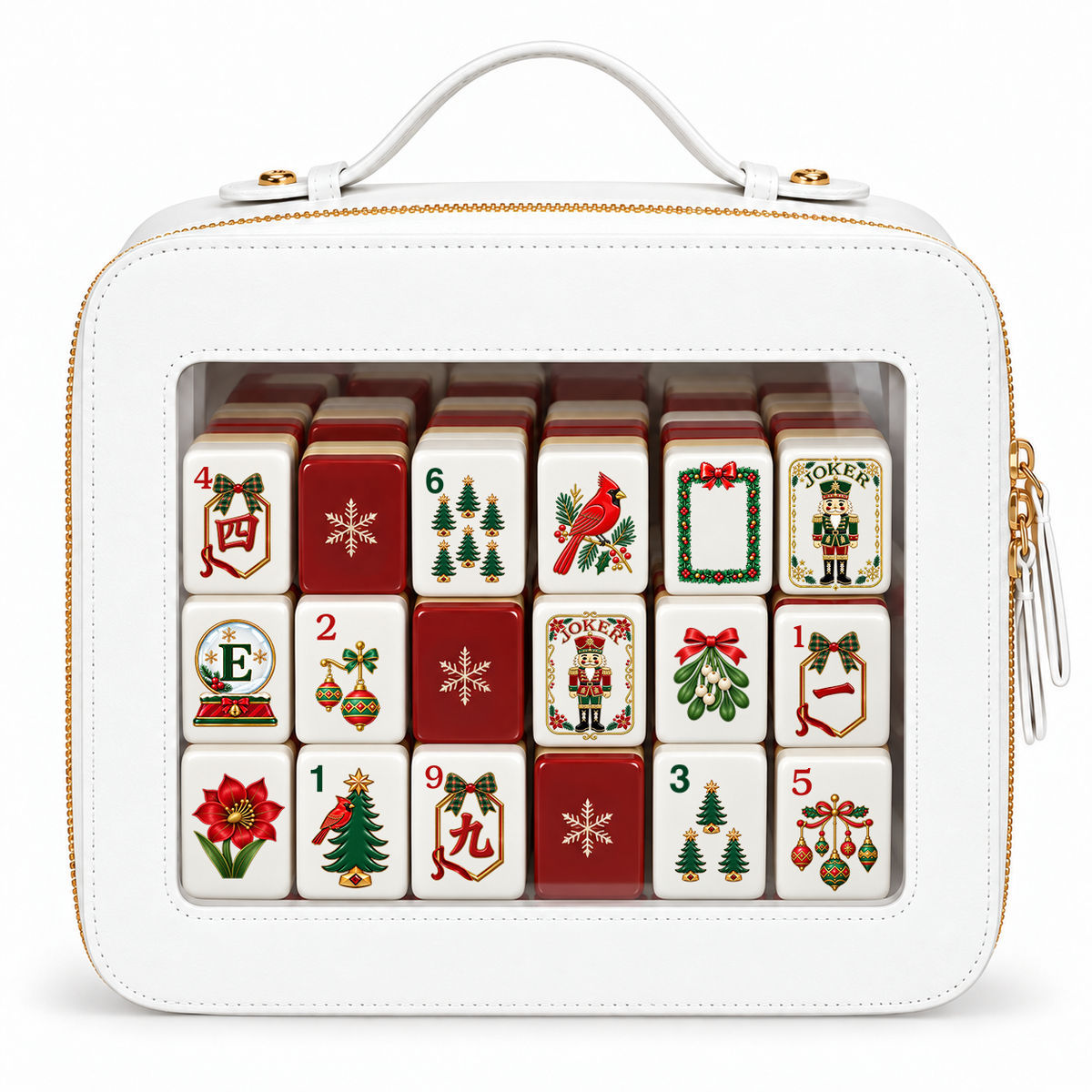
American mahjong competition uses the NMJL hand card, updated yearly, which defines all legal winning hands. Play requires exactly 152 tiles and 8 jokers; you call a hand only when your tiles match a single card pattern. Exposure is strict: you may only expose pungs (three identical), kongs (four identical), quints (five identical) and sextets (six identical)—never sequences. The Charleston, a tile-passing ritual before play begins, is mandatory. Winning hands score points based on pattern complexity; jokers are wildcards but cannot fill a single tile or a pair. Tournaments enforce hand verification and tile audits. Our best-selling sets come with 152 tiles and 8 jokers, sized for serious play.
🀄 Shop best-selling mahjong sets →
What is the NMJL hand card and why does it matter?
The National Mah Jongg League publishes a new hand card each spring. Every legal winning hand in competitive American mahjong appears only on that year's card. You cannot call a hand that isn't on the card, even if it seems logical. The card is divided into sections by point value, tile count, and pattern type. Each pattern shows which suits, numbers, and joker positions are allowed. Tournament players must own the current card and carry it to every game. Without memorizing or referencing the card constantly, competition play is impossible.
🎁 See our most-loved mahjong sets & accessories →

How does the Charleston work in tournament games?
The Charleston is the mandatory tile-passing ceremony before the first hand begins. East player passes three tiles face-down to their right (South), who passes three to West, who passes three to North. North then passes three back to East. This completes one round of the Charleston. In tournament play, most competitions run one Charleston; casual games often run three. The Charleston explained in detail covers timing, what tiles you may or must pass, and common mistakes. The purpose is to randomize opening hands fairly and prevent card-counting advantages.
What tiles can and cannot be exposed during play?
In American mahjong, exposure rules are strict and protect the integrity of the game. You may expose (lay face-up on the table, tabled for all to see) only these combinations:
Pung: three identical tiles (e.g., three 5 Dots)
Kong: four identical tiles
Quint: five identical tiles
Sextet: six identical tiles
You may never expose:
A single tile
A pair (two tiles)
A sequence or chow (1-2-3, 5-6-7, etc.)
Any combination using a joker in a single tile or pair position
When you expose a pung, kong, quint or sextet, you must clearly announce what it is. Other players immediately verify it matches the tiles you claim. Once exposed, those tiles remain on the table and locked into your final hand—you cannot recall them. Violating exposure rules loses the hand and usually incurs a penalty. Tournament referees audit exposed tiles carefully to catch errors before calling a win.
How is scoring calculated in competition?
NMJL competition scoring is based on the hand pattern's position and complexity on the current year's card. The hand card lists hands in ascending point value, typically from 25 points (lowest) to several hundred. When you call a winning hand, you identify which section of the card it matches. Your score is the point value on that line multiplied by the game stakes (commonly 1 point per chip or unit). Some tournaments use doubling rules: if your hand or your Pong (the tile you drew that completed your hand) is a Flower, you often double the base score. Ties (two or more hands possible from the wall or discard pile) result in the hand closest to the back of the card (highest point value) winning the tie. American mahjong scoring goes deeper into settlement methods and penalty scoring.
How do jokers function in competitive hands?
Jokers are wildcards that substitute for any tile except a single tile or a pair. If your hand pattern requires a pung (three identical tiles), you can replace one, two, or all three with jokers. You can also replace tiles in a kong, quint, or sextet. However, a joker can never be the only tile in a single-tile section, and it can never form a pair by itself. If the hand card shows a pair of 1 Bams, you must use two actual 1 Bams; jokers cannot fill that pair. Jokers are drawn randomly from the wall like other tiles and discarded the same way. When you expose a pung or kong containing a joker, you place the joker in the correct position so all players see what tile it represents. Counting your jokers before the Charleston is standard practice—you should have exactly eight. How jokers work explains detection, strategic use, and house rules around joker theft.

What disqualifies a hand or triggers a penalty in tournaments?
Tournament referees enforce strict rules to prevent cheating and enforce integrity:
Violation | Penalty | Why |
Calling a hand not on the current year's card | Loss of hand; sit out one round | Protects rule consistency |
Exposing an illegal combination (sequence, single tile, pair with joker) | Loss of hand; possible point penalty | Maintains game structure |
Drawing or discarding out of turn | Exposure rules applied; may void play | Prevents signaling and collusion |
Tile audit failure (misdeclared pung or exposed count) | Hand voided; points reversed if already paid | Ensures accuracy |
Passing the Charleston after time expires or passing fewer than three tiles | Hand restarts; Charleston replayed | Enforces fair randomization |
Removing or recalling an exposed tile | Loss of hand; player sits out a round | Prevents after-the-fact advantage |
Tournament directors clarify rule interpretations before play. If a dispute arises mid-hand, play pauses, the NMJL card is consulted, and a ruling is made. Repeated violations may result in suspension from the tournament.
✨ Find your Mahstead set — free US shipping →
What equipment do you need for tournament-legal play?
Competitive play requires precision equipment. Your mahjong set must contain exactly 152 playing tiles plus 8 jokers (160 total with spares). Acrylic tiles are standard; bamboo and bone sets are rarer in tournaments. A mahjong mat protects tiles and provides clear scoring and hand-holding zones. Racks with pushers help organize tiles neatly and reduce accidental exposure during draws. Many tournaments provide mats and racks, but bringing your own ensures consistency in your play. A travel bag or case keeps tiles organized and protects them between rounds. Bring the current year's NMJL card, a pen, and score sheets; most tournaments supply these, but redundancy prevents delays.
Before You Buy
Verify the tile count: Competition sets must have 152 playing tiles + 8 jokers. Ensure your set includes no blanks added to the 152.
Check tile size: Standard American mahjong tiles are 1 × 1 inch (25 × 25 mm). If using racks or a specific mat, confirm tile compatibility.
Confirm suit spelling: Bams (bamboo), Craks (characters/circles), Dots (circles). Imported sets sometimes use different names; confirm before buying for serious play.
Keep the original packaging: Store the card and rule sheet that come with your set. Many sets ship with the previous year's card; always purchase the current year's card separately or verify you have the latest.
Test joker visibility: Jokers must be visually distinct (often bright yellow or marked). During a tournament warm-up, draw all eight and confirm you can spot them quickly in a full hand.
Comparison: Set Choices for Tournament Play
Set Type | Best For | Durability | Cost Basis | Key Feature |
Standard acrylic, single color | Local club play, weekly games | 10+ years | Budget-friendly | Lightweight, easy to handle |
Acrylic with engraved titles | Club trophies, team play | 10+ years | Mid-range | Personalization, team identity |
Acrylic with custom colors | Serious tournaments, home tournaments | 10+ years | Variable | Visual appeal, tile distinction |
Bamboo/bone sets (rare) | Heritage events, museum-quality | 20+ years | Premium | Authentic feel, prestige |
Most tournament venues accept any acrylic set with correct tile count and joker count. Engraved sets from our mahjong titles collection are popular for tournament hosts and regular clubs because they mark ownership and add personality without compromising play.
Quick Checklist: Before Your First Tournament
☐ Own the current year's NMJL hand card
☐ Verify your set has 152 tiles + 8 jokers
☐ Practice the Charleston at home with experienced players
☐ Memorize exposure rules: pung, kong, quint, sextet only
☐ Learn hand card sections and point values
☐ Confirm joker visibility and count before each session
☐ Bring a rack with pushers or use the tournament's provided racks
☐ Carry a mat or use the venue's table
☐ Bring tile-cleaning cloth (tiles pick up dust during Charleston)
☐ Arrive 15 minutes early to test equipment and ask the director for clarification

FAQ
Can I play a hand that isn't on the NMJL card?
No. In tournament play, a hand is legal only if it appears on the current year's official card. Casual home games sometimes allow non-card hands, but competitions are strict. Always reference the card during play.
What happens if I expose a pung incorrectly?
If you expose a pung and it's later determined to be wrong (e.g., you said three 5 Dots but one is a joker in the wrong position), your hand is voided and you may forfeit the hand's points. Some tournaments impose a round penalty. Always verify your exposure aloud before the table.
Are jokers allowed in every hand?
Jokers are wildcards for any tile except single tiles and pairs. If a hand pattern requires a pair, you must use two actual tiles. Most hands allow jokers in pungs, kongs, quints, and sextets. Check the hand card's notation.
How many tiles do I keep in my hand during play?
You hold 13 tiles in your hand during regular play. After drawing a tile, you temporarily hold 14; if no call is made, you discard one, returning to 13. The Pong (the tile that wins the hand) is drawn last, completing 14 tiles total.
What's the difference between a quint and a sextet?
A quint is five identical tiles. A sextet is six identical tiles. A sextet is rarer and usually worth more points on the hand card. Both are legal exposure combinations, but you cannot expose seven identical tiles.
Can I take back a discard?
No. Once you discard a tile and release it into the center, it cannot be reclaimed. If another player calls it, they use it. If no call is made, the next player may take it or pass. This is tournament law.
How do I verify the tile count during a tournament?
Count all 160 tiles (152 playing tiles + 8 jokers) before the first hand. Most tournaments require a joint count by all four players or a referee. If any tile is missing or cracked, report it immediately and use a backup set or replacement tile if available.


View More
View More
View More
