
Is Mahjong Similar to Hand and Foot? Key Differences Explained
Last updated: Nov 23, 2026
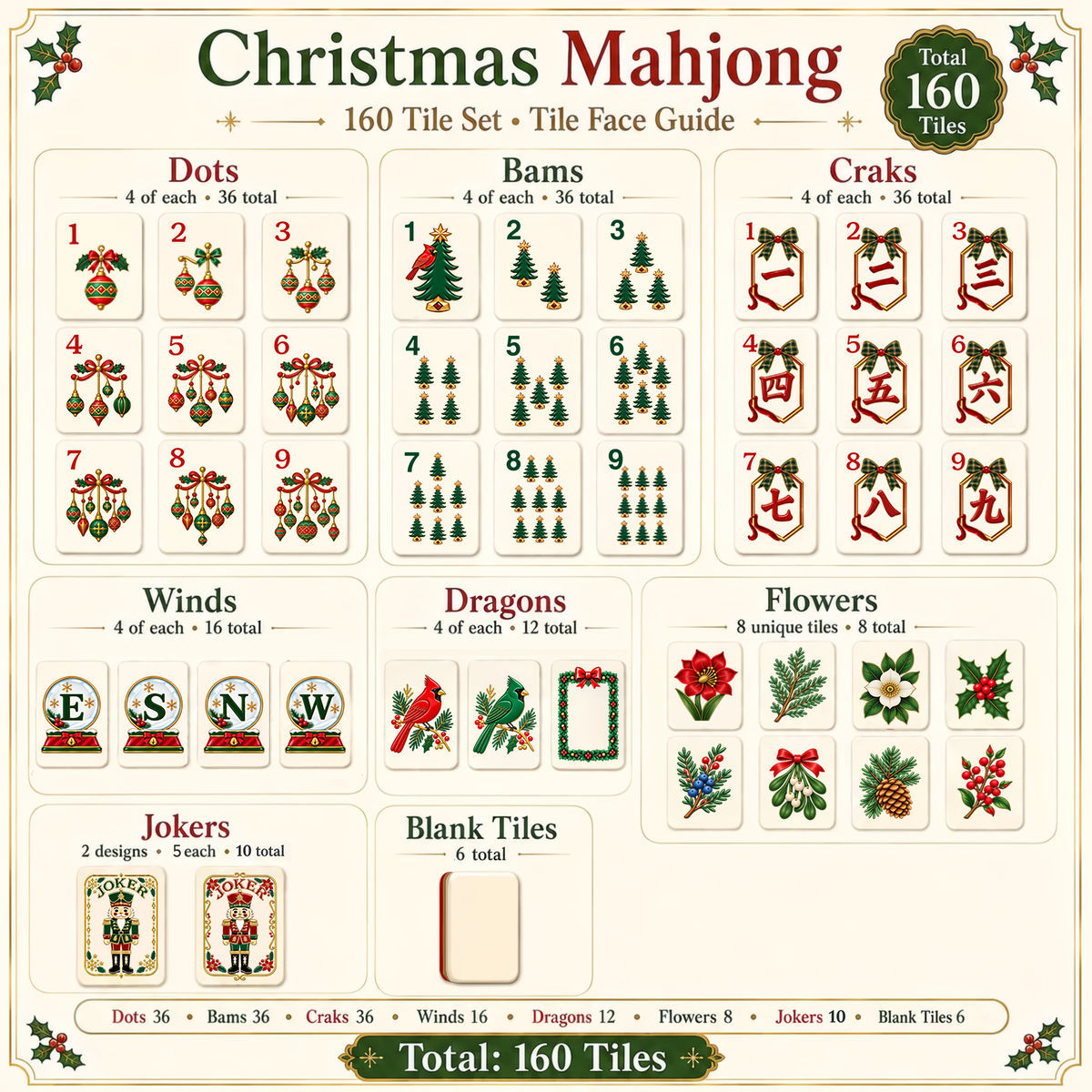
Hand and Foot is a rummy-variant card game (not tiles) played with multiple decks, where you build melds of cards in your hand and a separate "foot" pile, with no standard tile set. Mahjong—specifically American mahjong, the dominant variant in the US—uses exactly 152 tiles divided into three number suits (Bams, Craks, Dots 1–9), plus winds, dragons, flowers, and jokers. In Hand and Foot, you draw and discard one card per turn and meld freely on the table; in American mahjong, you draw one tile, pass three to other players before play starts (the Charleston), and may only expose pungs (three identical tiles), kongs (four), or longer runs using the current year's hand reference card. American mahjong requires exact hand matches from the official card; Hand and Foot uses flexible meld rules. Both are social games, but mahjong demands tile-specific equipment and more formal hand structure.
What Game Family Does Each Belong to?
Hand and Foot descends from canasta and rummy; players build melds of consecutive cards or sets of identical ranks on the table. Mahjong originated in 19th-century China and spreads across dozens of rule variants worldwide. American mahjong evolved from the Chinese game but with its own strict framework: hands are defined by the annual National Mah Jongg League card, melds must match printed patterns exactly, and the game uses a fixed tile count. Hand and Foot emphasizes flexible combinations and point accumulation; American mahjong emphasizes rigid pattern recognition and going "mah jongg" (winning) by matching one complete hand. They share the social, turn-based structure but almost nothing else mechanically.

What Do Players Actually Hold and Play With?
Hand and Foot uses standard playing cards—typically two to four decks shuffled together—and requires no special equipment beyond a table and score sheet. Players hold cards in their hand and draw from a central discard pile. American mahjong uses 152 identical acrylic or bone tiles (we supply 160-tile sets with spare jokers for durability), a cloth mat with carved wooden walls (called a rack or wall), pushers, and a printed hand card from the current year. You draw one tile per turn from a wall built by all four players; you must pass three tiles to neighbors before any tile is drawn. The tile count is exact and non-negotiable. Hand and Foot is more portable (play it anywhere with cards); mahjong requires best-selling mahjong sets with all tiles present and a dedicated mat to manage the wall and tile distribution fairly.
🀄 Shop best-selling mahjong sets →
How Do Melds Work in Each Game?
In Hand and Foot, a meld is any group of three or more cards of the same rank (a set) or three or more consecutive cards of the same suit (a run). You can add cards to your melds or other players' melds as the game progresses. Any meld you build stays face-up on the table in front of you. In American mahjong, a meld is defined by the official hand card each year. You may only expose a pung (three identical tiles, like three 5 Dots), a kong (four identical tiles), a quint (five identical), or a sextet (six identical). You never expose sequences or chows; every meld must be identical tiles. Jokers can never form a single tile or a pair—they can only substitute within a pung or longer meld. The hand card shows you hundreds of winning combinations; you win only by matching one pattern exactly. Hand and Foot is forgiving and additive; American mahjong is precise and card-dependent.
What's the Role of Jokers and Wild Cards?
In Hand and Foot, many players add jokers or twos as wild cards that stand in for any card, allowing flexible melds. The rules vary by house. In American mahjong, jokers are specific tiles—your 160-tile set includes 8 jokers—and they act as substitutes for any tile you need in a pung, kong, quint, or sextet. However, a joker can never be a single tile, a pair, or the only card in a position. A hand may not go mah jongg if it relies on jokers incorrectly; you must have enough non-joker tiles to support your claim. Jokers also have a white tile variant (Soap) that serves as a zero or wild in some contexts. For detailed strategy, see how jokers work. Hand and Foot treats wilds as flexible fillers; mahjong treats jokers as rigid tools constrained by the hand card.

How Does Scoring Compare?
Hand and Foot scoring is cumulative: you earn points for melds, for going "down" (playing your first meld), and for bonuses like clean hands (no wild cards) or completing a "foot" pile. Scoring typically runs 50 to 500+ points per hand depending on house rules, and you often play to a target like 10,000 total. American mahjong assigns fixed point values per hand on the official card—usually between 25 and 80 points—based on pattern difficulty. You win points by declaring mah jongg; if you're wrong, you pay a penalty. Games are often played "timed" (e.g., 4 games in 2 hours) or to a set number of rounds. Scoring in Hand and Foot is more flexible and reaches higher numbers; American mahjong is tighter, card-defined, and typically played in sessions of a fixed number of hands. A complete guide appears in American mahjong scoring.
Comparison: Game Structure at a Glance
Aspect | Hand and Foot | American Mahjong |
Equipment | 2–4 card decks, score sheet | 160-tile set, mat, rack, official hand card |
Melds | Flexible sets and runs | Card-defined pungs, kongs, quints, sextets only |
Winning | First to target score | Exact hand match from card |
Wild cards | Jokers/twos (house rules vary) | 8 jokers, constrained use |
Turn action | Draw and discard one card | Pass 3 tiles, then draw 1 tile per turn |
Setup time | <5 minutes | 10–15 minutes (wall build, Charleston) |
Learning curve | Easier, flexible rules | Moderate; card-dependent, precise |
Portability | High (just cards) | Lower (tile set, mat needed) |
What Should You Choose?
If you already play Hand and Foot and want to try mahjong, know that mahjong has steeper setup and memorization demands but offers deeper strategy and fewer house-rule arguments (because the card is official). Hand and Foot is faster to teach and forgiving; mahjong rewards attention to tile patterns and hand structure. You cannot play both games with the same materials—Hand and Foot needs cards, mahjong needs tiles. If you're drawn to the social, turn-based feel of Hand and Foot and want the next level of complexity, join a local mahjong group (check community centers, libraries, or country clubs near you) for a demo before buying a set. Many players enjoy both. Our mahjong for beginners guide will orient you to American rules and help you decide if it's your game.
🎁 See our most-loved mahjong sets & accessories →
What to Check Before You Buy
Do you have 4 players? Mahjong is a 4-player game by default; Hand and Foot scales to 2–6. If you're short players, ask whether your group accepts 3-player mahjong (rules differ; see 2 and 3 player mahjong rules).
Have you read the hand card? Before spending on a mahjong set, spend 10 minutes looking at a sample hand card (available free online or in clubs). If the pattern-matching feels tedious, stick with Hand and Foot.
Is your table large enough? A mahjong wall takes up a 3×3 foot minimum space. Hand and Foot fits on any table.
Do you want official rules or house rules? American mahjong has one official rule set (the NMJL card each year); Hand and Foot varies widely. If consistency matters to you, mahjong wins.
✨ Find your Mahstead set — free US shipping →

FAQ
Can I play Hand and Foot with a mahjong tile set?
No. Hand and Foot requires cards with ranks and suits; mahjong tiles have different markings and counts. They're incompatible. Buy the right equipment for each game.
Is mahjong harder to learn than Hand and Foot?
Yes, moderately. Mahjong requires learning the tile symbols, the annual hand card, and the Charleston passing ritual. Hand and Foot uses familiar cards and flexible rules. Both take a few sessions to feel natural.
Can I modify American mahjong rules like I do with Hand and Foot?
You can, but the official game is played from the National Mah Jongg League card with no house variations. Tournaments enforce strict rules. Most home games follow the published card exactly to avoid disputes.
How much do mahjong sets cost compared to a deck of cards?
A single card deck costs a few dollars; Hand and Foot needs multiple decks. A Mahstead mahjong set is a larger upfront investment because it includes tiles, rack, pushers, and mat, but it lasts decades with proper care. See current price on our best-selling sets page.
Which game is more portable?
Hand and Foot is far more portable—cards fit in a bag and go anywhere. Mahjong requires a set, mat, walls, and more table space. If you travel frequently, Hand and Foot wins.
Do I need to buy a mahjong set if I'm only trying the game once?
No. Borrow a set from a club or friend first. Most local groups let newcomers play on their equipment before you invest. Many clubs host casual nights where you can ask questions and test your interest.


View More
View More
View More
