
Mahjong for Rummy Players: What Transfers and What Changes
Last updated: Nov 23, 2026
Rummy players already understand tile grouping, discard strategy, and reading opponents—massive advantages. But American mahjong replaces sequences with fixed hands from the year's card, adds a ritual tile-pass called the Charleston, and lets you expose groups mid-game. You'll recognize the itch to draw-and-meld, yet the how shifts completely. Mahjong demands you memorize valid hands (not improvise them), limits jokers strictly, and scores differently. Most rummy veterans pick up the tile mechanics in one session; the mental leap is accepting that you can't create any hand you want. Cost and learning pace are identical to starting fresh—no special barrier for card players, just a reframing of what "winning hand" means.
What rummy muscle memory actually transfers?
Your instinct for recognizing patterns, tracking discards, and reading which suits opponents are abandoning carries directly into mahjong. In rummy, you spot when the discard pile telegraphs a player's strategy; in mahjong, the wall and exposed melds do the same. You're already trained to count—how many 7s are left, which Dragons haven't appeared—the numeracy shifts from one suit to four players and three suits instead. Bluffing and deception work in mahjong too: a discard that looks safe often isn't. That skill is yours to keep.

Why mahjong isn't just "rummy with tiles"?
Rummy's power is improvisation: you build any valid set (e.g., 5–6–7 of Hearts) anywhere in your hand. American mahjong forbids this. You may only declare hands listed on the official annual card—currently the 2026 card, issued each spring. That means no seven-card sequence, no "wild consecutive" rule of your own. Instead, you work backward from the card: what hands are possible today? then do I have tiles for any of them? This psychological flip separates experienced rummy players from mahjong beginners faster than anything else. You must also learn how to read the mahjong card—a dense reference grid—which has no rummy equivalent.
Second, mahjong forbids the meld-anything-anytime freedom rummy offers. You expose Pungs (three identical tiles, e.g., three 5 Dots) and Kongs (four identical tiles), but never sequences. Jokers attach only to melds you expose, never to a single tile or pair in your hand. Rummy lets jokers stand in for any card; mahjong is strict: they plug gaps in public groups only. For card players, this feels like playing with a governor on the engine—it is, and that's intentional.
🀄 Shop best-selling mahjong sets →
How does hand-building strategy differ?
In rummy, you hold 10 or 13 tiles and react: I drew a 7; now what? Mahjong inverts this into a 14-tile draw phase. You start with 13 tiles (dealt by the dealer), then draw one more each turn, always discarding one back—keeping 14 total. The meld rules mean you rarely keep sequences; instead, you hunt for three-of-a-kinds and pairs. A rummy vet scanning 14 tiles will instinctively see runs, but American mahjong rarely needs them. Reframe: look for triplets, pairs, and exposed melds from opponents that you can complete.
Rummy players also learn to watch the draws. In mahjong, the wall—the undealt tile reserve—shrinks visibly, and everyone can count tiles remaining. Late-game pressure intensifies; you can't bluff about what's left. Transparency is different from rummy's hidden-deck mystery.
Third, in rummy you might carry multiple partial hands until the last moment. Mahjong punishes this: if you never meld and another player wins, you lose points (called being "set"). Rummy rewards hoarding; mahjong rewards decisiveness.
What's the role of luck versus skill?
Rummy's opening hand determines fate partly; a good shuffle gives you sequences. Mahjong adds the Charleston—a three-pass ritual where all four players exchange tiles before the game begins. Think of it as rummy's mulligan. You trade three tiles to the player on your right, then receive three from the left, then pass two and receive two—a symmetrical recalibration. This levels luck significantly; a bad deal is briefly fixable by strategy.
Skill differentiates more over time. Remembering which tiles have been discarded (a rummy staple) is harder in mahjong because three other players are discarding too. But the payoff is bigger: a player who tracks all three suits will know which hands remain viable when others see only fog. Rummy wisdom applies but at a higher difficulty.
Skill | Rummy | Mahjong |
Pattern recognition | Core—run spotting | Core—triplet spotting |
Discard memory | 1–2 discard piles | 3 players' piles + wall |
Hand flexibility | High—any valid set works | Low—only card hands count |
Luck mitigation | Shuffle quality | Charleston ritual |
Bluffing payoff | Medium | High (opaque hand state) |
How do you actually start playing mahjong?
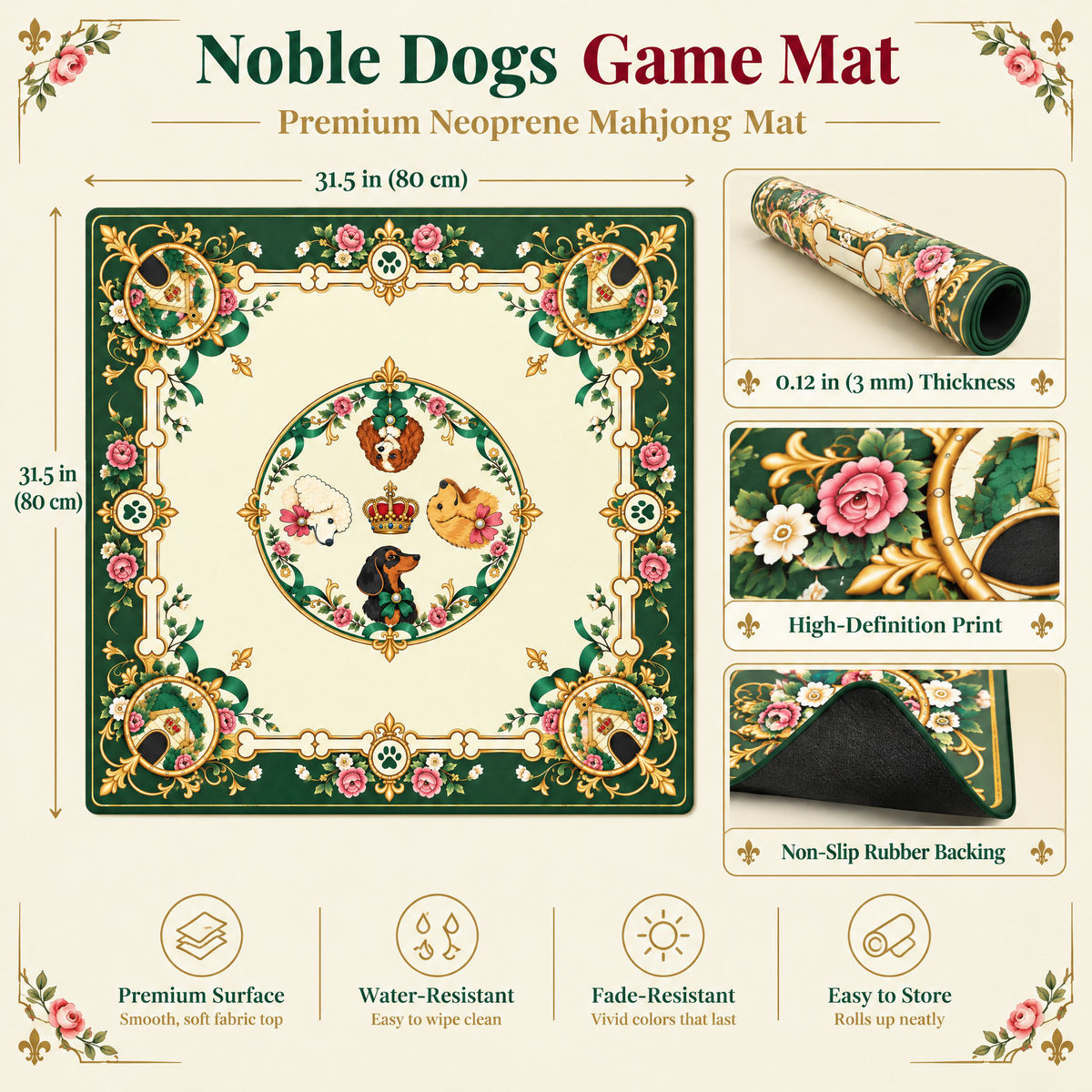
First, get a quality American mahjong set—152 tiles plus jokers, engraved clearly so you read suits instantly under poor lighting (a rummy habit you'll keep). You need a mat with guide markings if you're serious; the zones teach you where melds go. Buy or find the 2026 NMJL card (issued annually, legal inside the US). You'll sit four-handed at a table; a rack with pushers organizes your tiles so you don't peek accidentally or broadcast your hand state.
Read how to play American mahjong in full. The Charleston happens first—reread that section—then the dealer rolls dice to determine starting position. Play rotates; each player draws, melds if able, and discards. First to declare a legal hand from the card wins the round. Scoring is different from rummy: each hand on the card carries a point value. Learn scoring after your first session; don't let it overwhelm the rhythm.
Play with experienced players your first time if possible. Rummy players often pick up tiles in one evening; the first full game with the Charleston and discards might take 90 minutes, then 30–45 minutes per round after. You'll feel clumsy—normal—because the hand list replaces your improvisation superpower. Embrace that constraint; it's where the puzzle lives.
🎁 See our most-loved mahjong sets & accessories →
What mistakes do rummy veterans make?
Trying to build sequences. You will see a 3-4-5 of Bams in your rack and feel compelled to keep them. In American mahjong, a sequence is often useless because the card might not call for it that year. Check the card first. This is the top speed bump for card players.
Overusing jokers. In rummy, jokers are magical wildcards. Mahjong restrictions feel petty at first: you can't use a joker as a single tile, and a joker in a pung means you have only two real tiles plus the joker. It's tight, but it's law. Jokers shore up melds you've exposed, not fantasies in your closed hand.
Discarding too fast. Rummy trains you to shed tiles quickly (lower hand size = faster wins). Mahjong requires 14-tile turns; rushing means you'll discard something another player needs, giving them a "pung" call. Slow down. Think about what suits are floating.
Assuming you're "safe" to discard. A 1 Bam (the bird tile) seems dead—but if someone's holding a Kong (four tiles), they might want it. Watch melds on the table; reverse-engineer what each player needs.
Not memorizing the Charleston. This ritual feels elaborate, but it's the game's engine. Get it right or the whole session derails. Practice it offline before you sit down.
What to check before you buy: Ensure your tiles are thick acrylic or plastic (easy to read, durable through hundreds of plays). Verify the set includes all 152 tiles plus jokers for a full four-player game. If you travel, pick a case or bag rated for tile protection—ceramic tiles crack in luggage. Check that your mat has court markings (Kong zone, pung zone) so new players orient melds correctly.
✨ Find your Mahstead set — free US shipping →
== Rummy players—especially those who crave tactical depth—find mahjong addictive after session two, when the card stops feeling like a rulebook and starts feeling like a treasure map. Your discard discipline and pattern-matching already give you an edge. The adjustment is accepting that creativity is not your tool here; constraint is. That's why mahjong for beginners emphasizes learning the card before the tiles—the mental model flips before the game even starts. ==

FAQ
Can I play mahjong with rummy rules (any three-of-a-kind or sequence)?
No. American mahjong requires hands from the official annual card only. Playing "mahjong rummy rules" is a different game entirely and won't teach you the real version. Stick to the card; that constraint is mahjong's genius.
How long does it take a rummy player to be competitive at mahjong?
Most rummy veterans play a full game competently after one session. Strategic depth—reading what opponents hold, blocking winning tiles—takes 10–20 sessions, same as any card game. Your discard memory gives you a 2–3 session head start.
Do I need a mat and rack, or just tiles?
Tiles alone work, but a mat with guide zones teaches hand organization instantly, and a rack keeps your tiles upright so opponents can't see your strategy. For casual play, tiles and a table surface suffice. For regular weekly games, both tools justify themselves in reduced confusion.
What if I play Chinese or Hong Kong mahjong—will those skills transfer?
Partially. All mahjong variants share pattern recognition and tile memory. Chinese and Hong Kong allow sequences (chows), so your rummy intuition works better there. American mahjong's "no sequences" rule is unique and requires a full mental reframe; don't assume the skills are identical across variants.
Is mahjong harder than rummy?
Not harder—different. Rummy tests hand flexibility; mahjong tests memory and opponent reading. A strong rummy player often excels at mahjong faster than a non-card-player, but the learning curves are parallel, not overlapping. Expect one to feel easier for 20 sessions, then they balance out.
Where can I find a group to play with?
Community centers, libraries, synagogues, and country clubs often host weekly mahjong games open to all skill levels. Search your local community center or library website for "mahjong" or "mah-jong" groups. Meetup boards and local social media groups are another reliable source.


View More
View More
View More
