
Is Mahjong Harder Than Phase 10? A Real Comparison
Last updated: Nov 23, 2026
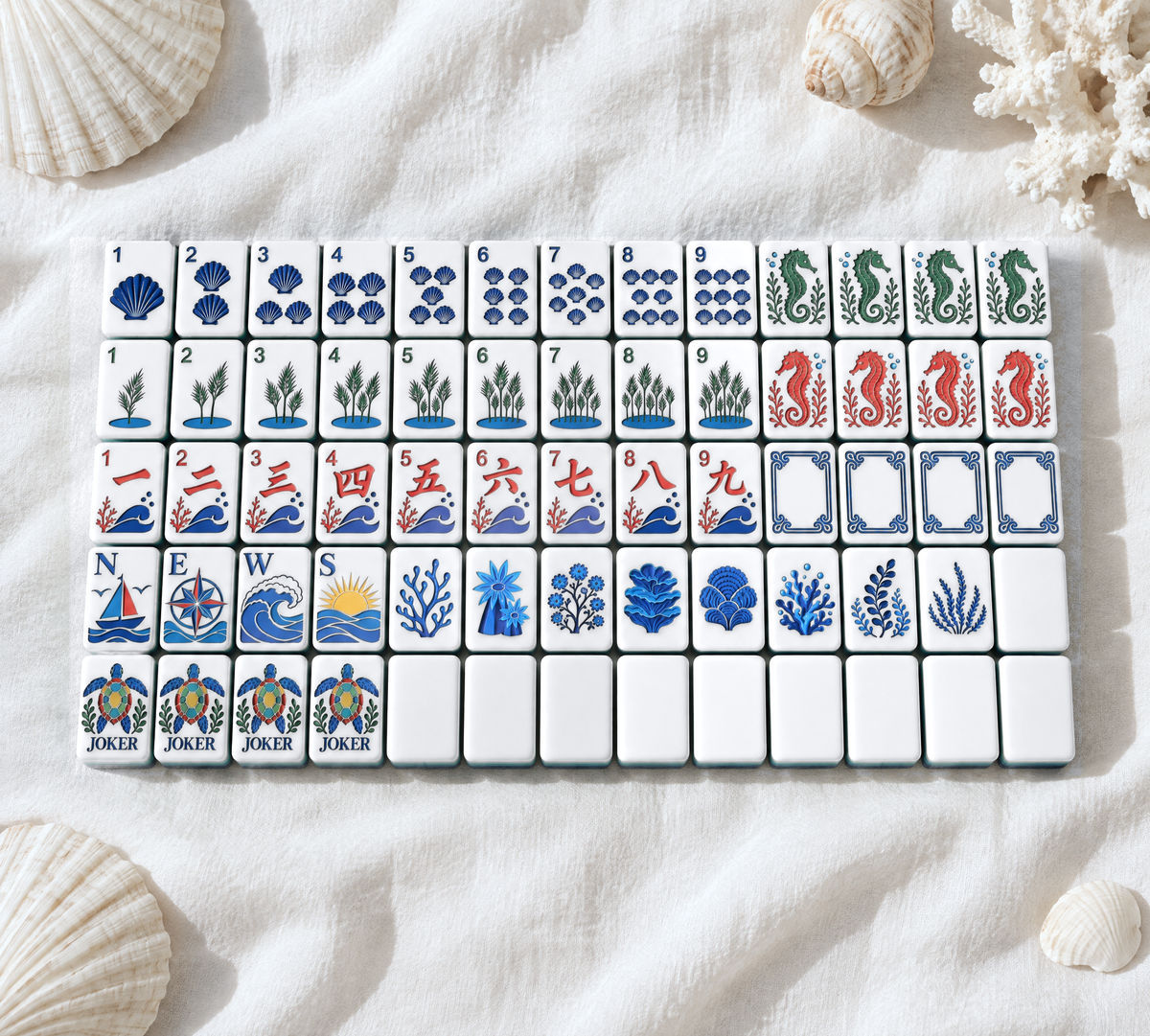
Mahjong isn't objectively harder than Phase 10—it's different hard. Phase 10 is a linear, hand-progression game: complete ten phases in order, moving forward only. American mahjong requires you to hold 13 tiles, recognize patterns from a reference card while building hands, track four players' discards, and play hands that vary every single year. Phase 10 has one ruleset; mahjong demands you study a new card each spring. That said, Phase 10's turn-based simplicity means new players can join mid-learning. Mahjong's learning curve is steeper but flatter once you cross it—most players feel confident within 10 games. Neither is "hard" if you approach it as play, not performance. Mahstead's best-selling acrylic sets come with clear tiles that help beginners spot patterns faster than traditional bone or bamboo.
Why Phase 10 Looks Easier at First Glance
Phase 10 feels immediately approachable: draw a card, play a card, complete your phase, move on. There's no reference material, no tile exchange ritual, no hand-reading pressure. You're racing toward ten fixed goals. But "easier to start" doesn't mean "easier to master"—Phase 10 players often spend years competing without fundamentally changing their strategy. Mahjong feels steeper on day one because you're consulting the card constantly. By game five, that texture is muscle memory.

Pattern Recognition: The Real Bottleneck
Phase 10 tests sequence-spotting: consecutive runs and sets of identical numbers. One way to win, repeated ten times.
Mahjong tests multi-pattern fluency. You're learning to recognize 40+ hand types at once—pairs, pungs, kongs, quints, odd/even splits, dragons-and-winds combos. The National Mah Jongg League card changes every spring, so last year's expertise doesn't carry forward completely. A 20-year player still consults the card. New players often assume this means they'll feel lost forever; in truth, the card becomes invisible after 15 games. Your eyes stop reading and start scanning. Pattern recognition in mahjong is learnable. It's not memory; it's categorization.
Speed of Play vs. Depth of Strategy
Phase 10 rounds last 30–60 minutes. Mahjong rounds typically run 45–90 minutes, sometimes longer if players are new. That's not because mahjong is inefficient—it's because every decision touches three other players and two possible outcomes (discard X or hold X). Phase 10 has no interpersonal tension; your play doesn't block anyone meaningfully. Mahjong is a reading game. Watching what another player discards tells you what they're not building toward. Holding a tile one extra turn signals strength. Speed isn't a measure of difficulty here; information density is. A fast mahjong player isn't a better player; they're just riskier.
Memory Load: Tracking vs. Recalling
Here's where mahjong's reputation for difficulty often overstates itself. You don't memorize the card. You reference it. Discard tracking is the real cognitive load—remember which winds each player has thrown, which dragons are still in the wall, which suits are running thin. Phase 10 has zero discard analysis; every card thrown is irrelevant once it's gone. Mahjong players develop discard literacy the way chess players track piece placement—not through effort, but through repeated exposure. After 20 games, you'll notice yourself remembering discards without trying. That's not hard; that's just how human attention works under structured play.

The Hardest Part (and How to Skip Past It)
The steepest part of mahjong is the first two hours. Learning which tiles exist (winds, dragons, three suits), how the Charleston tile-passing ritual works, and why jokers can't be used alone or in pairs—that's textbook overwhelm. Phase 10 has no equivalent: you know playing cards, you know number sequences, done. But here's the secret: mahjong's initial barrier is shallow. You don't need to understand everything in week one. You need to understand seven rules and then play. Rules clarify through action. Sit down with a veteran player, get a quick setup walk-through (Charleston, how to read the card, legal calls), and play three hands. By hand three, the fog lifts. By hand ten, you're comfortable. By hand 25, you're competitive. Phase 10 demands that same learning curve but masks it better; mahjong front-loads discomfort.
🀄 Shop best-selling mahjong sets →
The Real Question: Which Should You Actually Play?
Factor | Phase 10 | Mahjong | Winner for You |
Learn in one sitting | Yes | No (needs 2–3 games) | Phase 10 if time-limited |
Annual rule changes | None | Yes (League card refreshes spring) | Phase 10 if you hate updates |
Discard tracking | Not needed | Essential | Mahjong if you like reading opponents |
Teach a new player mid-game | Possible | Hard | Phase 10 for drop-in play |
Long-term depth | Moderate | High | Mahjong for ongoing groups |
Solo practice possible | Limited | Yes (you can play solitaire) | Mahjong for solo learners |
Tile/card quality matters | Low | High (acrylic vs. bone changes gameplay) | Mahjong if you value equipment |
Phase 10 is harder in one sense: it's a tighter race with higher variance toward the end. Mahjong is harder in another: initial mechanics density. Neither is objectively "harder." Phase 10 favors quick learners who like turn-based simplicity. Mahjong favors people who enjoy pattern puzzles, tile texture, and social reading. If you've played cards for decades and want something new, mahjong's learning curve is worth the two-week discomfort. If you want a board game you can teach anyone at a dinner party, Phase 10 wins.
🎁 See our most-loved mahjong sets & accessories →
What Beginners Actually Struggle With (And How to Avoid It)
Most new mahjong players don't fail because the game is hard. They fail because they skip context. Common stumbles:
Studying rules before playing. Wrong approach. Rules make sense only in motion. Find a beginner guide you can reference mid-play, then sit down with experienced players.
Not asking what's in their set. A 152-tile set is standard for American mahjong. Understanding tile composition—suits, dragons, winds, flowers, jokers—prevents confusion when you open the box.
Choosing sets with illegible tiles. Cheap bone sets have hand-painted symbols that fade or look identical across suits. Acrylic from Mahstead's best-selling collection uses photo-etched symbols and color-coding (red Craks, green Bams, white Dots) that cut learning time in half.
Playing without a mat. You don't need one, but a mahjong mat with zones keeps the wall organized and prevents misdeals—huge when you're still learning wall structure.
The gap between "mahjong seems hard" and "mahjong is fun" is three things: one experienced player, one readable set, and one mat. Everything else is practice.
✨ Find your Mahstead set — free US shipping →
What You'll Need to Get Started
If you decide mahjong is your game, you'll need a set that reads clearly. Engraved acrylic sets make symbols jump off the tile, reducing the mental load when you're learning. A mat with drawn zones isn't mandatory, but it prevents chaos during the Charleston and wall deals. Racks with pushers help newer players organize their hand without accidentally mixing tiles. For travel or hosting multiple games, a bag or case keeps everything together—important if you're moving your set between houses weekly.

FAQ
Can you play mahjong if you've never played Phase 10?
Absolutely. The two games share almost nothing mechanically. Mahjong works from first principles—suits, numbers, dragons, winds. Phase 10 intuition won't help or hurt. You're starting fresh either way.
How long does it take to play a real game of mahjong?
One full game (four players, one round of play) typically takes 45–90 minutes as a beginner or intermediate group. Competitive play runs 60–120 minutes. Phase 10 averages 30–60 minutes, so mahjong is slower by design—more information per turn.
Do I need to memorize the mahjong card?
No. You reference the card every hand for the first 10–15 games. After that, your eyes scan it rather than read it. Veterans still consult the card on new suits. It's a tool, not a test.
Is American mahjong the only version?
No. Chinese, Hong Kong, Taiwanese, and Riichi mahjong exist and have different rules, hand structures, and scoring. American mahjong is unique for using a card-based hand list that changes yearly. If you're shopping for a set, confirm it's 152-tile standard (used in American games) unless you're learning a different variant.
What makes some mahjong sets harder to learn with than others?
Tile clarity matters most. Traditional bone sets have hand-painted symbols that fade or blur together visually. Acrylic sets with photo-etched symbols and color-coding (suit colors) let you spot patterns instantly. Readability cuts beginner confusion by weeks.
Can I play mahjong with fewer than four people?
Yes, but rules change for two or three players. The game is designed for four, and removing players shifts strategy significantly. Guidelines exist for 2- and 3-player variants, but they're less common in casual play.


View More
View More
View More
