
How to Play 13579 Hands in American Mahjong
Last updated: Nov 23, 2026
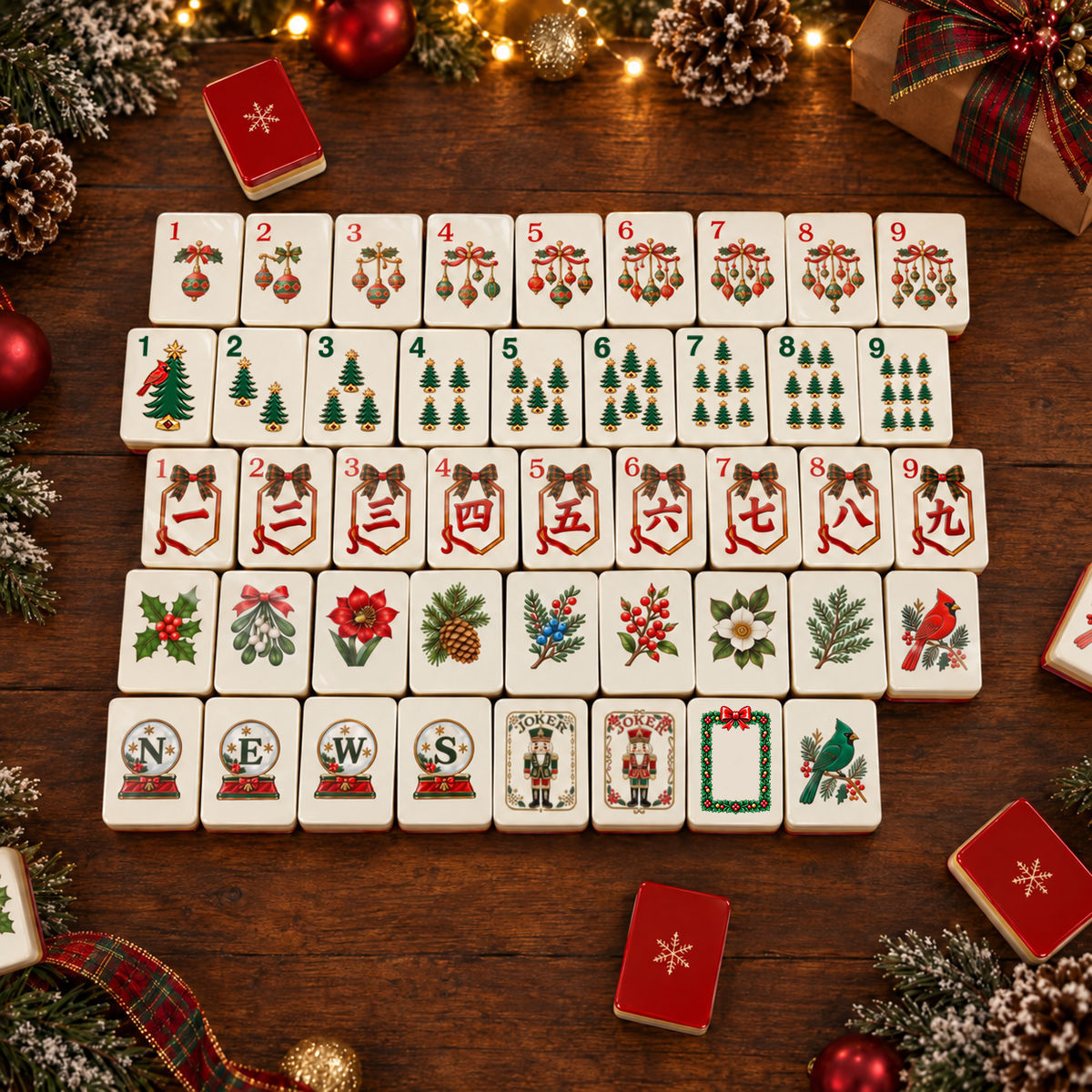
13579 hands are odd-number tile patterns on the National Mah Jongg League card—composed exclusively of 1s, 3s, 5s, 7s, and 9s in Bams, Craks, and/or Dots. You build them by collecting exposed pungs, kongs, quints, or sextets (three to six identical tiles) and a pair, following the exact line listed on that year's card. They typically score 30–70 points depending on suit uniformity and complexity. Play one with a standard best-selling mahjong set of 152 tiles, eight jokers, and the current season's card. Common mistakes: misreading the card's notation, using jokers where they're forbidden (never in a single tile or pair), or declaring before you have the complete hand.
What makes a 13579 hand different from other odd-number patterns?
13579 hands use only tiles numbered 1, 3, 5, 7, and 9—never 2, 4, 6, or 8. They differ from, say, 2468 hands (even numbers) or mixed-range hands like 1234 by requiring you to skip every other number. On the card, these hands group by suit (all Bams, all Craks, all Dots, or combinations). The constraint creates longer search windows—you're hunting specific numbers across the table and the wall—but the payoff is typically higher points. Each hand's score depends on whether it's single-suit (uniform color, more points) or multi-suit (three colors mixed, fewer points).

How do you identify a 13579 hand on your card?
Open your current year's National Mah Jongg League card and scan the section marked for odd-number hands. Look for rows that list five or six tile slots, each labeled with 1, 3, 5, 7, or 9. Note the suit symbols (Bams = bamboo, Craks = Chinese character faces, Dots = circles) and the grouping notation—pungs (3), kongs (4), quints (5), or sextets (6). Each hand also shows a pair position, usually at the top or bottom. For example, a line might read: 1 Pung, 3 Pung, 5 Pung, 7 Pung, 9 Pung, Pair—all in one suit (single-suit 13579). Another might mix suits. Jokers are allowed in pungs, kongs, quints, and sextets (never in the pair). Always cross-check the exact hand against the card before calling "Mahjong"—misreading a hand can cost you points or force a false declaration.
What's the step-by-step process to build and declare a 13579 hand?
Step 1: Study your card. Before drawing tiles, know which 13579 hands are possible this season and their point values.
Step 2: Collect exposures during play. As other players discard, watch for 1s, 3s, 5s, 7s, and 9s that match a hand you're tracking. Call "Pung" if three tiles land on the table and it suits your hand; expose it. If a fourth identical tile is discarded later, you may add it and keep the pung exposed as a kong.
Step 3: Count jokers carefully. You may use jokers to fill any spot in a pung, kong, quint, or sextet—but the total number of jokers across all your sets is limited. Never place a joker where the hand shows "No Joker" or in the pair.
Step 4: Draw and draw. Continue drawing from the wall and the discard pile, looking for the pair and any remaining sets. Jokers can substitute for missing tiles, but you must have at least one natural (unjoker) tile in each non-pair group—how jokers work explains the limits in detail.
Step 5: Declare when complete. Once you hold the exact hand—all sets and the pair—say "Mahjong" and lay your tiles flat on the mat or rack so all players can verify against the card. Settle scoring and reset.
Which 13579 hands score highest, and why?
Single-suit 13579 hands (all Bams, or all Craks, or all Dots) typically pay 50–70 points, because the constraint is tighter—you're matching both number and color. A hand like "1 Kong, 3 Kong, 5 Kong, 7 Kong, 9 Kong, Pair—all Craks" is rare and high-value because you need 16 identical or near-identical tiles in one suit. Multi-suit 13579 hands (mixing Bams, Craks, and Dots) score less—usually 30–50 points—because the number restriction alone is less restrictive once you can pull from three colors. Quints and sextets (5 or 6 identical tiles) in a hand raise the score further because they're harder to assemble. Study American mahjong scoring to confirm point values for each hand and confirm payout rules at your table before starting.

What are the most common mistakes players make with 13579 hands?
Mistake | Why It Happens | How to Avoid It |
Misreading the card—confusing 13579 with 2468 or mixed ranges | Similar notation; quick scanning under pressure | Trace each hand with your finger; spell out "one-three-five-seven-nine" aloud |
Using a joker in the pair | Jokers look flexible; pair feels like any other group | Memorize: joker = never in a pair or single tile, full stop |
Declaring with only three tiles in a slot (calling it a pung) when the hand requires a kong | Excitement; forgetting the exact hand structure | Recount your sets before declaring; check the card one final time |
Exposing a pung for a 13579 hand, then later realizing you need a kong in that position | Card changes required; group size was misread | Write the hand number on paper so you know exactly what you're building |
Mixing joker counts across hands | Forgetting how many jokers you've already used in other sets | Lay jokers face-up; count aloud ("Two jokers used; four remain") |
🀄 Shop best-selling mahjong sets →
Why does the current year's card matter for 13579 hands?
The National Mah Jongg League issues a new card every spring, and hand lists change annually. A 13579 hand that paid 60 points last year might be worth 40 this year—or might not appear at all. Using an old card at the table can lead to disputes, false declarations, and wasted turns. Each card reflects subtle rebalancing to keep hands competitive and fair. Always confirm you and your fellow players have the current year's card before starting. Many players keep the card laminated or in a mat that displays it, so there's no confusion mid-game. If you're playing a variant like Riichi or Hong Kong mahjong, those games have different hand lists entirely; American 13579 hands don't apply.
How does a 13579 hand fit into a full game strategy?
Building a 13579 hand early in your draw gives you a high-scoring goal, but it also telegraphs your strategy to the table—everyone sees you calling Pungs of 1s, 5s, and 9s. Experienced players will stop discarding those tiles, slowing your progress. Some players hold a 13579 hand as a backup while pursuing a different hand (e.g., a mixed-suit hand with lower risk), then pivot if the odd numbers start flowing. Others play aggressively, exposing pungs immediately to signal commitment and sometimes scare rivals into speeding up their own hands. Neither approach is "wrong"—it depends on the table's pace, your position (East, South, West, North affects draw order), and how many players are one tile away from winning. A solid foundation is how to play American mahjong; advanced strategy comes from dozens of games.
What to check before you buy a set to practice 13579 hands:
Tile count: Ensure you have the full 152 playing tiles (8 jokers included) plus the current year's National Mah Jongg League card.
Clarity of suits: Bams (bamboo sticks), Craks (Chinese character symbols), and Dots (circles) must be visually distinct—engraved or painted clearly so you don't misread a 1 Bam as a 1 Crak under table lighting.
Joker visibility: Jokers should be marked boldly so they're never confused with numbered tiles mid-hand.
Rack comfort: If you'll play weekly, a rack with pushers saves hand fatigue and keeps tiles organized so you can spot your sets faster.
Mat durability: A quality mat protects tiles, displays the card clearly, and reduces noise—useful if you play at shared tables.
Mahjong racks with pushers stabilize your hand, and how to choose a mahjong mat walks you through layout options so you can see your 13579 progress as you build it.
🎁 See our most-loved mahjong sets & accessories →
Ready to master 13579 hands? Here's your next move.
Print or laminate your current year's card and host a practice game. Assign one player to build a 13579 hand while others watch, calling out mistakes in real time. Rotate roles. After three or four practice rounds, play a real game—the confidence will show. A durable mahjong mat keeps tiles readable and cards visible under any lighting, and travel bags and cases make it easy to carry your set to a friend's house or a weekly club. Once 13579 hands feel automatic, branch into adjacent patterns (2468, quints, sextets) and you'll find your winning rate climbing steadily.
✨ Find your Mahstead set — free US shipping →

FAQ
Can I use a joker in the pair of a 13579 hand?
No. American mahjong forbids jokers in pairs and single tiles. Your pair must always be two identical natural tiles (e.g., two 1 Bams). Jokers are allowed only in pungs, kongs, quints, and sextets—the grouped sections.
How many jokers can I use in a single 13579 hand?
The exact limit depends on your hand's structure and the card notation. A quint (5 identical tiles) might allow up to two jokers; a sextet (6) might allow three. Always check the card's "Joker" column for that specific hand. Never assume—misusing jokers forfeits the hand.
Is a 13579 hand worth more points than a 2468 hand?
It depends on suit uniformity and complexity, not the number pattern alone. A single-suit 13579 might score 60 points while a single-suit 2468 scores 55, but a multi-suit 2468 could score higher than a multi-suit 13579. Compare your specific hands on the current card before deciding which to pursue.
What if I miscall a 13579 hand—declare it wrong?
You lose your turn, and in most house rules, you cannot meld again until the next hand. Some groups impose a point penalty. Always verify your hand against the card before saying "Mahjong" so you avoid a costly false declaration.
Can I play 13579 hands in non-American mahjong variants (Chinese, Hong Kong, Riichi)?
No. 13579 hands and the National Mah Jongg League card are unique to American mahjong. Chinese, Hong Kong, Riichi, and other variants use their own hand hierarchies and tile mechanics. Stick to the rules of the game you're playing—mixing them creates confusion and disputes.


View More
View More
View More
