
Green Dragon Tile in Chinese Mahjong: What It Means and How It Plays
Last updated: Nov 23, 2026
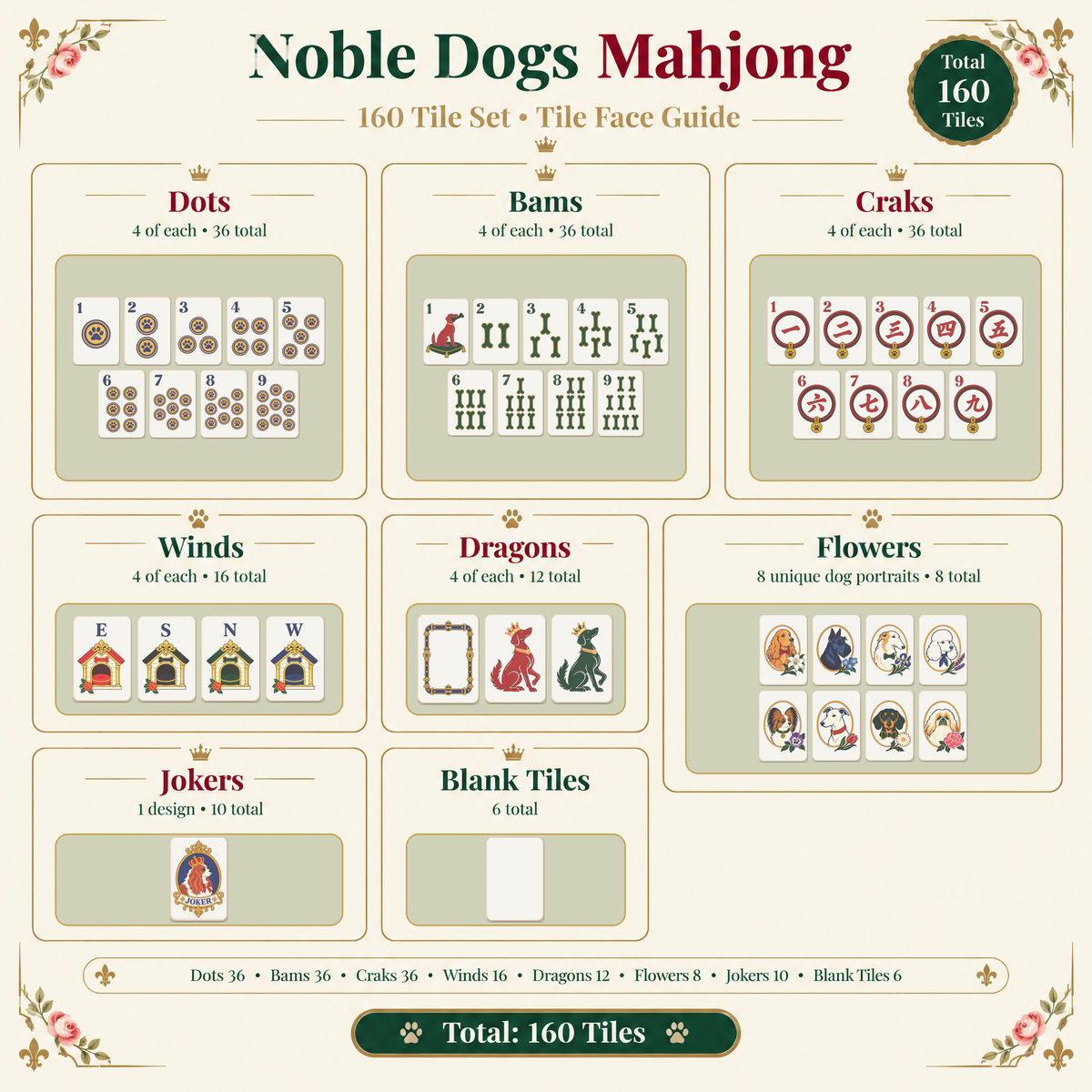
In Chinese mahjong, the green dragon (綠發 or 發, pronounced "fa") symbolizes growth and prosperity—a core honor tile that every serious player must recognize and play strategically. Because Chinese mahjong rules differ sharply from American play, understanding what the green dragon means in its native context builds respect for the game's depth and helps players navigate cross-variant tables.
What does the green dragon tile look like?
The green dragon is printed on a small rectangular ceramic or bamboo tile in a rich green shade, with a bold Chinese character (usually 發) centered on its face. The back of the tile matches the other honor tiles: plain, unmarked, and uniform. In older sets, hand-carved bone or jade versions feature intricate relief detail; modern acrylic reproductions (like our best-selling mahjong sets) use crisp engraving for clarity at arm's length. The tile is identical in size to all others: roughly 1 inch long by 0.75 inches wide. Four identical green dragon tiles appear in every Chinese set, and players must recognize it instantly during rapid discard and claim sequences—poor visibility leads to missed scoring opportunities and rule disputes.

How does the green dragon differ from American mahjong dragons?
American mahjong treats dragons as value markers tied to suit structure: the White dragon acts as zero in Dot sequences (paired with the White suit concept), the Red dragon anchors Crak patterns, and the Green dragon supports Bam melds. In American play, you cannot win on a dragon pair alone unless the hand card permits it, and dragons follow joker rules strictly. Chinese mahjong, by contrast, assigns the green dragon pure honor status: it holds equal weight to the red and white dragons and scoring depends on how many you collect in sets, not on what number suit they complement. A pung (three green dragons) is an honor set worth fixed points; a quint or sextet scores higher. Chinese mahjong also permits "all honors" hands that exclude number tiles entirely—the green dragon is a legal core tile for such melds. American rules forbid this: every American hand requires at least one suit sequence or a structured pattern from the official card. This structural gap means a winning Chinese hand may never appear on an American mahjong card.
Why is the green dragon valuable in Chinese mahjong strategy?
The green dragon signals defensive and offensive opportunity because honor tiles—especially dragon pungs—score consistently across most hand types. Collecting three green dragons early signals strength to opponents, who may then "block" (refuse to discard) complementary tiles. Experienced Chinese players watch for green dragon hoarding: if one player builds a pung, the other three will avoid discarding greens, forcing the collector to draw from the wall instead. The green dragon also appears in "all dragons" hands (all three dragons in pungs or kongs), which carry premium scoring under most Chinese variants. Because dragon points are fixed and independent of suit progression, the green dragon becomes a safe anchor tile when number suit melds are uncertain. In contrast, American mahjong relegates the green dragon to supporting a specific Bam sequence or pair pattern—it has no standalone value and cannot be won on by itself in most years. This makes strategic green dragon play a Chinese-only skill.
What are the scoring implications of green dragon melds?
Under standard Chinese mahjong (Hong Kong rules), a pung of green dragons is worth 2 fan (multiples of scoring units); a quint or sextet grades higher depending on local house rules. If a player melds an "all dragons" hand (reds, greens, and whites each in a pung or kong), scoring jumps to 6–8 fan or more, often doubled for winning on a green dragon discard. Taiwanese and Riichi variants adjust these point values: Riichi mahjong, for instance, treats dragons as yaku (hand pattern triggers) rather than fixed-point sets, so a green dragon pung contributes to hand value multipliers. American mahjong assigns no independent point value to the green dragon; it scores only as part of a named hand pattern from the current year's card—see the pillar guide to what's in an American mahjong set for how American scoring works entirely differently. A common beginner mistake is asking "How many points is my green dragon pung?" without realizing American hands are fixed-pattern, not tile-counting systems.
Can you build a winning hand using only green dragons in Chinese mahjong?
No—you cannot win on green dragons alone under any standard Chinese mahjong ruleset. A legal winning hand must contain one "eye" (pair) plus four melds (pung, kong, quint, or sextet), totaling 14 tiles. If you hold three green dragon pungs (12 tiles) plus one green dragon pair (2 tiles), you have only three complete melds—you need four. However, you can win with an "all dragons" hand that includes three separate dragon melds (red pung, green pung, white pung or kong) plus any fourth meld, which scores heavily. Alternatively, a hand with two green dragon melds (pung and quint, for example) plus two other melds (bamboos, characters, dots, or other honors) qualifies as a legal win. The green dragon must contribute to a complete hand structure, not dominate it alone. This rule mirrors American mahjong: you cannot win on a single tile type; understanding how jokers work in American play teaches the same principle—every meld and pair must combine into a named pattern, never a solo suit or honor.

How should you handle green dragons during the deal and opening moves?
At the deal, sort your green dragons early: if you receive one or two, note whether other players discard greens (indicating low collector interest) or hoard them (suggesting someone is building a pung). In the opening 6–8 discards (before heavy melds), assess the table's dragon strategy: if no one has claimed a green yet, the table is likely avoiding honor strategies. Discard your low-value number tiles first (1s and 9s in each suit) and keep middle numbers (4–6) flexible. If you pick a green dragon early, choose between two tactics: (1) immediately discard it to signal you're not collecting, or (2) hold and pair it to bait other players into either blocking or committing to other suits. Experienced players use green dragon discards as tells—a green thrown early suggests a weak hand, while a late green signals a player forced to discard after exhausting other options. Never hoard more than one unmelded green in the opening phase; it signals predictability. 🀄 Shop best-selling mahjong sets →
Scenario | Your Move | Why It Works |
You draw a green dragon on turn 2, no one else has claimed dragons | Discard it immediately | Signals low dragon interest; keeps opponents guessing |
You've collected two greens and see no discards; one opponent is blocking | Hold one, discard the other at turn 7–8 | Reduces predictability; tests if blocking player has a real pung |
All three dragons (red, green, white) are in your hand; you have one other meld | Build the all-dragons hand aggressively | Highest-scoring pure honor structure; worth 6+ fan |
You need a green pair to complete a win, wall has 3 tiles left | Claim any green discard immediately (no exceptions) | Winning tile is your priority; melds can score lower |
What to check before you buy a mahjong set for Chinese play
Tile count: Verify the set contains exactly 136 tiles (not the 152-tile American standard). Chinese sets occasionally include jokers or blanks—confirm these are not added to the playing count. Dragon clarity: Hold a green dragon at arm's length in daylight; the character must be crisp and legible. Worn engraving leads to misreads and table disputes. Honor tile consistency: All four green dragons must be identical in color, size, and finish—no shade drift or chipping. Tile feel: Acrylic tiles should have smooth, slightly textured surfaces for confident gripping and discarding. Slippery tiles cause miscalls and frustration. Check that mahjong racks with pushers fit your set's tile thickness if you plan to organize by suit. Storage: A sturdy travel bag or case protects dragons and all honor tiles from edge damage during transport—cracks in high-use tiles (like honors) render them unplayable in organized play.
🎁 See our most-loved mahjong sets & accessories →
How does the green dragon compare across global mahjong variants?
Variant | Green Dragon Role | Point Value | Win Condition |
Chinese (Hong Kong) | Honor tile; pure dragon meld | 2 fan per pung | Part of four-meld hand |
Taiwanese | Honor tile; yaku trigger | Variable per ruleset | Multi-meld hand + winning discard |
Riichi (Japanese) | Dragon honor; yakuhai | 1 han per pung | Hand pattern from point chart |
American | Suit marker (Bams); paired with number sequences | Card-dependent (no fixed points) | Named pattern from current-year card only |
Vietnamese | Honor tile; secondary to suit play | Local rules vary | Depends on house variant |
✨ Find your Mahstead set — free US shipping →
American mahjong diverges most sharply: the green dragon never stands as an independent honor. Instead, it belongs to the Bam suit and must pair with Bam number sequences or other structural elements on the official card. Chinese, Taiwanese, and Riichi all treat the green dragon as a universal honor—its value is intrinsic, not borrowed from a suit. If you play across variants, this is the critical distinction to internalize: honor-based games (Chinese, Taiwanese, Riichi) reward green dragon collection; American mahjong penalizes it unless the hand card explicitly allows it.
When should you NOT play the green dragon aggressively?
Early-game aggression (building a green pung immediately) exposes your strategy and invites blocking. Wait until at least 8–10 tiles have been discarded before signaling serious dragon intent. If two other players have already built melds in suits and one player is hoarding whites (not greens), the table has likely chosen non-honor paths—forcing a green pung will cost you scoring potential as opponents deny you discards. Also avoid aggressive green play if you're holding only one completed meld; you need at least two stable melds plus a green pung to claim a "dragon hand" win. Defensive patience often outscores early commitment. Beginners frequently rush into honor tile collection because they see a complete pung early; experienced players recognize that table momentum and opponent blocking often make honor hands impossible before the endgame.
Why do some Chinese players call it "Fa" instead of "Green Dragon"?
"Fa" (發) is the Cantonese pronunciation of the Chinese character on the tile, meaning "to prosper" or "to distribute." In Hong Kong and Guangdong mahjong culture, calling tiles by their characters is standard: the white dragon is "Bak" (白), the red is "Chung" (中), and the south wind is "Nam" (南). This character-based language is faster at the table and carries cultural meaning—using the character name honors the game's Chinese heritage. American players, by contrast, default to English color names or suit references because the American game introduced tiles to a non-Chinese audience in the early 20th century. If you play in Chinese-dominant tables (common in San Francisco, New York, and Vancouver), learning to call tiles by character or Cantonese name is a sign of respect and integration. Most international modern play uses English terms for clarity, but multilingual tables often blend both—expect "green fa" or "green dragon" used interchangeably.

FAQ
Can the green dragon be used in a chow (three-tile sequence) in Chinese mahjong?
No. Dragons cannot be chowed in any Chinese variant. They form pungs, kongs, quints, or sextets only—never sequences with other tiles. Only number tiles (1–9 of bamboos, characters, and dots) form chows.
If I win by discarding the green dragon, do I score bonus points?
Under most Hong Kong rules, winning by a discard (called "tsumo" in Riichi terms or "win by pickup" in Chinese) of any tile, including green, follows standard hand scoring. Some house rules apply a small bonus for winning on an honor discard, but it's local variation—not a rule in formal play.
How many green dragons must I have to win in Chinese mahjong?
None mandatory. You can win with zero greens if your four melds come entirely from number tiles and other honors. However, including one green pung or higher in your hand often raises the score, making green collection strategically attractive.
Is the green dragon the same in American mahjong?
No. American mahjong's green dragon is a suit marker for Bams and cannot be won on independently. Chinese mahjong's green dragon is a pure honor tile with intrinsic scoring value. Never mix the two systems at the same table.
What should I do if a green dragon tile in my set is cracked or faded?
Replace it before organized play. A damaged honor tile can lead to misidentification and disputes. Check our best-selling mahjong sets for sets with durable acrylic engraving that resists wear and cracking over years of weekly games.
Can I use an American mahjong set to play Chinese mahjong?
No. American sets are 152 tiles; Chinese sets are 136 tiles. The tile compositions and honor distributions differ, and American sets lack the proper balance of dragons, winds, and flowers for Chinese rule play. Use a dedicated Chinese set.
How do I know if a green dragon tile is authentic or counterfeit?
Check weight (authentic acrylic or ceramic feels substantial, not hollow), color consistency (all four greens must match exactly), character clarity (sharp, centered engraving with no blur), and tile size uniformity (use calipers if available—each tile should be 1.0 ± 0.02 inches). Counterfeit sets often have color drift or soft engraving.


View More
View More
View More
