
Fundraiser Mahjong Tournament Format: Rules & Hosting Guide
Last updated: Nov 23, 2026
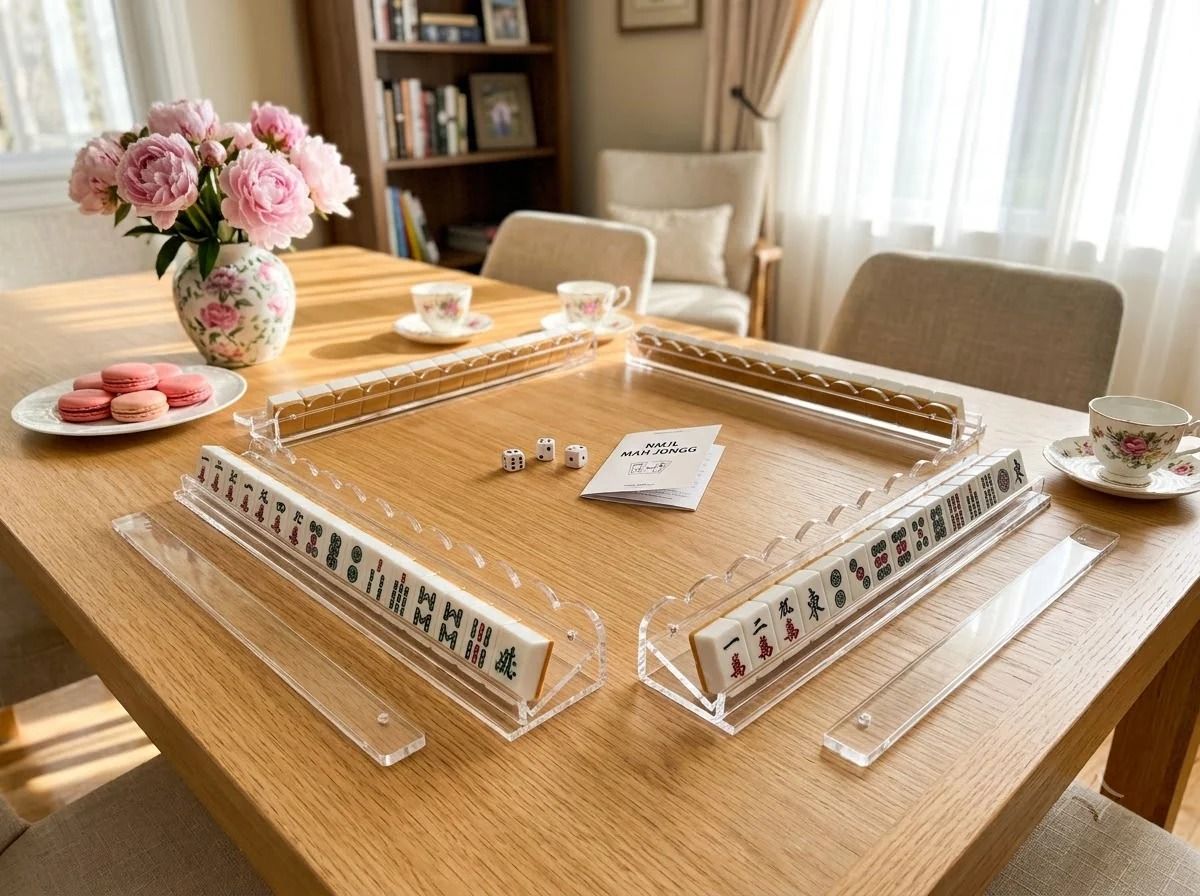
A fundraiser mahjong tournament uses American mahjong rules played in rotating team or individual brackets over 3–6 hours, with players paying entry fees that fund prizes and donations. Players compete in a series of rounds (typically 4–8 hands per round), earning points toward a leaderboard; scoring follows standard American mahjong, with bonus points often added for fundraising achievement (most money raised, best newcomer, etc.). You'll need multiple sets of 152-tile American mahjong plus spares, mats, and racks so each table plays simultaneously. Prize pools can be structured as cash back to top finishers, raffle entries, or donated entirely to your cause—transparency on how money is split builds trust. The format works best for 8–32 players and fits community centers, synagogues, senior centers, and clubs; hosting requires one scorekeeper, a printed rotation schedule, and clear house rules posted beforehand.
Why does a mahjong tournament raise money faster than casual play?
Tournament structure creates urgency and social proof. Players commit to a defined time block, pay upfront (no vague "donate if you like"), and compete for ranked prizes—this drives higher participation and bigger entry fees than asking for donations during open play. A 20-player tournament at moderate entry fees raises 2–3× what hosting a regular game night generates, because the fundraising goal becomes part of the event design, not an afterthought. Keeping scores visible on a large board or projector also creates friendly competition that encourages players to stay, recruit friends, and bid for raffle add-ons.
What entry fee structure works for mahjong fundraisers?
The most common model is a flat per-player fee (ask us for a quote on typical fundraiser volumes to understand your per-table setup cost), split between a prize pool and your charity. For example, you might keep 60–70% for prizes and awards, donating 30–40% to your cause; transparency about this split in your promotional materials builds credibility. Some tournaments add optional "buy-in" raffle entries (a smaller second fee) for raffle prizes unrelated to tournament ranking—this boosts revenue without inflating entry cost. For newcomers, offer a reduced entry or free "practice table" in the first round to lower barriers; they often become repeat donors. Sponsors can also underwrite prizes (restaurant gift cards, theater tickets, store merchandise) so 100% of player fees go to your cause.
How do you organize tournament rounds and table rotation?
For 8–20 players, use a Swiss-system format: all players play simultaneously in Round 1 at assigned tables, then are re-paired for Round 2 based on current standing (top scorers play each other, mid-tier players mix). This keeps competition balanced and allows every player to face different opponents. For 20+ players, round-robin (every player plays every opponent once) becomes unwieldy; instead, run 4–6 fixed rounds and rank players by total points. Each round plays 2–4 hands of American mahjong; keep rounds to 45 minutes so players can take a 10-minute break between rounds and you maintain schedule. A printed rotation sheet posted at each table prevents disputes—list player names, table assignments, and seat order (East, South, West, North, which rotate per hand). Use a simple scoring ledger or free tournament software to track cumulative points and update the public leaderboard after each round.
Tournament Size | Best Format | Rounds | Time Needed | Why It Works |
8–12 players | Swiss (paired by standing) | 4–5 | 2.5–3.5 hours | Close competition, all play simultaneously |
12–20 players | Swiss with rotation | 5–6 | 3.5–4.5 hours | Fair matchups, avoids repeat pairings |
20–32 players | Round-robin (fixed tables) | 4–6 | 3–4 hours | Logistical simplicity, known opponents per table |
32+ players | Multiple tournaments or shifts | Multiple | 4+ hours | Prevents table crowding, runs easier |
What equipment do you need to host a clean tournament?
You'll need one complete 160-tile American mahjong set per table (so 2–4 sets for a 8–16 player fundraiser) plus extra jokers and spare tiles. Invest in coordinating mahjong mats for each table so players don't mix tile handling styles; a mat with a clearly marked discard rack reduces argument about whose tile was played last. Racks with pushers keep hands organized during play and prevent accidental tile exposure—critical when you have dozens of eyes on games in a fundraiser setting. Bring a portable carrying case or bag to transport all sets, so setup is fast and teardown is clean. A laminated scoresheet, clipboard, and pen per table (or a projected leaderboard updated live) complete the setup. Pro tip: set up all tables 30 minutes before start time to test tiles, ensure mats lay flat, and confirm each set has the correct 152 tiles plus spares.
🀄 Shop best-selling mahjong sets →
How do you adapt American mahjong rules for tournament play?
Standard American mahjong rules stay unchanged: players draw and discard to form the 14-tile hand required by the current year's National Mah Jongg League card, scoring follows the official card, and jokers are wild. However, tournaments often add house rules to keep the pace moving and prevent disputes:
Hand time limit: 10 minutes per hand; if no one melds in 10 minutes, the hand is void and you move to the next.
No string calls: A player must announce a win clearly before touching their tiles; verbal commitment matters in a crowded room.
Joker usage: Confirm whether jokers can be used in pairs or only in melds (standard American rule: never in a single tile or pair). State this on your printed rules sheet.
Dead hand rule: If a player exposes a tile illegally or draws out of turn, that hand becomes dead (no scoring) and play moves to the next hand. This prevents collusion.
Tie-breaking: If two players end the tournament with identical points, use total wins (not hand points) as the tiebreaker, then random draw if still tied.
Post these rules visibly at each table and review them aloud during the welcome speech so no one claims ignorance later.
What mistakes do first-time fundraiser hosts make?
Underestimate setup time. Testing all sets for tile completeness, teaching newcomers the Charleston (the tile-passing ritual before play), and orienting players to the mat and racks takes 20–30 minutes—don't start play less than 45 minutes after doors open. Forget to clarify prize splits. State upfront (on flyers, at registration, verbally) what % of entry fees go to your cause vs. prizes; silence here sparks resentment. Overcomplicate scoring. Use a single, simple leaderboard (total points across all rounds) rather than weighted tiers or bonus multipliers; transparency beats cleverness. Ignore pacing. A 4-hand round should take 45 minutes including tile setup and scoring; if games run long, you'll kill enthusiasm and lose the schedule. Neglect recruiting a co-host. You cannot run the leaderboard, announce rounds, troubleshoot tile disputes, and visit all tables alone; recruit a friend or volunteer to manage scoring while you host.
🎁 See our most-loved mahjong sets & accessories →
Before You Host: A Checklist
[ ] Confirm total player count 1 week prior (size drives table/set count and room rental).
[ ] Test all mahjong sets: count 152 tiles per set, verify 8 jokers, check for cracks or warped tiles.
[ ] Print and laminate: tournament bracket, scoresheet template, house rules, rotation schedule.
[ ] Reserve enough mats and racks so each table operates independently; confirm tiles fit mats without overlap.
[ ] Recruit a scorekeeper (volunteer or staff) trained on your scoring system.
[ ] Email all players the format, rules, and suggested preparation (e.g., "brush up on how to read the mahjong card").
[ ] Arrange a test game 2 weeks prior with 4 players to time each round and spot bottlenecks.
[ ] Confirm venue WiFi or mobile hotspot if you're projecting a live leaderboard.
[ ] Set registration 30 minutes before play; collect fees in cash or with a digital payment link.
[ ] Announce the prize pool, fundraising total, and donation breakdown at the closing ceremony.
✨ Find your Mahstead set — free US shipping →
What's the best way to market a mahjong fundraiser?
Target existing mahjong communities first: senior centers, synagogues, community colleges, libraries, and country clubs often host open game nights and can distribute flyers. Use social media to post a simple graphic showing the date, time, entry fee, and fundraising cause—"Mahjong Tournament for [Charity Name]" speaks for itself to players. Highlight the beginner-friendly aspect (no experience required, teaching provided) to recruit new players and grow your donor base. Create a simple FAQ on your event page addressing "what's in an American mahjong set" and basic hand-winning rules for newcomers. Offer early-bird entry discounts (ask us for a quote structure suitable to your cause) to lock in commitments 2 weeks out; this also lets you finalize table count and set inventory. Word-of-mouth from past mahjong events is your strongest marketing—existing players recruit friends and return annually, so document your first fundraiser with photos and thank-you notes to build momentum for year two.

FAQ
Can I run a mahjong fundraiser with fewer than 4 players per table?
Yes, using 2 or 3 player American mahjong rules, though tournament flow is smoother with 4 per table. If you have an odd number (e.g., 10 players), run one 3-player table and two 4-player tables in each round, rotating the 3-player group between rounds.
Do I need a National Mah Jongg League card for a fundraiser tournament?
Yes. All players must use the current year's official card to validate hands. You can project the card or print copies for each table; purchasing a supply ahead saves stress during play.
How do I score if no one wins a hand?
If the wall is exhausted with no winning hand, that hand is void (no points awarded) and you move to the next hand. Keep play moving—dwelling on a void hand wastes time that donors pay for.
What if a player wants to join mid-tournament?
Allow late entries through Round 2 (after that, standings get unfair). Seat them at the next available table; their starting score is the median of current standings so they are neither penalized nor favored.
Can I offer a prize for "best new player" in a fundraiser?
Absolutely. Designate a small prize (raffle entry, gift card, or donated item) for highest-scoring first-time mahjong player; this incentivizes recruitment and celebrates newcomers.
Should I keep 100% of entry fees or split with prizes?
Split is typical: 30–40% to your cause, 60–70% to prize pool, so players feel they have a shot at winning. Fully donated tournaments work only if prizes are underwritten by sponsors; otherwise, perceived value drops and entry fees fall.


View More
View More
View More
