
Easiest Mahjong Rules for Rummikub Players
Last updated: Nov 23, 2026
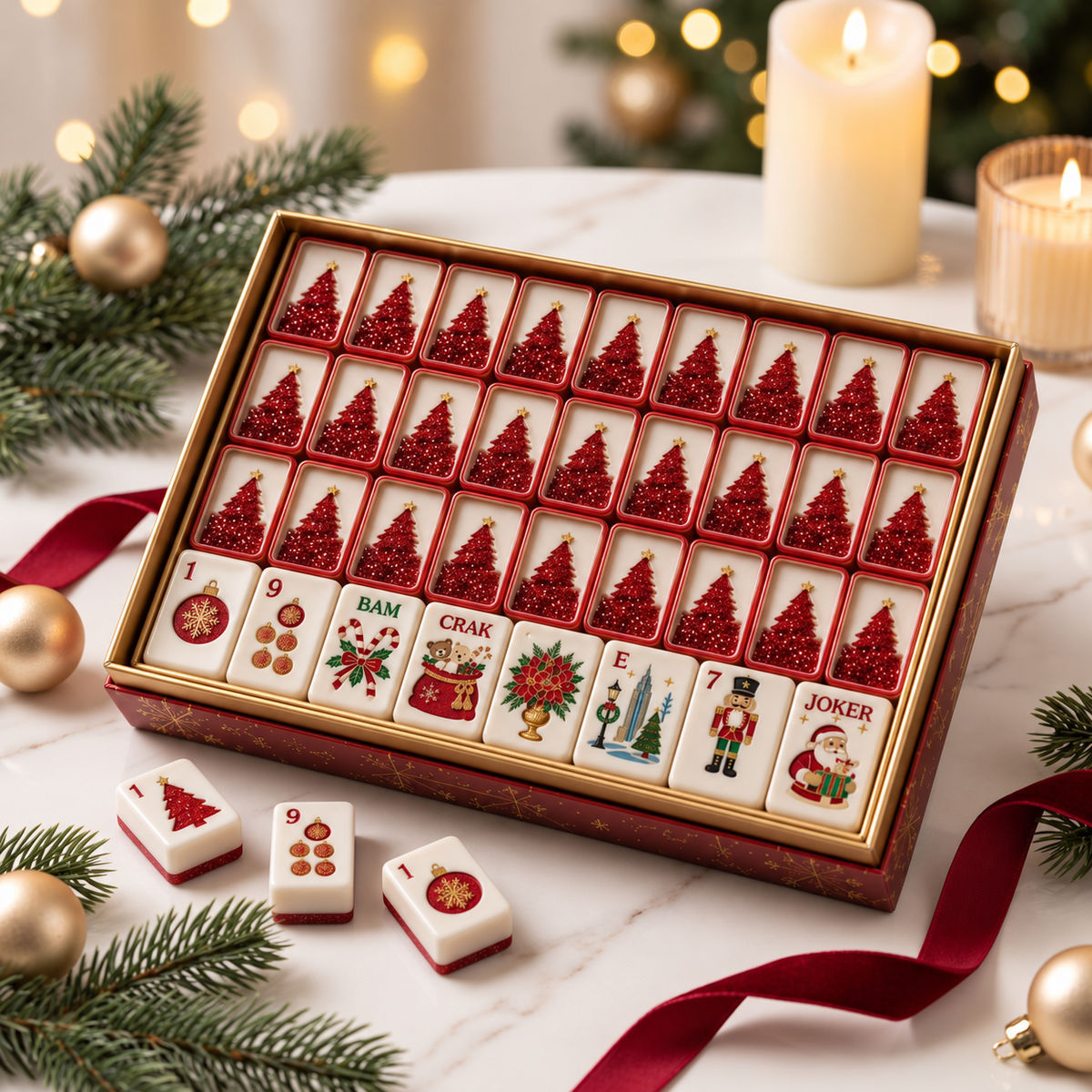
American mahjong and Rummikub share surface similarities—both use numbered tiles, suits, and jokers—but they're fundamentally different games. Rummikub rewards you for laying down melds (runs and sets) during play. American mahjong is a closed-hand game: you build your entire winning hand in private, then expose it all at once. This one shift changes everything about strategy, pacing, and what skills transfer from your Rummikub years.
How is "forming a hand" actually different?
In Rummikub, you lay down runs (5-6-7) and sets (three 8s) whenever you can. American mahjong has no runs at all. Every winning hand consists only of pungs (three identical tiles), kongs (four identical tiles), quints (five identical tiles), sextets (six identical tiles), and one pair. A valid hand also must match a pattern on the current year's hand card—you can't invent your own. For example, a legal hand might be three 5 Craks, three 2 Dots, three 8 Bams, three 1 Dots, and a pair of Red Dragons. In Rummikub, that exact arrangement would be worthless; in American mahjong, it might be worth points. You never build a hand mid-game; you wait until you hold all 14 tiles that match one card pattern, then you declare and score.

What actually transfers from Rummikub skill?
Your instinct for spotting tile groups translates directly. Rummikub taught you to hold like tiles together and to track which numbers are safe to discard. You already know joker logic: a joker replaces one missing tile in a group. You've developed patience watching other players' melds and learning which tiles stay in play longer. Pattern recognition—spotting when three of something are hiding in your rack—is the same skill. The discipline of not rushing applies even harder in American mahjong, where a single premature discard can cost the entire hand. If you've ever held a Rummikub hand and mentally rearranged it before laying down, you've already practiced the tile organization that American mahjong demands.
What's the biggest mental shift?
The biggest change: you cannot play tiles during the game. In Rummikub, play builds on the table. In American mahjong, your rack stays hidden. You draw one tile, discard one tile, and repeat. The moment you have 14 tiles matching one card pattern, you announce "Mah Jongg" and the hand ends. You're not competing to lay tiles faster; you're competing to complete your private hand first. This means:
Discards become weapons. Every tile you discard signals something about your hand. Expert players read discard order like a book. If you throw away three 2 Bams immediately, opponents assume you're not chasing a hand with 2 Bams; if you hold back and then discard a 2 Bam late, they know it was a strategic sacrifice.
The hand card becomes scripture. Before each game, someone reads the year's card aloud. Every legal winning hand is listed. You scan it and decide which patterns you can chase. No inventing; no workarounds.
Drawing from the wall replaces drawing from discard. In Rummikub, you draw from a central pool. American mahjong players draw from a "wall" of face-down tiles arranged in a snake around the table. It adds ritual and slows the pace slightly—which many Rummikub players love.
How does the Charleston fit in?
Before any hand is played, the four players perform the Charleston: a three-stage tile exchange (pass right, pass left, pass across) where you swap 3 tiles three times. The Charleston has no Rummikub equivalent. Its purpose is to randomize tiles fairly and let newer players offload unwanted tiles early. You pass face-down; you don't see what you're trading until they land in your hand. The Charleston takes 90 seconds and feels like a ritual at first, but after one game, it becomes automatic and many Rummikub players cite it as their favorite part—a built-in moment to reset and strategize.
🀄 Shop best-selling mahjong sets →
Which tiles appear in American mahjong that Rummikub never had?
Rummikub uses only numbered tiles (1–13) and jokers. American mahjong adds a full suit system and special tiles that will feel foreign at first:
Tile Type | What It Is | Rummikub Equivalent | How to Think of It |
Bams | Tiles 1–9, marked with bamboo sticks or a bird (1 Bam) | Red tiles | First suit; no difference in strategy |
Craks | Tiles 1–9, marked with circular cracks or Chinese characters | Yellow tiles | Second suit; no difference in strategy |
Dots | Tiles 1–9, marked with round dots | Blue tiles | Third suit; no difference in strategy |
Winds | North, East, West, South (4 of each) | Nothing | Honorable tiles; treated like 1–9 tiles in sets |
Dragons | Red, Green, White (4 of each) | Nothing | Honorable tiles; same as Winds |
Flowers | Plum, Orchid, Bamboo, Chrysanthemum (2 of each) | Nothing | Bonuses; rare in hands; often skipped in beginner games |
Jokers | Blanks that replace any tile | Jokers | Same rule as Rummikub: one joker = one missing tile |
The key: Bams, Craks, and Dots are just three suits. Their identity matters for pattern-matching on the card but doesn't change how you form a pung. A pung of 5 Bams is worth the same as a pung of 5 Craks. Winds and Dragons are wild cards conceptually—they're not numbered, so they can't form sequences anyway (American mahjong has no sequences, remember). Flowers are decorative and often ignored by beginners; learn them later.

What are the most common beginner mistakes to avoid?
Mistake 1: Expecting to build melds as you play. You can't. Your entire hand stays private until you've won. Accept this immediately; it will feel slow for 20 minutes, then it becomes thrilling.
Mistake 2: Holding jokers for "flexibility." Rummikub taught you jokers are precious. In American mahjong, they matter just as much—but only if you use them. Holding a joker in hopes of a better hand later is a losing strategy. If a joker completes your hand today, play it today.
Mistake 3: Discarding tiles without reading the table. Pay attention to what others discard. If three opponents throw 2 Bams within five turns, assume 2 Bams are safe to hold. If nobody has discarded a 7 Dot in 30 minutes, assume someone nearby is hunting 7 Dots and discard something else.
Mistake 4: Ignoring the hand card. The card is your bible. Every hand you chase must be on the card. Many Rummikub players try to invent their own patterns. This does not work. Spend your first game just reading the card and noticing patterns. Hands always include at least one pung of an honor tile (Wind or Dragon) or a pung of 1s or 9s—this is not written, but you'll see it the moment you study three cards.
Mistake 5: Keeping a "pretty" hand at the expense of winning one. You might hold a hand worth 50 points on the card—a big score. But if a simpler hand worth 20 points is one draw away, and the complex hand is five draws away, abandon the complex hand. Many Rummikub players overvalue tile combos; American mahjong rewards speed.
🎁 See our most-loved mahjong sets & accessories →
What to check before you buy (and start playing)
Do you have the current year's hand card? Every spring, the National Mah Jongg League releases that year's card. Old cards are illegal for league play but great for learning. Find a PDF online (free) or print a copy. Laminated cards are helpful; some Mahstead mats include a reference card slot.
Is your set complete? You need exactly 152 tiles in play plus 8 jokers. Sets marked 160 tiles include spare tiles for replacements. Verify all four suits exist (Bams, Craks, Dots), all winds and dragons are present, and nothing is cracked or stained—tiles wear in storage.
Do you have a mat? A mahjong mat organizes your hand and theirs. It's not required, but without one, tiles scatter on a bare table, and you'll struggle to see which player is chasing what. A mat is a one-time investment that transforms the experience.
Is your play space large enough? American mahjong needs a table at least 36×36 inches. Four players, four racks of tiles, and a wall of tiles in the center. A standard dining table works; a small desk does not.
Have you watched one full hand? Before joining a serious game, watch an experienced player complete a hand. Seeing the Charleston, the draw rhythm, the discard cascade, and the final announcement will dissolve 80% of your questions. YouTube has plenty of full-game walkthroughs; one 10-minute video is worth a thousand words.
How quickly can a Rummikub player pick this up?
Most Rummikub players are sit-down-and-playing-real-hands-competently within three games. The first game feels chaotic; you'll misread the card, discard something that burns you, and lose big. Game two, the rhythm clicks: you understand the draw cycle and notice when someone's discards narrow. Game three, you're chasing patterns confidently and reading the table. By game four, you're joking, strategizing, and genuinely having fun. The Charleston, the hand card, and the "no sequences" rule are the only real barriers—and none of them is complex, just unfamiliar.
✨ Find your Mahstead set — free US shipping →
What if you want to level up?
Once you've mastered the basics, read how to read a mahjong card to unlock advanced strategy. Understand how jokers work in deeper detail—their math, when to spend them, when to hoard them. Study American mahjong scoring so you know which hands are worth the chase. Return to the pillar on mahjong for beginners anytime you have foundational questions. Many Rummikub clubs evolve into mahjong clubs after one introduction; the tile set you buy today might be your table's set for years.

FAQ
Can I use a Rummikub set to play American mahjong?
No. Rummikub sets use different tiles, different numbers, and no honor tiles (Winds, Dragons). You need an American mahjong set of 152 tiles. Mixing them creates confusion and breaks scoring.
Do I need to memorize the hand card before my first game?
No. Keep the card at the table and reference it constantly. Experienced players have internalized patterns, but beginners should read openly. It's not cheating; it's learning.
How do I know when someone is winning?
They announce "Mah Jongg!" loudly, then lay down all 14 tiles on the mat in groups. The table verifies the hand matches a pattern on the card. If it does, they score. If not, the hand is foul and they lose points.
Is there a hand card online, or do I have to buy one?
The National Mah Jongg League publishes the card every spring. PDFs circulate freely online. You can print it for free. Laminated physical cards are available for purchase, but not required to learn.
What happens if I run out of tiles before anyone wins?
The hand ends in a draw, called a "wall game." No one scores. Rarely happens in casual play; common in expert games where players are aggressive or the wall is unusually strong.
Can I play American mahjong with three people, or two, or five?
American mahjong is designed for four players. Two or three-player variants exist but change the rules significantly. Five-player mahjong is not standard American mahjong.
How long does a game take?
One hand (one winner, or wall game) typically takes 15–30 minutes with experienced players, 30–45 with beginners. A full session of 5–8 hands runs 1.5–3 hours. The Charleston adds 90 seconds per hand.


View More
View More
View More
