
Easiest Mahjong Rules for Bridge Players
Last updated: Nov 23, 2026
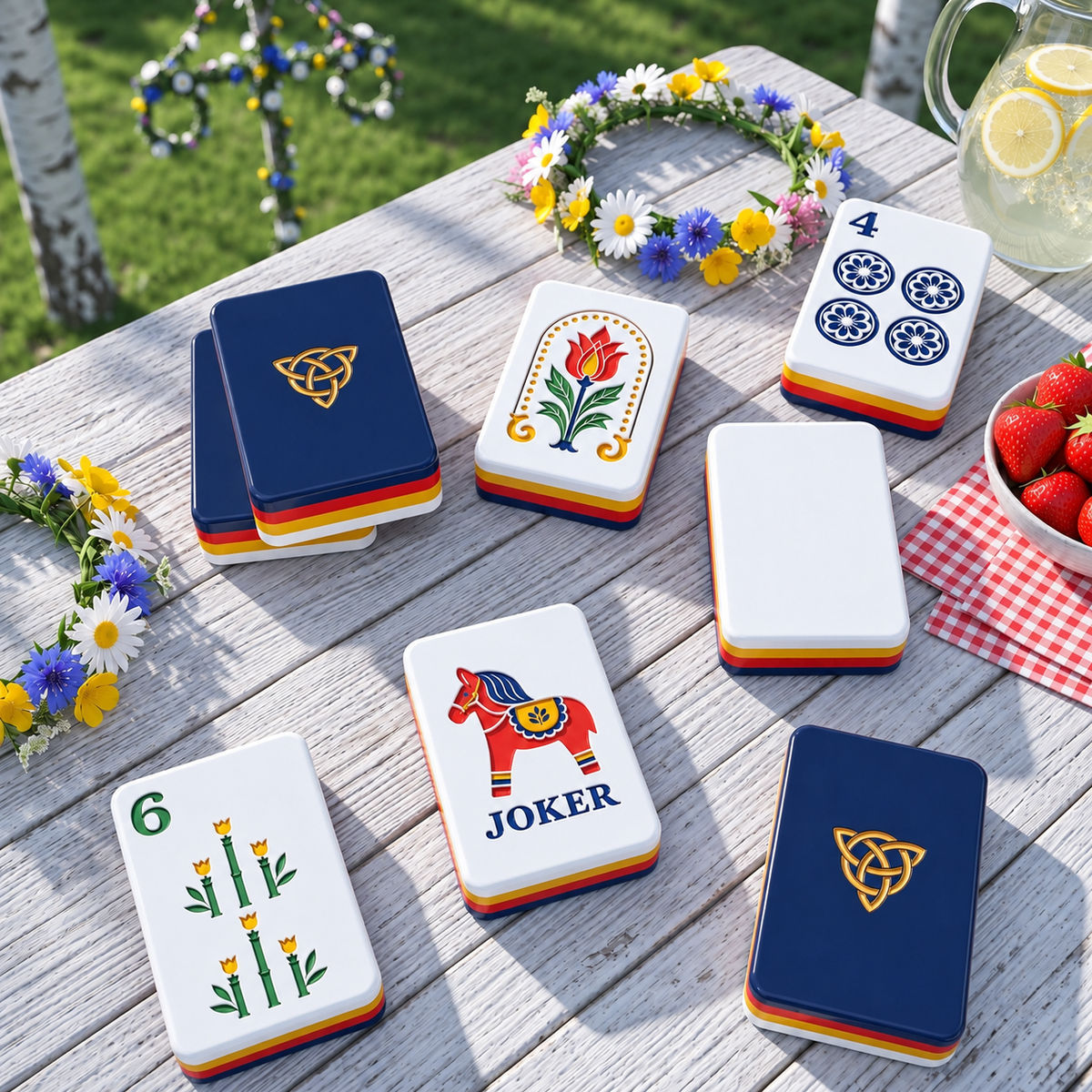
Bridge players have a huge advantage: you already understand trumps, hand management, reading opponents, and the pressure of declaring a contract. American mahjong shares that strategic weight. The rules are simpler than you think. You draw one tile per turn, discard one, and match the current year's National Mah Jongg League card to win. Hands use three suits (Bams, Craks, Dots numbered 1–9), winds, dragons, and flowers. You can expose groups of identical tiles (a pung: three, or a kong: four) and jokers act as wildcards. Games take 30–60 minutes with four players; a standard set has 152 tiles plus 8 jokers. A Mahstead acrylic set costs a fraction of a bridge table but lasts decades. Bridge players often join weekly groups within a month because the decision-making—which tile to keep, when to claim a discard, how to read the card—scratches the same competitive itch.
If you've mastered bridge bidding and play, American mahjong's rules will feel natural. Here's what transfers, what doesn't, and how to get started.
What parts of bridge carry directly into mahjong?
In bridge, you manage fourteen cards, remember what's been played, and balance risk with pattern recognition. Mahjong demands the same. You hold thirteen tiles on your rack, watch what others discard, and infer what they need. Like bridge, you must decide: hold a half-formed hand hoping to draw the right suit, or pivot to a safer pattern. A player holding three Bam 5s knows—just as you know your suit distribution—how likely the fourth is to appear. The metagame mirrors bridge too: if you've seen all three remaining Dot 7s discarded, you know the fourth is dead. You read the table for tells. Someone discarding Winds hesitantly probably holds three and isn't confident in completing the hand. Bridge taught you that already.
🀄 Shop best-selling mahjong sets →

How is winning different from winning a bridge hand?
Bridge demands a contract and high card play; mahjong demands a single completed hand. You don't bid. Instead, before each game, tiles pass around the table in a ritual called the Charleston—you give three tiles to your left, three straight, three across, and three back. Then you draw one tile per turn and discard one. The first player to complete a legal hand from the current year's National Mah Jongg League card wins immediately—no dummy, no tricks, one winner per hand. Bridge is you against the other three, collaborating; mahjong is you against three opponents, entirely. A winning hand must match exactly one entry on the card: for example, "three pungs of Dots and a pair of Green Dragons." No invention. No "close enough." This feels jarring to bridge players at first because there's no contract stage to anchor you—but that's actually freeing. You're never "down three." You win or don't; the next hand begins.
Which bridge skills don't transfer—and why?
Bridge runs on suit dominance and rank hierarchy; mahjong doesn't. In bridge, Ace beats King; in mahjong, a 9 Bam is not "better than" a 1 Bam. Each tile has equal standing. You can't sequence your tiles. In bridge, you play three-card sequences like 5-6-7 of hearts in a single trick. Mahjong has no sequences—you can only make groups of identical tiles (a pung: three of the same, or a kong: four) or display pairs. This is the single biggest mental shift. A bridge player instinctively looks for 1-2-3 of Bams and assumes it's valid; in American mahjong, it's not. You can't call a tile someone discards to form a sequence. You can only claim a discard to complete a pung, kong, or—on your winning turn—your final hand. Bridge also punishes hesitation; mahjong punishes speed. In bridge, play fast and you'll miss a finesse. In mahjong, rushing to declare causes illegal hands and loses you the game. Bridge players often rush their first two games; then they settle and excel.
What do bridge players grasp within one evening?
The tile count and distribution. You've managed 13 cards × 4 players = 52 total in bridge; mahjong uses 152 tiles × 4 players spread across a center wall and racks. The math is friendlier. With four players and four copies of each tile in play, probability is transparent. If you've seen 2 Red Dragons, you know 2 remain unseen (one in the wall, one held). Bridge players already calculate probabilities; they just apply them to a smaller, cleaner deck. The card (the annual list of legal hands) looks intimidating on first glance—it's a laminated sheet with dozens of patterns—but bridge players skip past intimidation. You've memorized bidding conventions. You'll memorize the card sections (like "all pairs" or "two pungs and a pung of winds") within two sessions. The draw-and-discard turn structure is instantaneous once you've played one hand. Most bridge players leave their first game saying, "When's next week?"

How does hand difficulty compare to bridge hand difficulty?
Bridge hands range from trivial (eleven-trick dummy) to brutal (squeeze plays, end-plays). American mahjong hands similarly graduate. Some patterns are accessible—three pungs and a pair of Dragons uses seven tiles and common numbers. Others demand precision: "pung of 1 Bams, pung of 5 Dots, pung of 9 Craks, pair of Green Dragons, and two jokers." The card organizes patterns by section. Bridge players study the card like a convention sheet. A bridge player strong enough to handle two-over-one systems has no trouble mastering the card's structure. Where bridge players often struggle is accepting the card's rigidity: you can't invent a hand. You can't say, "My three Bams and three Dots and that pair of Winds ought to win." Only hands on this year's card win. That frustrates perfectionism at first. By week three, bridge players appreciate it: it's the ultimate leveler. Everyone plays the same set of legal hands. Skill is reading the table and the wall, not luck.
What's the fastest way to learn while hosting four players?
One player reads the card aloud while others follow. Start with the simplest section (usually three pungs, a pair, and a kong). Play five hands—just long enough for the rhythm to stick. On hand six, open the card silently; players refer to it independently. By hand ten, most bridge players navigate the card faster than they navigate a bidding box. Assign one player as the scorekeeper (a bridge player always loves this role). After three weeks of weekly games, bridge players typically stop thinking about the rules and start thinking about strategy: which tiles to unblock, whether to claim a discard or wait for the wall, how to infer opponent hands. This is when they become dangerous players.
The best-selling mahjong sets include a card, racks, pushers, and jokers—everything you need. Acrylic tiles are durable for weekly games; wood is heavier and noisier, which bridge players often prefer for the table feel.
Consideration | Bridge Player Edge | Potential Friction | Resolution |
Risk assessment | You read probabilities instantly | You might freeze on close calls | Trust your instinct faster; mahjong rewards decisiveness more than bridge |
Opponent reading | You track discards like suit length | Pattern recognition alone isn't enough; you must infer hand type | Combine discard patterns with exposed tiles—you'll catch on by week two |
Precision | You play by the rule book rigidly | Mahjong's legality is non-negotiable too | No house rules. One card per year. This is actually your strength. |
Hand memorization | You've memorized conventions | The card has 40–50 hand patterns | Treat sections like convention chapters; you'll retain them faster than you think |
Patience | You sit comfortably for 2+ hours | Mahjong games run 30–60 minutes each | You'll want to play back-to-back games by week three—great, keep playing |
🎁 See our most-loved mahjong sets & accessories →
How do you host your first game this week?
Get four players and one set. You'll need a mahjong mat or a clean table (the mat protects tiles and makes setup visible). Seat players around a table. Assign compass positions: East, South, West, North. Download or print the current year's National Mah Jongg League card (it's free online and updated each spring). Shuffle all 152 tiles facedown. Build a wall: 38 tiles per player, stacked two high in front of each position, oriented so tiles stand upright. East draws two tiles (one on top of another). South draws two. West draws two. North draws two. Then East draws one more. You've each drawn six tiles. Rotate; each draws until everyone holds thirteen. Do the Charleston (the passing ritual): turn left and pass any three tiles you don't want. Turn across and pass three. Turn right and pass three. Turn back and pass three. East draws one new tile from the wall. Play begins. Each turn: draw one tile, then discard one faceup tile into the center. If someone can use your discard to complete a pung, kong, or a winning hand, they claim it loudly. Otherwise it stays in the center. When someone calls "Mahjong!" the hand ends and you score. Shuffle, build a new wall, and play again. Two hours will give you four to six hands. By the end, bridge players are already texting for next week's time.
✨ Find your Mahstead set — free US shipping →
A quick reference: rules bridge players misremember
Bridge players often slip into bridge logic during their first games. Here's what to watch:
You cannot play a sequence (1-2-3 of Bams). Only identical-tile groups count (pung: three, or kong: four).
You cannot call a discard to form a sequence. Only pungs, kongs, and the final winning hand count.
A pair must be two identical tiles. Not two different tiles of the same rank.
Jokers are wildcards, not a fifth suit. They replace specific tiles in exposed groups and pairs; you can never play a joker as a solo tile or in a pair slot alone.
The card changes every spring. Hands valid in 2026 might not be in 2027. Always use the current year's card.
One winner per hand, no ties. The first player to declare a legal completed hand wins immediately.
For more detail on how jokers work and the strict American rules, bridge players benefit from a single deep-dive read before their first game. It erases confusion fast.
What to check before you buy: Does your set include a card? (Best-selling sets do.) Do the tiles feel comfortable to shuffle after an hour? (Test at a demo night if you can, or read real reviews.) Do you have a mat or table cover to protect your tiles and make the discard center clear? A mat isn't mandatory, but it prevents tiles from sliding and makes the game flow smoother—your table will thank you. Acrylic tiles are lighter and quieter than bone-and-bamboo; they're ideal for bridge players used to card tables. They also stack evenly in the wall, which matters.
For beginners arriving with bridge experience, the full beginner guide covers Charleston details and scoring. Skim it once before your first night so questions don't slow play.

FAQ
Do I need to memorize the card before my first game?
No. Keep the card visible on the table and glance at it when making or checking hands. By week two, you'll recognize 80% of patterns without looking. Bridge players typically have the card internalized by week four.
Why can't I make sequences? That feels limiting.
Sequences would make hands less distinct and easier to complete—the card works because patterns are specific. American mahjong's constraint is what makes it strategic; bridge's constraint is the trick count. They're different games with different puzzles.
How is scoring different from bridge scoring?
American mahjong scoring assigns points based on hand difficulty (the card assigns each hand a base value). No vulnerable or non-vulnerable. Four players rotate the dealer position each hand. Scores are tallied cumulatively over an evening. Bridge players grasp it within two games.
Can I play with three people instead of four?
Yes, but 2 and 3 player rules modify the wall size and pass order. Four-player mahjong is the standard. If you're a bridge threesome, the adjustment is small but real.
What if someone calls "Mahjong" with an illegal hand?
They lose that hand and typically sit out the next one (house rules vary). In bridge terms, it's like a claim dispute—and you're using the card as the arbiter. No gray zone; the card is law.


View More
View More
View More
