
Double in Mahjong: Examples, Rules & When to Use It
Last updated: Nov 23, 2026
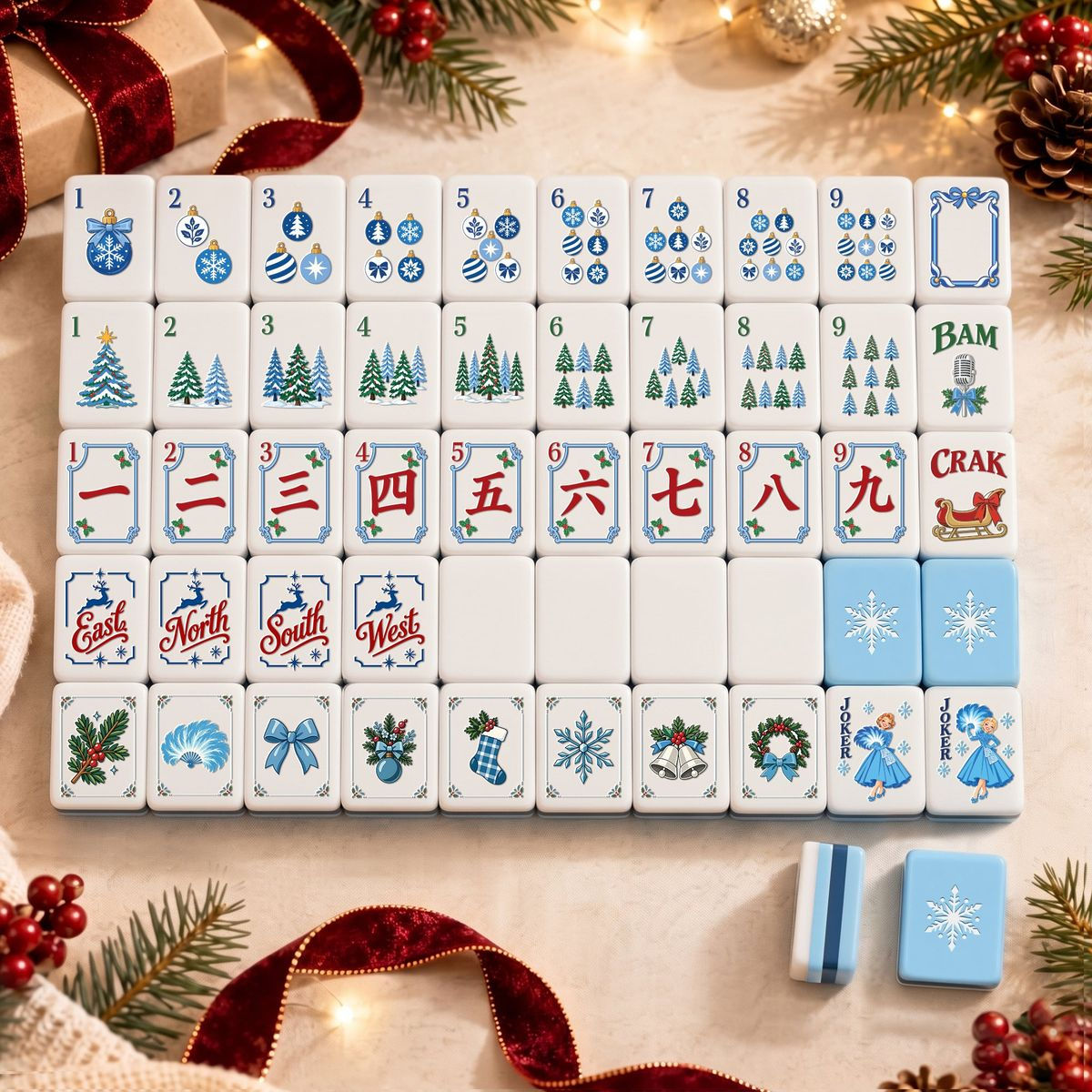
A double in American mahjong occurs when your completed hand satisfies two distinct patterns listed on the National Mah Jongg League card in the same round. You must have exactly 14 tiles arranged so that both patterns are valid at once—for example, a hand might be read as both "2 Pungs + 1 Pair" and "All Terminals" if the tiles allow it. You declare the double when you call "Mahjong," and your score is multiplied by two. Doubles are rare because the card patterns are carefully designed; most hands fit only one line. You cannot create a double by rearranging tiles after exposure or by claiming a pung fits two different sections—the tiles themselves must satisfy both patterns simultaneously without any change.
What exactly is a double, and how do you recognize one?
A double means your hand matches two separate patterns on the card at the same time. Unlike other games, you don't choose which pattern to call—you present your 14 tiles and say "Mahjong on Pattern X and Pattern Y." Both must be genuine and verifiable by the other players. If anyone challenges you, you must prove both patterns work without moving a single tile. This is why doubles are thrilling but demanding: you need not only a valid hand, but an extra valid hand hiding in the same 14 tiles.

Can you double using exposed tiles, or only your hidden hand?
Once you expose a pung, kong, or longer run during play, those tiles lock into that specific role. You cannot claim they belong to a second pattern on your double. For example, if you expose three 5 Craks as a pung, they are only a pung—you cannot later say they are part of an "All Craks" line for your double. Jokers in exposed melds also count only as the tile they represent in that position. Your only flexibility is in the tiles you hold concealed until "Mahjong," and even then, both patterns must exist in your final arrangement without any tiles doing double duty across both lines.
What are three realistic double examples from actual play?
Example 1: Consecutive Pung Double You hold three 1 Bams, three 2 Bams, three 3 Bams, and two 4 Bams. This can read as "3 Consecutive Pungs" (a common pattern family) and also as "6 in a Row Bams" (another family that lists 1–6 Bams as a valid block). Same 14 tiles, two patterns—that is a double.
Example 2: Like Number Winds Double You hold four Winds (all four directions) plus two pairs of a number—say, two pairs of 5 Dots. One card section may call this "2 Pairs + 2 Like Numbers," while another section lists "4 Winds + 2 Like Numbers." If both exist on the card for the same section, you can declare both and double your points.
Example 3: All Terminals with Pair Double You have three 1 Dots, three 9 Dots, three 1 Craks, three 9 Craks, and two 1 Bams. This satisfies "All Terminals, 5 Tiles" and might also satisfy a "Pair + 4 Terminal Pungs" line if that appears on the card. Again, no tile moves or reinterprets—it is simply seen two ways.
These examples show that doubles emerge from hand overlap, not from clever rearrangement. Our guide to reading the mahjong card explains how to spot which sections might contain overlapping patterns.
🀄 Shop best-selling mahjong sets →
What are the most common mistakes players make with doubles?
Mistake 1: Rearranging After You Call Mahjong The hand is locked at the moment you call "Mahjong." You cannot then move tiles around to make a second pattern appear. The tiles must already form both patterns in the order you present them.
Mistake 2: Using the Same Tile in Two Roles If a 5 Crak is the third tile of a pung in Pattern A, it cannot also be the first tile of a sequence in Pattern B. Each tile has one physical location; it cannot serve two roles simultaneously. This is the biggest source of false doubles at casual tables.
Mistake 3: Misreading Which Section the Double Applies To The National Mah Jongg League card divides hands into sections (often by number of tiles exposed, suit requirements, or pattern family). A double can only exist if both patterns belong to the same section of the card for that round. If Pattern A is listed in "Section 1" and Pattern B in "Section 2," you cannot double between them.
Mistake 4: Forgetting That Jokers Cannot Replace in a Pair If your pair is holding your double together, it must be two identical real tiles—never a joker plus a tile, even if they represent the same thing. How jokers work has more detail.
Mistake 5: Assuming Your Hand "Looks Like" Two Patterns The card is the law. If two patterns do not both appear on the current year's card, no double exists—even if they seem logically similar. Each year's card is distinct, and you must check both lines exist before declaring.
When should you pursue a double during play, and when should you ignore it?
Doubles are tempting but risky. Chasing a double means holding unusual tile combinations, which delays your ability to call "Mahjong" if your first-choice pattern does not arrive. Meanwhile, the player before you might call or someone might discard a tile that ruins both your patterns.
Pursue a double if: You have already drawn most of both patterns naturally, the game is early (many turns left), and your first-choice pattern is common enough that you stay flexible. For instance, if 11 of your 14 tiles already form a likely double, waiting one or two turns for the final three tiles is worth the gamble.
Ignore a double if: You have a one-tile-away single hand already locked, or you are in late turns and other players are close to calling. A sure hand now beats a possible double later. In money or tournament play, the math favors the quick call unless you are already a turn or two ahead.
A experienced table often plays doubles conservatively: most players call a single hand rather than risk a "dead draw" waiting for a second pattern that never comes. The double is a nice bonus when it arrives by luck, not a strategy to chase.

Why are doubles rare, and what does this tell us about set design?
The National Mah Jongg League card is constructed so that most hands fit exactly one pattern. Doubles occur only where two pattern lines happen to share tile requirements naturally—and that overlap is intentional but sparse. If the card were poorly designed, doubles would be common and the game would become chaotic (players too often chasing double opportunities instead of calling).
This rarity also reflects the tiles themselves. With 152 tiles, four of each number in each suit, and fixed Wind and Dragon counts, most hand compositions exhaust one pattern family before accidentally matching a second. A best-selling mahjong set has no special "double tiles"—all 152 are standard—so the card (not the tiles) determines whether a double is even possible.
Understanding this teaches a lesson: American mahjong is a reading game first, a luck game second. The card is the puzzle, and doubles are rare solutions that reward players who study the card carefully before the game starts.
🎁 See our most-loved mahjong sets & accessories →
Comparison: Single Hand vs. Double Strategy
Aspect | Single Hand | Double Hand |
Tile flexibility | High; you discard freely. | Low; many tiles are locked into two patterns. |
Speed to call | Fast; often 1–3 turns. | Slow; usually 4+ turns or never. |
Point value | Standard rate (varies by hand). | Double the standard rate. |
Risk level | Low; you call when ready. | High; you may never complete it. |
Best for | Winning this round; steady play. | Ahead in score; extra turns available. |
Typical outcome | 70% of games won with a single hand. | 5–10% of games involve a called double. |
What to check before you buy—and how to play doubles confidently
Study the current card at home before game night. Spend 10 minutes marking or photographing sections where you see potential double overlaps. Know which patterns share tile types (all Terminals, all one suit, like numbers, etc.). This preparation turns a rare accident into a recognizable pattern.
Play with clear, legible tiles. If your tiles are worn, misaligned, or hard to read, you will miss doubles because you cannot see your own hand structure. Our best-selling acrylic mahjong sets feature crisp engraving and uniform size, making it easy to spot patterns at a glance. A quality mat also helps organize your hand so you see connections.
Announce a double clearly and prove both patterns immediately. Say "Mahjong on [Pattern A] and [Pattern B]," then lay out your tiles in a way that makes both patterns visible (or arrange them twice if needed). If you cannot prove it in 10 seconds, players are right to challenge it.
Agree on dispute resolution beforehand. If a player denies your double, does the card read together to decide, or does the group vote? Settle this at the start of the game, not mid-dispute.
Key Takeaway Checklist
✓ A double means your 14 tiles satisfy two distinct patterns on the card simultaneously.
✓ Both patterns must belong to the same section of the card for that round.
✓ You cannot rearrange tiles or move a tile between two roles after calling "Mahjong."
✓ Exposed melds lock into their original purpose and cannot be reinterpreted for a double.
✓ Jokers in a pair do not exist; your pair must be two real, identical tiles.
✓ Doubles are rare (5–10% of games) because the card is designed to prevent accidental overlaps.
✓ Pursue a double only if you already have most of both patterns and the game is early.
✓ Study the current year's card before play to spot potential doubles.
✨ Find your Mahstead set — free US shipping →
For the full rules of American mahjong and how doubles fit into the bigger game, see our beginner's guide to American mahjong.

FAQ
Can you declare a double after the other players have seen your hand?
No. You declare a double at the moment you call "Mahjong," before showing your tiles. If you wait and later say "actually, that was also a double," it does not count. The declaration is part of calling Mahjong itself.
What if one pattern on your double uses a joker, but the second pattern needs that joker to be a real tile?
You cannot use the same joker in two different roles. If Pattern A exposes a pung with a joker substituting for a 5 Crak, Pattern B cannot claim that joker is a real 5 Crak. The joker is locked into Pattern A's role.
Do doubles exist in Hong Kong or Riichi mahjong the same way?
No. Hong Kong and Riichi mahjong use different rule sets and tile sets. Doubles in those variants work differently or do not exist in the same form. American mahjong's double is unique to the National Mah Jongg League card system.
If the card lists the same pattern twice (in two different sections), can you double it?
No. A double requires two different patterns. If "3 Consecutive Pungs" appears in both Section A and Section B, calling Mahjong on it is still just one hand. You need two functionally different patterns overlapping in your tiles.
How many doubles have you seen at a weekly game?
In a typical four-player game, a genuine called double happens once every 4–6 weeks of weekly play. False declarations (where players mistakenly think they have a double) happen slightly more often but are caught during tile verification.
Can you hold your hand in a way that "prepares" for a double while keeping a single hand safe?
Experienced players often keep their tiles arranged so that if they draw the right tile, a second pattern suddenly appears—but they can still call "Mahjong" on the first pattern if they do not draw it. This is smart play, not against the rules, because your single hand is always ready to declare.


View More
View More
View More
