
Consecutive Run in Mahjong Examples: American Rules Explained
Last updated: Nov 23, 2026
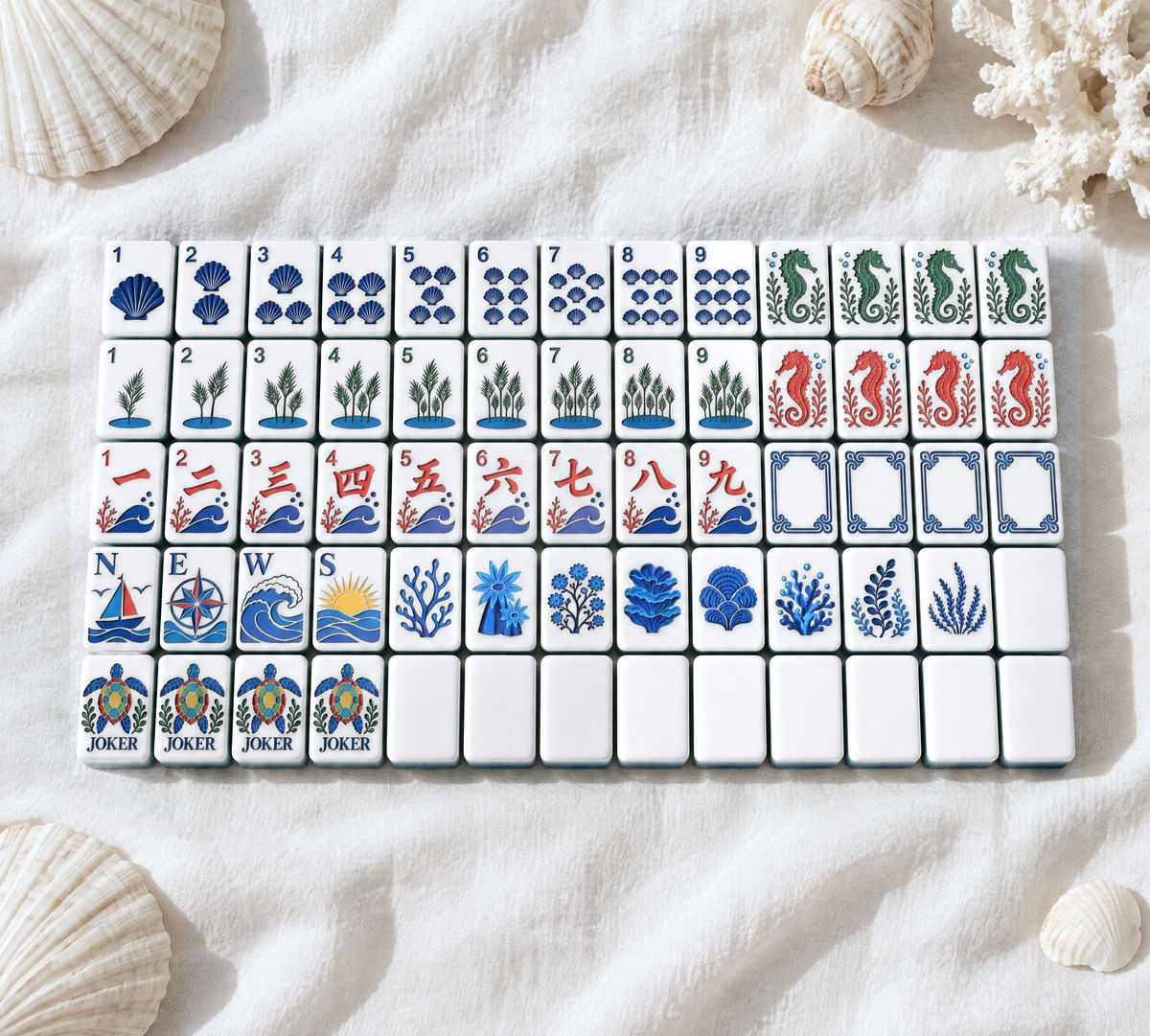
American mahjong has no drawable "runs" or "chows" like Chinese variants do. Instead, you match exact hand patterns printed on the current National Mah Jongg League card. The word "consecutive" appears only when describing pattern layouts—e.g., "Like Numbers" or "Consecutive Like Numbers"—which means tiles arranged in number order (1, 2, 3) or (3, 4, 5). All tiles in a single group (pung, kong, or quint) must be identical; sequences of different numbers only exist as descriptions of how exposed melds relate to one another across your hand. You cannot call or go out with a run. The annual card shows all legal winning hands; if your tiles match a listed pattern, you win—no runs, no improvisation. Study how to read the mahjong card to see how patterns use the term "consecutive."
🀄 Shop best-selling mahjong sets →
Why American Mahjong Has No Runs
American mahjong descended from Chinese mahjong but was simplified for speed and clarity. The founding American players removed the ability to declare sequences in real time, replacing it with a fixed card of pre-printed winning patterns. This single rule change—no runs allowed—eliminates the complexity of calculating valid melds on the fly. Every legal hand appears on the card beforehand. Your job is to recognize patterns, not create them. This makes the game faster, fairer, and easier to audit: either your exposed tiles match the card, or they don't.

What "Consecutive" Actually Means on the Card
When you see "Consecutive Like Numbers" or "Like Numbers Consecutive" in a pattern description, it refers to the layout of numbers within groups. A group showing "1, 2, 3" uses three consecutive numbers—but each must be a pung (three identical tiles of that number). For example, three 1 Bams, three 2 Bams, and three 3 Bams. You are not playing 1–2–3 as a sequence; you are playing three separate identical groups whose numbers happen to count up. Jokers can replace any tile except the pair and single tiles, so you might see a hand with some numbers filled by jokers. The word "consecutive" never means you can call a 1–2–3 as a run mid-game; it only describes how the card displays the finished hand.
Real Pattern Example: Like Numbers Consecutive
Imagine the current year's card lists a "Like Numbers Consecutive" hand on a specific row:
Pair: 1 Wind (any one Wind tile, held private) Group 1: Three 1 Dots (a pung) Group 2: Three 2 Dots (a pung) Group 3: Three 3 Dots (a pung) Group 4: Three 4 Dots (a pung)
The numbers 1, 2, 3, 4 are consecutive, but each group is identical (all 1 Dots, all 2 Dots, etc.). You drew or melded these four separate identical groups; you did not play them as a "run." If you wanted to go out on this hand and you had all four groups exposed plus a pair, you would announce "Like Numbers Consecutive, 1–4 Dots" and show the card. The dealer or a player checks the card, confirms the match, and you score points. No run-calling involved.
Common Mistake: Thinking You Can Declare a Run
New players often confuse American mahjong with Chinese or Riichi variants. They assume that when they hold tiles like 2 Bam, 3 Bam, 4 Bam in their hand, they can declare it as a "chow" or "run" and place it on the table. This is not allowed. In American mahjong, you only expose pungs (three identical), kongs (four identical), quints (five identical), or sextets (six identical). If you want to show that your hand includes consecutive numbers, the hand pattern must already be listed on the card, and all your groups must be identical pungs or larger. You cannot improvise a run. The card is the only rule book; what is not on the card is not legal, period.
How the Card Guides "Consecutive" Hands
The National Mah Jongg League releases one new card each spring. That card lists roughly 80–120 winning hand patterns for the year. Each pattern has:
A name (e.g., "Like Numbers Consecutive")
A suit or color (Bams, Craks, Dots, Winds, Dragons, or mixed)
A description of the groups and pair
For "consecutive" patterns, the card shows which numbers must be used in order (1–2–3, 2–3–4, etc.). Because these patterns are printed in advance, the game does not require you to think fast or debate validity—you simply draw, discard, meld, and check the card when you think you are ready to go out. American mahjong's speed comes from removing real-time decision-making about run legality.

Comparing American "Consecutive" to Other Variants
Variant | Runs Allowed? | How They Work | Timing | Strategy |
American | No (patterns only) | Match exact card patterns; no improvisation | Before play (card study) | Memorize patterns; execute trades |
Chinese | Yes (chows/sequences) | Declare 1–2–3 or similar mid-game; can be hidden | During play (real-time calling) | Calculate melds fast; adapt to draws |
Hong Kong | Yes (chows and pairs) | Similar to Chinese; complex scoring for each type | During play | Track scoring rules for each meld |
Riichi | Yes (sequences in sets) | Declare sequences as part of winning hand; can be open | When going out | Hidden vs. open meld strategy |
American mahjong removes run ambiguity by requiring all patterns to be pre-approved. This is why American players call it the "card game"—the card is law.
🎁 See our most-loved mahjong sets & accessories →
Why Beginners Struggle with American Patterns
If you are new to American mahjong, the lack of improvisation can feel restrictive at first. You cannot invent a winning hand; you must find it on the card. Many beginners waste time looking for patterns that do not exist or miss valid patterns because they did not study the card before the game. The solution is simple: spend 10–15 minutes reviewing the year's card before you play, not during. Scan for "consecutive" patterns and note how many jokers each one allows. Jokers are wild and can replace any tile except the pair, so a hand heavy in jokers is often easier to build. When you sit down to play, you will recognize patterns faster, make smarter trades during the Charleston (the tile-passing phase), and draw tiles toward hands you have already seen. Study also cuts down table time and keeps the game flowing.
Learn the Charleston tile exchange and how jokers work to deepen your setup strategy.
What You'll Need
To play American mahjong and spot consecutive patterns, you need a quality 160-tile acrylic set with clear, readable tiles. Acrylic tiles are durable, easy to clean, and shift smoothly on a mat—essential when you are studying the card and making fast decisions. Pair your set with a mahjong mat designed to hold the current year's NMJL card under a clear plastic window. This layout keeps the card visible and reference-friendly while you play. If you play weekly, a rack with pushers reduces hand fatigue and keeps your tiles organized by suit—both help you spot consecutive patterns faster. A sturdy travel bag protects your set during transport to weekly games.
Before You Buy or Play: A Quick Checklist
✓ Get the current year's NMJL card (available online or from your game group).
✓ Print a copy or laminate it so it survives humid game nights.
✓ Review 5–10 "consecutive" patterns before your first game.
✓ Note how many jokers each pattern accepts (usually 2–4).
✓ Ask an experienced player to walk you through one pattern in detail.
✓ During the Charleston, aim for tiles that match one of your target patterns.
✓ Do not assume a run is legal—always check the card.
✓ If you see tiles in order (1, 2, 3), remember: each must be a separate identical group, not a sequence you called in real time.
✨ Find your Mahstead set — free US shipping →
Scoring and Winning with Consecutive Patterns
Once you have a hand that matches a "consecutive" pattern on the card, you announce it and show your tiles and the card row to the table. The dealer or an appointed scorer confirms the match. You score points based on the pattern's complexity (listed on the card). Consecutive patterns often score well because they require four identical groups—more tiles, more risk, more reward. If your hand has a high percentage of jokers (wildcard tiles), the score is usually lower, since jokers reduce the difficulty. Mastering consecutive patterns is one of the fastest ways to build a scoring-focused American mahjong game.
Read American mahjong scoring for a full breakdown of point values.

FAQ
Can I declare a run in American mahjong like I would in Chinese mahjong?
No. American mahjong allows only identical groups (pungs, kongs, quints, sextets). All winning hands must match patterns on the current National Mah Jongg League card. No runs, chows, or sequences can be called mid-game. The card is the only valid rulebook.
What does "consecutive" mean on an American mahjong card?
"Consecutive" refers to the number order of groups in a hand pattern, not to a drawable run. For example, a "Like Numbers Consecutive" hand requires four groups of identical tiles in order: 1 Dots, 2 Dots, 3 Dots, 4 Dots. Each group is still a pung (three identical tiles), not a sequence.
How many jokers can I use in a consecutive pattern?
It depends on the specific hand pattern listed on the card. Most consecutive patterns allow 2–4 jokers. Jokers can replace any tile except the pair and single tiles. Always check the card row for the joker count before committing to that hand.
If I have 2 Bam, 3 Bam, 4 Bam in my hand, can I call them as a run?
No. You cannot expose or call a run. Those three tiles are just tiles in your private hand. You could only use them if a pattern on the card asks for 2 Bam pungs, 3 Bam pungs, and 4 Bam pungs as separate identical groups, and you had nine tiles total for those three groups.
Why does American mahjong not allow runs like other variants?
American mahjong was simplified from Chinese mahjong by removing real-time meld decisions. All legal hands are pre-printed on the annual card. This makes the game faster, fairer, and easier to learn—no debates about run validity at the table.
What is the best way to study consecutive patterns before I play?
Review the current year's card for 10–15 minutes before game time. Note which "consecutive" patterns exist, how many jokers each allows, and which suits are used. During the Charleston tile exchange, prioritize drawing toward the consecutive hands you studied. Memorizing even five patterns will double your confidence.


View More
View More
View More
