
Competition Rules vs. Mahjong Solitaire: What's Different
Last updated: Nov 23, 2026
Competition mahjong uses the National Mah Jongg League card (updated yearly), requires exactly four players, fixed hand patterns, the Charleston tile-passing ritual, standardized American tiles (152 playing tiles plus jokers), and strict rules on exposure, calling, and scoring—with one winner per hand. Mahjong solitaire is a single-player puzzle: you match pairs of identical tiles on a preset layout (no players, no hand patterns, no card, no Charleston) until the board clears or blocks, and the goal is simply to solve it. Competition demands real opponents, the League card, live judgment calls, and synchronized tile flow; solitaire is meditative, turn-based, and playable anytime alone. If you host a weekly four-player game, you need competition rules and best-selling acrylic sets. If you want a zen puzzle, solitaire requires a different tile layout altogether—often digital or a specialized physical board.
What exactly is competition mahjong?
Competition mahjong in America means you sit with three players around a table, draw tiles from a central wall, and match your hand to one of the listed patterns on the current year's National Mah Jongg League card. You can only win by completing a hand that appears on the card. Each hand plays out in real time: players pass tiles (the Charleston), draw in turn, discard openly, call exposed melds (pungs, kongs, quints, sextets), and one player declares "mahjong" when their tiles form a legal winning pattern. The game follows strict exposure rules—no sequences (chows), only identical-tile melds—and the League card changes every spring, so strategy shifts yearly. Jokers can substitute for any tile in a meld but never form a single tile or pair. A full game lasts roughly 45 minutes to two hours depending on table speed. Competition assumes four players; fewer players use different rules (more complex, less common). This is what we play every week at Mahstead—it's social, skill-based, and structured.

How is mahjong solitaire fundamentally different?
Mahjong solitaire is a solo puzzle game where you face a static board of tiles arranged in a fixed layout (often a turtle, pagoda, or pyramid shape) and your only goal is to clear the board by matching pairs of identical tiles. There's no player competition, no hand patterns, no League card, no pass-draw-call-win sequence, and no time pressure—you work at your own pace until you either solve it or reach a dead end where no more matches exist. Most solitaire variants run on apps or digital platforms; physical solitaire boards are less common but exist. A typical solitaire round takes 5–15 minutes. The gameplay is meditative and puzzle-focused: you study the board, find valid pairs (tiles must have a free edge on at least one side, depending on the ruleset), remove them, and watch the layout cascade. There's no opponent, no scoring system tied to patterns, no jokers as wild tiles, and no hand strategy—only logical deduction. If you love the look and feel of mahjong tiles but want solo, contemplative play, solitaire is your game. If you want the social, rule-based competition we host every Thursday, you need American tournament rules.
🀄 Shop best-selling mahjong sets →
What equipment do you need for each format?
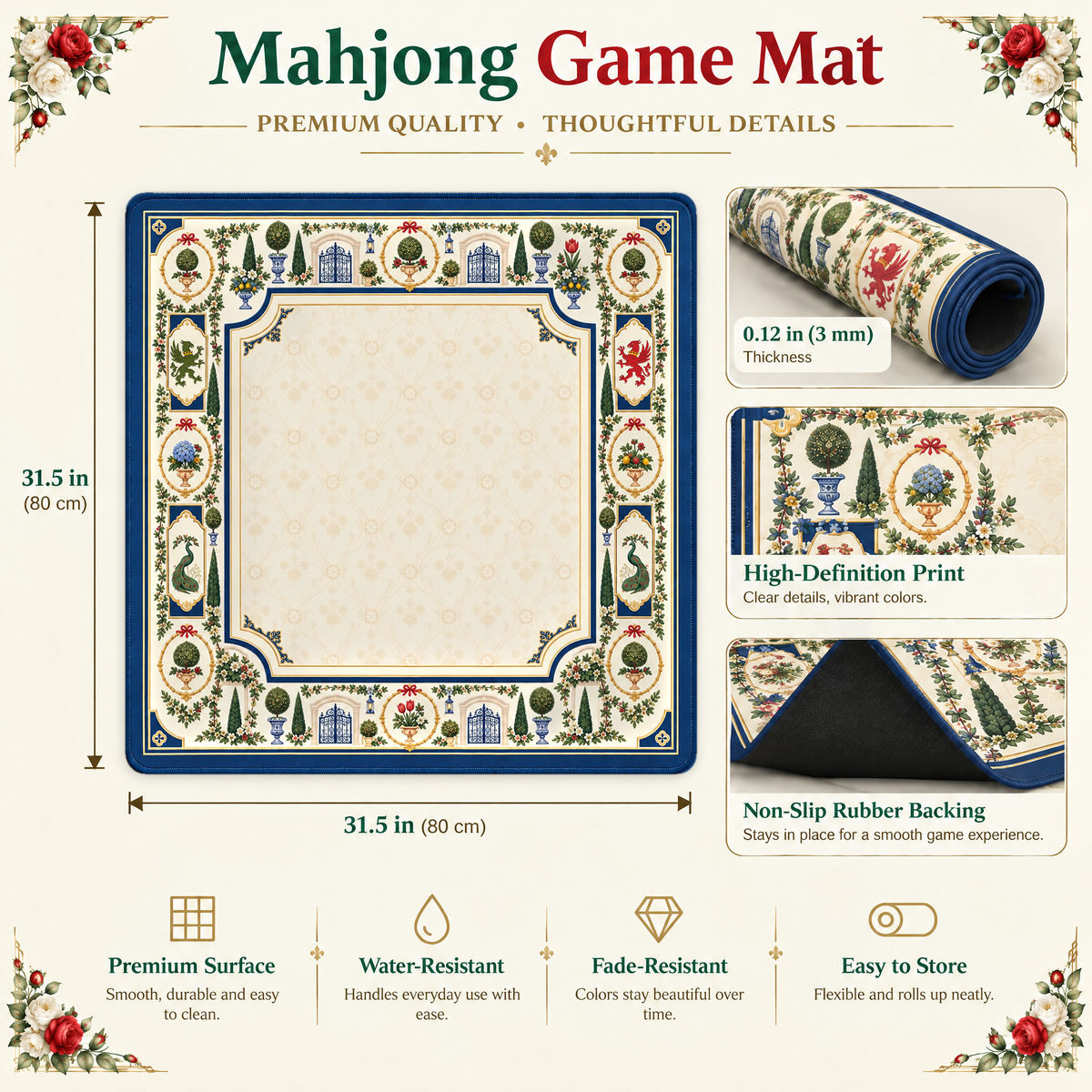
Competition mahjong requires a full four-player American set (152 playing tiles plus jokers in one deck), a mat to organize the wall and melds, racks with pushers to hold and display tiles, the current year's National Mah Jongg League card (order annually from the League itself), a wind indicator (brass or tile-based), and dice to set the starting wall. Optional: a timer, score sheet, and a padded bag for transport to your weekly game venue. A four-player set from our best-selling collection runs the full suite: acrylic tiles, organized racks, and everything to host right now.
Mahjong solitaire typically uses a digital app (free or low-cost subscriptions on phones and tablets) or a specialty physical board with tiles in a pre-set configuration. Physical solitaire boards are niche; most players opt for apps because layouts are unlimited, storage is instant, and difficulty adjusts. If you want a physical solitaire experience, you'd need a printed template and a pile of loose tiles—not a standard competitive set. Solitaire doesn't require a mat, pushers, racks, the League card, or four players; it's just you, your tiles or screen, and logic.
Format | Players | Main Equipment | The Card | Goal |
Competition | 4 | Full American set, mat, racks, pushers | NMJL card (yearly) | Match League pattern, win hand |
Solitaire | 1 | App or specialty board | None | Clear all tiles, no matches left |
The difference is stark: competition is a social, structured multiplayer game; solitaire is a meditative solo puzzle. Your equipment choice—and where you shop—depends entirely on which one calls to you.
How do the rules and winning conditions differ?
Competition rules center on the League card. You build one of the hand patterns printed on that year's card—patterns are numbered and show required tile combinations (like "all pungs in Craks," "mixed suitless," or "pairs in Dots and Bams with Winds"). The winning hand must appear exactly on the card; a hand off the card, no matter how logical it looks, is illegal and loses. You play with fixed tiles (no optional blanks), must follow exposure rules (no chows, only pungs/kongs/quints/sextets), must respect the Charleston passing ritual, and cannot call discard or draw freely—calls are announced aloud and shared at the table. Scoring depends on the pattern (also from the card); there's one winner per hand, and play rotates. A game is a series of hands; a session may last two hours or more.
Mahjong solitaire has no League card and no legal/illegal patterns—your only rule is to match identical tiles. There's no winner or loser; you either solve the puzzle or you don't. No one calls anything; no one passes. You play against the board's logic, not opponents. Solving a solitaire hand in 5 minutes means you succeeded; taking 20 minutes or giving up means you didn't. There's no scoring in the competition sense; most apps track time or moves as a personal metric. Solitaire is puzzle-completion; competition is skill, memory, speed, and reading opponents.

Which version should you learn first?
If you're new to mahjong, competition American mahjong is harder to learn but more rewarding socially. You need to memorize the current year's card (hundreds of hands), understand exposure rules, master the Charleston, recognize fast-paced discards and calls, and coordinate with three other players. Learning curve: 3–6 weeks of weekly games before you feel confident. Payoff: a lifelong, weekly social ritual. We recommend starting with a beginner's guide to American mahjong and how to read the card.
Mahjong solitaire is instantly accessible but intellectually shallow once you grasp it. You learn pair-matching in seconds; the challenge is the layout and your pattern recognition. There's no social component, no new rules to study year to year, and no opponent adaptation. It's perfect for a commute, a quiet evening, or practicing tile recognition—but you'll plateau quickly. Solitaire works best as a supplement to competition play or as a solo wind-down after a full game night.
If you want ongoing growth, variety, and connection with other players, choose competition. If you want zen puzzle time with zero social pressure, choose solitaire. Most of us do both: we play hard competition Thursday nights and solitaire on our phones Friday morning to decompress.
🎁 See our most-loved mahjong sets & accessories →
Real table-tested differences: what actually matters in play
Here's what we've noticed after thousands of hands:
Pace: Competition moves fast—tiles flow, calls happen instantly, you discard quickly. Solitaire has no time pressure; you go as slow as you want.
Memory load: Competition demands you know 50–200+ hand patterns by sight (depending on your skill level). Solitaire needs zero pattern memory; you just spot matches.
Opponent reads: In competition, you watch discards, infer what tiles others need, and defend your own hand. Solitaire has no opponents, so no bluffing, no strategy pivots mid-hand.
Tile handling: Competition rewards neat, organized racks and pushers to hide your tiles and speed play. Solitaire on a board or app has no hiding; all tiles are visible all the time.
Joker use: Competition uses jokers as wild substitutes in melds; they're essential strategy. Solitaire typically has no jokers at all.
Scoring: Competition scoring is math (points based on pattern complexity, location, exposure, and speed). Solitaire has no score—just success or failure.
Duration: One competition hand: 10–30 minutes. One solitaire puzzle: 5–15 minutes.
The deepest difference: competition is a game with opponents and judgment calls; solitaire is a puzzle with one correct solution. If you crave the game, commit to competition. If you love the tiles but not the rivalry, solitaire fits perfectly.
✨ Find your Mahstead set — free US shipping →
What to check before you buy
Do you have three other players nearby? Competition needs four. If you're solo or have only one or two friends, solitaire (or 2–3 player American mahjong rules) works better.
Can you commit to learning the yearly card? Competition requires ordering the League card every spring and studying it. Solitaire is instant—no annual learning.
Do you want to host or travel? If hosting, you need a mat, racks, and a set in good condition. If traveling to a club, bring a lightweight bag. Solitaire requires only a phone or specialty board.
Budget: A full competition set with mat, racks, and pushers costs more than a solitaire app subscription. A best-selling acrylic set with accessories is a one-time investment; solitaire apps range from free to a few dollars annually.
Tile quality: If you play competition weekly, you'll wear tiles—acrylic sets last years and show your loyalty. Solitaire boards rarely wear because they're used casually. Check product reviews and material before ordering.

FAQ
Can I play competition mahjong with fewer than four players?
Yes, but rules change significantly. Two or three players use modified wall setups, different draws, and adjusted exposure rules. Learn 2–3 player rules here. Most clubs and weekly games are four-player; fewer-player variants are less common and harder to find opponents for.
Is mahjong solitaire the same as the digital app versions?
Mostly yes. Both follow the same tile-matching, pair-removal logic, but apps offer unlimited layouts and difficulty levels, while physical solitaire boards are fixed. Apps are more accessible; physical boards offer a tactile experience if you love the tiles themselves.
Do I need to buy a new League card every year for competition?
Yes. The National Mah Jongg League issues a new card every spring with updated hand patterns. You order it directly from the League (usually around $20–$30, not from Mahstead). Without the current card, you cannot legally play competition; previous years' cards are not valid for tournament or club play.
Can I use the same tiles for both competition and solitaire?
Technically yes, but it's not ideal. Competition tiles are organized in racks and melds openly; solitaire needs tiles loose and shuffled for layout. You'd need a second set if you host weekly competition—mixing the two slows both games down.
What's the hardest part of learning competition mahjong?
Memorizing the hand patterns on the card fast enough to spot them mid-game. Most players spend their first month drilling the card. The second-hardest part is speed—learning to call, discard, and read the table without slowing the game. Solitaire has no learning curve; competition takes weeks to feel natural.
Do jokers work the same way in both formats?
No. In competition, jokers are wild tiles that substitute for any tile in an exposed meld (pung, kong, etc.) but never form a single tile or pair. In most solitaire apps and boards, there are no jokers at all—just fixed tile pairs. This is a fundamental rule difference.


View More
View More
View More
