
Chinese Mahjong vs. Riichi Mahjong: Key Rules & Differences
Last updated: Nov 23, 2026
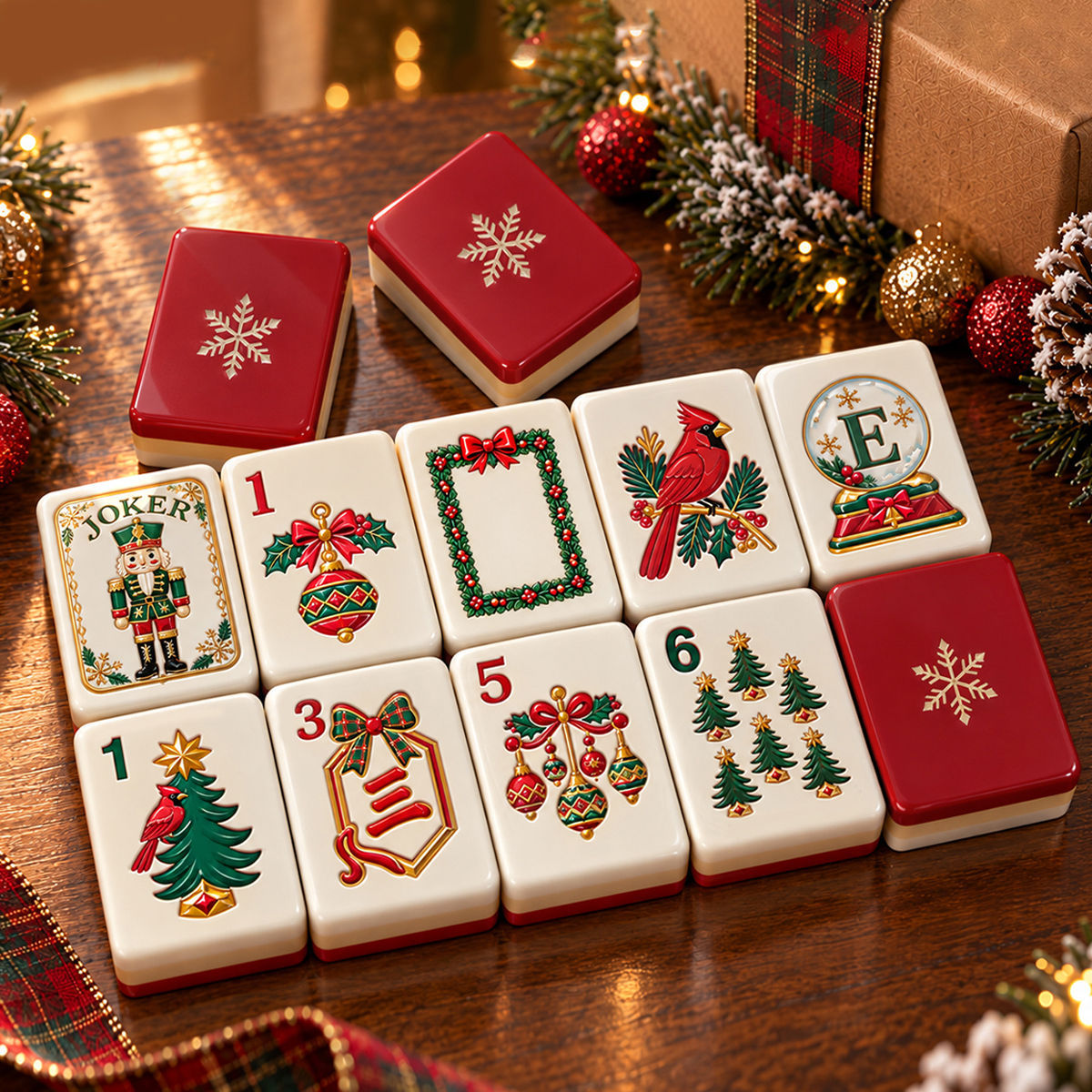
Chinese mahjong (Cantonese or Mandarin standard) uses 144 tiles: three suits (1–9 each in Bams, Craks, Dots), 16 winds, 12 dragons, 8 flowers, 8 jokers. Winning hand = 14 tiles in melds (chows, pungs, or pairs). Riichi mahjong uses 136 tiles: three suits, 16 winds, 12 dragons (no flowers, no jokers). Winning hand = 13 tiles plus draw in patterns called yaku; players must declare riichi (locked hand) before winning, scoring by yaku type and dora (bonus tiles). American mahjong, played by our weekly groups, uses 152 tiles: no chows allowed, only pungs/kongs/jokers, hands from the National Mah Jongg League card only. If you're learning, explore the best-selling sets to match your chosen variant's tile count and design.
Does Chinese mahjong allow sequences like Riichi does?
Yes—Chinese mahjong allows and even encourages chows (sequences of three consecutive numbers in one suit, e.g., 3-4-5 Bams). Players can call a chow from any player's discard if it completes a winning hand. Riichi mahjong also permits chows: they're called shuntsu and are essential for building yaku. American mahjong forbids chows entirely; you can only expose pungs (three identical tiles), kongs (four), quints (five) or sextets (six)—no sequences, ever. This single rule change upends strategy: Chinese and Riichi players think in linear number patterns; American players hunt for repeated tiles and honor (wind/dragon) groups.

What's the role of jokers in Chinese versus Riichi mahjong?
Chinese mahjong includes 8 jokers (four pairs of duplicate-looking tiles), which act as wildcards in melds. A joker can replace any tile in a pung, chow or pair, making hands easier to complete and speeding gameplay. Riichi mahjong contains no jokers—every tile is fixed and meaningful. Instead, Riichi uses dora (bonus tiles, typically 1–4 per hand), which are revealed and visible to all players; dora increase your hand's point value but don't substitute. American mahjong uses 8 jokers that work similarly to Chinese jokers in melds, but jokers cannot form a single tile, a pair, or a pung by themselves—they must always enhance an existing meld. This rule prevents cheap wins and forces American players to build genuine tile combinations.
How do winning hands and scoring differ across the three variants?
Aspect | Chinese | Riichi | American |
Winning composition | 14 tiles in 4 melds + 1 pair | 13 tiles in melds + 1 draw tile (14 total) | 14 tiles per NMJL card; pung/kong/pair combos only |
How you win | Complete hand, then declare win | Declare riichi (locked hand), then draw winning tile | Complete hand from current year's card, call "mahjong" |
Scoring basis | Fan (pattern complexity), points calculated live | Yaku (pattern name) + dora (bonus tiles) + hand closedness | Point value printed on card; first to agreed limit (often 2,000) wins |
Melds allowed | Chows, pungs, pairs (13+ honors/terminals scores higher) | Shuntsu (chows), kotsu (pungs), pairs; yaku combos fixed | Pungs, kongs, quints, sextets, pairs; jokers only in existing melds |
Jokers/wildcards | Yes, 8 jokers substitute freely | No jokers; dora bonus tiles used instead | Yes, 8 jokers; enhance melds only, never standalone |
Hand selection | Any valid combination | Fixed yaku patterns (e.g., tanyao, yakuhai) | ONLY hands on current year's NMJL card |
Games per session | 4–8 rounds (wind rotations) | Often 8 or 12 rounds | Typically 4–8 games per sitting |
Chinese and Riichi scoring reward pattern complexity; American scoring ties to the card. If you play casually with friends, American rules are easiest to teach (the card is your referee). If you're serious about Riichi, expect to memorize 10–20 standard yaku; Chinese mahjong requires quick mental math and fan calculation.
What hands and patterns are required to win in each variant?
Chinese mahjong requires a "standard" winning hand: four melds of three tiles each (chows, pungs, or any mix) plus one pair. Beyond the standard structure, bonus patterns (hu) like "all pungs," "all chows," "terminals and honors only," or "dragon pung" increase your payout. A hand is either standard or doesn't win—there's no "valid but low" category.
Riichi mahjong restricts winning hands to specific named patterns called yaku. Examples: tanyao (1–8 only, no terminals or honors), yakuhai (pung of your seat wind or a dragon), pinfu (no melds, open hand, no pair bonuses), tsumo (self-draw), ron (win from another's discard). A hand must satisfy at least one yaku to win; a "random" 13-tile combination with no yaku name is a loss, even if it looks complete. Yaku are scored by han (tier): 1-han hands are 1,000–2,000 points; 5+ han ("mangan") is 8,000 points minimum. Memorizing yaku is the core skill.
American mahjong uses only hands published on that year's National Mah Jongg League card, issued every spring. The card shows 60–80 hand patterns (e.g., "Pung Pung Pung" with specific number ranges, or "2 Like Numbers with Pairs"). Players cannot win with off-card hands—period. This removes memorization and speeds learning, but requires carrying the card to every game. The card rotates annually, so even experienced players refresh their knowledge each spring.
Can you mix rules or play with fewer players?
No—each variant is designed as a closed system. Mixing Chinese scoring with Riichi yaku confuses everyone and invalidates the game's balance. However, each variant offers solo-player or reduced-player modes: Chinese mahjong has 2- and 3-player variants (tiles removed, different draw/discard mechanics); Riichi mahjong has 3-player (sanma: 108 tiles, 13-tile winning hand, different yaku). American mahjong also supports 2 and 3 players—the National Mah Jongg League publishes adjusted hands for reduced-player games. Learn how 2 and 3 player mahjong rules work if your group has fewer than four on game night. Never invent hybrid rules mid-session; pick a variant, stick to it, and tell all players upfront.

Which variant is easiest for a beginner to learn?
American mahjong is the fastest to learn if you have the card. The card removes the need to memorize winning patterns—you just follow it. Downside: you must own the current card (or print it), and the card changes yearly. Learning takes 1–3 sessions for basics; mastery takes months.
Chinese mahjong is intuitive structurally (four melds + pair) but requires mental math and live calculation of fan/points. Learning takes 2–4 sessions; scoring fluency takes weeks.
Riichi mahjong has a steeper yaku memorization curve and complex scoring rules (mangan, haneman, baiman thresholds). A beginner needs 4–8 sessions and a reference card. However, Riichi gameplay is tighter and more balanced competitively.
If you're hosting your first game, American rules are beginner-friendliest because the card is your rule book. Browse our best-selling acrylic sets designed for American play—they're clear, durable, and ship free across the US.
🀄 Shop best-selling mahjong sets →
What equipment do you need for each variant?
All three use a mahjong set (tiles), a rack (to hold tiles), a mat (to protect the table and organize discards), dice (to determine seating and first draw), a wind indicator, and often a scoring device or pen-and-paper.
Chinese mahjong: 144-tile set; players often prefer bone or bamboo (traditional feel) or plastic (durability).
Riichi mahjong: 136-tile set; tournament play uses plastic tiles and a honma (stalk) to track dora; casual play may skip it.
American mahjong: 152-tile set; many players use acrylic (bright, engraved designs, lightweight). A mahjong mat with a card pocket is nearly essential so the current NMJL card sits within arm's reach. Racks with pushers are standard for all variants; they keep tiles organized and prevent accidental reveals.
Most players in the US who want "mahjong sets" are shopping for American variants, so 152-tile acrylic sets dominate. If you're playing Riichi with Japanese friends or Chinese with family, clarify tile count and material before buying.
🎁 See our most-loved mahjong sets & accessories →
What to check before you buy a mahjong set for your variant
Tile count: Chinese = 144; Riichi = 136; American = 152. Count the product description or ask the seller. (Most retailers don't clearly label tile count; Mahstead's 160-tile sets are designed for American play, with 152 playing tiles.)
Material: Plastic (durable, loud, affordable), bone/bamboo (quieter, traditional, pricier), acrylic (bright, engraved designs, lightweight). Choose based on aesthetic and budget.
Jokers and spare tiles: Chinese and American sets include jokers; Riichi does not. Check the box contents.
Accompanying gear: Rack, mat, dice, wind indicator, scoring device. Some sets are tile-only; others bundle accessories. Decide if you need a travel bag or case to transport your set.
Engraving or customization: Some players add names, dates, or designs to celebrate a set. Mahstead offers engraved American mahjong sets so you can personalize for a club or occasion.
Annual card rotation (American only): If you're buying an American set, confirm you have access to the current year's NMJL card. The card is free to print online or purchase; it updates every spring.
Why some players love one variant over another
Chinese mahjong fans prize the fluidity of chows and the social, fast-paced gameplay. It's dominant in East Asia, Hong Kong, and many diaspora communities. Scoring is transparent and calculated on the spot.
Riichi mahjong enthusiasts value precision, strategic depth, and a worldwide competitive structure (Riichi is tournament-playable). The yaku system rewards skillful hand-building. It's the standard in Japan and has a growing Western fanbase.
American mahjong players (our weekly groups) love the card-driven simplicity, the annual refresh (new hand combos each spring), and the social, collaborative atmosphere. It's dominant in the US, especially among clubs and retirees. No complex scoring—just points on the card.
None is objectively "better"; it depends on your social circle, available teachers, and what scratches your strategic itch.
✨ Find your Mahstead set — free US shipping →

FAQ
Can I play American mahjong rules with a Chinese 144-tile set?
No. American mahjong requires 152 tiles (the extra jokers and honors). A 144-tile set lacks tiles and jokers that American hands depend on. You'd also need the current National Mah Jongg League card. Stick to a 152-tile American set.
Is Riichi mahjong played socially in the US, or only competitively?
Both. Riichi has casual clubs in larger US cities and online communities, but it's far less widespread than American or Chinese mahjong among US players. Competitive tournaments exist; casual play is slower and more educational. If you're in a city with a Riichi community (often near universities or Japanese cultural centers), it's playable. Otherwise, American or Chinese are easier to find.
Do Chinese and Riichi players ever play together?
Not in the same game. The rules are too different. However, players often learn multiple variants—many Riichi players also know Chinese mahjong. Some casual groups may alternate nights: one week Chinese, one week Riichi. Always confirm the variant before sitting down.
What's the fastest variant to play one game?
American mahjong usually completes one game in 15–25 minutes (4 players, once everyone knows the card). Chinese and Riichi can take 20–40 minutes per game depending on player speed and skill. American is fastest because the card eliminates debate over valid hands.
Do I need to speak a specific language to learn any variant?
No, but terminology helps. Chinese mahjong terms are in Cantonese or Mandarin; Riichi uses Japanese; American uses English. Many Western players learn Riichi without fluent Japanese and Chinese mahjong without Cantonese—online guides and apps explain it in English. If you're learning from a native speaker, expect their terms in their language; most will explain in English too.
Which set should I buy if I want to try multiple variants?
Buy one American 152-tile set first (easiest to learn, largest US player base, our specialty). Once comfortable, a separate 136-tile Riichi set or 144-tile Chinese set adds a new challenge. Avoid trying to hybridize; each set is optimized for its rules.


View More
View More
View More
