
Big Hand in Mahjong: Examples & How to Read Them
Last updated: Nov 23, 2026
In American mahjong, a "big hand" means any winning combination that appears on the current year's National Mah Jongg League card and scores the maximum points possible—typically among the highest-value patterns listed. Big hands usually contain long sequences of identical tiles (like five or six matching numbers in one suit), multiple exposed pungs or kongs, and smart use of jokers to fill gaps. They're printed on the official card alongside point values; you find them by matching your tiles to the hand pattern and noting the section and position. The card is your only guide to legal wins, so learning to read it fast is the first step to building big hands consistently. Mahstead's best-selling mahjong sets come with a reference guide to help you scan the card more smoothly during play.
A "big hand" in American mahjong is any winning combination that appears on the current year's National Mah Jongg League card and scores the maximum points possible—typically among the highest-value patterns listed. Big hands usually contain long sequences of identical tiles (like five or six matching numbers in one suit), multiple exposed pungs or kongs, and smart use of jokers to fill gaps. They're printed on the official card alongside point values; you find them by matching your tiles to the hand pattern and noting the section and position. The card is your only guide to legal wins, so learning to read it fast is the first step to building big hands consistently.
🀄 Shop best-selling mahjong sets →
What counts as a "big" hand—and why point value is what matters?
Point value, not tile rarity, defines a "big" hand in American mahjong. Every legal winning hand on the current year's card has a point value assigned: some are worth 2 points, others 10 or 20. A "big" hand is simply one near the top of the point scale in that year's card. You don't need rare tiles or lucky draws—you need a pattern that's worth serious points. The card organizes hands by section (like "Consecutives," "Like Numbers," or "Honors") and shows dozens of patterns per section. Learning which patterns score highest in your card's layout is the fastest way to recognize big hands at the table.
What do high-scoring hands typically contain?
High-scoring American mahjong hands almost always feature long runs of the same suit and multiple pungs or kongs you can expose to the table. A pung is exactly three identical tiles (e.g., three 5 Dots); a kong is four identical tiles. Sextets (six identical tiles) and quints (five identical tiles) also appear in big hands and score generously because they require more matching tiles and fewer jokers. Jokers fill gaps—you can't build a big hand without them—so hands that use jokers strategically (replacing one difficult tile) rather than squandering them score higher. Hands with all honors (Winds and Dragons) or all one suit also rank among the biggest on most cards. Study your current card's top-scoring section and you'll spot what tiles cluster there.
How do you spot a big hand forming during your draw phase?
Watch for two things as you draw: a run of matching numbers in one suit (like 2, 3, 4, 5 Bams appearing in your hand) or a cluster of identical tiles you can pung. These are the skeleton of big hands. Once you have three or four tiles in sequence or a matching pair, check the card during your turn to see which high-value hands in that suit or honor category you're closest to completing. Keep jokers until you know what gap they need to fill—don't waste them. If you draw a fourth wind or dragon, hold it; multiples of honors often anchor big-scoring patterns. Learn how to read the mahjong card for speed and accuracy so you can evaluate your tiles fast.
What role do jokers play in building big hands?
Jokers are wild cards that substitute for any tile you're missing—and they're essential to scoring big. American mahjong comes with eight jokers in every 160-tile set. You can expose a pung, kong, quint, or sextet containing one or more jokers, but you can never use a joker in a single tile or as part of a pair. This rule means big hands that require long runs use jokers to fill the one or two gaps they can't draw naturally. A hand needing five 5 Bams in a row might use one joker as the missing 5 Bam; the other four you draw. Smart players hold jokers loosely and only lock them in when they know the exact hand they're chasing. How jokers work covers the rules in detail.
How do consecutive hands and honor hands compare in point value?
Hand Type | Typical Tiles | Difficulty | Card Position | Why High-Scoring |
Consecutives (e.g., 1–9 sequence) | Same suit, long runs | Requires many draws, few jokers | Often top section | Longest sequences = rarest |
Like Numbers (e.g., all 5s) | Mixed suits, same number | Medium; more tile availability | Mid-to-high section | Clean symmetry, needs exposure |
All Honors | Winds + Dragons only | Medium; harder to collect | High section | Specialized patterns, strategy |
All One Suit | Bams/Craks/Dots only | Low-to-medium; suits cluster | Mid section | Commonly built but scores well |
Consecutive hands (running 1 through 9, or subsets) usually score the highest because they demand the longest unbroken runs and fewest joker shortcuts. Honor-only hands (Winds and Dragons with no number tiles) also rank very high because they're harder to draw and require specific strategic planning. Like-number hands (all 5s, for example) are easier to assemble but still score generously. Beginners often build all-one-suit hands first because the card clears them early; they're solid but not the biggest. Study your card's structure to see which section your venue favors—often the top few patterns dominate the hands players actually win.
🎁 See our most-loved mahjong sets & accessories →
Why does the card change every year and how does it affect big hands?
The National Mah Jongg League releases a new official card every spring, shuffling which patterns appear and what they're worth. A hand that scored 10 points last year might be worth 8 this year or move to a different section entirely. This keeps the game fresh—players can't rely on old strategies—and prevents any one pattern from dominating forever. When the new card arrives, spend your first few games studying the top third of hands in each section; those are your big-hand targets. Memorize two or three patterns per section so you can recognize them instantly. Updating your mental map each spring is part of becoming a strong player. How to play American mahjong explains the role of the card in more depth.
What mistakes kill a big-hand opportunity at the table?
The most common mistake is discarding a tile you think is "safe" without checking the card first. That tile might be the one joker you need to complete a 15-point hand. Second mistake: holding too many jokers waiting for a perfect hand and never winning—big hands are rare; a 5-point win today beats a missed 12-point tomorrow. Third: not exposing your pungs and kongs soon enough. Exposed tiles help your teammates see what you're building and they also lock in your path on the card; waiting too late to expose gives you no lane to win. Fourth: ignoring the card during discard. When an opponent passes a tile that fits a big-hand section, note it—they may be chasing that pattern and you should avoid discarding into it.
What to check before you buy a set for reading the card during play
• Does the set include a printed reference guide or scorecard summary? • Are the tiles large enough to read suit symbols clearly in dim lighting? • Does the printed card or mat you're using have large, legible text? • Can you hold and sort your hand without fumbling tiles on a narrow rack?
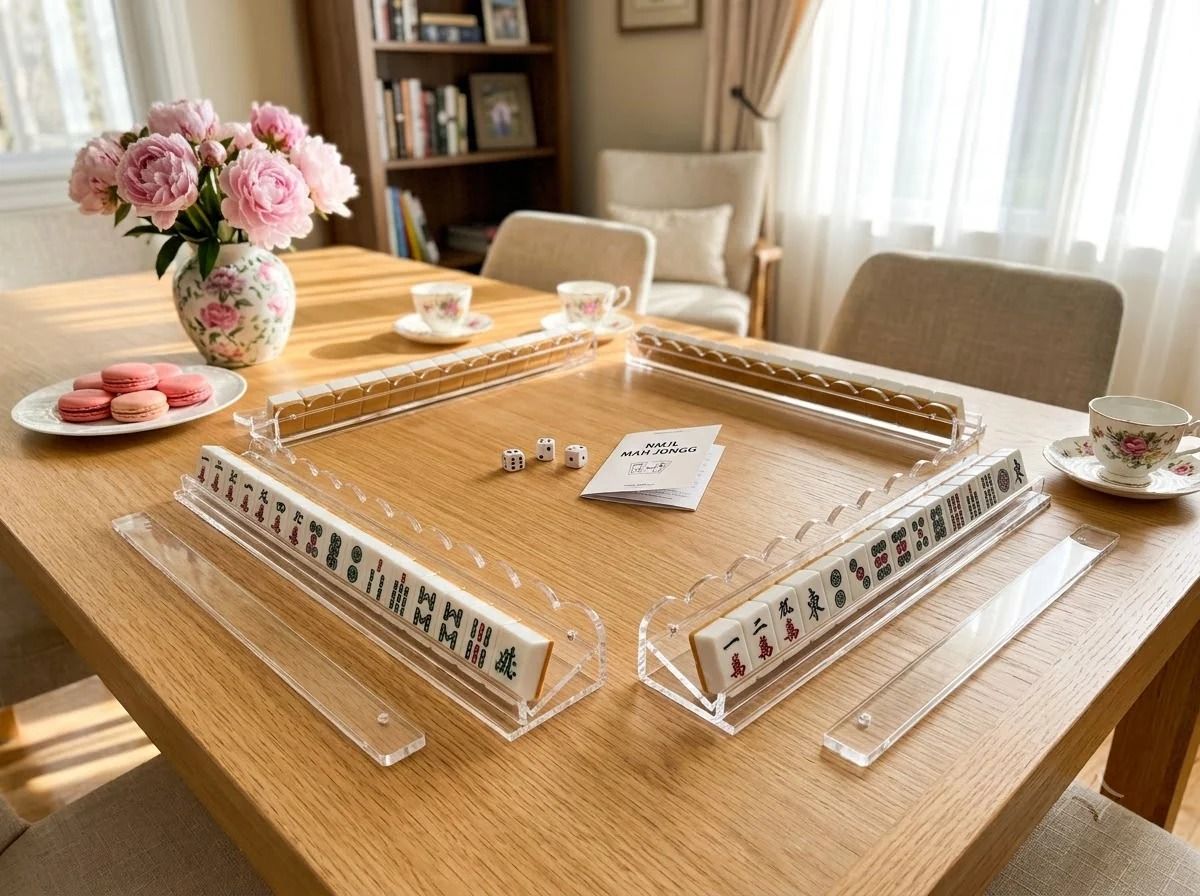
Mahjong racks with pushers give you stable, organized tile display so you can study the card without losing your hand's arrangement. A good rack and a printed card at the table are your two weapons against missed big hands.
✨ Find your Mahstead set — free US shipping →

FAQ
What's the difference between a "big hand" and any other winning hand?
A big hand is simply one of the highest-scoring patterns on the current year's official card. Any legal win counts as winning; "big" refers only to point value. Beginners often build smaller hands (3–5 points) before chasing the top-tier patterns (12–20 points).
Can you win with a hand not on the card?
No. In American mahjong, only hands printed on the current year's National Mah Jongg League card are legal. Hands off the card, no matter how beautiful, are dead draws.
How many jokers do I need to build a big hand?
Most big hands use one to three jokers. You draw the majority of the tiles naturally and use jokers to fill rare gaps. Hands requiring four or more jokers are rare and usually not your best bet.
If I'm holding five of the same tile, can that be part of a big hand?
Yes—a quint (five identical tiles) is legal and often appears in high-scoring patterns. You'd expose it to the table like a pung or kong.
Should I discard jokers early if I don't see an obvious big-hand pattern yet?
No. Hold jokers until mid-game when your hand direction becomes clear. Discarding them early wastes your biggest asset for pivoting toward big hands.
How fast should I be able to recognize a big hand on the card?
With practice, 5–10 seconds per turn. Experienced players scan two or three sections of the card as they draw, narrowing options by suit and tile availability before committing to a pattern.


View More
View More
View More
