
American Mahjong vs. Hong Kong Mahjong: Key Differences
Last updated: Nov 23, 2026
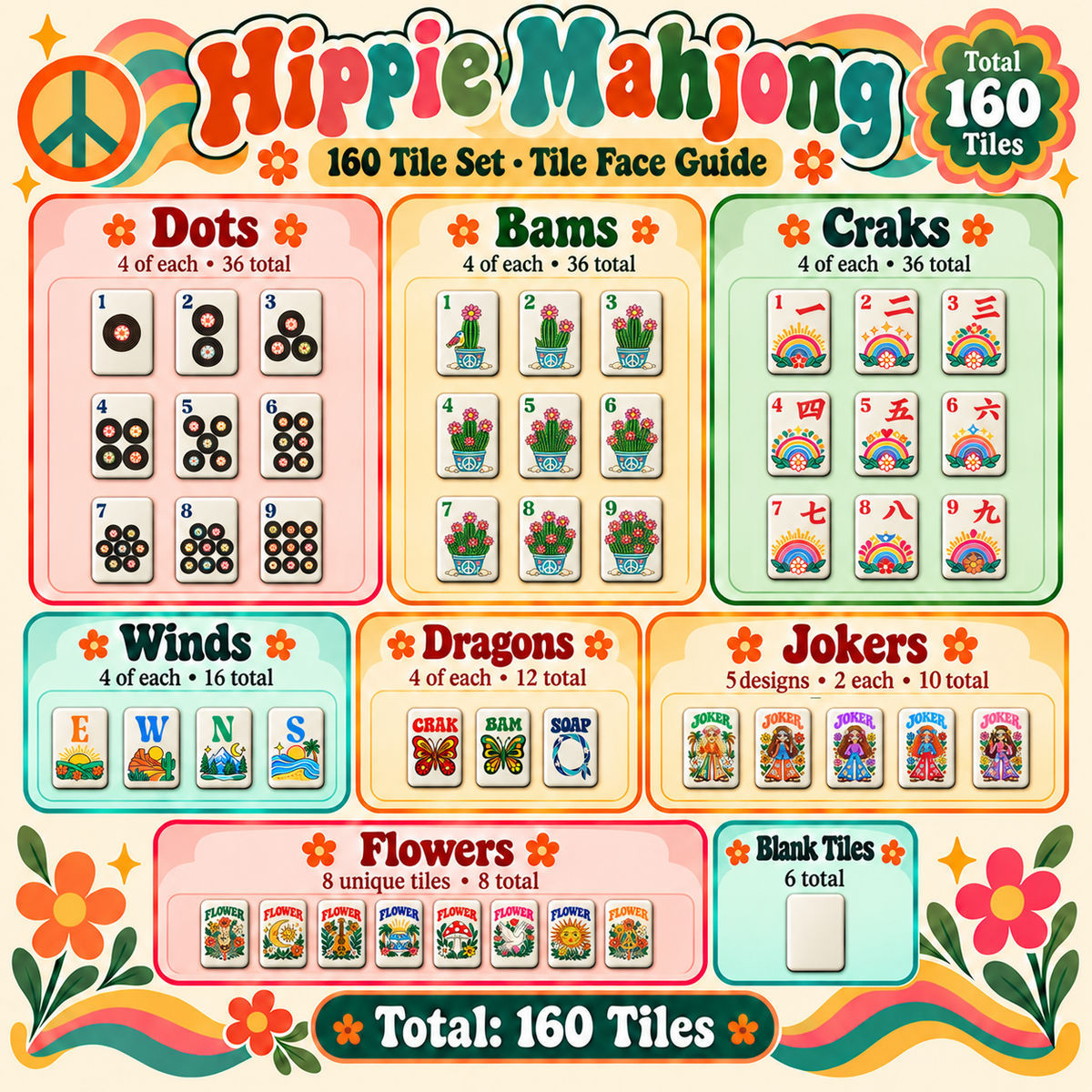
American mahjong uses the current year's National Mah Jongg League card to dictate hand patterns—you cannot call or expose sequences (chows), only pungs, kongs, and quints of identical tiles. Hong Kong mahjong, by contrast, allows you to build hands openly using sequences of numbered tiles, pungs, kongs, and eyes (pairs); you call winning tiles immediately and play continues from there. American sets contain 152 tiles plus 8 jokers; Hong Kong sets typically use 136 or 144 tiles with no jokers. Both need a mat and racks to play well; our best-selling mahjong sets serve American rules exclusively. Choose American if your group prefers pattern-matching off a reference card; choose Hong Kong if your group enjoys fluid, on-the-fly sequence building with fewer mechanical constraints. 🀄 Shop best-selling mahjong sets →
What tiles and set size differ between the two?
American mahjong uses exactly 152 tiles: three suits (Bams, Craks, Dots numbered 1–9), four winds, three dragons, eight flowers, and eight jokers. The 1 Bam shows a bird; the white dragon serves as zero and pairs with Dots. Hong Kong mahjong typically uses 136 tiles (four of each number 1–9 in three suits, four winds, three dragons, no flowers or jokers). Some Hong Kong players add two extra tiles for a 144-tile count. The structural simplification in Hong Kong means no reference card, no drawn tile-pass ritual (Charleston), and no memorizing hand patterns—you build sequences and sets as the game flows.

How do hand patterns work in each game?
American mahjong players consult the National Mah Jongg League card each year, which lists hundreds of valid hand combos: patterns like two pungs plus a quint, or three kongs plus an eye. You must match one of those exact patterns to win. Hong Kong mahjong requires four groups (any mix of sequences or sets) plus a pair; the groups form as tiles are drawn and discarded. No card, no pattern memorization—sequences like 1 Bam–2 Bam–3 Bam or 5 Crak–6 Crak–7 Crak are immediately valid. A Hong Kong player wins the moment they form their four groups and pair; no waiting, no card check.
Can you call and expose tiles mid-game?
In American mahjong, you may expose pungs (three identical tiles), kongs (four identical), quints (five identical), or sextets (six identical)—but never sequences. Jokers cannot form a single tile or pair. Calling mid-game is rare; most plays stay concealed until someone wins. Hong Kong mahjong encourages open play: you call (claim) a discarded tile to complete a set or sequence immediately, expose it to the table, and continue. If a tile is discarded and no one calls it, play passes. This openness makes Hong Kong more social and faster; American games reward discretion and require more calculation before exposing your hand.
How does scoring compare?
Aspect | American | Hong Kong |
Win declaration | Match exact hand to card, dealer announces | Call and expose final tile immediately |
Points system | Varies by year's League card; typically 25–70 points per hand | Base points + multipliers (doubles); payouts often simpler |
Joker role | Substitute for any tile in exposed sets; never in pairs or singles | No jokers; no substitution mechanic |
Hand complexity | Rigid—must match printed pattern | Fluid—any valid combo of sequences and sets |
Play speed | Slower; more decision time and concealment | Faster; real-time calls and exposure |
American scoring is tied to the yearly card; hands range from simple (low-point) to complex (high-point). You calculate points after announcing a win. Hong Kong scoring is often base points per hand plus multipliers for doubles, winds, or dragons; the payout settles quickly. Neither variant is objectively "harder"—American demands pattern memory, Hong Kong demands sequence spotting and quick calls.

Which rules do beginners struggle with most?
New American players often misunderstand the Charleston—the tile-passing ritual before play begins. They also confuse joker rules: jokers cannot form a pair or a single tile in an exposed set; they substitute only within groups of three or more identical tiles. Many beginners memorize a few hands on the card but forget to check the card during play. Beginners in Hong Kong mahjong, by contrast, struggle with calling discipline: they hesitate to claim a discard, miss sequence opportunities, or miscalculate which tiles block their win. American rewards patience and note-taking; Hong Kong rewards speed and confidence. Both games benefit enormously from a clear mahjong mat and a set of racks with pushers, which help organize tiles and reduce fumbling.
🎁 See our most-loved mahjong sets & accessories →
Which variant should your group choose?
If your table enjoys working from a written playbook, references, and slow, deliberate play—American is your game. If your group prefers speed, open calling, social energy, and minimal rulebook checking—Hong Kong wins. American suits regular Friday-night groups who know the card cold; Hong Kong suits casual, drop-in players. Many groups play both: American in winter, Hong Kong in summer, or vice versa. Your choice depends less on skill level and more on your group's rhythm. If you're already set on American, our best-selling mahjong sets are built to American standards with high-contrast engraved tiles for fast reading and a mat designed to fit the standard tile-and-rack layout.
Why American and Hong Kong rules diverged historically
American mahjong emerged in the 1920s–1930s as Chinese rules arrived in the U.S. and were adapted for casual Western play; the National Mah Jongg League standardized American rules in 1937. The yearly card system was invented to keep the game fresh and competitive. Hong Kong mahjong stayed closer to classical Chinese roots and emphasizes sequences, faster play, and no external reference. Taiwanese and Riichi (Japanese) mahjong each added their own layers: Taiwanese uses different point systems and hand definitions; Riichi stresses waiting forms and self-drawn wins. All four major variants share the 152/136-tile core and suit structure, but diverge in openness, speed, and scoring. For American players, the card is the law; for others, the hand itself—and the tiles in play—is the law.
✨ Find your Mahstead set — free US shipping →
What to check before you buy
If you're shopping for an American mahjong set, verify it contains 152 playable tiles plus 8 jokers (totaling 160 in a standard set). Check that tiles are engraved clearly enough to read quickly in dim light—especially Bams, Craks, and Dots, which can blur under poor contrast. Confirm the set includes a mat and racks with pushers; a bare tile-only set forces you to improvise storage and display. If you're learning both American and Hong Kong, keep your sets separate: American sets are card-dependent and joker-reliant, while Hong Kong sets are more portable and require no reference material. A good mat saves your table from scratches and makes the game feel intentional; our mats are pre-marked with discard zones and position labels. If you travel between game nights, a padded bag or case protects tiles and keeps your setup consolidated.

FAQ
Can I use an American mahjong set to play Hong Kong mahjong?
Technically yes—the tile types are the same—but American jokers and your reliance on the card will confuse play. Hong Kong uses no jokers and no card, so you'd discard eight unused tiles before each hand. It's simpler to keep sets separate if you play both regularly.
How long does a typical hand take in each game?
American hands average 10–15 minutes per round, including tile draw, Charleston, and deliberation. Hong Kong hands often finish in 5–8 minutes because calling is instant and no card reference halts play. American suits a longer evening; Hong Kong suits rapid rotation.
Do I need the same set to play American and Hong Kong at the same table?
No. As long as tiles are readable and organized by suit, either set works for either game. However, mixing an American set (with jokers) into a Hong Kong game creates confusion. Dedicated players keep each variant's set isolated.
Which variant is easier to teach to new players?
Hong Kong is often easier to teach initially because there's no card to consult and fewer special rules (no jokers, no Charleston). American takes 2–3 weeks to feel natural. However, American appeals to players who love puzzles and pattern recognition.
Can a Hong Kong set be used to play Taiwanese or Riichi mahjong?
Yes, the core 136 tiles work for both. Taiwanese and Riichi mahjong share Hong Kong's tile base but add different scoring and waiting rules. You'll need to learn those specific hand-winning conditions, but the physical set transfers cleanly.
What's the main reason American and Hong Kong variants feel so different?
American uses a reference card that locks valid hand patterns annually; Hong Kong builds hands freely from sequence and set logic. This makes American feel more like a puzzle game and Hong Kong feel more like a trading-card game played in real time.
If I own an American set, is it worth buying a Hong Kong set too?
Only if your group plays both regularly. Many groups stick to one variant. If you're curious, rent or borrow a Hong Kong set from a friend first. Otherwise, invest deeper in American racks, mats, and carrying cases to level up your main game.
Do American and Hong Kong mahjong players ever play together in the same room?
Rarely. The rule sets conflict too much. However, some larger mahjong communities host both games on different nights or in separate rooms, letting players migrate between tables based on preference.


View More
View More
View More
