
American Mahjong Setup: The Complete Guide to Playing Your First Game
Last updated: Nov 23, 2026

American mahjong setup requires a 160-tile set (152 playing tiles plus spares), a mat or table space, four racks with pushers, and the current National Mah Jongg League card. One player deals 13 tiles per person in a specific pattern; the 14th tile (the live draw) stays separate. The discard area sits in the mat center, where called tiles land. Setup takes about 15 minutes including the Charleston (the pre-game tile exchange). Most errors happen during the initial deal—counting wrong or mixing jokers into the wall. A quality mat prevents tiles from sliding, while racks with pushers keep your hand hidden and organized. From best-selling mahjong sets, choose one that matches your table size and group skill level.
Setting up an American mahjong game correctly makes the difference between a smooth night and confusion. We've hosted hundreds of games, and the same setup mistakes repeat—so we've built this guide to stop them before they happen.
What does a complete American mahjong setup include?
Your setup has four essential pieces: a tile set, a mat, racks with pushers, and the season's National Mah Jongg League card. A standard 160-tile set contains exactly 152 playing tiles (three suits of 36 tiles each, 16 winds, 12 dragons, eight flowers, and eight jokers), plus spare tiles. The mat defines the play area and protects tiles from shifting during draws and calls. Four racks hold your tiles vertically so opponents can't see your hand. Pushers keep tiles in place and let you move them without touching neighbors. The League card (updated every spring) shows every valid winning hand for that year—you cannot win without it. Without any one piece, the game stops.
🀄 Shop best-selling mahjong sets →

How do you physically arrange tiles before the first hand?
Start with the 152 playing tiles (jokers separate). One player—the dealer for round one—builds the wall: count out 34 tiles in a row, then stack them two tiles high in front of you. Rotate: each player builds a 34-tile wall to their right until you form a square of four walls. The wall now shows 136 tiles facing down (68 two-tile stacks, four walls of 17 stacks per wall). Push a small gap into the dealer's wall about one-third from the right; this marks where draws begin. Place the eight jokers and two dice nearby—not in the wall. The complete wall takes five minutes if you count aloud. A mat with built-in wall markers helps you align stacks and prevents drift.
What's the tile-dealing sequence and when does it go wrong?
The dealer throws both dice. Count that many stacks to the right from the gap. The player opposite the dealer goes first; you deal four tiles to each player in turn, right to left, going around the table four times (16 tiles). Then deal one more to each—now everyone has 13. The dealer takes their 14th tile from the live end of the wall (the end after the gap); this first draw ends setup. Most players miscoun the dice throw, deal to the wrong person, or deal four rounds instead of four tiles per round. Count aloud and use fingers to mark each person. If someone has 14 tiles and another has 12, stop and recount before the first discard.
Why do mat and rack choice matter for a clean setup?
A mat keeps tiles from sliding when you draw or shuffle the wall—critical on smooth tables. A mat with a center discard zone clearly marks where called tiles go, preventing pile-ups. Racks with pushers stabilize your 13 or 14 tiles so you're not fumbling or accidentally showing your hand to the left player. Pushers let you adjust tile order silently without lifting your fingers off the table. Without racks, experienced players still win because they hide their hand by memory; beginners leak information by handling tiles constantly. A mat also signals to everyone that this is a real game, not a casual play—it sets the tone. Our collection of mahjong mats includes options for every table size, and racks with pushers that make tile management invisible.
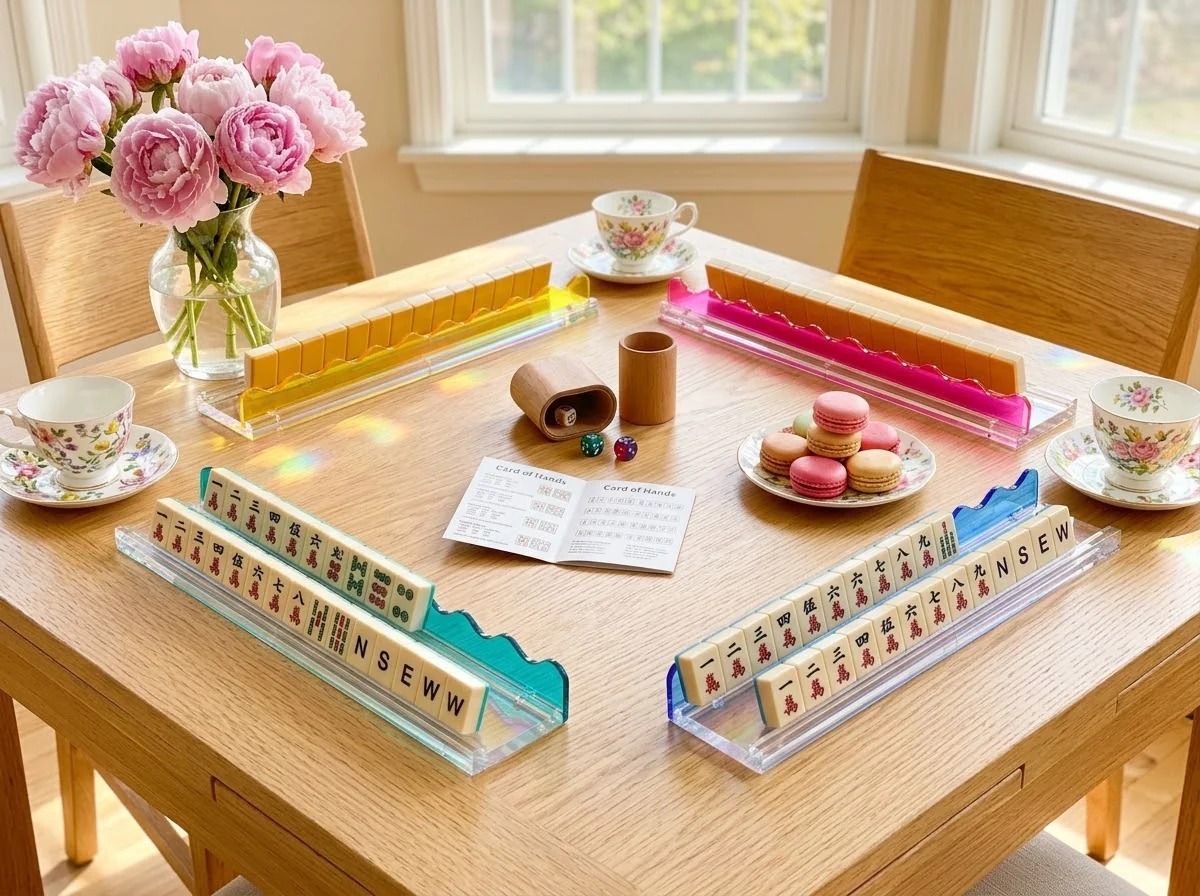
How does the Charleston fit into setup, and what if someone refuses to play it?
The Charleston is the mandatory pre-game tile pass: after setup but before the first discard, each player passes three tiles right, three tiles across, and three tiles left (nine tiles total per person). This randomizes the hand and prevents one dealer from dominating the first round. Players push tiles under the rack so no one sees what they're getting. If a player sees a tile mid-exchange, it stays (no peeking allowed). The Charleston takes two minutes and is part of official American mahjong rules—you cannot skip it. Some casual groups omit it to speed up play; that's fine for family fun, but League play requires it. The Charleston explained covers every variation and common arguments.
What's the biggest mistake in American mahjong setup and how do you avoid it?
The number-one error: jokers are mixed into the wall or counted as regular tiles during the deal. Jokers must stay separate until used as wild cards in your hand or on the table. If you deal a joker to someone, that player has 14 tiles while another has 12—the whole hand collapses. The fix: before the dealer builds the wall, physically remove all eight jokers and set them aside in a line where everyone can see them. Count your 152 playing tiles (no jokers, no blanks) and build the wall only from those. The second mistake: someone deals from the wrong end of the wall after the initial deal. The dice throw determines where to start; after that, draws always come from the "live" end (the end after your starting gap). Mark this with a small chip or token if your mat doesn't have one built in.
Setup Element | Purpose | Setup Time | Critical? |
152 playing tiles | Complete valid hand | 2 min (remove jokers, count) | Yes—missing one tile blocks play |
160-tile set with spares | Replace damaged tiles mid-game | 1 min (store spares) | Highly useful—saves a ruined hand |
Mat | Prevents tile drift, marks discard zone | 30 sec (lay flat) | Yes—on smooth tables, essential |
Four racks with pushers | Hand concealment, tile control | 1 min (position per seat) | Highly useful—stops information leaks |
League card (current year) | Only source of valid hands | 30 sec (place center-table) | Yes—no card, no one can win |
Dice | Determines wall start position | 10 sec | Yes—randomizes each hand |
🎁 See our most-loved mahjong sets & accessories →
What to check before you buy a set and start playing
Tile count: Confirm your set contains 160 tiles (152 for play, spares included). If the box says 144 or 166, that's a different format and may not work for American rules.
Joker placement: Open the set and verify all eight jokers are clearly marked and separate from suits. Jokers should never be mixed in with Bams, Craks, or Dots.
Rack and pusher fit: Test one tile in a rack with pusher before you commit. If tiles fall or pushers don't grip, you'll waste time adjusting mid-game.
Mat size: Measure your table. A mat that's too small forces the wall onto your lap; too large wastes space. Standard tables (36–42 inches) need a 27–32 inch mat.
Season's League card: Before your first game, buy or download the current year's National Mah Jongg League card. No card = no winning hands possible. Many new players buy a set but forget the card and can't start.
Tile clarity: Hold tiles at arm's length. Can you read the numbers and suits from across a table? If not, you'll slow play constantly.
For your first game, explore our best-selling mahjong sets—they include everything except the League card. If you're hosting regularly, add a mat designed for mahjong and racks with pushers for a professional setup. We ship free across the US.
✨ Find your Mahstead set — free US shipping →
For a deeper dive into the full rules and how hands work, see how to play American mahjong.
FAQ
Can I set up American mahjong on a regular dining table without a mat?
Yes, but only if the surface is textured (not shiny). On smooth wood or glass, tiles slide and you'll lose time straightening them. A mat costs less than one wasted hour.
What if I don't have pushers—can I use my fingers to move tiles?
You can, but it's slower and lets opponents see your tiles as you rearrange them. Pushers are the industry standard because they hide your hand movements. Many beginners buy racks later because they realize the advantage.
How many jokers do I actually play with each hand?
Eight jokers total in the set. Not all eight are used in every hand—you use only the jokers in your hand or that get called onto the table. See how jokers work for the rules.
Do I need to buy the current year's League card, or can I use last year's?
You must use the current year's card. Winning hands change every spring. Last year's card will not show valid hands for 2026, and any hand you make won't count at League-sanctioned games. Buy or print it before you play.
If a tile gets cracked during setup, what do I do?
Replace it with a spare from your set. A 160-tile set includes spares specifically for this. If you run out of spares, you cannot play that hand—you'd need to stop and repair the tile or start over with a different set.
How long does setup actually take once everyone arrives?
Fifteen minutes if everyone knows the steps. Wall building takes five minutes, dealing takes three, and the Charleston takes two. New players often ask if 20 minutes is normal—yes. Once you've played ten games, you'll do it in ten.


View More
View More
View More
